


08 Aug Bill to Ban Social Media, Gaming Accounts for Kids Under 13: UPSC Insights
✎ The SHIELD Bill, 2025, proposes age-verification systems, bans personalised advertising for minors, and empowers parents with monitoring tools, while imposing penalties up to ₹10 crore for non-compliance under the IT Act…
Subject Relevance — Where This Topic Fits
- GS Paper II — Governance, Constitution, Polity, Social Justice and International Relations (Digital Governance, Child Protection Policies) | GS Paper III — Science and Technology (Cyber Security, Data Privacy, AI Regulation)
- Prelims: Digital Personal Data Protection Act, 2023, Information Technology (Intermediary Guidelines and Digital Media Ethics Code) Rules, 2021, Section 69A of the IT Act, Age Verification Mechanisms, Personalised Advertising, Dark Patterns in Digital Platforms, Protection of Children from Sexual Offences (POCSO) Act, 2012, UN Convention on the Rights of the Child
- Essay: The Role of Technology in Child Development: Balancing Innovation with Ethical Responsibility, Digital Sovereignty and Governance: Can India Lead the Way in Child-Centric Internet Policies?
Quick Revision: The SHIELD Bill, 2025, proposes age-verification systems, bans personalised advertising for minors, and empowers parents with monitoring tools, while imposing penalties up to ₹10 crore for non-compliance under the IT Act framework.
Why is this in the news?
A private member’s bill titled the Safeguarding Healthy Internet Environments for Little Digital-Natives (SHIELD) Bill, 2025, introduced by BJP MP Baijayant Panda, seeks to prohibit children under 13 from creating accounts on social media and gaming platforms without verified parental consent. The bill also proposes stringent restrictions on personalised advertising targeting minors, mandatory age-verification systems, and parental-control dashboards to monitor and regulate children’s digital activity. This legislative initiative reflects growing global and domestic concerns over the psychological, developmental, and safety risks posed by unregulated digital exposure to minors, particularly in the domains of social media, online gaming, and targeted advertising.
Background
- The exponential growth of social media and online gaming platforms has significantly increased digital exposure among children, raising concerns about mental health impacts, addiction, and exposure to harmful content such as violence, extremism, and pornography.
- India’s digital ecosystem has witnessed a surge in child users, with studies indicating that a substantial proportion of children under 13 are active on platforms despite age restrictions, often using false identities or parental accounts.
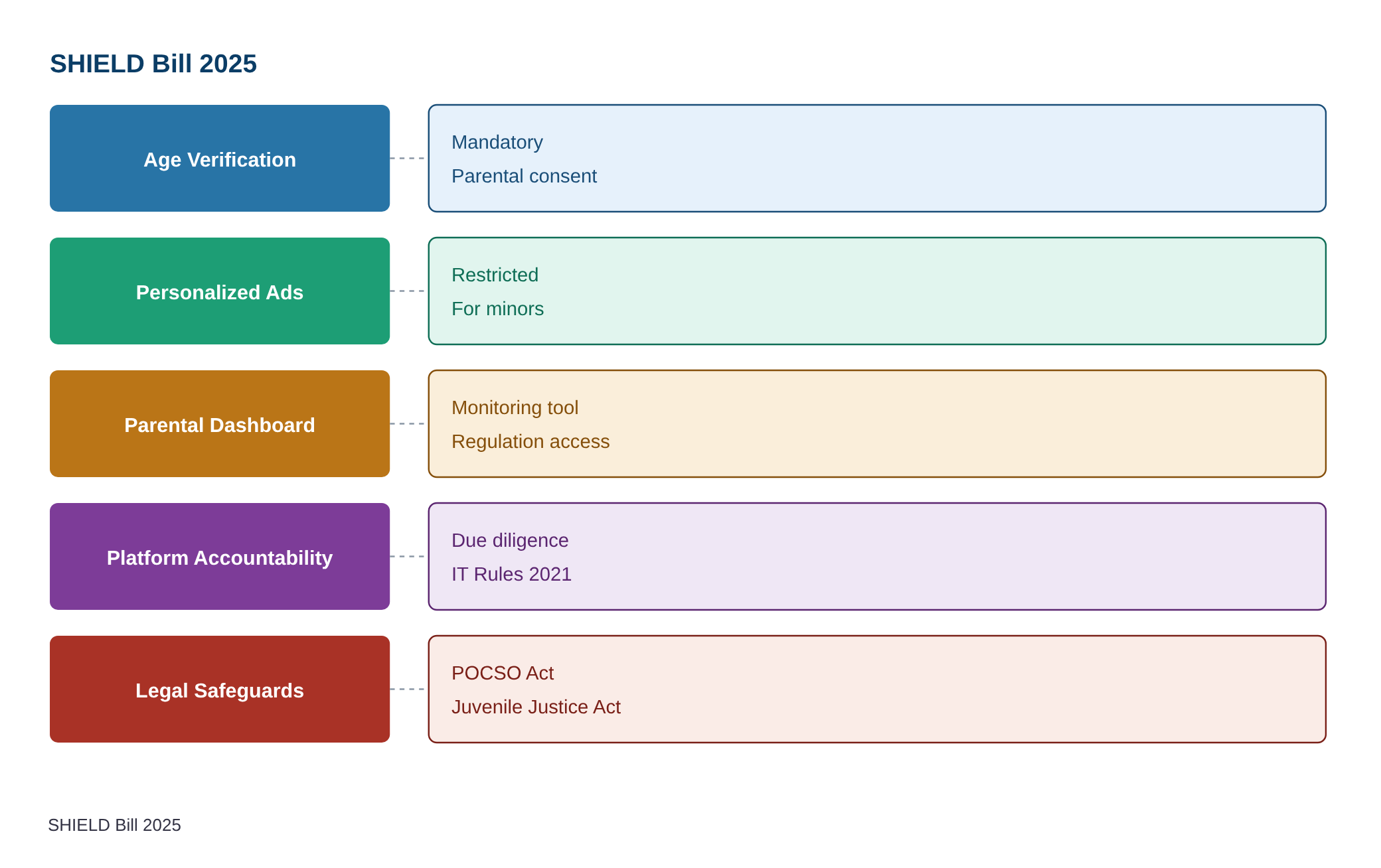
- The Information Technology (Intermediary Guidelines and Digital Media Ethics Code) Rules, 2021, introduced under the IT Act, 2000, mandate due diligence by intermediaries but lack specific provisions for child protection beyond general safeguards.
- The Digital Personal Data Protection Act, 2023, while addressing data privacy, does not comprehensively cover the protection of minors from targeted advertising or exposure to harmful content.
- Global precedents, such as the Children’s Online Privacy Protection Act (COPPA) in the United States and the General Data Protection Regulation (GDPR) in the EU, have established frameworks for child data protection, influencing domestic policy discourse.
- The Protection of Children from Sexual Offences (POCSO) Act, 2012, and the Juvenile Justice (Care and Protection of Children) Act, 2015, provide legal frameworks for child protection but do not directly address digital risks.
What is the SHIELD Bill, 2025?
- The SHIELD Bill, 2025, is a private member’s bill introduced in Parliament aimed at establishing a robust regulatory framework to safeguard children under 18 from harmful digital environments, with a focus on social media, online gaming, and advertising platforms.
- The bill defines a ‘child’ as any individual below 18 years of age, aligning with the UN Convention on the Rights of the Child and India’s existing child protection laws.
- It proposes a ban on children under 13 creating accounts on social media or gaming platforms without verified parental consent, ensuring that platforms implement age-verification mechanisms such as government-issued ID checks or biometric verification.
- Personalised advertising targeting minors is prohibited, and platforms must refrain from tracking, profiling, or using algorithms that tailor content based on children’s data, thereby reducing manipulative advertising practices.
- Mandatory parental-control dashboards are envisaged, allowing guardians to monitor activity, manage privacy settings, restrict screen time, and block access to inappropriate content, thereby empowering parents in digital parenting.
- Platforms are required to implement safeguards against exposure to pornography, gambling, simulated betting, violent or extremist content, and drug-related material, with mechanisms for content moderation and reporting.
- Non-compliance with the proposed provisions may result in penalties up to ₹10 crore per violation, with repeated or wilful breaches potentially leading to temporary suspension or blocking of services under Section 69A of the IT Act, 2000.
- The bill reflects a shift towards child-centric digital governance, emphasising the principle of ‘best interests of the child’ and aligning with global standards for protecting minors in digital spaces.
Key Features
| Feature | Significance |
|---|---|
| Age verification systems | Mandatory for platforms accessible to minors to verify parental consent before account creation, ensuring compliance with safeguarding norms. |
| Parental-control dashboards | Allow guardians to monitor activity, manage privacy settings, and restrict screen time, enhancing child safety in digital spaces. |
| Prohibition on personalised advertising | Platforms barred from tracking, profiling, or targeting minors with personalised ads, reducing exposure to manipulative content. |
| Content restrictions | Platforms must prevent exposure to pornography, gambling, extremist material, and drug-related content for children under 18. |
| Penalties and enforcement | Violations may attract fines up to ₹10 crore and potential suspension or blocking under Section 69A of the IT Act. |
Why it Matters
Child Protection and Digital Rights
- Addresses the vulnerability of minors to online exploitation, cyberbullying, and addictive content through legislative safeguards.
- Aligns with the UN Convention on the Rights of the Child (1989), which mandates protection from harmful digital environments.
- Balances digital inclusion with safety, recognising the internet as a critical space for education and social development.
Regulatory Framework for Digital Intermediaries
- Expands the scope of the Information Technology Act, 2000, to include social media, gaming, and other digital platforms under child-specific regulations.
- Introduces age-verification mechanisms, a novel compliance requirement for intermediaries operating in India.
- Sets a precedent for sector-specific regulations within India’s broader digital governance architecture.
Parental and Community Responsibilities
- Empowers parents with tools to monitor and control digital exposure, fostering shared responsibility between families and platforms.
- Encourages digital literacy initiatives to educate guardians on safe online practices and platform accountability.
- Highlights the role of schools and civil society in advocating for child-centric digital policies.
Economic Implications for Platforms
- Imposes compliance costs on platforms for age verification, content moderation, and parental-control systems, potentially affecting profitability.
- May incentivise platforms to develop child-safe algorithms and moderation tools, driving innovation in ethical AI.
- Raises questions about the economic viability of platforms targeting minors, particularly in gaming and social media sectors.
Challenges
1. Implementation and Enforcement
- Age verification systems may face resistance due to privacy concerns and potential surveillance overreach.
- Enforcement mechanisms, including penalties and blocking orders, require robust institutional capacity and inter-agency coordination.
- Platforms may exploit jurisdictional loopholes or offshore operations to bypass Indian regulations.
UPSC Link: GS Paper 2 – Governance, Transparency & Accountability
2. Balancing Safety with Accessibility
- Overly restrictive measures may exclude minors from educational and social opportunities online, particularly in rural or underserved areas.
- Parental-control dashboards risk becoming tools of excessive surveillance, infringing on children’s digital autonomy.
- Defining ‘child’ uniformly across platforms (13 vs. 18 years) may create inconsistencies in compliance.
UPSC Link: GS Paper 1 – Social Empowerment
3. Technological and Ethical Dilemmas
- Age verification technologies (e.g., biometric data) raise ethical concerns about data privacy and potential misuse.
- Personalised advertising bans may disproportionately affect revenue models of platforms reliant on ad-based monetisation.
- Content moderation algorithms struggle to distinguish between harmful and benign content for minors, risking over-censorship.
UPSC Link: GS Paper 3 – Science & Technology
4. Global Regulatory Fragmentation
- Divergent regulations across jurisdictions (e.g., EU’s Digital Services Act, US COPPA) complicate compliance for global platforms.
- India’s unilateral approach may lead to trade disputes or platform exits, affecting digital sovereignty.
- Lack of international harmonisation risks creating ‘digital safe havens’ for exploitative content.
UPSC Link: GS Paper 2 – International Relations
5. Private Member’s Bill Limitations
- Private member’s bills rarely pass into law, raising questions about the bill’s eventual adoption and political feasibility.
- Limited parliamentary time and adjournments may delay or derail the bill’s progress.
- Lack of bipartisan consensus could weaken the bill’s enforceability and public support.
UPSC Link: GS Paper 2 – Parliament & State Legislatures
Challenges — UPSC Perspective
| Issue | Concern |
|---|---|
| Data privacy in age verification | Risk of biometric data misuse or third-party breaches in age-verification systems. |
| Over-censorship of content | Algorithmic moderation may inadvertently block educational or creative content for minors. |
| Platform compliance costs | High costs of implementing age verification and parental-control systems may deter smaller platforms. |
| Rural-urban digital divide | Limited internet access in rural areas may exclude minors from digital opportunities despite safeguards. |
| Jurisdictional arbitrage | Platforms may relocate servers or operations to avoid Indian regulations. |
| Parental literacy gaps | Guardians in low-income or marginalised communities may lack awareness of digital safety tools. |
Way Forward
- Constitute a multi-stakeholder committee (government, platforms, child rights experts) to draft operational guidelines for age verification and parental controls.
- Pilot age-verification systems in select states with high digital penetration to assess feasibility and public acceptance.
- Launch nationwide digital literacy campaigns for parents and children, focusing on safe online practices and platform accountability.
- Amend the Information Technology Act to include explicit provisions for child protection, aligning with the proposed bill’s objectives.
- Encourage platforms to adopt ethical AI frameworks for content moderation, prioritising child safety without over-censorship.
- Collaborate with global regulators to harmonise age-verification standards and avoid regulatory fragmentation.
- Strengthen enforcement mechanisms by training law enforcement and judiciary on digital child protection laws.
- Establish a grievance redressal mechanism for parents and children to report violations and seek remediation.
UPSC Value Addition
Keywords for Mains Answer-Writing
Digital Personal Data Protection Act 2023 · Children’s online safety · Social Media Regulation in India · Parental Consent Mechanisms · Age Verification Systems · Personalised Advertising to Minors · Information Technology (Intermediary Guidelines and Digital Media Ethics Code) Rules 2021 · Section 69A of IT Act 2000 · Digital Rights of Children · Protective Regulatory Framework for Minors
Constitutional & Policy Linkages
- Article 15(3) – Special provisions for children
- Article 21A – Right to education (digital inclusion)
- Article 39(f) – Children’s rights to protection and development
Concept Flow
Exposure to harmful digital content → Legislative response (SHIELD Bill) → Age verification & parental controls → Platform compliance → Enforcement & penalties → Child safety outcomes
Prelims Practice Questions
Q1. Consider the following statements regarding the proposed SHIELD Bill, 2025:
1. The bill seeks to bar children under 13 from creating social media or gaming accounts without verified parental consent.
2. It proposes mandatory age-verification systems for all digital platforms accessible to minors.
3. Platforms violating the bill may face penalties up to ₹5 crore.
4. The bill defines a child as anyone below 18 years of age.
How many of the above statements are correct?
- Only one
- Only two
- Only three
- All four
Answer: Only three — Statement 1 is correct as per the bill’s proposal. Statement 2 is incorrect because the bill mandates age-verification systems only for platforms accessible to minors, not all digital platforms. Statement 3 is incorrect; the penalty proposed is up to ₹10 crore, not ₹5 crore. Statement 4 is correct as the bill defines a child as anyone below 18.
Q2. Assertion (A): The SHIELD Bill, 2025, proposes to prohibit social media platforms from tracking, profiling, or using personalised advertising for children.
Reason (R): The bill aims to safeguard children from exposure to harmful content and data exploitation.
In the context of the above two statements, which one of the following is correct?
- Both A and R are true, and R is the correct explanation of A
- Both A and R are true, but R is not the correct explanation of A
- A is true but R is false
- A is false but R is true
Answer: Both A and R are true, and R is the correct explanation of A — Both Assertion (A) and Reason (R) are true. The SHIELD Bill explicitly prohibits tracking, profiling, and personalised advertising for children to protect them from data exploitation and harmful content. Reason (R) correctly explains Assertion (A).
Q3. Match the following provisions of the proposed SHIELD Bill, 2025, with their corresponding objectives:
Column I (Provision)
A. Age-verification systems
B. Parental-control dashboards
C. Prohibition on personalised advertising
D. Penalties for violations
Column II (Objective)
1. Prevent exposure to harmful content
2. Ensure verified parental consent
3. Monitor and manage child activity
4. Impose financial and operational consequences
Select the correct match:
- A-2, B-3, C-1, D-4
- A-1, B-2, C-3, D-4
- A-3, B-1, C-4, D-2
- A-4, B-2, C-1, D-3
Answer: A-2, B-3, C-1, D-4 — A-2 (Age-verification systems ensure verified parental consent), B-3 (Parental-control dashboards allow monitoring and management of child activity), C-1 (Prohibition on personalised advertising aims to prevent exposure to harmful content), D-4 (Penalties for violations impose financial and operational consequences).
Mains Practice Question
✍ Critically examine the need for a dedicated regulatory framework like the proposed SHIELD Bill, 2025, to safeguard children in the digital ecosystem. In your answer, discuss the constitutional and statutory provisions that underpin such regulation, the role of parental consent mechanisms, and the challenges in implementing age-verification systems. Also, analyse the balance between child protection and digital rights in this context. (15 Marks)
Approach: MODEL-ANSWER SKELETON:
1. **Constitutional and Statutory Foundations:**
– Article 14 (Right to Equality) and Article 21 (Right to Privacy) of the Constitution provide the basis for protecting children’s digital rights.
– The Digital Personal Data Protection Act, 2023, and the Information Technology (Intermediary Guidelines and Digital Media Ethics Code) Rules, 2021, form the existing regulatory framework.
– The UN Convention on the Rights of the Child (ratified by India) obligates the state to protect children from all forms of exploitation, including digital harm.
2. **Need for the SHIELD Bill:**
– Rising instances of cyberbullying, grooming, and exposure to harmful content (pornography, extremist material) necessitate a dedicated framework.
– Personalised advertising and data profiling of minors violate their privacy and autonomy, as recognised in *Justice K.S. Puttaswamy v. Union of India* (2017).
– The bill addresses gaps in the current IT Rules by introducing age-verification and parental consent mechanisms.
3. **Parental Consent and Age-Verification Mechanisms:**
– Parental consent dashboards empower guardians to monitor and restrict activity, aligning with the principle of ‘best interests of the child’ (Article 3, UNCRC).
– Age-verification systems (e.g., biometric verification, government-issued ID checks) raise concerns about data privacy, consent fatigue, and exclusion of marginalised children.
– Challenges include technological feasibility, cost, and the risk of creating a surveillance state.
4. **Balancing Child Protection and Digital Rights:**
– The bill must ensure proportionality: measures should not unduly restrict children’s access to educational or creative digital spaces.
– Alternatives like ‘age-appropriate design codes’ (inspired by the UK’s Age-Appropriate Design Code) could mitigate risks without heavy-handed regulation.
– Judicial oversight (e.g., under Section 69A of the IT Act) is essential to prevent arbitrary blocking of platforms.
5. **Conclusion:**
– The SHIELD Bill is a step toward harmonising child protection with digital rights, but its success hinges on robust implementation, stakeholder consultations, and periodic reviews. A rights-based approach, rather than a punitive one, is critical for long-term efficacy.
Source: Hindustan Times
Generated by AanyaAi for educational purpose.

- यूपीएससी/पीसीएस: 25 सितंबर 2026 को सरकारी प्रतिभूतियों की बोली प्रक्रिया, ₹34,000 करोड़ का पुनर्प्रस्ताव - September 24, 2026
- RBI to Auction ₹34,000 Crore Govt Securities on Sept 25, 2026: Key Details for UPSC & PCS - September 24, 2026
- भारत सेमीकंडक्टर उद्योग में ‘सकारात्मक चक्र’ की ओर: अशोक चंदक - September 24, 2026

No Comments