


08 Aug Supreme Court’s Historic Verdict on Tamil Nadu’s Super-Speciality Seats: Implications for UPSC & State PCS
✎ The Supreme Court's verdict ensures that 50% of super-speciality medical seats remaining vacant after the second round of All India Quota counselling, if the percentile is subsequently reduced, will revert to the respective…
Subject Relevance — Where This Topic Fits
- GS Paper II — Governance, Constitution, Polity, Social Justice
- Prelims: Super-speciality medical seats, All India Quota (AIQ), Directorate General of Health Services (DGHS), Medical Counselling Committee (MCC), NEET Super Speciality, In-service reservation, Article 32 of the Indian Constitution, Federalism in India
- Essay: Balancing State autonomy and national standards in higher education., Judicial intervention in medical education policy and its implications for public health.
Quick Revision: The Supreme Court’s verdict ensures that 50% of super-speciality medical seats remaining vacant after the second round of All India Quota counselling, if the percentile is subsequently reduced, will revert to the respective State, strengthening state control over medical education resources.
Why is this in the news?
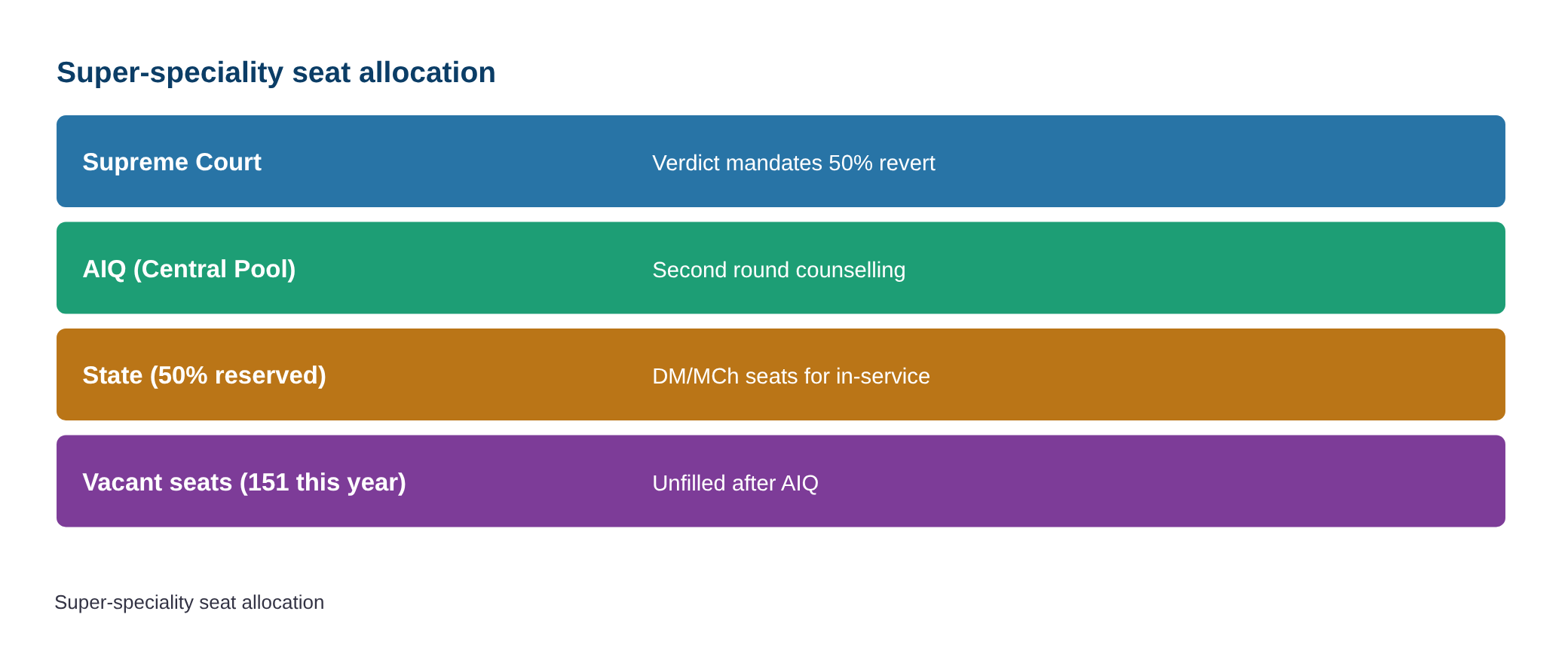
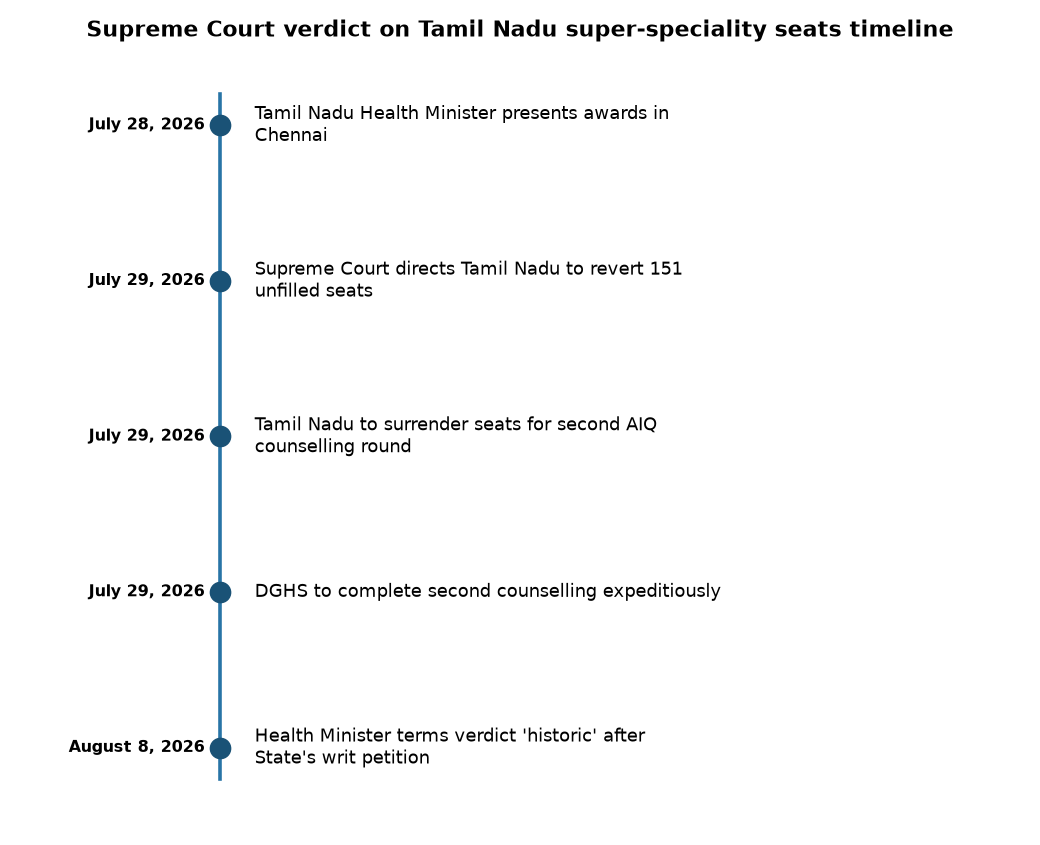
The Tamil Nadu Health Minister has lauded a recent Supreme Court verdict concerning the allocation of super-speciality medical seats, terming it ‘historic’. The ruling mandates that if seats remain vacant after the second round of All India Quota (AIQ) counselling and a decision is made to reduce the qualifying percentile, 50% of these seats must be reverted to the respective State. This decision particularly impacts Tamil Nadu, which reserves 50% of its DM/MCh super-speciality seats for in-service candidates, and had 151 such seats unfilled this year.
Background
- Medical education in India, particularly at the super-speciality level, involves a complex interplay between central and state authorities, governed by regulations from bodies like the National Medical Commission (NMC) and the Directorate General of Health Services (DGHS).
- The All India Quota (AIQ) was introduced to facilitate admissions to medical courses across states, ensuring national integration and merit-based selection, with a portion of seats surrendered by states to the central pool.
- States often implement reservations for specific categories, including ‘in-service’ candidates, to incentivise doctors to serve in public health systems and address rural healthcare shortages.
- Disputes frequently arise regarding the management of vacant seats, the reduction of qualifying percentiles, and the balance between AIQ and state-specific reservation policies.
- Previous instances have seen states losing control over vacant seats to the AIQ, leading to concerns about the equitable distribution of educational opportunities and the effective utilisation of medical talent within states.
- The present Supreme Court verdict addresses the mechanism for reverting unfilled seats to states, particularly when the qualifying percentile is lowered post-counselling, aiming to safeguard state interests and ensure optimal seat utilisation.
What is the All India Quota (AIQ) in Medical Admissions?
- The All India Quota (AIQ) is a scheme under which a percentage of seats in government medical and dental colleges across India are reserved for candidates from any state, irrespective of their domicile.
- It was introduced by the Supreme Court to promote national integration and provide opportunities for meritorious students to pursue medical education in any part of the country.
- The counselling for AIQ seats is conducted by the Medical Counselling Committee (MCC) on behalf of the Directorate General of Health Services (DGHS), Ministry of Health & Family Welfare, Government of India.
- The remaining seats in state government colleges fall under the State Quota, for which counselling is conducted by the respective state authorities, often incorporating state-specific reservation policies.
- The primary objective of the AIQ is to ensure that a certain percentage of seats are filled purely on the basis of national merit, without any state-specific domicile or reservation criteria, except for those mandated by central legislation.
- Unfilled AIQ seats, after multiple rounds of counselling, are typically reverted to the respective state quotas to be filled by state counselling authorities, though specific rules govern this reversion process, as highlighted by the recent Supreme Court verdict.
- The NEET (National Eligibility cum Entrance Test) is the single entrance examination for admission to all medical courses, including those under the AIQ and state quotas, ensuring a uniform standard for selection.
Key Features
| Feature | Significance |
|---|---|
| Supreme Court Verdict on Super-Speciality Seats | The apex court’s directive ensures that unfilled 50% of super-speciality seats reserved for in-service candidates in Tamil Nadu are reverted to the State if the percentile is reduced post-second round of AIQ counselling, safeguarding service doctors’ interests. |
| Reversion of Vacant Seats to State Pool | The verdict mandates that 50% of vacant seats after the second round must be returned to Tamil Nadu, ensuring state control over seat allocation for in-service candidates. |
| Preservation of Percentile for Second Round | The court prohibited the DGHS from reducing the percentile during the second round of counselling, preventing dilution of merit and ensuring fairness in seat allocation. |
| Historical Context of Writ Petition | The State’s timely intervention through a writ petition in the Supreme Court is credited for securing this verdict, addressing long-standing grievances of Tamil Nadu’s in-service doctors. |
| Impact on In-Service Candidates | The ruling provides a mechanism to prevent the loss of reserved seats for in-service candidates, who face challenges due to limited promotional opportunities and reduced super-speciality posts. |
Why it Matters
Legal and Judicial
- The verdict reinforces the judiciary’s role in safeguarding the rights of state-employed medical professionals against arbitrary centralised seat allocation policies.
- It sets a precedent for future disputes involving inter-state seat allocation in super-speciality medical education, particularly concerning reserved categories.
- The ruling underscores the importance of timely legal recourse in protecting state-specific interests in healthcare manpower planning.
Healthcare Governance
- The decision aligns with the principle of decentralised governance in healthcare, allowing states to retain control over reserved seats for in-service candidates.
- It highlights the need for states to adopt proactive measures to address vacancies in super-speciality seats, which are critical for specialised medical services.
- The verdict may incentivise states to improve promotional opportunities and financial incentives for in-service doctors to reduce seat vacancies in future.
Social Justice
- The ruling ensures equitable access to super-speciality seats for in-service candidates, who often face systemic disadvantages in competitive national-level examinations.
- It addresses the broader issue of brain drain from public healthcare systems by providing a safety net for service doctors seeking advanced training.
- The verdict may contribute to reducing regional disparities in access to super-speciality medical education and healthcare services.
Challenges
1. Vacancy in Super-Speciality Seats
- Persistent vacancies in super-speciality seats (e.g., Cardiology, Surgical Gastroenterology) despite state reservations, indicating systemic inefficiencies in seat allocation and utilisation.
- Lack of promotional opportunities and financial incentives discourages in-service doctors from pursuing super-speciality training, exacerbating seat vacancies.
- Reduced availability of super-speciality posts in the state health system limits career progression for service doctors, leading to lower participation in NEET-SS examinations.
UPSC Link: GS-II: Issues relating to development and management of Social Sector/Services relating to Health
2. Centralised vs. State-Controlled Seat Allocation
- Conflict between the centralised AIQ system and state-specific reservations for in-service candidates, leading to legal disputes and operational ambiguities.
- The DGHS’s unilateral authority to reduce percentiles post-counselling undermines state-level planning for healthcare manpower, particularly in reserved categories.
- Lack of synchronisation between state health systems and centralised counselling processes results in suboptimal utilisation of super-speciality seats.
UPSC Link: GS-II: Functions and responsibilities of the Union and the States
3. Merit vs. Reservation in Medical Education
- Balancing merit-based admissions with state-mandated reservations for in-service candidates remains a contentious issue, particularly in high-demand super-speciality branches.
- The reduction of percentiles to fill vacant seats risks diluting academic standards and compromising the quality of medical specialists in the state.
- The verdict does not resolve the broader debate on whether reservations for in-service candidates are the optimal solution to address healthcare workforce shortages.
UPSC Link: GS-II: Government policies and interventions for development in various sectors
4. Implementation and Compliance
- Ensuring timely compliance with the Supreme Court’s directives by the DGHS and state authorities remains a challenge, particularly in high-pressure counselling timelines.
- Monitoring and verification of seat reversion and subsequent allocation processes require robust institutional mechanisms to prevent procedural lapses.
- The scepticism among government doctors regarding the practical impact of the verdict highlights the need for transparent communication and accountability in implementation.
UPSC Link: GS-II: Role of Civil Services in a democracy
Challenges — UPSC Perspective
| Issue | Concern |
|---|---|
| Vacancy in Super-Speciality Seats | Systemic inefficiencies and lack of incentives leading to persistent unfilled seats despite state reservations. |
| Centralised Seat Allocation | Conflict between AIQ system and state-specific reservations, causing operational ambiguities and legal disputes. |
| Merit vs. Reservation Debate | Tension between maintaining academic standards and accommodating state-mandated reservations for in-service candidates. |
| Implementation Compliance | Risk of procedural lapses and lack of transparency in adhering to Supreme Court directives. |
| Career Progression for Service Doctors | Limited promotional opportunities and financial incentives discouraging participation in super-speciality training. |
| Regional Disparities in Healthcare | Unequal access to super-speciality medical education and services across states. |
Way Forward
- State government should expedite the reversion of 151 super-speciality seats to the State pool and ensure transparent allocation to in-service candidates as per Supreme Court directives.
- Conduct a comprehensive review of promotional policies and financial incentives for in-service doctors to address the root causes of seat vacancies in super-speciality branches.
- Strengthen state-level counselling mechanisms to synchronise with centralised processes, ensuring seamless seat allocation and utilisation.
- Establish a monitoring committee comprising representatives from the State Health Department, DGHS, and medical professionals to oversee compliance with the verdict.
- Initiate targeted awareness campaigns to encourage in-service doctors to participate in NEET-SS examinations, highlighting the benefits of super-speciality training.
- Collaborate with medical colleges and hospitals to expand super-speciality post availability, aligning with state healthcare priorities.
- Advocate for policy reforms at the national level to balance merit-based admissions with state-specific reservations in super-speciality medical education.
- Document and analyse the impact of the verdict on seat allocation and healthcare service delivery to inform future policy decisions.
UPSC Value Addition
Keywords for Mains Answer-Writing
Super-speciality medical education · All India Quota (AIQ) · State Quota · In-service reservation · Medical counselling process · Supreme Court directives · Federalism in healthcare · NEET Super Speciality · Directorate General of Health Services (DGHS) · Medical seat allocation · Public health policy · Access to medical education
Constitutional & Policy Linkages
- {‘Article 14’: ‘Equality before law and equal protection of laws’}
- {‘Article 16’: ‘Equality of opportunity in matters of public employment’}
- {‘Article 21’: ‘Right to health and medical education’}
- {‘Seventh Schedule’: ‘Division of powers between Union and States in health education’}
Concept Flow
Supreme Court verdict on super-speciality seats → State’s reservation policy for in-service candidates → Vacancy in seats due to lack of participation → State files writ petition → Supreme Court directs reversion of vacant seats → DGHS conducts second round of AIQ counselling → Reduction of percentile considered → 50% seats reverted to State if vacant → State allocates seats to in-service candidates → Addresses systemic issues like lack of incentives and promotional opportunities
Prelims Practice Questions
Q1. Consider the following statements regarding super-speciality medical seats in India:
1. The All India Quota (AIQ) for super-speciality seats is managed by the Directorate General of Health Services (DGHS).
2. State governments can reserve a portion of their super-speciality seats for in-service candidates.
3. The Supreme Court has mandated that unfilled AIQ seats must always revert to the respective states without any condition.
How many of the above statements are correct?
- Only one
- Only two
- Only three
- None
Answer: Only two — Statement 1 is correct: The DGHS is responsible for counselling for the All India Quota. Statement 2 is correct: States like Tamil Nadu implement reservations for in-service candidates. Statement 3 is incorrect: The Supreme Court’s recent directive specifies conditions for reversion, such as the percentile not being reduced after the second round of counselling, and even then, only 50% reverting to the state.
Q2. Assertion (A): The Supreme Court’s directives on super-speciality medical seat allocation aim to ensure equitable distribution and timely filling of vacant seats.
Reason (R): Reducing the percentile after the second round of counselling for All India Quota seats can disadvantage in-service candidates who rely on state-specific reservations.
Which one of the following is correct in respect of the above statements?
- Both A and R are true and R is the correct explanation of A
- Both A and R are true but R is not the correct explanation of A
- A is true but R is false
- A is false but R is true
Answer: Both A and R are true but R is not the correct explanation of A — Assertion (A) is true as the Supreme Court’s interventions often seek to streamline the process and ensure fairness. Reason (R) is also true, as a reduction in percentile for AIQ seats could potentially fill seats that might otherwise revert to states, thereby impacting the opportunities for in-service candidates under state quotas. R provides a context for the court’s nuanced directives regarding percentile reduction and seat reversion.
Mains Practice Question
✍ Critically examine the implications of the Supreme Court’s directives on the allocation of super-speciality medical seats, particularly concerning the balance between All India Quota and State-specific reservations for in-service candidates. (15 Marks)
Approach: MODEL-ANSWER SKELETON:
1. Introduction: Briefly introduce the context of super-speciality medical seat allocation, highlighting the dual system of All India Quota (AIQ) and State Quota, and the role of in-service reservations.
2. Key Directives of the Supreme Court: Detail the specific aspects of the recent Supreme Court verdict, including:
a. Surrender of unfilled state-reserved seats to DGHS for AIQ.
b. Condition for reversion of 50% of vacant seats to states if percentile is reduced after the second round of AIQ counselling.
c. Emphasis on expeditious completion of counselling.
3. Implications for All India Quota (AIQ):
a. Enhanced opportunity for candidates through AIQ by incorporating surrendered seats.
b. Standardisation of counselling process.
4. Implications for State-specific Reservations (e.g., in-service candidates):
a. Protection of state interests: The 50% reversion clause offers a safeguard against complete loss of seats if cut-offs are lowered.
b. Potential challenges: Concerns from state medical associations regarding the filling of ‘important’ specialities in AIQ, leaving less desirable ones for reversion.
c. Impact on career progression and motivation of in-service doctors.
5. Balance between AIQ and State Autonomy:
a. Federalism in healthcare education: Discuss the tension between national standardisation and state-specific needs/policies.
b. Role of judicial intervention in resolving such conflicts.
6. Conclusion: Summarise the verdict’s attempt to balance meritocracy, national integration in medical education, and the legitimate interests of states and their in-service medical personnel, while acknowledging ongoing debates and potential future adjustments.
Source: The Hindu
Generated by AanyaAi for educational purpose.

- महाराष्ट्र में त्योहार जुलूसों पर बॉम्बे हाईकोर्ट का बड़ा फैसला: पटाखे, लेजर और संगीत पर रोक - September 24, 2026
- Bombay HC Bans Firecrackers, Music in Maharashtra Processions: Key UPSC Analysis - September 24, 2026
- तमिलनाडु में महिला कर्मचारियों के लिए सवैतनिक माहवारी अवकाश नीति पर HC का आदेश - September 24, 2026

No Comments