


23 Oct Swachhata Abhiyaan 6.0: ARI’s Waste Management & Sustainable Gardening Model
✎ Institutional waste management through decentralized composting enhances resource efficiency, reduces landfill dependency, and promotes sustainable horticulture, aligning with national missions for cleanliness and environmental…
Subject Relevance — Where This Topic Fits
- GS Paper II — Governance, Transparency and Accountability | GS Paper III — Environment and Sustainable Development | GS Paper III — Science and Technology
- Prelims: Swachh Bharat Mission, Solid Waste Management Rules, 2016, Composting, Circular Economy, Urban Forestry, Agroforestry, Nutrient Recycling, Biodiversity Conservation
- Essay: Sustainable Development: Balancing Growth and Environmental Stewardship, Innovation in Waste Management: A Path to Circular Economy
Quick Revision: Institutional waste management through decentralized composting enhances resource efficiency, reduces landfill dependency, and promotes sustainable horticulture, aligning with national missions for cleanliness and environmental stewardship.
Why is this in the news?
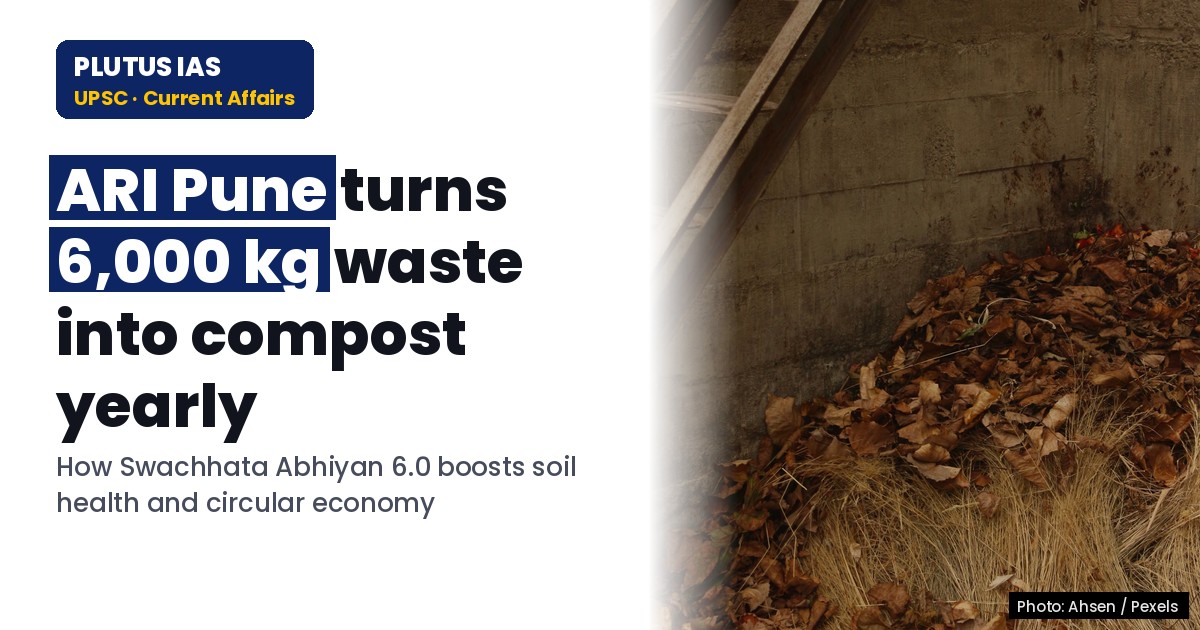
The Agharkar Research Institute (ARI), Pune, under Swachhata Abhiyan 6.0, has demonstrated a model of scientific waste management and sustainable horticulture by producing approximately 6,000 kg of compost annually from fallen leaves and garden waste for its campus gardens. This initiative underscores the practical application of circular economy principles, resource conservation, and biodiversity enhancement in institutional settings, aligning with national missions for cleanliness and environmental sustainability.
Background
- Swachhata Abhiyan is a nationwide campaign launched by the Government of India to promote cleanliness, hygiene, and sustainable waste management practices across institutions, including research centers, educational campuses, and urban local bodies.
- The campaign is implemented under the aegis of the Ministry of Housing and Urban Affairs and aligns with the broader objectives of the Swachh Bharat Mission (Urban) and Swachh Bharat Mission (Gramin).
- Institutional waste management, particularly in research and educational campuses, presents unique challenges due to the generation of diverse types of solid waste, including organic, inorganic, and hazardous materials.
- The Solid Waste Management Rules, 2016, mandate the segregation, processing, and scientific disposal of waste, emphasizing decentralized composting and recycling to reduce landfill dependency.
- Sustainable horticulture in institutional campuses contributes to environmental quality, biodiversity conservation, and the promotion of green infrastructure, aligning with the National Biodiversity Action Plan.
- The Agharkar Research Institute, a premier research institution and autonomous institute under the Department of Science and Technology (DST), focuses on botanical and environmental sciences, making it a suitable venue for demonstrating waste-to-resource initiatives.
What is Scientific Waste Management and Sustainable Horticulture in Institutional Contexts?
- Scientific waste management refers to the systematic collection, segregation, processing, and disposal of waste using evidence-based methods to minimize environmental impact and maximize resource recovery.
- Institutional organic waste, such as fallen leaves, garden trimmings, and food waste, can be processed through composting or vermicomposting to produce nutrient-rich organic manure, thereby reducing the volume of waste sent to landfills.
- Composting is an aerobic decomposition process where microorganisms break down organic matter into humus, a stable organic material that enhances soil structure, water retention, and nutrient availability.
- The composting process involves shredding organic waste, mixing it with bulking agents (e.g., dry leaves), and maintaining optimal moisture and aeration conditions to facilitate microbial activity.
- Sustainable horticulture in institutional settings involves the cultivation of diverse plant species, including trees, medicinal plants, ornamental species, and vegetables, using organic inputs and eco-friendly practices to promote biodiversity and environmental sustainability.
- The 6×6 Nutrition Garden Model demonstrated by ARI showcases how limited urban spaces can be utilized efficiently to cultivate a variety of vegetables, enhancing household nutrition security and reducing reliance on external food sources.
- Decentralized composting within institutional campuses reduces the environmental footprint associated with waste transportation and disposal, while also promoting self-sufficiency in organic inputs for horticulture.
- Institutional initiatives like those at ARI contribute to the achievement of Sustainable Development Goals (SDGs), particularly SDG 11 (Sustainable Cities and Communities), SDG 12 (Responsible Consumption and Production), and SDG 15 (Life on Land).
Key Features
| Feature | Significance |
|---|---|
| On-campus composting | Reduces organic waste disposal burden and converts garden waste into nutrient-rich compost for internal reuse |
| 6,000 kg annual compost production | Demonstrates circular economy principles by recycling organic matter into soil amendments within the institution |
| 80% compost + 20% soil mix for horticulture | Enhances soil structure, water retention, and nutrient availability for institutional gardens |
| 6×6 Nutrition Garden Model | Shows how small-scale urban horticulture can meet family-level nutritional needs through systematic crop planning |
| Biodiversity conservation in campus gardens | Supports ecological balance, plant conservation, and environmental quality within institutional premises |
Why it Matters
Environmental Sustainability
- Demonstrates practical implementation of circular economy principles in institutional waste management through on-site composting and nutrient recycling
- Reduces carbon footprint by eliminating transport emissions associated with organic waste disposal and external procurement of horticultural inputs
- Enhances soil health and biodiversity within campus ecosystems through organic matter enrichment and native plant conservation
Resource Efficiency
- Minimizes external dependence on synthetic fertilizers and horticultural inputs by generating 6,000 kg of compost annually from institutional waste
- Optimizes land use through structured gardening models (e.g., 6×6 Nutrition Garden) that maximize output per unit area
- Lowers operational costs for campus maintenance by reducing waste disposal expenses and external material purchases
Scientific and Educational Value
- Serves as a living laboratory for demonstrating waste-to-resource conversion methodologies to students, researchers, and visitors
- Facilitates conservation of rare and medicinal plant species, supporting ex-situ biodiversity preservation efforts
- Promotes interdisciplinary learning by integrating environmental science, horticulture, and sustainable agriculture practices
Policy Alignment
- Aligns with national initiatives such as Swachh Bharat Mission and circular economy frameworks promoted by NITI Aayog
- Supports Sustainable Development Goals (SDG 12: Responsible Consumption and Production, SDG 15: Life on Land)
- Contributes to India’s commitments under international environmental agreements (e.g., Paris Agreement, Convention on Biological Diversity)
Challenges
1. Scalability of On-Site Composting
- Limited space for composting pits in urban institutional campuses may constrain expansion of organic waste processing capacity
- Seasonal variations in organic waste generation (e.g., monsoon vs. summer) require adaptive management strategies to maintain compost quality
- Initial setup costs for composting infrastructure (e.g., shredders, aeration systems) may pose financial barriers for smaller institutions
UPSC Link: Environmental governance and waste management policies
2. Maintenance of Biodiversity in Urban Settings
- Urban heat islands and pollution stress may impact plant health despite organic soil amendments, requiring additional mitigation measures
- Balancing conservation priorities with aesthetic and functional requirements of institutional landscapes demands continuous monitoring
- Limited availability of native plant species for horticulture may hinder efforts to restore local ecological balance
UPSC Link: Urban biodiversity and ecological restoration
3. Awareness and Behavioral Change
- Institutional staff and visitors may lack awareness of composting benefits, leading to improper waste segregation practices
- Resistance to adopting organic horticulture methods due to perceived lower yields or higher labor requirements compared to conventional practices
- Need for continuous training programs to ensure consistent participation in waste management initiatives
UPSC Link: Public participation in environmental governance
Challenges — UPSC Perspective
| Issue | Concern |
|---|---|
| Space constraints for composting | Urban campuses may lack adequate area for scaling composting operations |
| Seasonal waste generation fluctuations | Inconsistent organic waste supply can disrupt composting timelines and quality |
| High initial infrastructure costs | Capital expenditure for composting equipment may deter smaller institutions |
| Urban environmental stressors | Pollution and heat islands may reduce plant resilience despite soil improvements |
Way Forward
- Institutionalize composting as a permanent operational practice with dedicated staff training and monitoring protocols
- Expand the 6×6 Nutrition Garden model to include more plant varieties and integrate it into institutional food systems
- Develop partnerships with local municipal bodies to exchange best practices in urban waste management and horticulture
- Conduct periodic audits of organic waste generation and compost production to identify optimization opportunities
- Integrate waste management and biodiversity conservation metrics into institutional sustainability reporting frameworks
- Collaborate with academic institutions to document and disseminate case studies on campus-level circular economy models
- Promote public-private partnerships to fund composting infrastructure in resource-constrained institutions
UPSC Value Addition
Keywords for Mains Answer-Writing
Swachhta Abhiyan 6.0 · Scientific Waste Management · Circular Economy · Composting · Sustainable Horticulture · Nutrient Recycling · Agharkar Research Institute (ARI) · Pune · Organic Waste Conversion · Soil Health Improvement · Green Infrastructure · Nutrition-Sensitive Gardening · 6×6 Nutrition Garden Model · Resource Efficiency · Biodiversity Conservation
Concept Flow
Institutional organic waste generation → Segregation and on-site collection → Composting through microbial decomposition → Nutrient-rich compost production → Application in campus horticulture → Soil health improvement and waste reduction → Circular economy demonstration → Educational and environmental impact
Prelims Practice Questions
Q1. Consider the following statements regarding the Swachhta Abhiyan 6.0 initiative:
1. Swachhta Abhiyan 6.0 is a government-led campaign focused on promoting scientific waste management and sustainable horticulture.
2. The Agharkar Research Institute (ARI) in Pune prepares approximately 6,000 kg of compost annually from organic waste generated within its campus.
3. The 6×6 Nutrition Garden Model developed by ARI aims to demonstrate large-scale commercial farming of vegetables.
How many of the above statements are correct?
- Only one
- Only two
- All three
- None
Answer: All three — Statement 1 is correct as Swachhta Abhiyan 6.0 is a government initiative promoting scientific waste management. Statement 2 is correct as ARI prepares around 6,000 kg of compost annually from organic waste. Statement 3 is incorrect as the 6×6 Nutrition Garden Model is designed for household-level nutrition-sensitive gardening, not large-scale commercial farming.
Q2. Assertion (A): The composting process at ARI involves the decomposition of organic waste through microbial activity and aeration.
Reason (R): The compost is prepared in designated pits where the material is crushed, mixed weekly, and left for 3-4 months to decompose into nutrient-rich compost.
- Both A and R are true, and R is the correct explanation of A
- Both A and R are true, but R is not the correct explanation of A
- A is true, but R is false
- A is false, but R is true
Answer: Both A and R are true, and R is the correct explanation of A — Assertion (A) is true as composting at ARI involves microbial decomposition and aeration. Reason (R) is also true and correctly explains the process, as the material is crushed, mixed weekly, and left for 3-4 months to decompose.
Q3. Match the following initiatives with their respective objectives:
Column I (Initiative) | Column II (Objective)
————————————————-|————————————————-
A. Swachhta Abhiyan 6.0 | 1. Promote scientific waste management
B. 6×6 Nutrition Garden Model | 2. Demonstrate household-level nutrition gardening
C. Composting at ARI | 3. Improve soil health through organic waste conversion
D. ARI’s Green Infrastructure | 4. Enhance biodiversity and environmental quality
Select the correct match:
- A-1, B-2, C-3, D-4; A-2, B-1, C-4, D-3; A-3, B-4, C-1, D-2; A-4, B-3, C-2, D-1
- answer_string_map_indexed_to_options_array_indexed_from_0_to_3_where_0_is_first_option
- explain_inline_array_indexed_from_0_to_3_where_0_is_first_option
- format
Answer: A-1, B-2, C-3, D-4; A-2, B-1, C-4, D-3; A-3, B-4, C-1, D-2; A-4, B-3, C-2, D-1 —
Q4. Which of the following best describes the primary objective of the Swachhta Abhiyan 6.0 initiative as implemented by the Agharkar Research Institute (ARI)?
- To generate revenue through the sale of compost
- To promote resource efficiency and circular economy principles through organic waste management
- To reduce the reliance on imported horticultural materials
- To establish ARI as a commercial composting facility
Answer: To promote resource efficiency and circular economy principles through organic waste management — The primary objective of Swachhta Abhiyan 6.0 at ARI is to promote resource efficiency and circular economy principles by converting organic waste into compost, thereby reducing the need for external horticultural inputs and improving soil health.
Mains Practice Question
✍ The Agharkar Research Institute (ARI) in Pune has demonstrated a model of scientific waste management and sustainable horticulture through its Swachhta Abhiyan 6.0 initiatives. Critically examine the significance of such models in promoting circular economy principles and resource efficiency in India. Also, analyse how these initiatives contribute to biodiversity conservation and environmental sustainability. (15 Marks)
Approach: MODEL-ANSWER SKELETON:
1. **Introduction (2 marks)**
– Define circular economy and resource efficiency in the context of waste management.
– Briefly introduce ARI’s initiatives under Swachhta Abhiyan 6.0 and their objectives.
2. **Significance in Promoting Circular Economy (5 marks)**
– **Waste-to-Resource Conversion**: Explain how ARI’s composting model converts organic waste into a valuable resource (compost), reducing landfill dependency and promoting nutrient recycling.
– **Localised Resource Utilisation**: Highlight the reduction in external procurement of horticultural materials, demonstrating self-sufficiency and cost-effectiveness.
– **Policy Alignment**: Link to national policies such as the Swachh Bharat Mission 2.0 and the National Mission for Sustainable Agriculture (NMSA), which emphasize waste management and sustainable practices.
– **Challenges**: Discuss potential challenges such as scalability, awareness, and infrastructure limitations in replicating such models across diverse regions.
3. **Contribution to Biodiversity Conservation and Environmental Sustainability (5 marks)**
– **Soil Health Improvement**: Explain how composting enhances soil structure, water retention, and nutrient availability, fostering healthier plant growth.
– **Green Infrastructure**: Describe ARI’s green infrastructure, including its diverse plant species, medicinal plants, and orchidarium, which supports local biodiversity.
– **Reduction in Environmental Footprint**: Discuss how on-campus composting reduces transportation emissions and environmental degradation associated with waste disposal.
– **Nutrition-Sensitive Gardening**: Highlight the 6×6 Nutrition Garden Model as a tool for promoting household-level food security and dietary diversity.
4. **Conclusion (3 marks)**
– Summarise the broader implications of ARI’s model for India’s sustainability goals.
– Emphasise the need for scaling such initiatives through public-private partnerships, awareness campaigns, and policy support.
– Conclude with a forward-looking statement on the role of scientific institutions in driving sustainable development.
Source: PIB (Press Information Bureau)
Generated by AanyaAi for educational purpose.
Related guides on our sites
- Best PSIR optional coaching for upsc
- Best economics optional coaching for upsc
- Best PSIR optional teacher for upsc
- Best teacher of PSIR optional for upsc

- 19वें ‘अर्बन मोबिलिटी इंडिया सम्मेलन 2026’ का उद्घाटन: भुवनेश्वर में हुआ आयोजन - October 24, 2026
- एसटीपीआई ने देहरादून में 30,000 वर्ग फुट की नई स्टार्टअप इन्क्यूबेशन सुविधा का उद्घाटन किया - October 24, 2026
- धान पराली प्रबंधन: सीएक्यूएम दल ने पंजाब का दौरा कर उठाए कदम - October 24, 2026

No Comments