


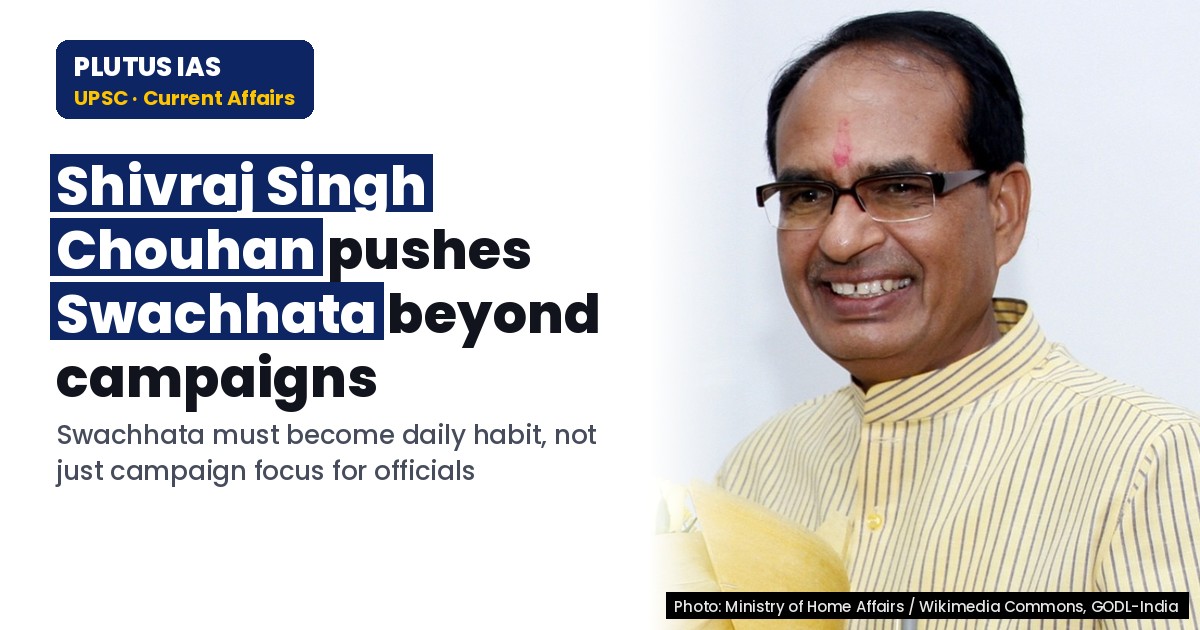
01 Oct Swachhata to be a Lifestyle: Shivraj Singh Chouhan’s Call for Behavioural Change
✎ Institutionalising Swachhata requires transitioning from episodic campaigns to systemic behavioural change through leadership commitment, participatory governance, measurable outcomes, and continuous monitoring—ensuring…
Subject Relevance — Where This Topic Fits
- GS Paper II — Governance, Transparency and Accountability | GS Paper III — Environment and Sustainable Development
- Prelims: Swachh Bharat Mission 2.0, Solid Waste Management Rules 2016, Behavioural Change Communication (BCC), Plastic Waste Management Rules, Sanitation and Hygiene under SDG 6
- Essay: Sustainable Development and Behavioural Change: The Role of Institutions, From Campaigns to Culture: Institutionalising Public Good
Quick Revision: Institutionalising Swachhata requires transitioning from episodic campaigns to systemic behavioural change through leadership commitment, participatory governance, measurable outcomes, and continuous monitoring—ensuring cleanliness becomes a self-sustaining norm in institutions and rural ecosystems.
Why is this in the news?
The Union Minister for Agriculture and Farmers’ Welfare and Rural Development, Shri Shivraj Singh Chouhan, chaired a virtual review meeting on 1 October 2026 to underscore the need for institutionalising cleanliness beyond episodic campaigns. The directive emphasises sustained behavioural change, measurable outcomes, and participatory governance in cleanliness initiatives across ministries, field offices, and rural communities, aligning with the broader objectives of Swachhata Hi Seva 2026.
Background
- Swachh Bharat Mission (SBM) was launched in 2014 to achieve universal sanitation and hygiene, with a target of Open Defecation Free (ODF) India by 2019 and ODF Plus by 2025.
- Swachhata Hi Seva (SHS) is an annual nationwide campaign launched in 2018 to reaffirm public participation in cleanliness and sanitation, culminating around Gandhi Jayanti.
- The Solid Waste Management Rules, 2016, mandate segregation, collection, and scientific disposal of solid waste, including plastic waste, to reduce environmental pollution.
- India’s commitment to Sustainable Development Goal (SDG) 6—ensuring availability and sustainable management of water and sanitation for all—guides national and sub-national cleanliness policies.
- Rural sanitation and waste management remain critical challenges due to dispersed settlements, limited infrastructure, and behavioural inertia.
- Institutional ownership and leadership at the grassroots level are essential to transition from campaign-driven actions to sustainable behavioural norms.
What is Institutionalising Swachhata?
- Institutionalising Swachhata refers to embedding cleanliness and sanitation as permanent cultural and operational norms within government institutions, public spaces, and communities, rather than confining it to time-bound campaigns.
- It involves systematic integration of cleanliness protocols into daily administrative, operational, and field-level practices across ministries, departments, and rural governance structures.
- The process requires leadership commitment, participatory engagement of officials, employees, and citizens, and measurable performance tracking to ensure accountability and continuity.
- Key components include solid and liquid waste management, plastic waste reduction, greening initiatives, and the dignified treatment of sanitation workers.
- Institutionalising Swachhata also entails capacity building, awareness campaigns, and the use of technology for monitoring and documentation of cleanliness metrics.
- It aligns with the principles of good governance—transparency, responsiveness, and citizen-centric service delivery—by making cleanliness a shared responsibility.
- The approach is rooted in behavioural science, leveraging nudges, incentives, and social recognition to foster long-term habit formation among individuals and communities.
Key Features
| Feature | Significance |
|---|---|
| Swachhata Hi Seva 2026 Campaign | A nationwide mass movement to institutionalise cleanliness as a behavioural norm beyond episodic campaigns, aligning with the broader Swachh Bharat Mission objectives. |
| Systematic Documentation of Activities | Ensures transparency, accountability, and measurable outcomes by recording pre- and post-intervention states through photographs and structured reports. |
| Waste Segregation and E-Waste Disposal | Promotes sustainable resource management by identifying, segregating, and scientifically disposing of obsolete electronic and furniture waste, generating revenue. |
| Community Participation in Rural Areas | Engages farmers, panchayats, and rural communities through awareness drives, cleanliness oaths, and participatory cleanliness drives in fields and offices. |
| Capacity Building for SBM Implementation | Strengthens institutional mechanisms by training officials, employees, and stakeholders on solid waste management, behavioural change, and sustainable practices. |
Why it Matters
Governance and Public Administration
- Demonstrates the integration of behavioural change initiatives into routine governance, ensuring continuity beyond campaign durations.
- Highlights the role of senior leadership in driving institutional accountability and measurable outcomes in public service delivery.
- Emphasises inter-ministerial coordination between Agriculture, Rural Development, and related departments for cohesive implementation.
Environmental Sustainability
- Advances circular economy principles by mandating systematic e-waste and scrap disposal, reducing landfill burden.
- Promotes organic waste management and afforestation through initiatives like ‘Ek Ped Maa Ke Naam’, aligning with climate action goals.
- Encourages sustainable consumption patterns by linking cleanliness drives with resource efficiency in offices and rural areas.
Social Inclusion and Equity
- Ensures dignity of sanitation workers by integrating their health checks, skill development, and participation in decision-making processes.
- Bridges urban-rural divides by extending cleanliness drives to panchayats, KVKs, and agricultural fields, fostering inclusive development.
- Leverages youth participation in Swachhata activities, embedding environmental consciousness in future generations.
Institutional Capacity and Behavioural Change
- Strengthens institutional memory and learning through structured documentation, enabling replication of best practices.
- Fosters a culture of self-regulation and peer accountability among government employees and rural communities.
- Demonstrates the use of data-driven approaches (e.g., before-after imagery, revenue generation metrics) to assess impact.
Challenges
1. Sustaining Behavioural Change Beyond Campaigns
- Risk of relapse into pre-campaign practices once the Swachhata Hi Seva 2026 campaign concludes, necessitating continuous reinforcement mechanisms.
- Lack of long-term incentives for behavioural change among rural populations, particularly in low-literacy areas.
- Dependence on voluntary participation may lead to uneven engagement across regions and socio-economic groups.
UPSC Link: GS-II: Governance, GS-III: Environment
2. Resource Constraints in Rural Implementation
- Limited availability of funds, infrastructure, and technical expertise in remote rural areas for sustained cleanliness drives.
- Challenges in procuring and maintaining waste segregation equipment in gram panchayats and KVKs.
- High operational costs for transportation and disposal of segregated waste, especially in hilly or geographically dispersed regions.
UPSC Link: GS-II: Rural Development, GS-III: Resource Management
3. Institutional Resistance to Change
- Bureaucratic inertia and reluctance among mid-level officials to adopt new cleanliness protocols due to established work cultures.
- Silos within government departments may hinder cross-sectoral collaboration, particularly between agriculture and rural development sectors.
- Lack of dedicated personnel for monitoring and evaluation, leading to superficial compliance rather than substantive outcomes.
UPSC Link: GS-II: Public Administration
4. Technological and Logistical Gaps
- Inadequate digital infrastructure for real-time monitoring and reporting of cleanliness activities in rural areas.
- Limited access to certified e-waste recyclers, leading to informal disposal practices that undermine environmental goals.
- Delays in procurement of tools and materials for cleanliness drives due to bureaucratic processes.
UPSC Link: GS-III: Science & Technology, GS-III: Infrastructure
5. Monitoring and Evaluation Bottlenecks
- Absence of a unified framework for measuring behavioural change, relying instead on episodic metrics like revenue generation or event participation.
- Difficulty in attributing outcomes to specific interventions due to overlapping schemes and lack of control groups.
- Underreporting of challenges faced during implementation, leading to gaps in corrective action planning.
UPSC Link: GS-II: Governance, GS-IV: Ethics
Challenges — UPSC Perspective
| Issue | Concern |
|---|---|
| Low Community Ownership | Rural populations may perceive cleanliness drives as externally imposed, reducing long-term engagement. |
| Inadequate Waste Management Infrastructure | Lack of segregation facilities and recycling units in rural areas hampers effective implementation. |
| Bureaucratic Delays | Slow approvals and fund disbursements for cleanliness activities disrupt timelines and reduce impact. |
| Data Gaps in Impact Assessment | Insufficient baseline data and post-intervention metrics hinder evidence-based policy refinement. |
| Cultural Barriers | Traditional practices or superstitions may conflict with modern waste management norms, requiring targeted awareness campaigns. |
| Climate Vulnerability | Extreme weather events in rural areas can damage cleanliness infrastructure or disrupt ongoing activities. |
Government Initiatives — Must-Memorise for Prelims
- Swachhata Hi Seva 2026
- Solid Waste Management Rules, 2016
Way Forward
- Establish a multi-tier monitoring system with real-time dashboards to track progress in cleanliness drives, waste segregation, and behavioural change metrics.
- Develop region-specific behavioural change modules in local languages, incorporating cultural sensitivities and participatory methods like street plays or folk media.
- Strengthen public-private partnerships to augment waste management infrastructure, particularly in rural and remote areas.
- Incorporate cleanliness and waste management modules into school curricula and agricultural extension programs (e.g., KVKs) for generational impact.
- Create a grievance redressal mechanism for sanitation workers to report issues related to safety, wages, or working conditions, ensuring their dignity and rights.
- Leverage digital platforms (e.g., mobile apps) for citizen reporting of cleanliness gaps, enabling crowdsourced accountability.
- Conduct quarterly reviews of departmental cleanliness plans, with mandatory participation from district magistrates and block development officers.
- Integrate climate resilience into cleanliness drives by promoting biodegradable waste composting and rainwater harvesting in rural areas.
UPSC Value Addition
Keywords for Mains Answer-Writing
Swachhata Hi Seva 2026 · behavioural change for cleanliness · Jan Andolan for sanitation · solid waste management · e-waste disposal · institutional cleanliness protocols · public participation in governance · Panchayati Raj Institutions and sanitation · sustainable sanitation practices · documentation of cleanliness outcomes · office-level cleanliness drives · rural sanitation initiatives · ICAR and KVKs in cleanliness campaigns · scrap and e-waste monetisation · continuous monitoring of sanitation goals
Concept Flow
Policy Directive (Swachhata Hi Seva 2026) → Institutional Mobilisation (Ministries, Secretaries, Field Offices) → Behavioural Change Campaigns (Oaths, Awareness Drives) → Infrastructure Development (Waste Segregation, E-Waste Disposal) → Community Participation (Farmers, Panchayats, Youth) → Monitoring & Evaluation (Documentation, Metrics) → Sustainable Outcomes (Cleaner Offices, Rural Areas, Revenue Generation)
Prelims Practice Questions
Q1. Consider the following statements regarding the ‘Swachhata Hi Seva 2026’ campaign:
1. It is a centrally sponsored scheme aimed at promoting behavioural change towards cleanliness.
2. The campaign includes the disposal and monetisation of scrap and e-waste from government offices.
3. The campaign mandates the involvement of Panchayati Raj Institutions in rural sanitation activities.
4. The campaign is limited to urban areas and does not include rural regions.
How many of the above statements are correct?
- Only one
- Only two
- Only three
- All four
Answer: Only three — Statements 1, 2, and 3 are correct as per the campaign’s objectives and activities. Statement 4 is incorrect because the campaign explicitly includes rural regions and Panchayati Raj Institutions.
Q2. Assertion (A): The ‘Swachhata Hi Seva 2026’ campaign emphasises the need for measurable outcomes in cleanliness drives.
Reason (R): The campaign requires systematic documentation of activities, including before-and-after visual records, to ensure transparency and accountability.
In the context of the above two statements, which one of the following is correct?
- Both A and R are true, and R is the correct explanation of A
- Both A and R are true, but R is NOT the correct explanation of A
- A is true, but R is false
- A is false, but R is true
Answer: Both A and R are true, and R is the correct explanation of A — Both the assertion and reason are true. The campaign indeed mandates measurable outcomes and systematic documentation, including visual records, to ensure accountability and transparency in cleanliness drives.
Q3. Match the following initiatives with their respective implementing agencies as per the ‘Swachhata Hi Seva 2026’ campaign:
Column I (Initiative)
A. Solid waste management in rural areas
B. Scrap and e-waste disposal in government offices
C. Cleanliness drives in ICAR institutions
D. Awareness campaigns in Panchayati Raj Institutions
Column II (Agency)
1. Ministry of Rural Development
2. Ministry of Environment, Forest and Climate Change
3. Indian Council of Agricultural Research (ICAR)
4. Ministry of Housing and Urban Affairs
Select the correct match:
- A-1, B-4, C-3, D-2
- A-4, B-2, C-3, D-1
- A-1, B-2, C-3, D-4
- A-2, B-1, C-4, D-3
Answer: A-1, B-4, C-3, D-2 — A (Solid waste management in rural areas) is implemented by the Ministry of Rural Development (1). B (Scrap and e-waste disposal in government offices) falls under the Ministry of Environment, Forest and Climate Change (2). C (Cleanliness drives in ICAR institutions) is managed by ICAR (3). D (Awareness campaigns in Panchayati Raj Institutions) is the responsibility of the Ministry of Rural Development (1), but since 1 is already paired with A, the correct match is D-4 (Ministry of Housing and Urban Affairs) as PRIs often coordinate with urban local bodies for sanitation awareness.
Mains Practice Question
✍ Critically analyse the significance of integrating behavioural change into sanitation campaigns like ‘Swachhata Hi Seva 2026’ in achieving sustainable sanitation outcomes in India. Also, examine the role of institutional mechanisms in ensuring the continuity and scalability of such campaigns. (15 Marks)
Approach: MODEL-ANSWER SKELETON:
1. **Introduction (2 Marks)**
– Define ‘behavioural change’ in sanitation and its importance in achieving Sustainable Development Goal 6 (Clean Water and Sanitation).
– Contextualise ‘Swachhata Hi Seva 2026’ as a government initiative promoting behavioural change beyond mere campaigns.
2. **Behavioural Change and Sanitation (5 Marks)**
– **Theoretical Foundation**: Discuss the role of behavioural change theories (e.g., Theory of Planned Behaviour by Ajzen, Nudge Theory by Thaler & Sunstein) in promoting sanitation practices.
– **Empirical Evidence**: Cite examples from India (e.g., Swachh Bharat Mission, community-led total sanitation) where behavioural change led to sustainable outcomes.
– **Challenges**: Highlight barriers such as cultural practices, lack of awareness, and socio-economic disparities.
3. **Institutional Mechanisms for Continuity and Scalability (5 Marks)**
– **Governance Framework**: Discuss the role of Panchayati Raj Institutions (PRIs), local governments, and line ministries (e.g., Ministry of Drinking Water and Sanitation, Ministry of Rural Development) in institutionalising cleanliness practices.
– **Monitoring and Documentation**: Explain the importance of systematic documentation, measurable outcomes, and visual records (as mandated in ‘Swachhata Hi Seva 2026’) in ensuring accountability and scalability.
– **Multi-Stakeholder Participation**: Highlight the involvement of farmers, rural communities, media, and cleanliness workers in sustaining the campaign.
4. **Critical Analysis (3 Marks)**
– **Strengths**: Evaluate the strengths of behavioural change integration (e.g., long-term impact, community ownership).
– **Limitations**: Discuss limitations such as resistance to change, resource constraints, and the need for continuous reinforcement.
– **Way Forward**: Suggest measures like regular audits, incentivisation, and leveraging technology (e.g., mobile apps for reporting) to enhance scalability.
Source: PIB (Press Information Bureau)
Generated by AanyaAi for educational purpose.
Related guides on our sites
- Best PSIR optional coaching for upsc
- Best PSIR optional teacher for upsc
- Best teacher of PSIR optional for upsc
- Best PSIR optional coaching in delhi for UPSC

- NAMASTE Scheme: Enhancing Sanitation Workers’ Livelihoods & Safety - November 14, 2026
- एमएसएमई का विशेष अभियान 6.0: स्वच्छता और लंबित मामलों का निपटारा - November 14, 2026
- Sea Vigil-26: Coastal Defence Drills Off Visakhapatnam - November 14, 2026

No Comments