


11 Aug Tamil Nadu Assembly to Freeze Lok Sabha Seats at 543: Key Polity Issue for UPSC 2026
✎ The 84th Constitutional Amendment (2001) and the 91st Amendment (2003) extended the freeze on delimitation until after the 2026 Census, ensuring stability in electoral representation.
Subject Relevance — Where This Topic Fits
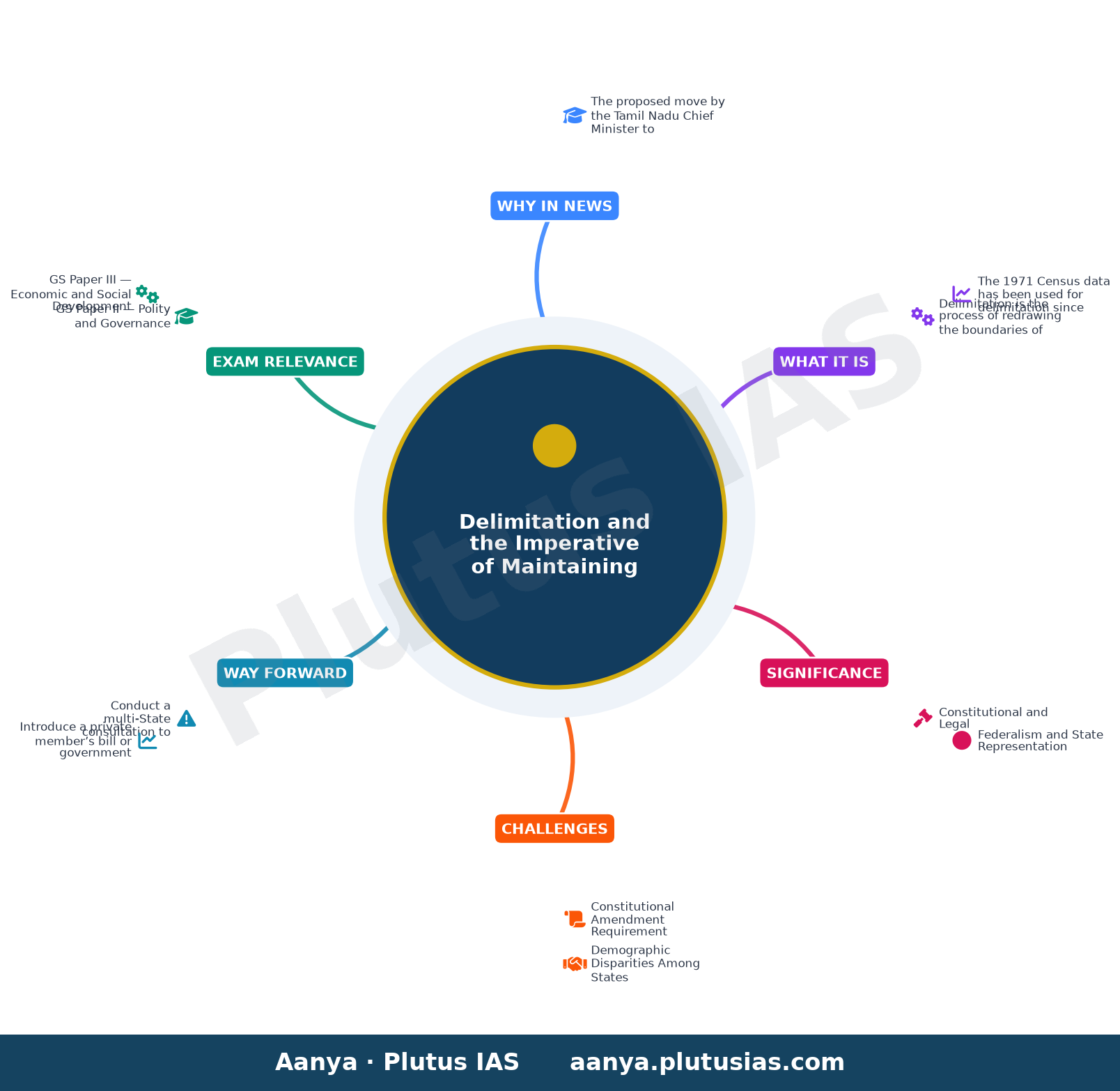
- GS Paper II — Polity and Governance | GS Paper III — Economic and Social Development
- Prelims: Delimitation Commission, Article 82 of the Constitution, Lok Sabha seat freeze, Inter-State seat distribution, 33% women’s reservation in Lok Sabha, Constitutional Amendment for delimitation
- Essay: The role of federalism in India’s democratic structure, Balancing demographic growth and representation in parliamentary democracy
Quick Revision: The 84th Constitutional Amendment (2001) and the 91st Amendment (2003) extended the freeze on delimitation until after the 2026 Census, ensuring stability in electoral representation.
Why is this in the news?
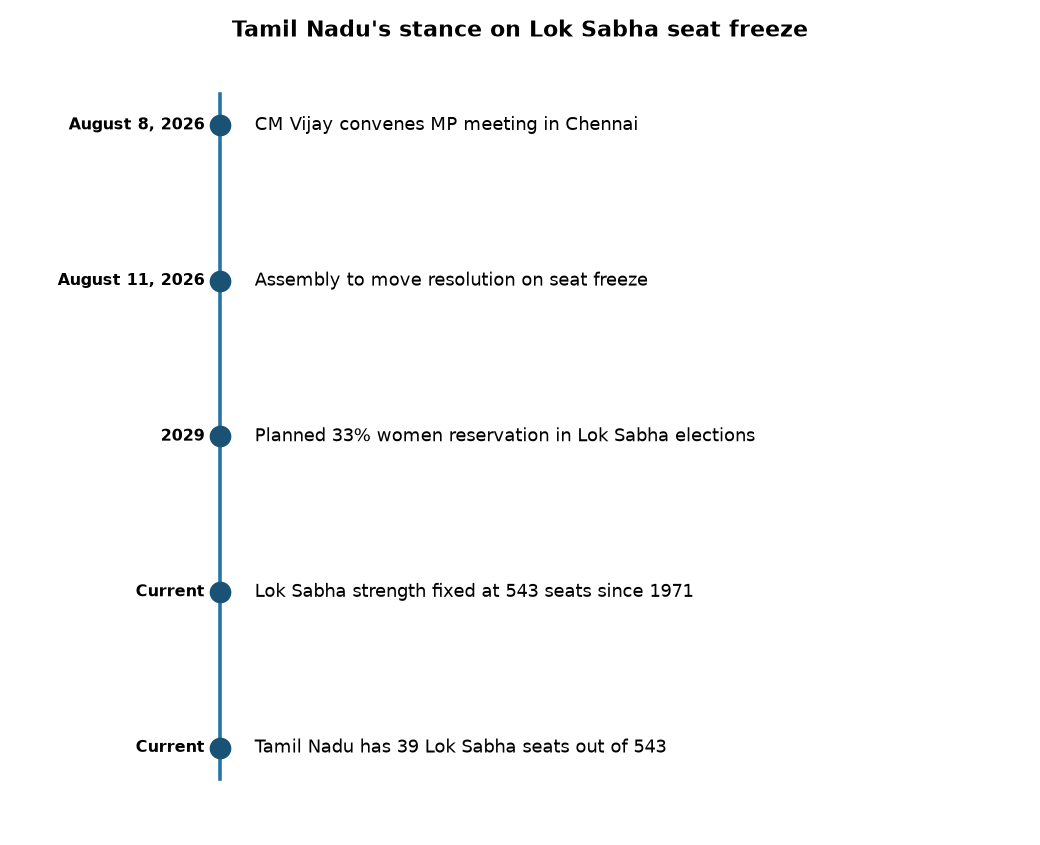
The proposed move by the Tamil Nadu Chief Minister to introduce a resolution in the State Assembly seeking a permanent freeze on the total number of Lok Sabha seats at 543 reflects a broader governance concern regarding the implications of the upcoming delimitation exercise. This initiative underscores the need to examine the constitutional framework governing delimitation, its historical evolution, and the potential socio-political consequences of altering the existing inter-State distribution of parliamentary seats.
Background
- The Constitution of India, under Article 82, mandates the readjustment of the number of seats in the Lok Sabha and State Legislative Assemblies after every decennial Census, a process known as delimitation.
- The 84th Constitutional Amendment Act, 2001, extended the freeze on delimitation until after the 2026 Census.
- The Union government is constitutionally empowered to constitute a Delimitation Commission to oversee the readjustment of seats, though any changes require parliamentary approval.
- Southern States, including Tamil Nadu, have historically expressed concerns about the potential reduction in their relative representation due to demographic shifts favoring northern States.
- The proposed resolution aligns with broader debates on federalism, equitable representation, and the need to balance demographic growth with democratic principles.
What is Delimitation and Why Does It Matter?
- Delimitation is the process of redrawing the boundaries of parliamentary and assembly constituencies to reflect changes in population, ensuring equitable representation.
- The 1971 Census data has been used for delimitation since 1976, with the total number of Lok Sabha seats fixed at 543 to maintain stability in representation.
- The 84th Amendment (2001) and the 91st Amendment (2003) extended the freeze on delimitation until after the 2026 Census, preventing frequent electoral boundary changes.
- Any future delimitation must adhere to the constitutional provisions of Article 81 (Composition of the House of the People) and Article 82 (Readjustment after each census).
- The resolution seeks to maintain the existing strength of 543 Lok Sabha seats, arguing that altering this could disrupt the balance of federalism and inter-State equity.
- The proposal also emphasizes the simultaneous implementation of the 33% women’s reservation in Lok Sabha and State Assemblies, based on the existing 543 seats.
Key Features
| Feature | Significance |
|---|---|
| Resolution in State Assembly | Aims to influence Union policy on Lok Sabha seat delimitation by leveraging State Assembly’s legislative platform. |
| Permanent freeze on Lok Sabha seats at 543 | Proposes constitutional or statutory safeguard to prevent future delimitation from altering inter-State seat distribution. |
| Preservation of inter-State seat ratio | Seeks to maintain the current allocation of seats among States, particularly protecting southern States’ representation. |
| Concurrent demand for 33% women’s reservation | Links the delimitation issue with the implementation of women’s reservation in legislatures, citing existing 543-seat framework. |
| Consensus-building with MPs | Involves coordination among Tamil Nadu’s MPs to present a unified State position on delimitation. |
Why it Matters
Constitutional and Legal
- The resolution invokes the constitutional framework governing Lok Sabha composition under Article 81, which empowers Parliament to determine seat distribution via delimitation.
Federalism and State Representation
- Highlights the tension between demographic changes and the principle of equal State representation in the Lok Sabha, particularly for southern States with slower population growth.
Electoral Reforms
- Links delimitation with the Women’s Reservation Bill (108th Constitutional Amendment), suggesting a holistic approach to electoral reforms while maintaining existing seat strength.
Institutional Coordination
- Demonstrates the role of State Assemblies in articulating regional concerns and influencing national policy through legislative resolutions.
Demographic and Representation Dynamics
- Raises the issue of whether the current seat allocation formula (based on 1971 Census) adequately reflects contemporary demographic realities without triggering delimitation.
Challenges
1. Constitutional Amendment Requirement
- Any freeze on Lok Sabha seats would necessitate a constitutional amendment under Article 81, requiring a two-thirds majority in Parliament and ratification by States.
- Amendments face procedural delays and potential opposition from States benefiting from future delimitation.
UPSC Link: Article 81 (Composition of the House of the People)
2. Demographic Disparities Among States
- Northern States with higher population growth advocate for delimitation to reflect current population, while southern States seek to retain existing seats to prevent loss of representation.
UPSC Link: Delimitation Commission
3. Implementation of Women’s Reservation
- Linking women’s reservation with delimitation may complicate the legislative process, as the Women’s Reservation Bill is pending implementation.
UPSC Link: 108th Constitutional Amendment Bill
4. Federal Tensions in Policy Formulation
- States’ divergent positions on delimitation risk exacerbating federal tensions, with potential implications for cooperative federalism and national unity.
UPSC Link: Cooperative Federalism
5. Legal and Administrative Hurdles
- The Delimitation Commission operates under the Delimitation Act, 2002, and any freeze would require legislative or constitutional overrides, posing legal and administrative challenges.
UPSC Link: Delimitation Act, 2002
Challenges — UPSC Perspective
| Issue | Concern |
|---|---|
| Constitutional Amendment | Requires supermajority in Parliament and State ratification, making it politically and procedurally complex. |
| Demographic Imbalance | Northern States may oppose a freeze, arguing it undermines fair representation based on population. |
| Women’s Reservation Linkage | Ties two distinct reform agendas, risking dilution of either initiative due to competing priorities. |
| Federal Discord | Divergent State positions may lead to policy paralysis or legal disputes over federal authority. |
| Administrative Feasibility | Freezing seats may conflict with the Delimitation Commission’s statutory mandate to redraw boundaries periodically. |
Way Forward
- Conduct a multi-State consultation to build consensus on delimitation, ensuring all regional concerns are addressed without undermining federal principles.
- Introduce a private member’s bill or government resolution in Parliament to explore constitutional amendments for a temporary freeze on seat increases.
- Engage the Delimitation Commission to study the feasibility of a phased or conditional freeze, balancing demographic growth with representation equity.
- Coordinate with the Law Ministry to assess the legal pathways for implementing a freeze, including judicial review and constitutional safeguards.
- Advocate for the simultaneous passage of the Women’s Reservation Bill to decouple it from delimitation debates and ensure timely implementation.
- Leverage inter-State forums (e.g., NITI Aayog, Inter-State Council) to facilitate dialogue on fair representation without altering the Lok Sabha’s structural framework.
- Commission independent demographic studies to evaluate the long-term impact of a freeze on State representation and national cohesion.
UPSC Value Addition
Keywords for Mains Answer-Writing
Delimitation Commission · Lok Sabha seat freeze · Constitutional Amendment for delimitation · Inter-State seat distribution · Women’s reservation in Parliament · Article 82 of the Constitution · Article 170 of the Constitution · Delimitation Act, 2002 · Federalism and representation · Constitutional provisions on delimitation · Parliamentary representation · State Assembly seat distribution · 33% women’s reservation in legislatures · Tamil Nadu Assembly resolution on delimitation · Union-State relations in delimitation
Constitutional & Policy Linkages
- Article 81 (Composition of the House of the People)
- Article 82 (Readjustment after each census)
- Article 170 (Composition of the Legislative Assemblies of the States)
- Seventh Schedule (Union and State List)
Concept Flow
Demographic shifts post-1971 Census → Demand for delimitation to reflect current population → Southern States oppose delimitation to retain seats → State Assembly resolution to freeze Lok Sabha seats at 543 → Constitutional amendment requirement under Article 81 → Federal tensions over representation → Linkage with Women’s Reservation Bill → Parliamentary and State-level negotiations.
Prelims Practice Questions
Q1. Consider the following statements regarding the delimitation of Lok Sabha seats in India:
1. The present strength of the Lok Sabha (543 seats) is fixed by the Constitution and cannot be altered without a constitutional amendment.
2. The Delimitation Commission is constituted under the Delimitation Act, 2002.
3. The next delimitation exercise is scheduled to be taken up after the first census conducted post-2026.
4. The 33% reservation for women in Parliament is to be implemented only after the delimitation process is completed.
How many of the above statements are correct?
- Only one
- Only two
- Only three
- All four
Answer: Only three — Statement 1 is incorrect: The present strength of 543 seats is not fixed by the Constitution but is a result of the delimitation process. Statement 2 is correct: The Delimitation Commission is constituted under the Delimitation Act, 2002. Statement 3 is correct: The next delimitation is to be taken up after the first census post-2026. Statement 4 is incorrect: The 33% reservation for women is to be implemented in the 2029 Lok Sabha elections without any delay, based on the existing 543 seats.
Q2. Assertion (A): The Union government can unilaterally freeze the number of Lok Sabha seats without a constitutional amendment.
Reason (R): The Constitution empowers Parliament to amend the provisions related to the composition of the Lok Sabha through a simple majority.
Options:
A. Both A and R are true, and R is the correct explanation of A.
B. Both A and R are true, but R is not the correct explanation of A.
C. A is true, but R is false.
D. A is false, but R is true.
Answer: ? — Assertion (A) is false: The Union government cannot unilaterally freeze the number of Lok Sabha seats without a constitutional amendment, as the process of delimitation involves constitutional provisions (Article 82 and 170) and requires a constitutional amendment. Reason (R) is true: Parliament can amend the Constitution through a special majority (Article 368), but this does not imply unilateral power to freeze seats without following the constitutional process.
Q3. Match the following provisions related to delimitation with their respective constitutional or statutory sources:
Column I (Provision)
1. Power to determine the number of seats in the Lok Sabha
2. Power to determine the number of seats in State Legislative Assemblies
3. Reservation of seats for Scheduled Castes and Scheduled Tribes
4. Reservation of seats for women in Parliament
Column II (Source)
A. Article 82 of the Constitution
B. Article 170 of the Constitution
C. Article 330 of the Constitution
D. Article 334 of the Constitution
E. 106th Constitutional Amendment Act, 2023
- 1-A, 2-B, 3-C, 4-E
- 1-A, 2-B, 3-D, 4-E
- 1-B, 2-A, 3-C, 4-D
- 1-A, 2-C, 3-B, 4-E
Answer: 1-A, 2-B, 3-D, 4-E — 1-A: Article 82 empowers Parliament to determine the number of seats in the Lok Sabha. 2-B: Article 170 empowers the State Legislature to determine the number of seats in State Legislative Assemblies. 3-C: Article 330 provides for reservation of seats for Scheduled Castes and Scheduled Tribes in the Lok Sabha. 4-E: The 106th Constitutional Amendment Act, 2023, provides for 33% reservation for women in Parliament.
Mains Practice Question
✍ Critically examine the constitutional and federal implications of a proposed freeze on the number of Lok Sabha seats at 543. In your answer, also discuss the consequences of such a freeze on the principle of proportional representation and the federal structure of India. (15 Marks)
Approach: MODEL-ANSWER SKELETON:
1. **Constitutional Provisions and Process of Delimitation**:
– Article 82 (read with Article 327) and Article 170 of the Constitution empower Parliament to readjust the number of seats in the Lok Sabha and State Legislative Assemblies after each census.
– The Delimitation Act, 2002, and the Delimitation Commission (constituted under this Act) are responsible for the process.
– A freeze on the number of seats would require a constitutional amendment, as the delimitation process is constitutionally mandated.
2. **Federal Implications**:
– Federalism in India is characterized by the representation of States in Parliament. A freeze could lead to a situation where some States gain or lose demographic advantage over time, potentially distorting the federal balance.
– Article 330 and 332 provide for reservation of seats for Scheduled Castes and Scheduled Tribes, which would also be affected by a freeze.
– The principle of ‘one person, one vote’ and ‘equal representation’ could be undermined if the freeze does not account for population changes.
3. **Proportional Representation and Democratic Principles**:
– The current system of delimitation aims to ensure that the number of seats in Parliament reflects the population distribution across States.
– A freeze could lead to over-representation of some States and under-representation of others, violating the principle of proportional representation.
– This could disproportionately benefit States with slower population growth and disadvantage States with higher population growth.
4. **Consequences of the Freeze**:
– **Demographic Distortion**: States with higher population growth (e.g., Bihar, Uttar Pradesh) would be under-represented, while States with slower growth (e.g., Kerala, Tamil Nadu) would be over-represented.
– **Impact on Women’s Reservation**: The 106th Constitutional Amendment Act, 2023, mandates 33% reservation for women in Parliament. A freeze could delay or complicate the implementation of this reservation.
– **Legal and Political Challenges**: A constitutional amendment would require a special majority in Parliament and ratification by half of the State Legislatures, which could face resistance from States with higher population growth.
5. **Balancing Views**:
– **Supporters of Freeze**: Argue that a freeze would provide stability and prevent frequent changes in constituency boundaries, which could disrupt governance.
– **Opponents of Freeze**: Argue that it would violate the principle of ‘one person, one vote’ and lead to unequal representation, undermining democratic principles.
6. **Conclusion**:
– A freeze on the number of Lok Sabha seats at 543 would have significant constitutional, federal, and democratic implications. While it may provide short-term stability, it risks distorting representation and undermining the federal structure of India. Any such freeze must be carefully balanced with the need for proportional representation and democratic fairness.
Source: The Hindu
Generated by AanyaAi for educational purpose.

- Gurugram’s groundwater extraction exceeds limit by 212%; HC seeks ban - October 4, 2026
- स्वतंत्रता सेनानी श्यामजी कृष्ण वर्मा की जन्म जयंती पर पीएम का श्रद्धांजलि - October 4, 2026
- KWML’s Feasibility Reports for Water Metro in 18 Cities: UPSC & PCS Insights - October 3, 2026

No Comments