


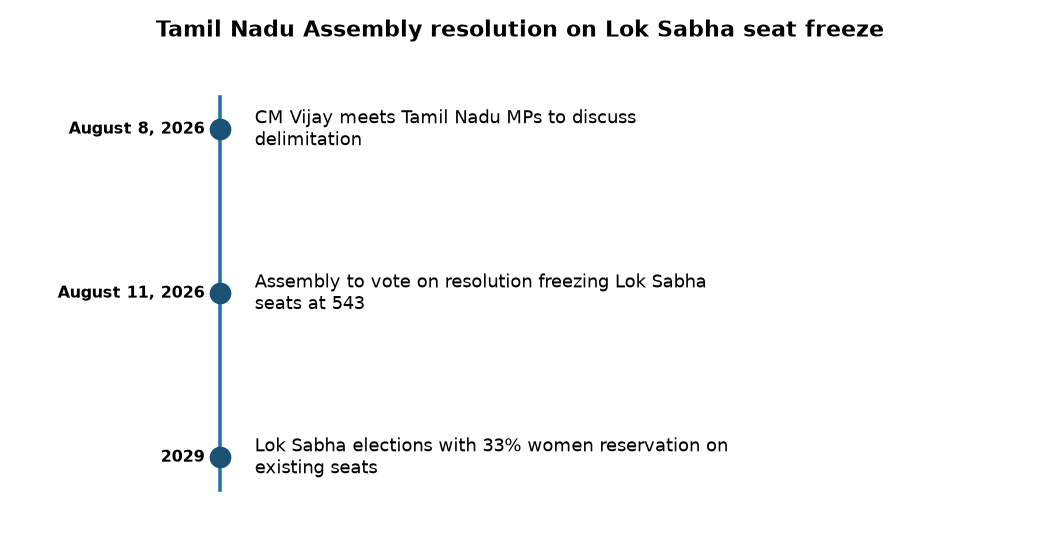
11 Aug Tamil Nadu Assembly to push for Lok Sabha seat freeze at 543
✎ The delimitation process, governed by Articles 82 and 170 of the Constitution, aims to ensure equitable representation but is currently frozen until after the 2026 Census; any change in seat distribution could significantly alter…
Subject Relevance — Where This Topic Fits
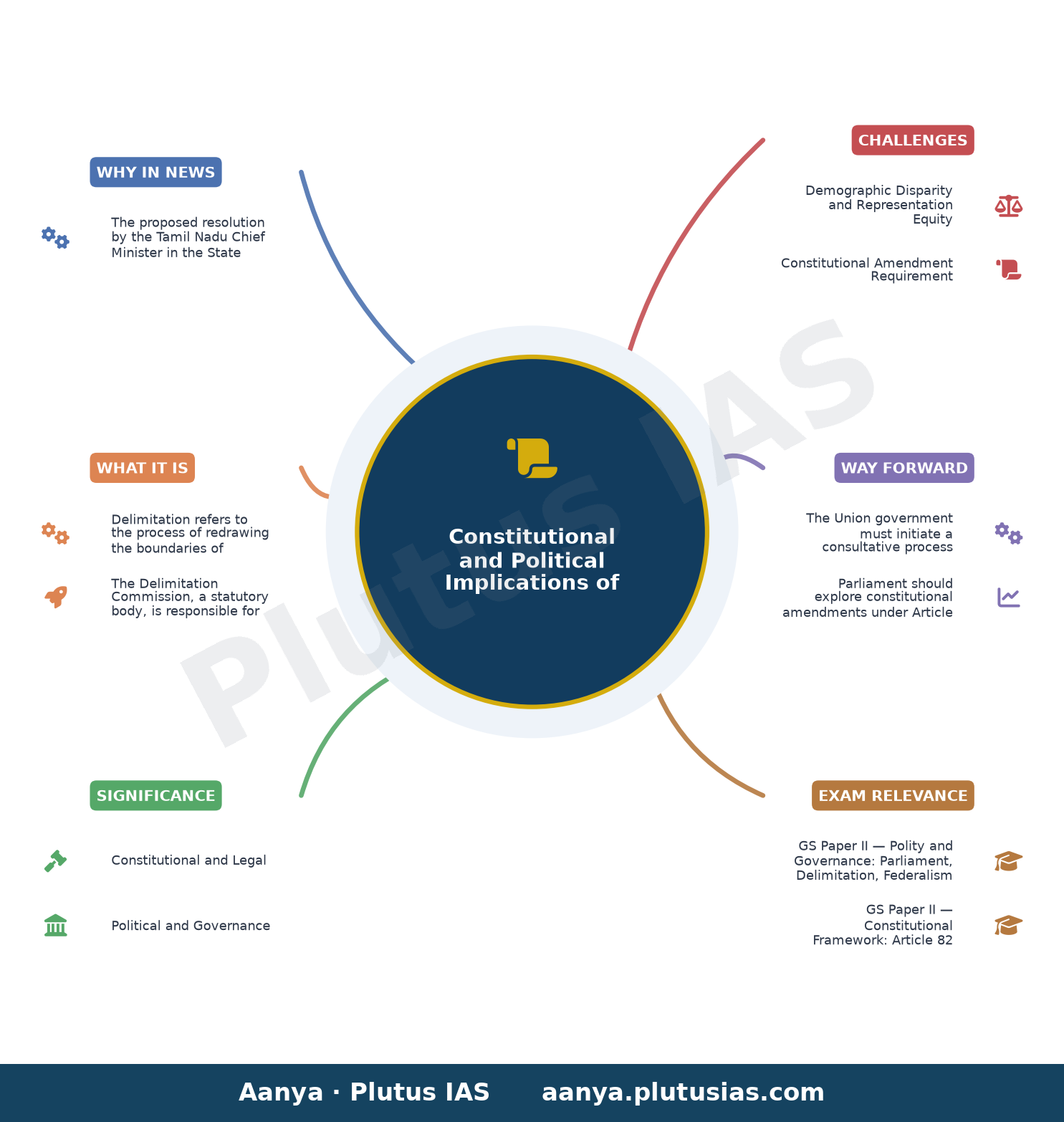
- GS Paper II — Polity and Governance: Parliament, Delimitation, Federalism | GS Paper II — Constitutional Framework: Article 82 and 170
- Prelims: Delimitation Commission, Lok Sabha seats, Article 82, Article 170, Inter-State seat distribution, Constitutional Amendment, Women’s Reservation Bill
- Essay: Federalism and Centre-State Relations in India, Balancing Representation and Governance: The Case of Delimitation
Quick Revision: The delimitation process, governed by Articles 82 and 170 of the Constitution, aims to ensure equitable representation but is currently frozen until after the 2026 Census; any change in seat distribution could significantly alter the political balance among States.
Why is this in the news?
The proposed resolution by the Tamil Nadu Chief Minister in the State Assembly seeks to urge the Union Government to permanently freeze the number of Lok Sabha seats at 543 and maintain the current inter-State distribution of seats. This move is part of a broader debate on the delimitation process, which has significant implications for federalism, representation, and the balance of political power among States. The resolution also underscores the importance of implementing the 33% reservation for women in legislative bodies without delay, based on the existing seat strength.
Background
- The Constitution of India mandates delimitation of parliamentary and Assembly constituencies after every census to ensure equitable representation, as per Articles 82 and 170.
- The last delimitation exercise was conducted in 2002–2008 and was based on the 2001 Census.
- The current strength of the Lok Sabha is 543, with seats allocated to States based on their population as per the 1971 Census (as frozen by the 42nd and 84th Constitutional Amendments).
- Southern States, including Tamil Nadu, have expressed concerns that a new delimitation exercise could reduce their relative representation due to lower population growth rates compared to northern States.
- The Union Government has not yet initiated a formal delimitation process, but discussions on the matter have gained momentum in recent months.
- The resolution in Tamil Nadu’s Assembly reflects a broader regional sentiment advocating for the preservation of existing seat distributions to protect States’ political and demographic interests.
What is Delimitation and Why Does It Matter?
- Delimitation refers to the process of redrawing the boundaries of parliamentary and Assembly constituencies to reflect changes in population distribution, as mandated by the Constitution.
- The Delimitation Commission, a statutory body, is responsible for this task and operates under the provisions of the Delimitation Act, 2002.
- The primary objective of delimitation is to ensure that each elected representative represents approximately an equal number of constituents, thereby maintaining the principle of ‘one person, one vote’.
- The current seat distribution in the Lok Sabha is based on the 1971 Census, with a freeze imposed to prevent frequent changes that could disrupt political stability.
- A new delimitation exercise could lead to an increase in the total number of Lok Sabha seats, with projections suggesting a potential rise to 744 seats based on population growth.
- Southern States argue that a new delimitation could reduce their relative political influence, as their population growth rates have been lower than those in northern States.
- The resolution in Tamil Nadu’s Assembly highlights the tension between maintaining federal balance and accommodating demographic changes, a core issue in India’s governance framework.
Key Features
| Feature | Significance |
|---|---|
| Proposed resolution to freeze Lok Sabha seats at 543 | Ensures stability in representation by preventing potential reallocation of seats that could alter inter-State distribution. |
| Maintenance of current Lok Sabha-Rajya Sabha ratio (2.2:1) | Preserves the constitutional balance between directly elected and indirectly elected members in Parliament. |
| Insistence on 33% reservation for women in elections | Aligns with constitutional amendments (106th CA) and ensures gender representation without altering seat count. |
| State-level Assembly resolution | Demonstrates cooperative federalism by involving state legislatures in national governance discussions. |
Why it Matters
Constitutional and Legal
- The resolution invokes Article 82 of the Constitution, which empowers Parliament to readjust territorial constituencies after each census, but allows freezing seats via a constitutional amendment if deemed necessary for stability.
- It underscores the principle of federalism by enabling states to influence national delimitation policy through legislative resolutions.
- The move highlights the tension between demographic changes and the constitutional mandate to maintain equitable representation across states.
Political and Governance
- Reflects inter-State concerns about potential loss of representation due to population shifts, particularly from southern states with slower growth rates.
- Demonstrates the role of state legislatures in shaping national policy on electoral representation, reinforcing cooperative federalism.
- Raises questions about the feasibility of implementing delimitation without altering the existing seat distribution framework.
Demographic and Electoral
- Highlights the demographic divergence between northern and southern states, where the latter fear reduced political influence due to lower population growth rates.
- Emphasises the need for data-driven delimitation that balances population parity with regional equity, as mandated by the Constitution.
- Links to the broader debate on whether the current seat allocation formula (1971 census) should be updated or frozen permanently.
Challenges
1. Demographic Disparity and Representation Equity
- Southern states argue that freezing seats at 543 disproportionately benefits them, as their population growth rates are lower than the national average.
- Northern states may perceive this as a move to entrench existing inequalities, potentially leading to legal and political disputes.
- The Constitution mandates that seats be readjusted based on population, raising ethical questions about freezing representation indefinitely.
UPSC Link: GS-II: Federalism, Representation
2. Constitutional Amendment Requirement
- Freezing the total number of Lok Sabha seats at 543 would require a constitutional amendment under Article 368, necessitating a two-thirds majority in Parliament and ratification by state legislatures.
- The process is time-consuming and politically contentious, as it involves balancing competing regional interests.
- Any amendment must also align with the 106th Constitutional Amendment (2023) for 33% women’s reservation, which is currently based on the existing seat count.
UPSC Link: GS-II: Constitutional Amendments
3. Implementation of Women’s Reservation
- The resolution’s call for 33% women’s reservation assumes the existing seat count (543) remains unchanged, which may conflict with future delimitation exercises.
- Delays in implementing women’s reservation could undermine the constitutional mandate and public trust in electoral reforms.
- The resolution does not address the operational challenges of reserving seats without altering the total number of constituencies.
UPSC Link: GS-II: Electoral Reforms
4. Federalism and State-Level Consensus
- Achieving a consensus among states on delimitation is difficult, as interests vary widely based on population dynamics and political priorities.
- The resolution reflects a state-led initiative, but its success depends on broader national agreement, which is politically fraught.
- Lack of consensus could lead to legal challenges, delaying or derailing the delimitation process entirely.
UPSC Link: GS-II: Cooperative Federalism
Challenges — UPSC Perspective
| Issue | Concern |
|---|---|
| Population Growth Disparity | Southern states risk losing seats if delimitation is based on current census data, while northern states gain representation. |
| Constitutional Amendment Process | Requires supermajority in Parliament and state ratification, making it politically and procedurally complex. |
| Women’s Reservation Timing | Implementation of 33% reservation must align with delimitation, but freezing seats may delay or complicate this process. |
| Inter-State Equity | Freezing seats could entrench existing inequalities, raising ethical and legal questions about fair representation. |
| Operational Feasibility | Reserving seats without altering constituency boundaries may create logistical challenges in election administration. |
Way Forward
- The Union government must initiate a consultative process with all states to assess the feasibility of freezing Lok Sabha seats at 543, ensuring broad-based consensus.
- Parliament should explore constitutional amendments under Article 368 to formalise the freeze, while addressing concerns of states with higher population growth.
- The Election Commission of India (ECI) should conduct a detailed study on the implications of freezing seats, including demographic projections and inter-State equity.
- State legislatures should coordinate to present a unified stance on delimitation, leveraging mechanisms like the Inter-State Council for dialogue.
- The 106th Constitutional Amendment (women’s reservation) should be implemented in tandem with any delimitation freeze to avoid operational conflicts.
- Legal experts should examine the constitutional validity of freezing seats without periodic readjustment, ensuring compliance with Article 82.
- Public awareness campaigns should be launched to educate citizens on the implications of delimitation and the need for balanced representation.
UPSC Value Addition
Keywords for Mains Answer-Writing
Delimitation Commission · Lok Sabha seat freeze · Inter-State seat distribution · Constitutional Amendment · Representation of States Act, 1950 · Article 82 of the Constitution · Article 170 of the Constitution · Parliamentary representation · Federal structure · 33% women reservation · Delimitation Commission procedure · Constitutional provisions on delimitation
Constitutional & Policy Linkages
- Article 82: Readjustment of territorial constituencies post-census.
- Article 368: Procedure for constitutional amendments.
- Seventh Schedule: Division of powers between Union and States (federalism).
Concept Flow
Population Census → Delimitation Commission assesses seat allocation → Parliament enacts readjustment under Article 82 → States raise concerns about equity → Proposal to freeze seats at 543 → Constitutional amendment under Article 368 → Implementation of women’s reservation (106th CA) → State legislatures pass resolutions → Union government evaluates feasibility → National consensus or legal challenges.
Prelims Practice Questions
Q1. Consider the following statements regarding the Delimitation Commission in India:
1. The Delimitation Commission is constituted under Article 82 of the Constitution.
2. The Commission is tasked with the delimitation of constituencies for the Lok Sabha and State Legislative Assemblies.
3. The recommendations of the Delimitation Commission are binding on the President of India.
4. The Commission is headed by the Chief Election Commissioner of India.
How many of the above statements are correct?
- Only one
- Only two
- Only three
- All
Answer: Only three — Statements 1 and 2 are correct as the Delimitation Commission is constituted under Article 82 and is responsible for delimiting constituencies for the Lok Sabha and State Legislative Assemblies. Statements 3 and 4 are incorrect as the recommendations of the Commission are not binding on the President and it is not headed by the Chief Election Commissioner.
Q2. Assertion (A): The Representation of the People Act, 1950 provides for the allocation of seats in the Lok Sabha and State Legislative Assemblies.
Reason (R): The allocation of seats is based on the population of each State as determined by the Census conducted every ten years.
In the context of the above two statements, which one of the following is correct?
- Both A and R are true, and R is the correct explanation of A.
- Both A and R are true, but R is not the correct explanation of A.
- A is true, but R is false.
- A is false, but R is true.
Answer: Both A and R are true, but R is not the correct explanation of A. — The Representation of the People Act, 1950 governs the allocation of seats in the Lok Sabha and State Legislative Assemblies, and this allocation is indeed based on the population of each State as determined by the Census conducted every ten years. Thus, both the assertion and reason are true, and the reason correctly explains the assertion.
Q3. Which of the following Articles of the Constitution of India mandates that the number of seats in the Lok Sabha shall not be altered except by law passed after a census?
A. Article 81
B. Article 82
C. Article 170
D. Article 330
- A
- B
- C
- D
Answer: B — Article 82 of the Constitution of India mandates that the number of seats in the Lok Sabha shall not be altered except by law passed after a census. Article 81 deals with the total number of seats in the Lok Sabha, Article 170 with the total number of seats in State Legislative Assemblies, and Article 330 with reservation of seats for Scheduled Castes and Scheduled Tribes in the Lok Sabha.
Mains Practice Question
✍ The proposal to freeze the number of Lok Sabha seats at 543 indefinitely and maintain the existing inter-State distribution of seats raises critical questions about the balance between population-based representation and federal principles in India. Critically examine the constitutional, political, and demographic implications of such a freeze. (15 Marks)
Approach: MODEL-ANSWER SKELETON:
1. Constitutional Framework: Cite Article 82 (readjustment of seats after each census), Article 81 (total seats in Lok Sabha), and Article 170 (State Assembly seats). Explain the mandatory periodic readjustment clause and its purpose.
2. Federal Principles vs. Population: Discuss the tension between the federal structure (equal voice to States) and democratic principles (population-based representation). Reference the 1976-2008 freeze and the 2002 amendment.
3. Demographic Imbalance: Highlight the growing disparity between States with high population growth (e.g., Bihar, Uttar Pradesh) and those with low growth (e.g., Kerala, Tamil Nadu). Use Census 2011 data on inter-State population distribution.
4. Political Implications: Analyze how a freeze affects political representation, resource allocation, and electoral politics. Reference debates on ‘one person, one vote’ and the need for consensus.
5. Judicial and Expert Views: Cite the Sarkaria Commission (1988) on the need for periodic readjustment and the Supreme Court’s observations in *Jammu & Kashmir v. Union of India* (1968) on federal balance.
6. Contemporary Context: Link to the 2026 delimitation debate and the 33% women reservation clause, emphasizing the procedural and substantive challenges in implementing reforms without altering seat numbers.
7. Balanced Conclusion: Weigh the arguments for stability and federal equity against the democratic principle of representation, suggesting a phased or consensus-based approach.
Source: The Hindu
Generated by AanyaAi for educational purpose.

- KWML’s Feasibility Reports for Water Metro in 18 Cities: UPSC & PCS Insights - October 3, 2026
- ओडिशा में वन्यजीव अनुसंधान अनुदान कार्यक्रम शुरू, सिमिलिपाल में 300 कैमरे और बढ़ेंगे - October 3, 2026
- India Summons Pakistan High Commission Official Over Violation - October 3, 2026

No Comments