


09 Aug Tamil Nadu Budget 2026: AI Approvals & ₹8,852 Cr Housing Boost Explained
✎ Tamil Nadu’s Budget 2026-27 introduces AI-enabled planning approvals (SPEED) and the MY-HOME scheme, a PPP-based housing initiative with ₹3,500 crore viability gap funding, to address urban housing deficits and governance…
Subject Relevance — Where This Topic Fits
- GS Paper II — Governance, Constitution, Polity, Social Justice and International Relations (Urban Governance, Housing Policies) | GS Paper III — Economy (Public-Private Partnerships, Urban Infrastructure, Digital Governance)
- Prelims: AI-enabled planning approvals, Single Platform for Efficient Expedited Development (SPEED), Metropolitan Youth and Family Housing Scheme (MY-HOME), Comprehensive Master Plan for Chennai Metropolitan Area (CMA), Viability Gap Funding (VGF), Digital Rental Voucher System, Third Master Plan (2027-2046), Tamil Nadu Shelter Fund, Public-Private Partnership (PPP) model, Urban Local Bodies (ULBs)
- Essay: The Role of Technology in Transforming Urban Governance: Lessons from Tamil Nadu’s AI-Enabled Planning Approvals, Affordable Housing as a Catalyst for Inclusive Growth: Evaluating Tamil Nadu’s MY-HOME Scheme
Quick Revision: Tamil Nadu’s Budget 2026-27 introduces AI-enabled planning approvals (SPEED) and the MY-HOME scheme, a PPP-based housing initiative with ₹3,500 crore viability gap funding, to address urban housing deficits and governance inefficiencies.
Why is this in the news?
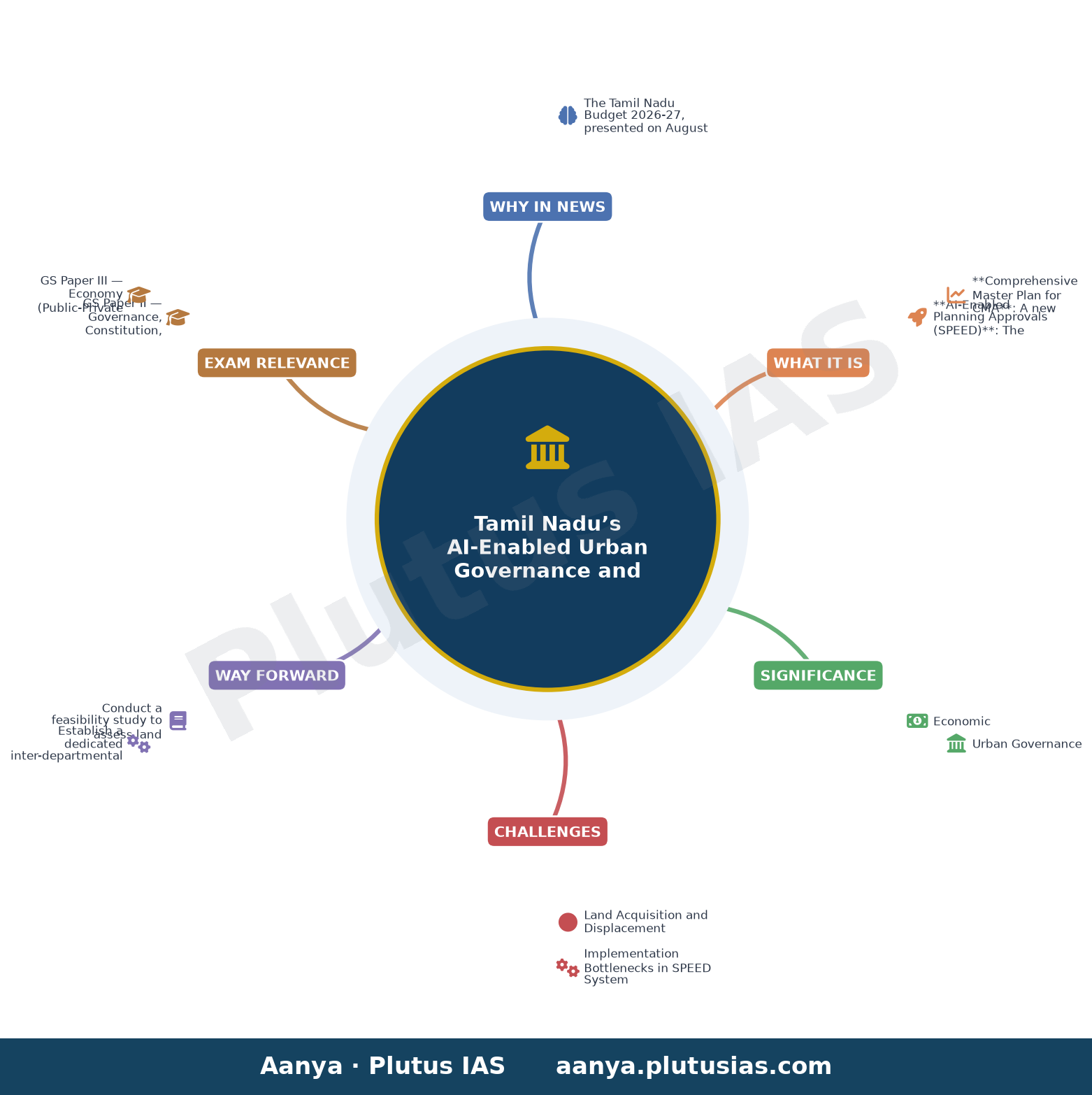
The Tamil Nadu Budget 2026-27, presented on August 5, 2026, introduces transformative urban governance and housing policies, including an AI-enabled planning approval system (SPEED) and the MY-HOME scheme for one lakh housing units. These initiatives reflect the state’s commitment to leveraging technology for efficient governance and addressing housing deficits through innovative financing and public-private partnerships, setting a precedent for other states in India.
Background
- Tamil Nadu, with a rapidly urbanising population, faces significant challenges in housing shortages, particularly for low-income families and youth, with Chennai’s Metropolitan Area (CMA) experiencing high demand for affordable housing.
- The state’s urbanisation rate of 48.4% (Census 2011) underscores the need for sustainable urban planning and infrastructure development to support economic growth and social equity.
- Previous housing schemes, such as the Tamil Nadu Urban Housing Board (TNUHDB) initiatives, have struggled with delays in approvals and implementation, necessitating reforms in governance and financing.
- The COVID-19 pandemic exacerbated housing vulnerabilities, particularly for migrant workers and informal sector workers, highlighting the urgency for inclusive housing policies.
- India’s urban population is projected to reach 600 million by 2030 (UN-Habitat), necessitating scalable solutions for housing and urban governance across states.
- Tamil Nadu’s focus on AI and digital governance aligns with the national push for ‘Digital India’ and the Smart Cities Mission, which emphasises technology-driven urban development.
Key Components of Tamil Nadu’s Urban and Housing Initiatives in Budget 2026-27
- **AI-Enabled Planning Approvals (SPEED)**: The Single Platform for Efficient Expedited Development (SPEED) integrates the Chennai Metropolitan Development Authority (CMDA), Directorate of Town and Country Planning (DTCP), and local bodies to streamline planning permissions using AI, reducing delays and enhancing transparency. This system is benchmarked against global best practices in urban governance.
- **Comprehensive Master Plan for CMA**: A new Comprehensive Master Plan is being prepared for the expanded CMA (5,904 sq. km.), covering long-term growth and transformation.
- **Metropolitan Youth and Family Housing Scheme (MY-HOME)**: A pilot initiative targeting one lakh housing units over seven years through a Public-Private Partnership (PPP) model, with an estimated investment of ₹15,000 crore.
- **Viability Gap Funding (VGF)**: The Tamil Nadu Shelter Fund will provide ₹3,500 crore in VGF to support the MY-HOME scheme, addressing financial viability challenges in affordable housing projects.
- **Housing Completion and New Initiatives**: The budget allocates ₹1,253 crore for completing 24,131 under-construction tenements and commencing work on 14,194 new tenements, alongside the MY-HOME scheme, to accelerate housing delivery.
- **Urban Governance Reforms**: The integration of AI in planning approvals and the preparation of a Comprehensive Master Plan reflect a shift towards data-driven, participatory urban governance, aligning with the 74th Constitutional Amendment Act (1992) and the National Urban Policy Framework.
- **Public-Private Partnership (PPP) Model**: The MY-HOME scheme leverages PPP to mobilise private sector investment, reduce fiscal burden on the state, and ensure timely project execution, while maintaining affordability for beneficiaries.
Key Features
| Feature | Significance |
|---|---|
| AI-enabled planning approval system (SPEED) | Integrates CMDA, DTCP, and local bodies to ensure transparent, timely, and efficient planning permissions across Tamil Nadu, reducing bureaucratic delays and corruption risks. |
| Comprehensive Master Plan for expanded CMA (5,904 sq. km.) | Provides a long-term roadmap for sustainable urban development, benchmarked against global metropolitan planning frameworks, ensuring structured growth and infrastructure alignment. |
| Metropolitan Youth and Family Housing Scheme (MY-HOME) | Aims to develop one lakh affordable housing units via PPP model, targeting low-income families and youth, with ₹3,500 crore viability gap funding to ensure financial viability. |
| Digital Rental Voucher System | Facilitates safe and affordable rental housing through a transparent voucher mechanism, addressing housing insecurity for marginalised sections in urban areas. |
| Third Master Plan (2027-2046) for CMA (1,189 sq. km.) | Lays the foundation for future urban planning, ensuring zoning, infrastructure, and environmental sustainability for Chennai’s metropolitan region. |
Why it Matters
Economic
- Stimulates investment of ₹15,000 crore in housing sector, leveraging public-private partnerships to boost economic activity and employment generation.
- Allocation of ₹8,852 crore to Housing and Urban Development Department reflects prioritisation of urban infrastructure, aligning with India’s urbanisation trajectory and Sustainable Development Goals (SDG 11).
- Viability Gap Funding (₹3,500 crore) reduces financial risks for private developers, encouraging participation in affordable housing projects.
- Expansion of CMA planning to 5,904 sq. km. unlocks real estate and infrastructure development opportunities, potentially increasing state revenue through land monetisation.
Urban Governance
- Introduction of SPEED system modernises urban planning approvals, reducing corruption and improving ease of doing business in Tamil Nadu.
- Comprehensive Master Plan ensures integrated urban development, addressing challenges like haphazard urban sprawl and inadequate infrastructure.
- Pilot launch of MY-HOME in CMA serves as a model for scalable affordable housing solutions, potentially replicable in other metropolitan regions.
- Digital Rental Voucher System introduces a market-based mechanism for affordable housing, reducing reliance on traditional public housing models.
Social
- Focus on low-income families and youth addresses housing insecurity, a critical issue in rapidly urbanising regions like Chennai.
- Completion of 24,131 under-construction tenements and commencement of 14,194 new units provides immediate relief to urban poor.
- Affordable housing schemes contribute to reducing urban inequality and improving quality of life for marginalised communities.
- Long-term transformation of CMA through master planning ensures equitable access to housing, infrastructure, and services.
Technological
- AI-enabled SPEED system sets a precedent for smart urban governance, integrating data analytics and automation to enhance efficiency.
- Digital Rental Voucher System leverages technology to streamline subsidy disbursement, reducing leakages and improving transparency.
- Master planning benchmarked against global frameworks (e.g., Singapore’s Urban Redevelopment Authority) demonstrates adoption of best practices.
Challenges
1. Land Acquisition and Displacement
- Expansion of CMA to 5,904 sq. km. may face land acquisition challenges, including resistance from local communities and legal hurdles under the Right to Fair Compensation and Transparency in Land Acquisition, Rehabilitation and Resettlement (RFCTLARR) Act, 2013.
- Risk of displacement of informal settlements without adequate rehabilitation, exacerbating socio-economic vulnerabilities.
UPSC Link: Land Reforms & RFCTLARR Act
2. Implementation Bottlenecks in SPEED System
- Integration of multiple agencies (CMDA, DTCP, local bodies) may face inter-departmental coordination challenges, leading to delays in system rollout.
- Digital divide and lack of technical capacity in rural and semi-urban local bodies could hinder effective adoption of AI-enabled approvals.
- Cybersecurity risks associated with AI-driven systems may expose planning data to breaches or misuse.
UPSC Link: E-Governance & Digital India
3. Financial Sustainability of MY-HOME
- Reliance on Viability Gap Funding (₹3,500 crore) raises questions about long-term fiscal sustainability, especially if private investment falls short of projections.
- Market volatility in real estate sector could impact the viability of PPP models, leading to delays or cancellations of housing projects.
- Inflationary pressures on construction costs may erode the affordability of housing units, defeating the scheme’s primary objective.
UPSC Link: Public-Private Partnerships
4. Urban Sprawl and Infrastructure Strain
- Expansion of CMA without corresponding investment in public transport, water supply, and sanitation could lead to urban sprawl and infrastructure deficits.
- Inadequate planning for peri-urban areas may result in unregulated development, environmental degradation, and increased commuting burdens.
- Climate change risks (e.g., flooding, heat islands) may not be adequately addressed in the Master Plan, compromising resilience.
UPSC Link: Urbanisation & Smart Cities Mission
5. Affordability and Gentrification
- Digital Rental Voucher System may inadvertently drive up rents in targeted areas, pricing out the very beneficiaries it aims to assist.
- Lack of rent control mechanisms could exacerbate housing insecurity for low-income groups despite the voucher system.
- Gentrification in redeveloped areas may displace existing communities, undermining social equity goals.
UPSC Link: Affordable Housing Policies
Challenges — UPSC Perspective
| Issue | Concern |
|---|---|
| Land Acquisition | Potential delays and legal disputes under RFCTLARR Act, risking project timelines. |
| Inter-Agency Coordination | SPEED system integration may falter due to bureaucratic silos and lack of technical capacity. |
| Financial Viability | MY-HOME’s reliance on viability gap funding may prove unsustainable if private investment lags. |
| Infrastructure Gaps | Expansion of CMA without parallel investment in transport, water, and sanitation could lead to urban dysfunction. |
| Digital Divide | Rural and semi-urban local bodies may lack the capacity to adopt AI-enabled planning approvals effectively. |
| Climate Resilience | Master Plan risks neglecting climate adaptation measures, exposing urban areas to future hazards. |
Government Initiatives — Must-Memorise for Prelims
- Metropolitan Youth and Family Housing Scheme (MY-HOME)
- Single Platform for Efficient Expedited Development (SPEED)
- Third Master Plan (2027-2046) for Chennai Metropolitan Area (CMA)
- Comprehensive Master Plan for expanded CMA (5,904 sq. km.)
Way Forward
- Conduct a feasibility study to assess land availability and acquisition challenges for the expanded CMA, ensuring alignment with RFCTLARR Act provisions.
- Establish a dedicated inter-departmental task force to oversee the implementation of the SPEED system, with clear timelines and accountability mechanisms.
- Develop a phased rollout plan for the MY-HOME scheme, prioritising areas with the highest housing demand and least infrastructure bottlenecks.
- Integrate climate resilience into the Comprehensive Master Plan, incorporating green infrastructure, flood management, and heat mitigation strategies.
- Strengthen digital infrastructure in rural and semi-urban local bodies through capacity-building programmes and technical partnerships with IT firms.
- Introduce rent control measures in areas covered by the Digital Rental Voucher System to prevent unintended gentrification and displacement.
- Monitor and evaluate the MY-HOME scheme’s progress through third-party audits, ensuring transparency in fund utilisation and project delivery.
- Collaborate with academic institutions and urban planning experts to refine the SPEED system’s AI algorithms, reducing bias and improving accuracy.
UPSC Value Addition
Keywords for Mains Answer-Writing
Tamil Nadu Budget 2026-27 · AI-enabled planning approvals · Single Platform for Efficient Expedited Development (SPEED) · Metropolitan Youth and Family Housing Scheme (MY-HOME) · Public-Private Partnership (PPP) in housing · Chennai Metropolitan Development Authority (CMDA) · Third Master Plan (2027-2046) · Comprehensive Master Plan for expanded CMA · Viability Gap Funding (VGF) · Digital Rental Voucher system · Urban planning reforms in India · Affordable housing policies · PPP models in urban infrastructure · State Finance Commission recommendations · Urban local bodies and planning approvals
Constitutional & Policy Linkages
- Article 243W – Powers, authority, and responsibilities of Municipalities (urban local governance).
- Article 243ZD – Committee for Metropolitan Planning (urban planning in metropolitan areas).
Concept Flow
Rapid urbanisation in Tamil Nadu → Increased demand for housing and infrastructure → Government announces MY-HOME and SPEED system in Budget 2026. → Expansion of CMA to 5,904 sq. km. → Need for long-term planning → Third Master Plan and Comprehensive Master Plan are formulated. → AI-enabled SPEED system → Streamlined planning approvals → Faster project execution and reduced corruption. → MY-HOME scheme → Public-private partnerships → Development of one lakh housing units with viability gap funding. → Digital Rental Voucher System → Affordable housing for low-income families → Reduced housing insecurity and improved quality of life. → Implementation challenges (land acquisition, financial sustainability) → Risk of delays and inefficiencies → Requires robust monitoring and adaptive governance.
Prelims Practice Questions
Q1. Consider the following statements regarding the Tamil Nadu Budget 2026-27:
1. The Budget announced an AI-enabled planning approval system named SPEED.
2. The MY-HOME scheme aims to develop one lakh housing units through a public-private partnership model.
3. The Chennai Metropolitan Development Authority (CMDA) is preparing the Third Master Plan (2027-2046) covering 5,904 sq. km.
4. The Budget allocated ₹40 crore for the Digital Rental Voucher system.
How many of the above statements are correct?
- Only one
- Only two
- Only three
- All four
Answer: Only three — Statements 1 and 2 are correct. Statement 3 is incorrect as the Third Master Plan (2027-2046) covers 1,189 sq. km., while the Comprehensive Master Plan covers 5,904 sq. km. Statement 4 is incorrect as ₹40 crore was allocated for the AI-enabled planning approval system (SPEED), not the Digital Rental Voucher system.
Q2. Assertion (A): The Tamil Nadu Budget 2026-27 introduced a new rental housing scheme to provide safe and affordable housing for low-income families and youth.
Reason (R): The scheme, MY-HOME, is designed to develop one lakh housing units over the next seven years through a public-private partnership model.
Options:
A) Both A and R are true, and R is the correct explanation of A.
B) Both A and R are true, but R is not the correct explanation of A.
C) A is true, but R is false.
D) A is false, but R is true.
Answer: ? — Both the Assertion (A) and Reason (R) are true. The MY-HOME scheme is indeed a new rental housing initiative aimed at providing affordable housing, and it plans to develop one lakh housing units through a PPP model over seven years. The Reason (R) correctly explains the Assertion (A).
Q3. Match the following initiatives announced in the Tamil Nadu Budget 2026-27 with their respective allocations:
Column I (Initiative) | Column II (Allocation in ₹ crore)
— | —
1. AI-enabled planning approval system (SPEED) | A. ₹25 crore
2. Comprehensive Master Plan for expanded CMA | B. ₹40 crore
3. Metropolitan Youth and Family Housing Scheme (MY-HOME) | C. ₹3,500 crore
4. Viability Gap Funding through Tamil Nadu Shelter Fund | D. ₹15,000 crore (investment)
Options:
A) 1-B, 2-A, 3-D, 4-C
B) 1-A, 2-B, 3-C, 4-D
C) 1-B, 2-A, 3-C, 4-D
D) 1-A, 2-D, 3-B, 4-C
- A
- B
- C
- D
Answer: A — 1-B: ₹40 crore was allocated for the AI-enabled planning approval system (SPEED). 2-A: ₹25 crore was allocated for the Comprehensive Master Plan for the expanded CMA. 3-D: The MY-HOME scheme aims to develop one lakh housing units with an estimated investment of ₹15,000 crore. 4-C: ₹3,500 crore was allocated as Viability Gap Funding through the Tamil Nadu Shelter Fund.
Mains Practice Question
✍ The Tamil Nadu Budget 2026-27 introduces transformative urban planning and housing reforms through initiatives such as the AI-enabled planning approval system (SPEED) and the Metropolitan Youth and Family Housing Scheme (MY-HOME). Critically examine the potential of these reforms to address urban housing shortages and streamline planning approvals in India. Also, discuss the challenges in implementing such schemes in the context of fiscal federalism and inter-state coordination. (15 Marks)
Approach: MODEL-ANSWER SKELETON:
1. **Introduction (2 marks)**
– Context: Urban housing shortage in India (e.g., 1.1 crore urban housing shortage as per NSSO 2012; exacerbated by migration to metros like Chennai).
– Objectives of Tamil Nadu’s reforms: transparency, efficiency, and affordability in housing and planning.
2. **AI-enabled planning approvals (SPEED) (4 marks)**
– **Mechanism**: Integration of CMDA, DTCP, and local bodies; AI-driven processing to reduce delays.
– **Potential**: Reduces bureaucratic red tape, enhances transparency, and accelerates project approvals (cite global examples like Singapore’s CORENET).
– **Challenges**: Data privacy concerns, resistance from bureaucratic stakeholders, and need for robust AI infrastructure.
3. **MY-HOME Scheme (4 marks)**
– **Structure**: PPP model with Viability Gap Funding (VGF) of ₹3,500 crore; Digital Rental Voucher system for affordability.
– **Potential**: Addresses low-income housing deficit; leverages private investment (₹15,000 crore) to scale up supply.
– **Challenges**: Land acquisition bottlenecks, regulatory hurdles in PPPs, and ensuring inclusivity in rental schemes.
4. **Fiscal Federalism and Inter-State Coordination (3 marks)**
– **Fiscal Federalism**: Role of State Finance Commissions; devolution of funds for urban development (74th CAA).
– **Inter-State Coordination**: Need for harmonised land-use policies and regional planning (e.g., NITI Aayog’s Aspirational Districts Programme).
– **Gaps**: Lack of uniform urban governance frameworks; centre-state tussles in funding and implementation.
5. **Conclusion (2 marks)**
– **Balanced View**: Reforms are path-breaking but require institutional strengthening, capacity building, and stakeholder consensus.
– **Way Forward**: Learning from best practices (e.g., Gujarat’s ‘Mukhyamantri Awas Yojana’), and leveraging technology for sustainable urbanisation.
Source: The Hindu
Generated by AanyaAi for educational purpose.

- Odisha Launches India’s First MICE Incentive Portal for UPSC Aspirants - October 5, 2026
- आईआईटी और एआई स्टार्टअप: क्या अब मास्टर डिग्री जरूरी नहीं? - October 5, 2026
- Himachal High Court VC Appointment Row: SC to Decide Future of Agriculture Universities - October 5, 2026

No Comments