


08 Aug Tamil Nadu CM Vijay opposes Lok Sabha seat expansion: Key UPSC insights
✎ Delimitation is constitutionally mandated but politically contentious; southern States oppose any expansion or redistribution of Lok Sabha seats to preserve their federal rights and political influence.
Subject Relevance — Where This Topic Fits
- GS Paper II — Constitutional and Non-Constitutional Bodies (Delimitation Commission) | GS Paper II — Federalism and Centre-State Relations | GS Paper III — Electoral Reforms and Representation of People Act
- Prelims: Delimitation Commission, Article 82 of the Constitution, Representation of the People Act, 1950, Federalism, Lok Sabha seat allocation, Constitutional Amendment Bill, Parliamentary sovereignty
- Essay: Federalism in India: Balancing Unity and Diversity, Electoral Reforms: Ensuring Fair Representation in a Democratic Framework
Quick Revision: Delimitation is constitutionally mandated but politically contentious; southern States oppose any expansion or redistribution of Lok Sabha seats to preserve their federal rights and political influence.
Why is this in the news?
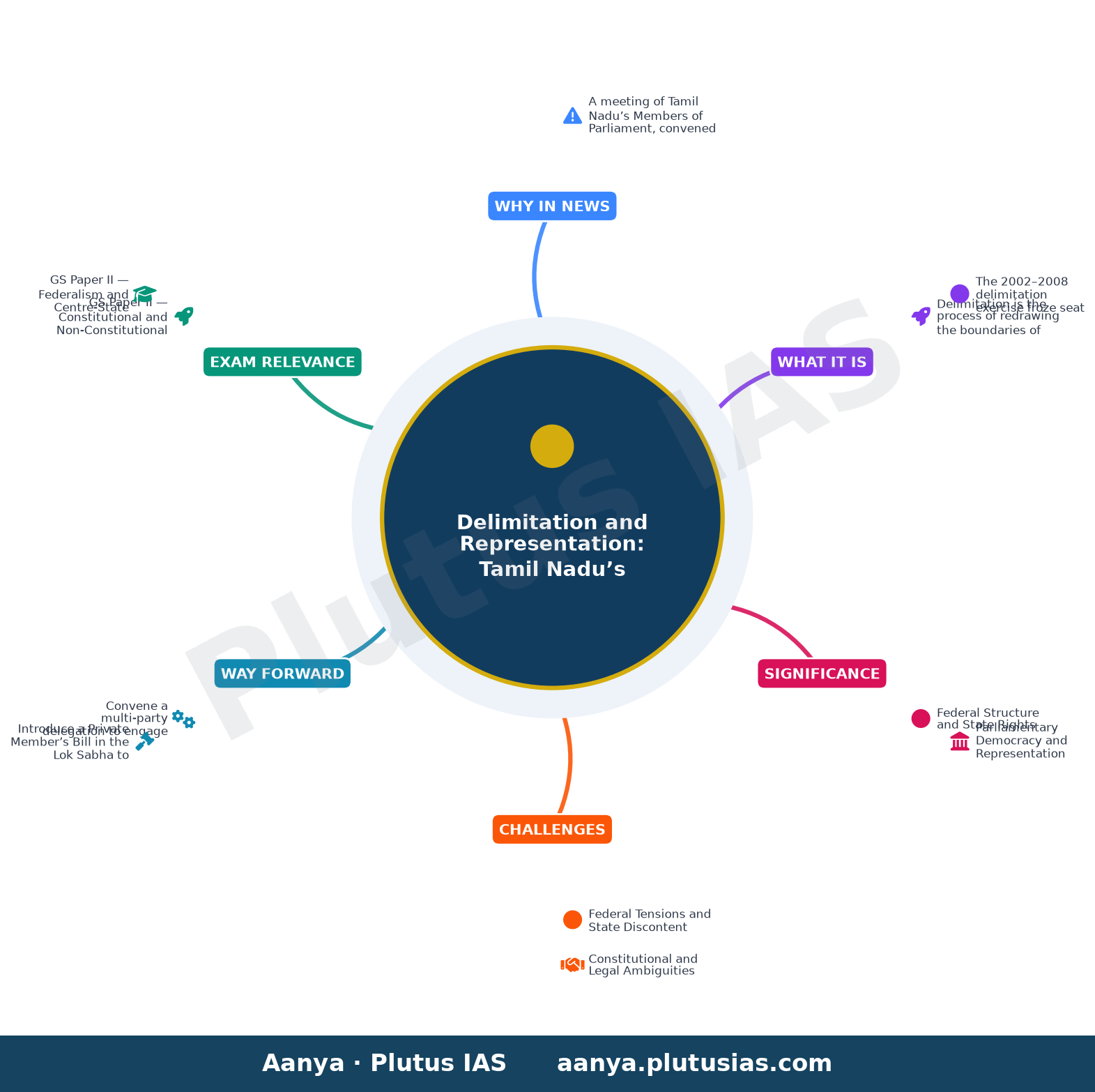
A meeting of Tamil Nadu’s Members of Parliament, convened by Chief Minister M.K. Stalin, has unanimously opposed the proposed Constitutional Amendment Bill on delimitation, advocating for a freeze on the total number of Lok Sabha seats at 543 and retention of existing seat allocations for States. The meeting also resolved to adopt a government resolution in the Tamil Nadu Assembly to safeguard the State’s interests, reflecting broader concerns among southern States regarding demographic shifts and political representation.
Background
- The Constitution of India mandates delimitation of parliamentary and assembly constituencies after every census to reflect population changes, as per Article 82.
- The last delimitation exercise was conducted in 2002–2008, freezing seat allocations until 2026 based on the 2001 Census.
- The 2021 Census data, though delayed, is expected to trigger the next delimitation cycle, raising apprehensions among southern States about potential loss of political representation due to lower population growth rates.
- Southern States, including Tamil Nadu, have historically argued for maintaining the status quo to prevent dilution of their influence in Parliament, citing concerns over federal equity.
- The proposed Constitutional Amendment Bill seeks to empower the Delimitation Commission with sweeping powers, including the authority to redraw boundaries and adjust seat allocations, which has drawn criticism for bypassing parliamentary scrutiny.
- Political parties in Tamil Nadu, including the DMK, Congress, and VCK, have consistently opposed any expansion or redistribution of Lok Sabha seats, emphasizing the need to protect the rights of States with lower population growth.
What is Delimitation and Why is it Contentious?
- Delimitation is the process of redrawing the boundaries of parliamentary and assembly constituencies to reflect population changes, conducted by the Delimitation Commission under Article 82 of the Constitution.
- The 2002–2008 delimitation exercise froze seat allocations until 2026, despite the 2011 Census, to avoid frequent changes and ensure political stability.
- Southern States oppose delimitation due to their lower population growth rates, which could result in a reduction of their Lok Sabha seats, thereby diminishing their political influence in Parliament.
- The proposed Constitutional Amendment Bill seeks to grant the Delimitation Commission broader powers, including the ability to adjust seat allocations without parliamentary oversight, raising concerns about federal encroachment.
- Critics argue that expanding the Lok Sabha beyond 543 seats (e.g., to 815 or 850) would dilute the effectiveness of parliamentary debates and reduce the quality of representation, as highlighted by Tamil Nadu MPs.
- The debate also touches upon the principle of federalism, with southern States asserting that their demographic contributions to national growth should not be penalized through reduced representation.
Key Features
| Feature | Significance |
|---|---|
| Proposed Constitutional Amendment on Delimitation | Aims to redraw Lok Sabha constituency boundaries and potentially increase the total number of seats beyond the existing 543, altering state-wise representation. |
| Freezing Lok Sabha Seats at 543 | Proposed to maintain the current total strength of the Lok Sabha, preventing any increase in the number of seats or reallocation of seats among states. |
| Government Resolution in Tamil Nadu Assembly | A legislative measure to formally oppose delimitation and uphold the rights of Tamil Nadu and southern states in parliamentary representation. |
| All-Party Meeting of Tamil Nadu MPs | Convened by the Chief Minister to consolidate opposition to delimitation, ensuring a unified stance across political parties. |
| Opposition to Sweeping Powers of Delimitation Commission | Demand that Parliament, rather than an executive commission, should have the final authority over delimitation to prevent arbitrary changes. |
Why it Matters
Federal Structure and State Rights
- Delimitation directly impacts the federal balance by altering state-wise representation in the Lok Sabha, potentially reducing the voice of southern states like Tamil Nadu in national decision-making.
- Southern states, including Tamil Nadu, argue that their demographic and political rights are being undermined by proposals that could dilute their representation.
- The demand to freeze seats at 543 reflects a broader concern about preserving the existing federal equilibrium and preventing disproportionate shifts in power.
Parliamentary Democracy and Representation
- The Lok Sabha’s strength and constituency boundaries determine the quality and quantity of representation for citizens, influencing policy priorities and resource allocation.
- Increasing the number of seats without proportional benefit to states like Tamil Nadu risks overburdening Parliament, reducing the effectiveness of debates and discussions.
- The proposal to freeze seats is seen as a safeguard against political manipulation of representation for electoral gains.
Constitutional and Legal Framework
- Delimitation is governed by Articles 81, 82, and 330 of the Constitution, which provide the legal basis for determining the number and boundaries of Lok Sabha constituencies.
- The 42nd and 84th Constitutional Amendments have historically addressed delimitation, with the latter freezing seat allocation until 2026, now under renewed scrutiny.
- The demand for Parliament’s authority over delimitation aligns with the constitutional principle of legislative supremacy in matters of representation.
Political and Electoral Dynamics
- Tamil Nadu’s political parties, despite ideological differences, have united against delimitation to protect state-specific interests, highlighting the role of regional parties in national politics.
- The meeting’s low participation (19 of 57 MPs) underscores intra-state political fragmentation, yet the consensus on opposing delimitation demonstrates shared regional concerns.
- The BJP-led government’s reduction in Parliament’s sitting days has fueled skepticism about the feasibility of accommodating additional MPs without compromising legislative efficiency.
Challenges
1. Federal Tensions and State Discontent
- Proposals to increase Lok Sabha seats risk exacerbating federal tensions, particularly between northern and southern states, by altering historical representation patterns.
- Southern states perceive delimitation as a move to marginalize their political influence, potentially leading to long-term disaffection and demands for greater autonomy.
- The lack of consensus among all Tamil Nadu MPs (DMK’s absence) highlights intra-state political divisions, complicating unified opposition to delimitation.
UPSC Link: GS II: Federalism and Centre-State Relations
2. Constitutional and Legal Ambiguities
- The Constitution does not explicitly cap the Lok Sabha’s strength, leaving room for interpretation and potential misuse of delimitation for political ends.
- The Delimitation Commission’s sweeping powers, as opposed to Parliament’s authority, raise concerns about executive overreach in matters of representation.
- Historical precedents, such as the 84th Amendment, demonstrate the potential for constitutional amendments to disrupt the federal balance, necessitating robust safeguards.
UPSC Link: GS II: Constitutional Framework
3. Parliamentary Functionality and Representation Quality
- Increasing the number of MPs without commensurate improvements in parliamentary infrastructure (e.g., seating, time for debates) risks diluting the quality of representation.
- The existing reduction in Parliament’s sitting days exacerbates concerns about the feasibility of accommodating additional MPs without compromising legislative efficacy.
- The demand to freeze seats at 543 is partly motivated by the need to maintain the effectiveness of parliamentary debates and reduce logistical burdens.
UPSC Link: GS II: Parliament and State Legislatures
4. Political Polarization and Regionalism
- The issue of delimitation has become a rallying point for regional parties, potentially deepening political polarization between states and the Centre.
- Southern states’ united stance against delimitation reflects a growing regional identity, which could influence future electoral strategies and alliances.
- The absence of the DMK in the meeting highlights intra-state political fragmentation, complicating efforts to present a unified front against delimitation.
UPSC Link: GS II: Political Parties and Pressure Groups
Challenges — UPSC Perspective
| Issue | Concern |
|---|---|
| Federal Imbalance | Risk of altering historical representation patterns, disproportionately affecting southern states like Tamil Nadu. |
| Executive Overreach | Concerns about the Delimitation Commission’s sweeping powers undermining Parliament’s authority in matters of representation. |
| Parliamentary Efficacy | Potential dilution of legislative efficiency if the number of MPs increases without corresponding improvements in infrastructure or sitting days. |
| Intra-State Political Fragmentation | Lack of consensus among Tamil Nadu MPs (e.g., DMK’s absence) complicating unified opposition to delimitation. |
| Constitutional Ambiguity | Absence of an explicit cap on Lok Sabha strength, leaving room for political manipulation of representation. |
| Regional Identity and Polarization | Growing regionalism among southern states, potentially deepening political divides with the Centre. |
Way Forward
- Convene a multi-party delegation to engage with the Union Government on the proposed delimitation amendment, emphasizing the need for parliamentary authority over the process.
- Introduce a Private Member’s Bill in the Lok Sabha to formalize the freeze on Lok Sabha seats at 543, ensuring legal backing for the demand.
- Strengthen inter-state consultations, particularly with southern states, to present a unified front against delimitation and protect federal interests.
- Advocate for a constitutional amendment to explicitly cap the Lok Sabha’s strength at 543, with provisions for periodic review without altering state-wise allocation.
- Enhance parliamentary infrastructure (e.g., seating, time for debates) to accommodate any future increase in MPs without compromising legislative efficacy.
- Leverage judicial recourse, if necessary, to challenge the Delimitation Commission’s sweeping powers and uphold the principle of legislative supremacy.
- Promote awareness campaigns to educate citizens on the implications of delimitation, fostering public support for the demand to freeze seats.
- Explore constitutional provisions for a National Commission on Federal Balance to address grievances of states like Tamil Nadu on representation issues.
UPSC Value Addition
Keywords for Mains Answer-Writing
Delimitation Commission · Lok Sabha seat freeze · Constitutional Amendment Bill on delimitation · Tamil Nadu Assembly resolution · Southern States’ representation · Federalism in India · Parliamentary sovereignty · Delimitation Commission powers · Representation of States Act, 1950 · Federal structure of India · Constitutional provisions on delimitation · Inter-State equity in representation · Delimitation Commission (Amendment) Bill 2026 · Federalism vs. Parliamentary sovereignty · State rights in federal polity
Constitutional & Policy Linkages
- {‘article’: ‘Article 81’, ‘note’: ‘Total number of seats in Lok Sabha’}
- {‘article’: ‘Article 82’, ‘note’: ‘Readjustment after each census’}
- {‘article’: ‘Article 330’, ‘note’: ‘Reservation of seats for SCs/STs’}
Concept Flow
Proposal for Constitutional Amendment on Delimitation → Potential increase in Lok Sabha seats beyond 543 → Alteration of state-wise representation → Southern states (e.g., Tamil Nadu) perceive dilution of political voice → All-party meeting in Tamil Nadu opposes delimitation → Demand to freeze seats at 543 and retain current allocation → Opposition to sweeping powers of Delimitation Commission → Emphasis on Parliament’s authority over representation → Potential federal tensions and legal challenges → Need for constitutional safeguards and political consensus.
Prelims Practice Questions
Q1. Consider the following statements regarding the Delimitation Commission in India:
1. The Delimitation Commission is a permanent body established by the Constitution of India.
2. The Commission is empowered to determine the number and boundaries of constituencies in each State.
3. The orders of the Delimitation Commission cannot be challenged in any court of law.
4. The first delimitation exercise was conducted based on the 1971 Census.
How many of the above statements are correct?
- Only one
- Only two
- Only three
- All
Answer: Only three — Statements 2 and 3 are correct. The Delimitation Commission is an ad-hoc body constituted under the Delimitation Act, 2002, and its orders are subject to judicial review. The first delimitation exercise was conducted post-independence in 1950-51, based on the 1941 Census.
Q2. Assertion (A): The Constitution of India empowers Parliament to alter the number of seats in the Lok Sabha through a simple majority.
Reason (R): The Representation of the People Act, 1950, provides for the allocation of seats in the Lok Sabha to States based on their population.
- A is correct but R is incorrect
- Both A and R are correct, and R is the correct explanation of A
- Both A and R are correct, but R is not the correct explanation of A
- A is incorrect but R is correct
Answer: A is incorrect but R is correct — Assertion (A) is correct: Parliament can alter the number of seats via a Constitutional Amendment. Reason (R) is correct but does not explain (A), as the Act merely allocates seats based on existing provisions, not the power to alter them.
Q3. Match the following pairs related to delimitation in India:
Column I (Provision) | Column II (Description)
1. Article 82 | A. Power of Parliament to readjust seats after each Census
2. Delimitation Act, 2002 | B. Establishes the Delimitation Commission
3. Article 330 | C. Reserves seats for Scheduled Castes in Lok Sabha
4. Representation of the People Act, 1950 | D. Allocates seats to States in Lok Sabha
- 1-A, 2-B, 3-C, 4-D
- 1-B, 2-A, 3-D, 4-C
- 1-C, 2-D, 3-A, 4-B
- 1-D, 2-C, 3-B, 4-A
Answer: 1-A, 2-B, 3-C, 4-D — Correct matches: 1-A (Article 82 empowers Parliament to readjust seats), 2-B (Delimitation Act, 2002 establishes the Commission), 3-C (Article 330 reserves seats for SCs), 4-D (Representation of the People Act, 1950 allocates seats).
Mains Practice Question
✍ The proposed Constitutional Amendment Bill on delimitation, aimed at increasing the number of Lok Sabha seats and altering constituency boundaries, has triggered a federal debate. Critically examine the constitutional and political implications of such an exercise for federalism in India, with particular reference to the concerns raised by southern States like Tamil Nadu. (15 Marks)
Approach: MODEL-ANSWER SKELETON:
1. **Constitutional Framework**:
– Article 82 (readjustment of seats post-Census), Article 327 (Parliament’s power to regulate elections), and the Representation of the People Act, 1950.
– Role of the Delimitation Commission (Delimitation Act, 2002) and its quasi-judicial nature.
– Federal principles: Article 1 (Union of States), 7th Schedule (State List), and the doctrine of ‘cooperative federalism’.
2. **Southern States’ Concerns**:
– Demographic stagnation vs. northern States’ population growth: implications for seat allocation (e.g., 1971 Census freeze).
– Historical context: 1976-2008 freeze on delimitation to protect southern States’ representation.
– Tamil Nadu’s argument: Freezing seats at 543 maintains inter-State equity and prevents marginalisation.
3. **Federalism vs. Parliamentary Sovereignty**:
– Parliament’s plenary power to amend the Constitution (Article 368) vs. federal safeguards (e.g., Article 370-like protections inapplicable here).
– Judicial review: Landmark cases (e.g., *S.R. Bommai v. Union of India*, *Kuldip Nayar v. Union of India*) on federalism and Centre-State relations.
– Political economy: Potential for northern States to dominate numerically in an expanded Lok Sabha.
4. **Balancing Views**:
– **Pro-delimitation**: Reflects demographic changes, enhances representation for growing populations (e.g., Uttar Pradesh, Bihar).
– **Anti-delimitation**: Risks eroding federal balance, dilutes southern States’ voice, and may exacerbate regional disparities.
5. **Way Forward**:
– Alternative models: Weighted representation (e.g., Rajya Sabha-like equal State representation) or a federal commission for delimitation.
– Role of judicial intervention: Courts as arbiters of federal disputes (e.g., *State of West Bengal v. Union of India*).
– Conclusion: Delimitation must balance democratic representation with federal equity, ensuring no State feels marginalised.
Source: The Hindu
Generated by AanyaAi for educational purpose.

- सुपर एल नीनो से भारत में 15,800 अतिरिक्त गर्मी से मौतें: जानिए पूरा मामला - September 23, 2026
- Super El Niño to Cause 15,800 Heat Deaths in India: UPSC Key Analysis - September 23, 2026
- यूपीएससी/पीसीएस के लिए दूरसंचार विनिर्माण में निवेश: ग्वालियर टीएमजेड के अवसर - September 23, 2026

No Comments