


07 Aug Tamil Nadu CM Vijay to Consult MPs on Delimitation Bill Impact
✎ Delimitation in India is governed by the Delimitation Act and conducted by a statutory Delimitation Commission under Article 82, ensuring equitable representation based on the latest census data.
Subject Relevance — Where This Topic Fits
- GS Paper II — Functions and Responsibilities of the Union and the States, Issues and Challenges Pertaining to the Federal Structure | GS Paper III — Government Policies and Interventions for Development in Various Sectors
- Prelims: Delimitation Commission, Article 82, Article 170, Representation of the People Act, 1950, First Delimitation Act, 1952, Delimitation Act, 2002, Assam-Meghalaya Boundary Dispute, Vanniyar Reservation Case
- Essay: Federalism and Centre-State Relations: The Case of Delimitation in India, Demographic Representation vs. Political Representation: The Delimitation Dilemma
Quick Revision: Delimitation in India is governed by the Delimitation Act and conducted by a statutory Delimitation Commission under Article 82, ensuring equitable representation based on the latest census data.
Why is this in the news?
The Chief Minister of Tamil Nadu, C. Joseph Vijay, has announced a consultative meeting with Tamil Nadu’s Members of Parliament to discuss the Union government’s proposed Delimitation Bill. This follows the Centre’s initiative to introduce the Bill in Parliament, which could potentially alter the electoral map of Tamil Nadu. The development is significant as it raises constitutional, political, and demographic concerns, particularly regarding the representation of marginalised communities and the federal structure of India.
Background
- The Delimitation Commission is a statutory body constituted under the Delimitation Act, tasked with redrawing the boundaries of parliamentary and assembly constituencies based on the latest census data.
- The last delimitation exercise was conducted in 2002 and implemented in 2008, based on the 2001 Census. The next delimitation was deferred due to the postponement of the 2021 Census.
- The Union government has proposed a new Delimitation Bill in 2026, which may include provisions for conducting delimitation based on the 2021 Census data, despite the census results not being officially published.
- Tamil Nadu has historically opposed delimitation exercises that could dilute its political representation, citing concerns over federalism and the protection of state rights.
- The 2026 Bill has sparked debates on whether delimitation should be conducted before the finalisation of the 2021 Census data, raising legal and constitutional questions.
- The meeting called by the Tamil Nadu Chief Minister underscores the state’s proactive stance in safeguarding its electoral representation and addressing potential demographic shifts.
What is the Delimitation Bill?
- The Delimitation Bill is a proposed legislation by the Union government to redraw the boundaries of parliamentary and assembly constituencies in India, based on the latest census data.
- The Bill aims to ensure equitable representation by adjusting constituency boundaries to reflect population changes, as mandated under Article 82 of the Constitution.
- The Delimitation Commission, constituted under the Delimitation Act, is responsible for executing the delimitation process, which includes identifying and demarcating constituencies.
- The proposed Bill may include provisions for conducting delimitation based on the 2021 Census, despite the census data not being officially published, which raises legal and procedural concerns.
- The Bill is expected to address issues such as the reservation of seats for Scheduled Castes (SCs) and Scheduled Tribes (STs), as outlined in Article 330 and Article 332 of the Constitution.
- The process of delimitation is critical for maintaining the principle of ‘one person, one vote’ and ensuring fair representation in the legislative bodies.
- The Bill may also include provisions for the delimitation of constituencies in Union Territories, as per the provisions of the Representation of the People Act, 1950.
- The consultation with Tamil Nadu MPs reflects the broader debate on the balance between demographic representation and political representation, particularly in states with significant population shifts.
Key Features
| Feature | Significance |
|---|---|
| Consultative meeting by CM Vijay | Demonstrates state-level political engagement in response to Union legislative proposals, highlighting federalism dynamics. |
| Delimitation Bill | Proposes redrawing of electoral boundaries, which directly impacts seat allocation and representation in Parliament. |
| Focus on Tamil Nadu MPs | Ensures state-specific concerns are articulated in Parliament, particularly regarding potential loss of seats or demographic shifts. |
| Official release mechanism | Indicates structured communication between state and Union governments, reflecting institutionalised federal processes. |
| Kalaivanar Arangam venue | Symbolises cultural and political significance of the location, reinforcing state-centric deliberations. |
Why it Matters
Constitutional and Federal Implications
- The Delimitation Bill engages Article 82 of the Constitution, which mandates delimitation of constituencies after every census, ensuring equitable representation.
- State-level consultation underscores the federal structure, where states have a voice in Union legislative processes affecting their representation.
- Potential demographic shifts in Tamil Nadu (e.g., migration patterns) could alter seat distribution, necessitating state input to protect electoral equity.
Political and Governance Dimensions
- The Chief Minister’s proactive engagement reflects political accountability and responsiveness to Union legislative actions.
- Consultation with MPs from both Houses ensures bipartisan representation, aligning state and parliamentary interests.
- The meeting’s timing (August 2026) suggests alignment with the Union government’s legislative calendar, indicating strategic timing for advocacy.
Electoral and Representation Concerns
- Delimitation may alter seat allocations, impacting political parties’ strategies and voter demographics in Tamil Nadu.
- Historical context: Tamil Nadu’s seat count has remained static since 1971, raising concerns over underrepresentation if new delimitation excludes population growth.
- The consultation aims to address fears of marginalisation, particularly in regions with high population density or minority concentrations.
Administrative and Procedural Aspects
- The use of the Tamil Nadu House in New Delhi for coordination highlights institutional mechanisms for inter-governmental communication.
- Official releases and structured invitations indicate adherence to procedural norms, ensuring transparency in state-Union interactions.
Challenges
1. Federal Tensions in Delimitation
- Potential conflict between state and Union governments over seat allocation criteria, particularly if Tamil Nadu perceives unfair treatment.
- Risk of politicisation, where delimitation becomes a tool for altering political power dynamics rather than ensuring fair representation.
- Legal challenges may arise if the Delimitation Bill is perceived to violate constitutional principles of equality or federalism.
UPSC Link: GS-II: Federalism and Centre-State Relations
2. Demographic and Representation Disparities
- Uneven population growth across Tamil Nadu’s regions could lead to overrepresentation or underrepresentation in delimitation outcomes.
- Marginalised communities (e.g., SCs, STs) may face reduced political voice if delimitation does not account for their demographic concentration.
- Urban-rural divide in population distribution could skew seat allocations, favouring urban constituencies disproportionately.
UPSC Link: GS-II: Electoral Reforms and Representation
3. Political Opposition and Stakeholder Resistance
- Opposition parties in Tamil Nadu may resist delimitation if it is perceived to favour the ruling party at the Union level.
- Civil society groups or regional parties could mobilise public opinion against perceived injustices in seat allocation.
- Historical grievances (e.g., past disputes over seat distribution) may resurface, complicating consensus-building.
UPSC Link: GS-II: Role of Political Parties and Pressure Groups
4.
- Delays in the legislative process due to parliamentary debates or judicial interventions could prolong uncertainty for Tamil Nadu.
- Logistical challenges in coordinating consultations across multiple MPs and political affiliations may dilute the meeting’s effectiveness.
- Potential lack of consensus among Tamil Nadu MPs on key issues could weaken the state’s bargaining position.
UPSC Link: GS-II: Parliamentary Procedures and Federal Governance
Challenges — UPSC Perspective
| Issue | Concern |
|---|---|
| Federal Disputes | Risk of Centre-State conflict over seat allocation criteria and perceived encroachment on state rights. |
| Demographic Imbalance | Uneven population growth may lead to over/under-representation, skewing electoral fairness. |
| Political Polarisation | Opposition from regional parties or civil society groups could escalate resistance to delimitation. |
| Legal Ambiguities | Potential violations of constitutional principles (e.g., Article 82) may invite judicial scrutiny. |
| Procedural Delays | Parliamentary debates or judicial interventions could delay implementation, prolonging uncertainty. |
| Coordination Gaps | Logistical challenges in consulting all MPs may dilute the state’s unified stance. |
Way Forward
- Conduct a demographic analysis of Tamil Nadu’s population distribution to identify regions at risk of underrepresentation.
- Engage with the Delimitation Commission to ensure Tamil Nadu’s unique demographic and cultural factors are considered in seat allocation.
- Foster bipartisan consensus among Tamil Nadu MPs to present a unified state position in Parliament.
- Leverage constitutional provisions (e.g., Article 82) to challenge any delimitation proposals perceived as unfair or unconstitutional.
- Initiate public awareness campaigns to educate voters on the implications of delimitation and their rights.
- Collaborate with regional parties and civil society groups to build a broad-based coalition for advocacy.
- Monitor parliamentary proceedings closely to respond swiftly to any amendments or objections to the Delimitation Bill.
- Document and submit state-specific data to the Delimitation Commission to substantiate Tamil Nadu’s claims for fair representation.
UPSC Value Addition
Keywords for Mains Answer-Writing
Delimitation Commission · Delimitation Act, 2002 · Article 82 and 170 · Representation of People Act, 1950 · Federalism · Constitutional provisions on delimitation · Tamil Nadu political representation · Federal-State relations · Parliamentary sovereignty · Judicial review of delimitation
Constitutional & Policy Linkages
- Article 82: Delimitation of constituencies after every census.
- Article 324: Role of the Election Commission in delimitation processes.
- Seventh Schedule: Division of powers between Union and State governments in electoral matters.
Concept Flow
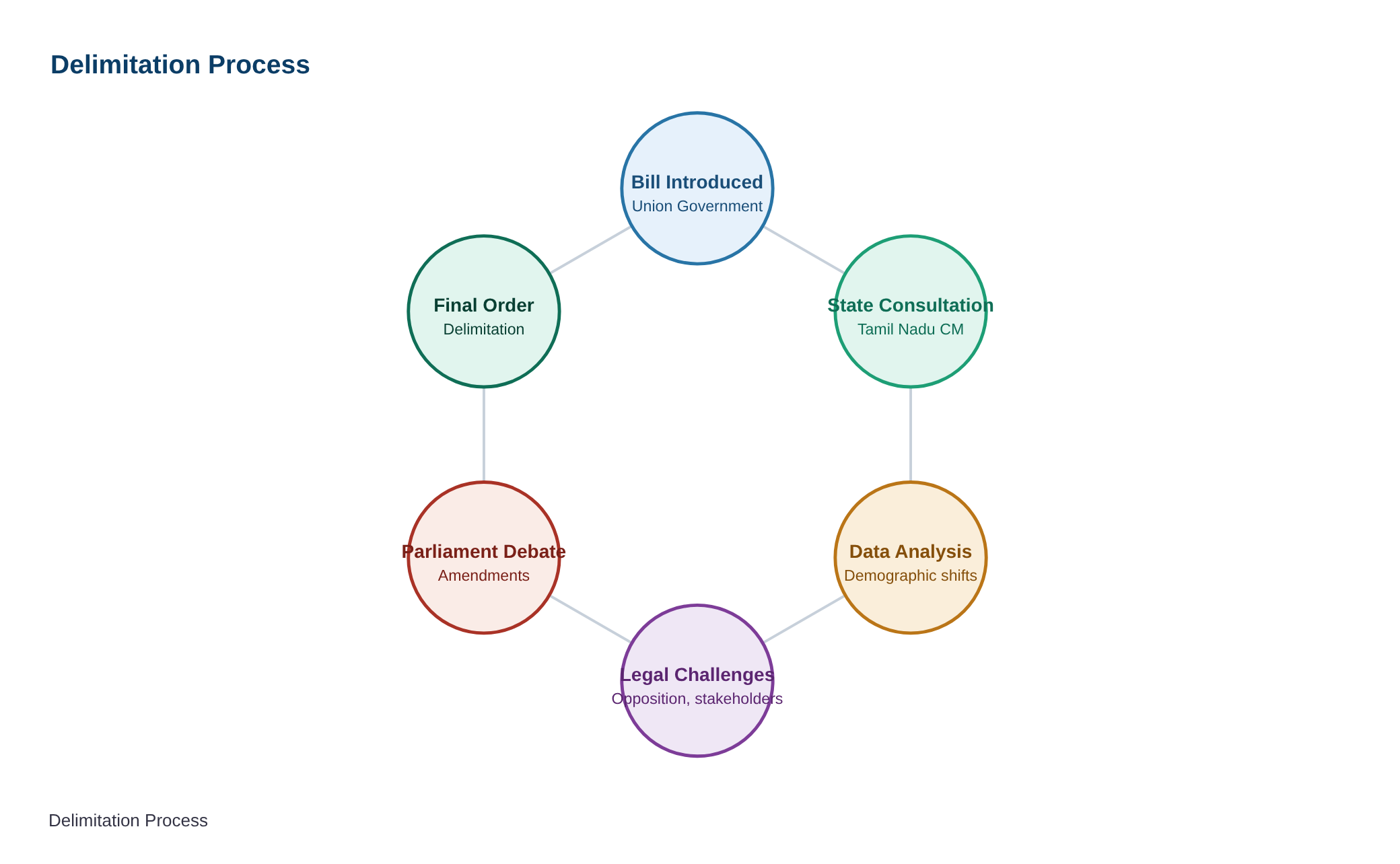
Delimitation Bill introduced by Union Government → State-level consultation by Tamil Nadu CM → Analysis of demographic data and potential seat changes → Political and legal challenges from opposition and stakeholders → Parliamentary debate and potential amendments → Final delimitation order and its implementation → Impact on electoral representation and governance.
Prelims Practice Questions
Q1. Consider the following statements regarding the Delimitation Commission in India:
1. The Delimitation Commission is a permanent body established under the Delimitation Act, 2002.
2. The Commission is tasked with the delimitation of constituencies for the Lok Sabha and State Legislative Assemblies.
3. The orders of the Delimitation Commission are subject to judicial review by the Supreme Court of India.
4. The Delimitation Commission can be set up only after every census is conducted in India.
How many of the above statements are correct?
- Only one
- Only two
- Only three
- All four
Answer: Only three — Statements 2 and 4 are correct. The Delimitation Commission is a temporary body constituted under the Delimitation Act, 2002, and it is set up after every census. Statement 1 is incorrect because the Commission is not permanent; it is constituted as and when needed. Statement 3 is incorrect because the orders of the Delimitation Commission are final and cannot be challenged in any court of law.
Q2. Assertion (A): The Delimitation Bill, 2026, if passed, will redefine the territorial constituencies of Tamil Nadu for the Lok Sabha and the State Legislative Assembly.
Reason (R): The Delimitation Commission determines the boundaries of constituencies based on the population census data and the provisions of the Representation of the People Act, 1950.
Code:
- Both A and R are true, and R is the correct explanation of A.
- Both A and R are true, but R is not the correct explanation of A.
- A is true, but R is false.
- A is false, but R is true.
Answer: Both A and R are true, and R is the correct explanation of A. — Both Assertion (A) and Reason (R) are true. The Delimitation Bill, if passed, would redefine territorial constituencies, and the Delimitation Commission’s role is to determine these boundaries based on census data and the Representation of the People Act, 1950. Hence, R correctly explains A.
Q3. Match the following provisions with their respective constitutional articles:
Column I (Provisions)
A. Composition of the Delimitation Commission
B. Power of Parliament to make laws on delimitation
C. Reservation of seats for Scheduled Castes and Scheduled Tribes
D. Duration of the Delimitation Commission
Column II (Articles)
1. Article 82
2. Article 330
3. Article 324(4)
4. Article 170
Select the correct match:
- A-3, B-1, C-2, D-4
- A-3, B-4, C-2, D-1
- A-1, B-3, C-2, D-4
- A-4, B-1, C-3, D-2
Answer: A-3, B-4, C-2, D-1 — The correct match is: A-3 (Composition of the Delimitation Commission under Article 324(4)), B-1 (Power of Parliament to make laws on delimitation under Article 82), C-2 (Reservation of seats for SCs and STs under Article 330), and D-4 (Duration of the Delimitation Commission is not explicitly mentioned in the Constitution but is governed by the Delimitation Act).
Mains Practice Question
✍ The Union government’s proposal to introduce a Delimitation Bill in Parliament has triggered a political debate in Tamil Nadu, with the state’s Chief Minister convening a consultative meeting with MPs. Critically examine the constitutional and political implications of delimitation in India, with particular reference to federalism and state autonomy. Also, analyse the role of the Delimitation Commission and the judicial safeguards available against its orders. (15 Marks)
Approach: MODEL-ANSWER SKELETON:
1. **Introduction**: Define delimitation and its constitutional basis (Articles 82 and 170, Delimitation Act, 2002). Mention the recent political context in Tamil Nadu.
2. **Constitutional Provisions**:
– Article 82: Parliament’s power to readjust delimitation after each census.
– Article 170: Composition of State Legislative Assemblies and delimitation.
– Representation of the People Act, 1950: Provisions on delimitation.
3. **Federalism and State Autonomy**:
– Delimitation as a centralising tool: Parliament’s exclusive power to legislate on delimitation.
– State concerns: Tamil Nadu’s opposition to potential loss of seats due to demographic shifts.
– Historical context: 2002 Delimitation Act and its impact on states like Assam and Jharkhand.
4. **Role of the Delimitation Commission**:
– Composition: Retired Supreme Court judge, Chief Election Commissioner, and state election commissioners.
– Functions: Determining boundaries based on census data, ensuring fair representation.
– Criticisms: Lack of state representation, potential for gerrymandering.
5. **Judicial Safeguards**:
– Finality of Delimitation Commission orders (Article 329(b)): No judicial review.
– Landmark cases: *S. Narayanan v. Union of India* (2021) on the scope of judicial review.
– Balancing federalism and judicial restraint.
6. **Conclusion**:
– Need for consensus between Centre and states on delimitation.
– Recommendations: Inclusion of state representatives in the Delimitation Commission or a constitutional amendment to allow judicial review in exceptional cases.
Source: The Hindu
Generated by AanyaAi for educational purpose.

- हिमाचल में बाल पोषण योजना: अब सप्ताह में दो बार मिलेगा अंडा या फल - September 23, 2026
- Himachal Pradesh’s Nutritious Food Scheme: Eggs/Fruits Twice Weekly for 5.5L Students - September 23, 2026
- रिफाइनरी क्षेत्र के लिए ऊर्जा सुरक्षा और नेट-ज़ीरो लक्ष्य में संतुलन जरूरी: विशेषज्ञ - September 23, 2026

No Comments