


08 Aug Tamil Nadu govt releases English version of Union-State Relations Report Part I for public access
✎ The High-Level Committee on Union-State Relations in Tamil Nadu exemplifies the state’s commitment to cooperative federalism and transparency by making Part I of its report publicly accessible in English.
Subject Relevance — Where This Topic Fits
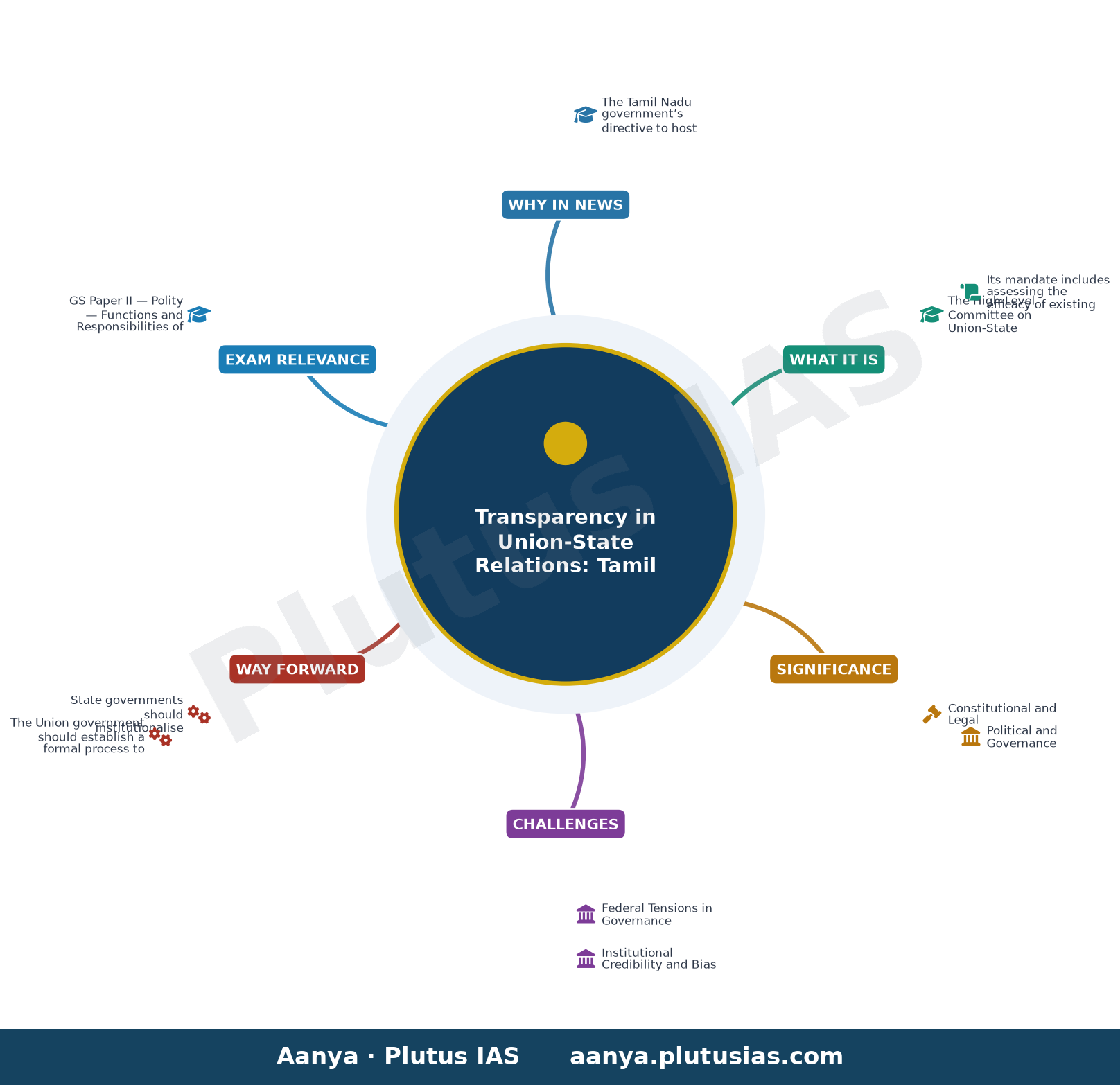
- GS Paper II — Polity — Functions and Responsibilities of the Union and the States, Issues and Challenges Pertaining to the Federal Structure
- Prelims: Union-State Relations, High-Level Committee on Union-State Relations, Federalism, Inter-State Council, Constitutional Provisions (Articles 263, 264-293)
- Essay: Federalism in India: Challenges and the Way Forward, Transparency and Governance: The Role of Public Access to Government Reports
Quick Revision: The High-Level Committee on Union-State Relations in Tamil Nadu exemplifies the state’s commitment to cooperative federalism and transparency by making Part I of its report publicly accessible in English.
Why is this in the news?
The Tamil Nadu government’s directive to host the English version of Part I of the High-Level Committee on Union-State Relations report in the public domain underscores the state’s commitment to transparency in federal governance. This move aligns with the principles of cooperative federalism and ensures wider accessibility of critical policy documents, facilitating informed public discourse and academic analysis. The decision also marks a departure from exclusive copyright claims, reinforcing the norm of open governance.
Background
- The High-Level Committee on Union-State Relations was constituted by the Tamil Nadu government on April 15, 2025, under the chairmanship of retired Supreme Court judge Justice Kurian Joseph.
- The committee included retired IAS officer K. Ashok Vardhan Shetty and former Vice-Chairman of the Tamil Nadu State Planning Commission M. Naganathan as members.
- Part I of the committee’s report was submitted to the then Chief Minister M.K. Stalin on February 16, 2026, and tabled in the Assembly on February 18, 2026.
- The report examines the constitutional and institutional framework governing Union-State relations, including fiscal federalism, administrative cooperation, and dispute resolution mechanisms.
- Tamil Nadu’s initiative follows broader national trends toward greater transparency in governance, including the Right to Information Act, 2005, and the push for open data policies.
- The government’s order to cancel exclusive copyright for the English version of the report reflects a commitment to democratic principles of access and accountability.
What is the High-Level Committee on Union-State Relations?
- The High-Level Committee on Union-State Relations is a state-level body constituted to examine and recommend measures to strengthen cooperative federalism in India.
- Its mandate includes assessing the efficacy of existing constitutional provisions, inter-state institutions, and fiscal arrangements between the Union and the States.
- The committee’s reports are intended to provide evidence-based recommendations to the state government for policy formulation and advocacy in federal matters.
- Part I of the report typically covers the constitutional and institutional framework, including the role of the Inter-State Council, Finance Commission, and other federal bodies.
- The committee’s composition ensures a blend of judicial, administrative, and planning expertise to address the complexities of Union-State relations.
- The report’s public dissemination is a step toward fostering transparency and enabling stakeholders—including policymakers, researchers, and civil society—to engage with the findings.
- The initiative aligns with the broader objective of enhancing public trust in governance by making critical policy documents accessible to all.
- The cancellation of exclusive copyright for the English version of the report reinforces the principle that government reports are public goods and not proprietary assets.
Key Features
| Feature | Significance |
|---|---|
| Open access to English version of Part I of the report | Enhances transparency in governance by providing equitable access to official documents in both official languages of the State. |
| Cancellation of exclusive copyright for the English version | Ensures the report remains in the public domain, preventing restrictive licensing that could limit dissemination and scrutiny. |
| Hosting on official portal (hlcusr.tn.gov.in) | Facilitates direct public access without intermediaries, reducing barriers to information retrieval. |
| Constitutional mandate for transparency in State-Citizen relations | Aligns with the principles of participatory democracy and informed citizenry under Article 19(1)(a) of the Constitution. |
| Committee led by retired Supreme Court judge | Conveys judicial imprimatur to the report, enhancing credibility and reducing perceptions of political bias. |
Why it Matters
Constitutional and Legal
- Reinforces the constitutional principle of transparency in governance, as envisaged under Article 19(1)(a) (Freedom of Speech and Expression) and Article 21 (Right to Life and Personal Liberty).
- Demonstrates adherence to the doctrine of open government, which is a cornerstone of democratic accountability.
- Sets a precedent for other States to follow, potentially influencing national policies on intergovernmental relations.
Political and Governance
- Highlights the role of State governments in scrutinising Union-State relations, a critical aspect of federalism in India.
- Reflects the evolving dynamics of Centre-State relations, particularly in the context of cooperative and competitive federalism.
- Underscores the importance of institutional mechanisms (e.g., High-Level Committees) in addressing federal disputes and grievances.
Administrative and Institutional
- Showcases the use of expert committees (e.g., retired judges, former civil servants) to address complex intergovernmental issues.
- Illustrates the role of State Planning Commissions in policy formulation and intergovernmental coordination.
- Demonstrates the efficiency of digital platforms in disseminating public documents, aligning with the e-governance agenda.
Societal and Democratic
- Promotes civic engagement by enabling citizens to access and analyse intergovernmental reports, fostering informed public discourse.
- Strengthens the accountability of both the Union and State governments to the electorate.
- Encourages greater scrutiny of federal structures, which is essential for a robust democracy.
Challenges
1. Federal Tensions in Governance
- The report may highlight contentious issues in Union-State relations, potentially exacerbating Centre-State tensions.
- Differences in interpretation of the report’s recommendations between the Union and State governments could lead to policy conflicts.
- The Union government may resist the findings, particularly if they challenge its policy prerogatives.
UPSC Link: federalism, cooperative vs competitive
2. Institutional Credibility and Bias
- The report’s recommendations may be perceived as politically motivated, given the State government’s role in its compilation.
- The involvement of a retired judge may not fully insulate the report from accusations of judicial bias.
- Public scrutiny could reveal methodological flaws or gaps in the report’s analysis.
UPSC Link: judicial activism, accountability
3. Access and Dissemination Challenges
- Despite open access, digital divide may limit the report’s reach to marginalised sections of society.
- Language barriers persist for non-English speakers, despite the availability of the Tamil version.
- Ensuring long-term archiving and preservation of the report on official portals may pose administrative challenges.
UPSC Link: digital governance, inclusivity
4. Implementation and Follow-Up
- The Union government may not act on the report’s recommendations, rendering the exercise symbolic.
- Lack of a structured mechanism to monitor the implementation of the report’s suggestions.
- Potential delays in translating the report’s findings into policy or legislative action.
UPSC Link: policy implementation, governance reforms
Challenges — UPSC Perspective
| Issue | Concern |
|---|---|
| Perceived political bias in the report | May undermine its credibility and acceptance among stakeholders. |
| Digital divide in access to the report | Limits the report’s reach to rural and marginalised communities. |
| Resistance from the Union government | Could lead to non-implementation of the report’s recommendations. |
| Methodological gaps in the report | May reduce the robustness of its findings and policy suggestions. |
| Language accessibility beyond Tamil and English | Excludes non-Tamil-speaking and non-English-speaking populations. |
| Lack of follow-up mechanism | Risks rendering the report a one-time exercise with no lasting impact. |
Way Forward
- State governments should institutionalise mechanisms to periodically review and update intergovernmental reports to ensure relevance.
- The Union government should establish a formal process to acknowledge and respond to State-specific reports on Union-State relations.
- E-governance initiatives should be expanded to include multilingual accessibility, ensuring inclusivity in public document dissemination.
- Civil society organisations and academia should be encouraged to analyse and critique such reports to foster public debate.
- Judicial and administrative training programmes should incorporate federalism studies to enhance understanding of intergovernmental dynamics.
- State governments should collaborate with the Union to develop a national framework for standardising intergovernmental reports.
- Public awareness campaigns should be launched to educate citizens on the importance of federalism and intergovernmental relations.
UPSC Value Addition
Keywords for Mains Answer-Writing
Union-State Relations · High-Level Committee on Union-State Relations · federalism in India · inter-governmental relations · transparency in governance · public domain access · constitutional provisions on Centre-State relations · Justice Kurian Joseph Committee · DMK government Tamil Nadu · federal accountability mechanisms · public policy and governance · right to information · executive-legislature relations · inter-state cooperation · governance reforms
Constitutional & Policy Linkages
- {‘Article 19(1)(a)’: ‘Freedom of Speech and Expression’}
- {‘Article 21’: ‘Right to Life and Personal Liberty’}
- {‘Article 263’: ‘Provisions for inter-State Councils’}
- {‘Seventh Schedule’: ‘Division of powers between Union and States’}
Concept Flow
Constitution of High-Level Committee on Union-State Relations by Tamil Nadu government → Committee submits Part I of the report to the State government → State government tables the report in the Assembly → Government Order mandates open access to the English version of the report → Cancellation of exclusive copyright to ensure public domain status → Hosting of the report on the official portal for public access → Public scrutiny and debate on the report’s findings and recommendations
Prelims Practice Questions
Q1. Consider the following statements regarding the High-Level Committee on Union-State Relations (HLCUSR) constituted by the Tamil Nadu government:
1. The committee was constituted on April 15, 2025, under the chairmanship of a retired Supreme Court judge.
2. The committee submitted Part I of its report to the then Chief Minister M.K. Stalin on February 16, 2026.
3. The committee was tasked with examining the exclusive copyright over the English version of its reports.
How many of the above statements are correct?
- Only one
- Only two
- All three
- None
Answer: All three — Statements 1 and 2 are correct. The committee was indeed constituted on April 15, 2025, under Justice Kurian Joseph. It submitted Part I of its report on February 16, 2026. Statement 3 is incorrect as the committee was not tasked with examining copyright; the Tamil Nadu government directed the cancellation of exclusive copyright for the English version of Part I.
Q2. Assertion (A): The Tamil Nadu government directed the High-Level Committee on Union-State Relations to host the English version of Part I of its report in the public domain.
Reason (R): This directive was issued to ensure transparency and facilitate public access to governance reports.
In the context of the above two statements, which one of the following is correct?
- Both A and R are true, and R is the correct explanation of A.
- Both A and R are true, but R is not the correct explanation of A.
- A is true, but R is false.
- A is false, but R is true.
Answer: Both A and R are true, but R is not the correct explanation of A. — Both the Assertion (A) and Reason (R) are true. The Tamil Nadu government did direct the HLCUSR to host the English version of Part I in the public domain, and the stated reason for this directive was to ensure transparency and public access to governance reports.
Mains Practice Question
✍ The Tamil Nadu government has recently directed the High-Level Committee on Union-State Relations to make the English version of Part I of its report publicly accessible, thereby reinforcing the principle of transparency in governance. Critically examine the significance of this step in the context of Centre-State relations and federalism in India. (15 Marks)
Approach: MODEL-ANSWER SKELETON:
1. **Context and Background** (2 Marks):
– Briefly introduce the High-Level Committee on Union-State Relations (HLCUSR), its constitution (April 15, 2025), and its mandate under Justice Kurian Joseph.
– Mention the submission of Part I of the report to the then Chief Minister M.K. Stalin on February 16, 2026, and its subsequent tabling in the Assembly.
2. **Federalism and Centre-State Relations** (4 Marks):
– Explain the constitutional framework of federalism in India (Articles 245-255, 263, and the Seventh Schedule).
– Discuss the evolving nature of Centre-State relations, highlighting tensions such as fiscal federalism, cooperative vs. competitive federalism, and the role of inter-state councils.
– Cite recent examples of Centre-State disputes (e.g., Goods and Services Tax (GST) compensation, Article 370 abrogation, or the COVID-19 pandemic response).
3. **Transparency and Governance** (4 Marks):
– Define transparency in governance and its importance in a federal structure (e.g., accountability, trust-building, and citizen participation).
– Link transparency to the Right to Information (RTI) Act, 2005, and the principles of open government.
– Discuss how public access to reports fosters democratic accountability and reduces information asymmetry between the Centre and States.
4. **Critical Analysis** (3 Marks):
– Evaluate the potential impact of this step on Centre-State relations: Does it enhance trust or could it lead to further centralization?
– Discuss the role of state governments in initiating such transparency measures and their effectiveness in addressing federal imbalances.
– Highlight challenges such as data localization, privacy concerns, or the risk of misinterpretation of reports.
5. **Conclusion** (2 Marks):
– Summarize the significance of the Tamil Nadu government’s directive in promoting federal accountability.
– Suggest measures for further strengthening transparency in Centre-State relations (e.g., standardized reporting formats, inter-state data-sharing platforms, or constitutional amendments).
Source: The Hindu
Generated by AanyaAi for educational purpose.

- आंध्र प्रदेश में चार नए पुलिस आयुक्तालयों को कैबिनेट की मंजूरी, जानिए क्या होंगे फायदे - September 23, 2026
- Andhra Pradesh to get 4 new Police Commissionerates: Key UPSC insights - September 23, 2026
- AI आधारित ‘HEADS’ से भारत में अवसाद जांच में क्रांति: जानिए कैसे होगा मदद - September 23, 2026

No Comments