


08 Aug Tamil Nadu Govt Releases English Version of Union-State Relations Report Part I
✎ The High-Level Committee on Union-State Relations in Tamil Nadu, led by Justice Kurian Joseph, examines Centre-State dynamics, with Part I of its report now publicly accessible in English, reinforcing principles of transparency…
Subject Relevance — Where This Topic Fits
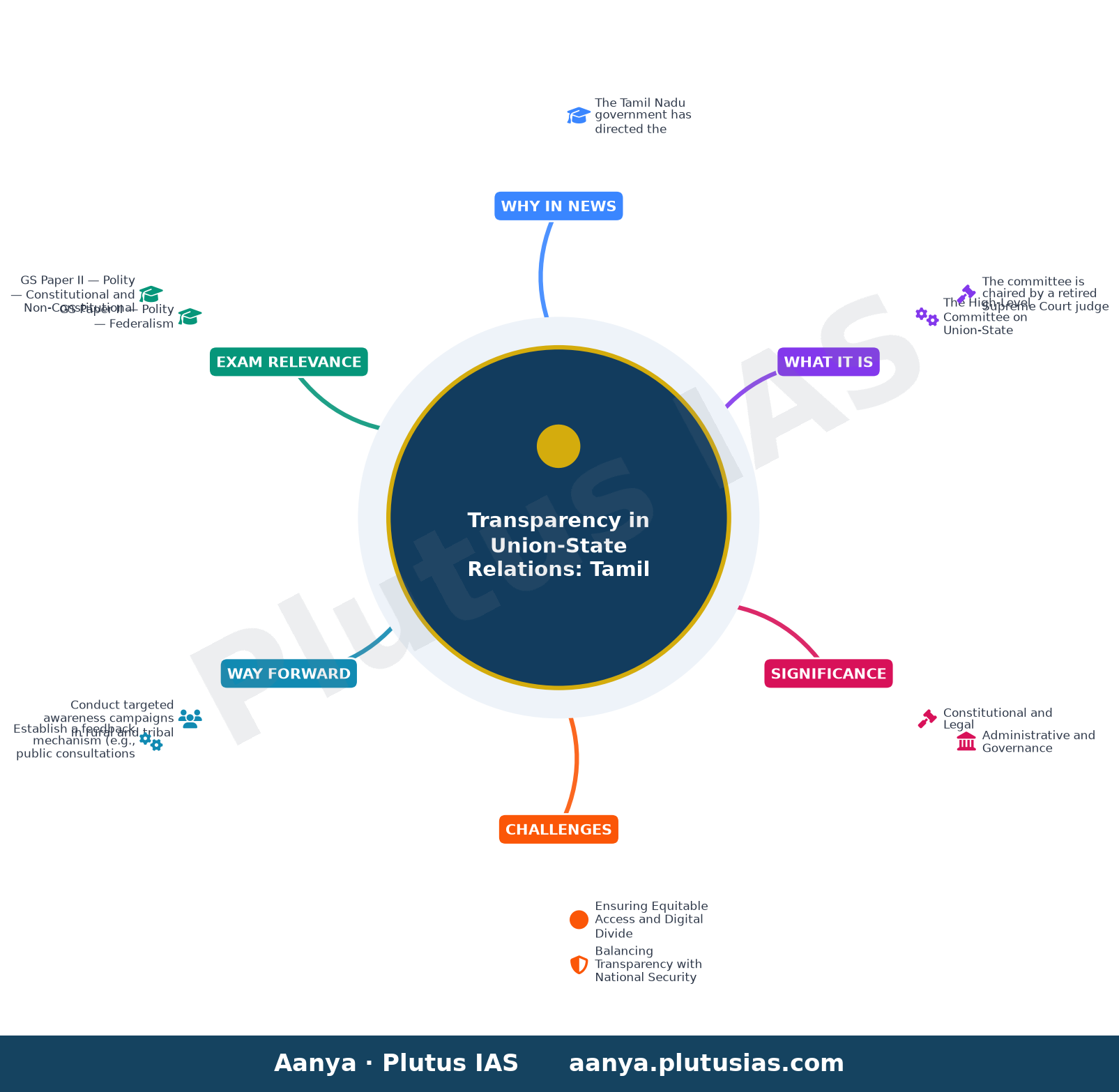
- GS Paper II — Polity — Federalism | GS Paper II — Polity — Constitutional and Non-Constitutional Bodies
- Prelims: Federalism, Union-State Relations, Inter-State Council, Constitutional Bodies, Tamil Nadu High-Level Committee, Public Access to Government Reports
- Essay: Federalism and the Challenges of Cooperative Governance in India
Quick Revision: The High-Level Committee on Union-State Relations in Tamil Nadu, led by Justice Kurian Joseph, examines Centre-State dynamics, with Part I of its report now publicly accessible in English, reinforcing principles of transparency and cooperative federalism.
Why is this in the news?
The Tamil Nadu government has directed the High-Level Committee on Union-State Relations to make the English version of Part I of its report publicly accessible, mirroring the Tamil version, by hosting it on an official portal and revoking exclusive copyright. This initiative underscores the state’s commitment to transparency and participatory governance in federal relations, particularly as the report examines critical issues in Centre-State dynamics.
Background
- The High-Level Committee on Union-State Relations was constituted by the Tamil Nadu government on 15 April 2025 under the leadership of retired Supreme Court judge Justice Kurian Joseph, with retired IAS officer K. Ashok Vardhan Shetty and former Vice-Chairman of the Tamil Nadu State Planning Commission M. Naganathan as members.
- The committee submitted Part I of its report to the then Chief Minister M.K. Stalin on 16 February 2026, which was subsequently tabled in the Assembly on 18 February 2026.
- The report examines the evolving nature of Union-State relations, with a focus on fiscal federalism, administrative cooperation, and constitutional provisions governing intergovernmental dynamics.
- Tamil Nadu’s decision to release the English version of the report aligns with broader transparency measures, ensuring equitable access to policy documents for stakeholders, including civil society, academia, and other states.
- The Government Order (GO) issued on 30 July 2026 explicitly revoked exclusive copyright for the English version, facilitating unrestricted dissemination.
- This move reflects Tamil Nadu’s proactive stance in leveraging federalism to address regional aspirations while promoting collaborative governance.
What is the High-Level Committee on Union-State Relations?
- The High-Level Committee on Union-State Relations was constituted by the Tamil Nadu government to conduct a comprehensive review of the Centre-State relationship, with a focus on constitutional provisions, fiscal federalism, and administrative mechanisms.
- The committee is chaired by a retired Supreme Court judge (Justice Kurian Joseph), ensuring judicial oversight and credibility in its findings.
- Its mandate includes examining the distribution of legislative, executive, and financial powers between the Union and the States, as enshrined in the Constitution.
- The committee’s work is particularly relevant in the context of debates on cooperative federalism, as envisaged under Article 263 of the Constitution.
- The committee’s recommendations are expected to inform policy discussions on Centre-State financial relations, including the devolution of funds and the resolution of disputes.
- The transparency initiative by Tamil Nadu sets a precedent for other states to emulate, fostering a culture of openness in governance and federal negotiations.
- The report’s public release enables stakeholders to scrutinise its findings, thereby enhancing democratic accountability in federal policymaking.
Key Features
| Feature | Significance |
|---|---|
| Open access to English version of Part I of the Union-State Relations report | Ensures transparency and public scrutiny of intergovernmental relations, fostering informed discourse among stakeholders. |
| Cancellation of exclusive copyright for the English version | Removes barriers to dissemination, aligning with principles of open governance and democratic accountability. |
| Hosting on official portal (hlcusr.tn.gov.in) | Provides a centralized, accessible platform for stakeholders, including researchers, policymakers, and the general public. |
| Constitutional mandate for transparency in governance | Supports the broader constitutional principle of participatory democracy under Article 19(1)(a). |
| Committee headed by retired Supreme Court judge | Enhances credibility and impartiality of the report, ensuring adherence to constitutional norms. |
Why it Matters
Constitutional and Legal
- Reinforces the constitutional principle of federalism by enabling public scrutiny of intergovernmental relations, a cornerstone of cooperative federalism under the Indian Constitution.
- Aligns with the right to information (Article 19(1)(a)) by ensuring accessibility of government reports to citizens, thereby promoting transparency and accountability.
- Demonstrates the state government’s commitment to upholding constitutional values of openness and participatory governance.
Administrative and Governance
- Sets a precedent for other states to adopt similar measures, potentially enhancing interstate cooperation and trust in federal structures.
- Encourages evidence-based policymaking by making critical reports accessible to researchers, civil society, and the media for analysis and critique.
- Facilitates cross-border learning and benchmarking, as states can compare their governance practices with those of Tamil Nadu.
Political and Democratic
- Strengthens democratic accountability by allowing citizens to assess the performance of their elected representatives and the executive in managing Union-State relations.
- Promotes informed public discourse on federal issues, enabling citizens to engage meaningfully in debates on governance and constitutional matters.
- Demonstrates the role of the judiciary (via retired judges) in fostering constitutional governance and public trust in institutions.
Challenges
1. Ensuring Equitable Access and Digital Divide
- Rural and marginalized communities may face challenges in accessing the report due to limited internet connectivity or digital literacy.
- The state must invest in awareness campaigns to ensure the report reaches all sections of society, including through offline modes like public libraries or local government offices.
UPSC Link: GS-II: Governance, Transparency
2. Balancing Transparency with National Security
- Certain sections of the report may contain sensitive information that could compromise national security or interstate relations if disclosed indiscriminately.
- The state must ensure that redactions are applied judiciously, in consultation with the Union government, to avoid unintended disclosures.
UPSC Link: GS-II: Federalism, Security
3. Sustaining Public Engagement
- Merely hosting the report does not guarantee public engagement; the state must proactively disseminate summaries, infographics, and conduct discussions to encourage utilization.
- Civil society organizations and media play a critical role in interpreting the report for the public, but their involvement requires sustained support and funding.
UPSC Link: GS-II: Governance, Civil Society
4. Coordination with the Union Government
- Interstate relations often involve the Union government, and Tamil Nadu’s unilateral disclosure of the report may raise concerns about federal sensitivity.
- The state must engage in continuous dialogue with the Union to ensure that transparency measures do not inadvertently undermine cooperative federalism.
UPSC Link: GS-II: Federalism, Centre-State Relations
Challenges — UPSC Perspective
| Issue | Concern |
|---|---|
| Digital divide | Limited internet access in rural areas may prevent equitable distribution of the report. |
| National security implications | Sensitive information in the report could pose risks if disclosed without adequate safeguards. |
| Public apathy | Lack of awareness or interest may lead to low utilization of the report by citizens and stakeholders. |
| Federal coordination | Potential friction with the Union government over the scope and timing of disclosures. |
| Sustainability of engagement | Ensuring long-term public interest and participation in governance discussions sparked by the report. |
Way Forward
- Conduct targeted awareness campaigns in rural and tribal areas to ensure the report reaches all sections of society, using both digital and offline channels.
- Establish a feedback mechanism (e.g., public consultations or online portals) to gather citizen inputs on the report and governance issues highlighted therein.
- Collaborate with civil society organizations, universities, and media houses to organize discussions, webinars, and workshops on the report’s findings.
- Develop simplified summaries, infographics, and FAQs to make the report accessible to non-experts, including school and college students.
- Engage in proactive dialogue with the Union government to address concerns about national security or federal sensitivity while maintaining transparency.
- Monitor and evaluate the impact of the report’s disclosure on public discourse, governance reforms, and interstate relations over the next 6-12 months.
- Explore partnerships with digital platforms (e.g., Koo, ShareChat) to disseminate the report in regional languages and local dialects.
- Incorporate the report’s recommendations into the state’s annual governance action plan, ensuring follow-up on key issues raised.
UPSC Value Addition
Keywords for Mains Answer-Writing
Union-State Relations · High-Level Committee on Union-State Relations · federalism in India · transparency in governance · inter-governmental relations · constitutional provisions on federalism · public access to government reports · copyright in government publications · Tamil Nadu government initiatives · Justice Kurian Joseph committee
Constitutional & Policy Linkages
- Article 19(1)(a) – Freedom of speech and expression, including the right to information.
- Article 263 – Provision for an Inter-State Council to promote cooperative federalism.
Concept Flow
Constitution of High-Level Committee on Union-State Relations by Tamil Nadu government (April 2025) → Submission of Part I of the report (February 2026) → Tabling in State Assembly (February 2026) → Government Order for open access to English version (July 2026) → Hosting on official portal (August 2026) → Public demand for transparency in governance → State government’s directive to release English version → Cancellation of exclusive copyright → Ensuring accessibility and accountability → Federalism and cooperative governance → Need for public scrutiny of intergovernmental relations → Transparency as a tool for democratic accountability → Open access to governance reports → Judicial oversight via retired Supreme Court judge → Enhancing credibility of the report → Strengthening public trust in governance institutions → Digital governance initiatives → Hosting reports on official portals → Ensuring equitable access → Addressing digital divide challenges → Constitutional right to information (Article 19(1)(a)) → Public’s right to access government documents → State’s obligation to facilitate transparency → Implementation through open data policies → Interstate relations and federal sensitivity → Potential friction with Union government → Need for coordinated disclosure policies → Balancing transparency and national security
Prelims Practice Questions
Q1. Consider the following statements regarding the High-Level Committee on Union-State Relations constituted by the Tamil Nadu government:
1. The committee was headed by a retired Supreme Court judge.
2. The committee submitted Part I of its report to the then Chief Minister M.K. Stalin on February 16, 2026.
3. The committee’s report was tabled in the Tamil Nadu Assembly on February 18, 2026.
4. The committee was constituted under the aegis of the Union Ministry of Home Affairs.
How many of the above statements are correct?
- Only one
- Only two
- Only three
- All
Answer: Only three — Statements 1, 2, and 3 are correct. Statement 4 is incorrect as the committee was constituted by the Tamil Nadu government, not the Union Ministry of Home Affairs.
Q2. Assertion (A): The Tamil Nadu government has directed the cancellation of exclusive copyright for the English version of Part I of the Union-State Relations report.
Reason (R): The government aims to ensure transparency by making the report accessible to the public in the public domain.
In the context of the above two statements, which one of the following is correct?
- Both A and R are true, and R is the correct explanation of A.
- Both A and R are true, but R is not the correct explanation of A.
- A is true, but R is false.
- A is false, but R is true.
Answer: Both A and R are true, and R is the correct explanation of A. — Both the assertion and reason are true, and the reason correctly explains the assertion. The cancellation of copyright is a means to ensure public access and transparency.
Q3. Match the following committees with their respective domains of focus:
Column I (Committee) | Column II (Domain)
———————-|——————
A. High-Level Committee on Union-State Relations | 1. Economic reforms
B. Sarkaria Commission | 2. Centre-State relations
C. NITI Aayog | 3. Inter-state water disputes
D. Justice B.N. Srikrishna Committee | 4. Federalism and constitutional governance
Select the correct match:
- A-4, B-2, C-1, D-3
- A-2, B-4, C-1, D-3
- A-4, B-2, C-3, D-1
- A-3, B-2, C-1, D-4
Answer: A-4, B-2, C-1, D-3 — The correct matches are: A (Union-State Relations) – 4 (Federalism and constitutional governance), B (Sarkaria Commission) – 2 (Centre-State relations), C (NITI Aayog) – 1 (Economic reforms), D (Justice B.N. Srikrishna Committee) – 3 (Inter-state water disputes).
Mains Practice Question
✍ Critically examine the constitutional and political significance of the Tamil Nadu government’s decision to place the English version of Part I of the Union-State Relations report in the public domain, including the implications for federalism and transparency in India. (15 Marks)
Approach: MODEL-ANSWER SKELETON:
1. **Constitutional Provision**: Reference Article 19(1)(a) (Freedom of speech and expression) and Article 292 (restrictions on the state to impose copyright restrictions on government documents).
2. **Federalism Context**: Discuss the federal structure under Part XI of the Constitution (Articles 245-263) and the principle of cooperative federalism.
3. **Transparency and Accountability**: Highlight the role of transparency in governance (Right to Information Act, 2005) and the importance of public access to government reports for democratic accountability.
4. **Judicial Precedents**: Cite relevant Supreme Court judgments (e.g., *State of U.P. v. Raj Narain*, 1975) on the right to access government records.
5. **Political Implications**: Analyze how such measures strengthen federalism by empowering states to share their perspectives and foster dialogue between the Centre and states.
6. **Counter-arguments**: Discuss potential concerns such as national security, confidentiality of sensitive information, and the need for balanced public interest.
7. **Conclusion**: Summarize the significance of the decision in promoting democratic values and federal balance, while acknowledging the need for safeguards.
Source: The Hindu
Generated by AanyaAi for educational purpose.

- आंध्र प्रदेश में चार नए पुलिस आयुक्तालयों को कैबिनेट की मंजूरी, जानिए क्या होंगे फायदे - September 23, 2026
- Andhra Pradesh to get 4 new Police Commissionerates: Key UPSC insights - September 23, 2026
- AI आधारित ‘HEADS’ से भारत में अवसाद जांच में क्रांति: जानिए कैसे होगा मदद - September 23, 2026

No Comments