


19 Sep Tamil Nadu Launches ‘Thaimaman Gold Ring’ Scheme for Newborns: Key Facts for UPSC
✎ The Thaimaman Gold Ring Scheme is a Tamil Nadu government initiative to provide a one-gram gold ring to newborns delivered in government hospitals, aimed at honouring children and reinforcing public trust in public healthcare…
Subject Relevance — Where This Topic Fits
- GS Paper II — Governance, Social Justice and Welfare Schemes | GS Paper IV — Ethics and Human Interface in Governance
- Prelims: Thaimaman Gold Ring Scheme, PICME portal, Reproductive and Child Health (RCH) identification number, Comprehensive Emergency Obstetric and Newborn Care (CEmONC) centres, maternal and child health indicators, institutional deliveries
- Essay: The interplay of tradition and modernity in public welfare schemes, Cultural symbolism in state-led social welfare initiatives
Quick Revision: The Thaimaman Gold Ring Scheme is a Tamil Nadu government initiative to provide a one-gram gold ring to newborns delivered in government hospitals, aimed at honouring children and reinforcing public trust in public healthcare, with eligibility tied to registration on the PICME portal and possession of an RCH identification number.
Why is this in the news?
The Tamil Nadu government is set to launch the ‘Thaimaman Gold Ring Scheme’ on 28 September 2026, a welfare initiative aimed at honouring newborn children born in government hospitals by providing them with a one-gram gold ring. This scheme is part of a broader effort to strengthen public confidence in Tamil Nadu’s public healthcare system and is rooted in the cultural significance of the maternal uncle (*thaimaman*) in Tamil society. The initiative follows a government order issued on 23 June 2026 and is designed to complement existing maternal and child health programmes, including financial assistance for pregnant women, free institutional deliveries, and nutritional support.
Background
- The state’s maternal and child health programmes include financial assistance schemes, which provides monetary support to pregnant women for safe deliveries.
- The *Pregnancy and Infant Cohort Monitoring and Evaluation (PICME)* software is used for real-time tracking of maternal and child health indicators, enabling data-driven policymaking.
- Nearly 99.9% of deliveries in Tamil Nadu occur in healthcare institutions, with 53% taking place in government hospitals, underscoring the critical role of public healthcare facilities.
- The cultural dimension of the scheme reflects the traditional Tamil value placed on the maternal uncle (*thaimaman*), who plays a significant role in the upbringing and celebration of a child.
What is the Thaimaman Gold Ring Scheme?
- The scheme is a welfare initiative launched by the Tamil Nadu government to provide a one-gram gold ring to every child born in a government hospital on or after 22 June 2026.
- Each gold ring will bear a unique serial number and be supplied in tamper-proof packaging to ensure authenticity and prevent misuse.
- The scheme is designed to honour newborn children and strengthen public confidence in Tamil Nadu’s public healthcare system, particularly government hospitals.
- Eligibility is restricted to mothers permanently residing in Tamil Nadu who are registered on the *PICME portal* and possess a *Reproductive and Child Health (RCH) identification number*.
- The gold rings will initially be distributed at 107 designated hubs, with each hub catering to up to 100 children daily from the launch date. Thereafter, rings will be handed over to eligible newborns at the time of discharge from government hospitals.
- A total of 1.28 lakh gold rings have been procured in the first phase to cover eligible births from 22 June 2026 onwards.
- The scheme complements existing maternal and child health programmes, including free institutional deliveries, nutritional support, and emergency obstetric care.
- The cultural symbolism of the gold ring is tied to the traditional Tamil role of the maternal uncle (*thaimaman*), who is often associated with blessings and protection for the child.
Key Features
| Feature | Significance |
|---|---|
| One-gram gold ring for newborns | Symbolic recognition of birth in government hospitals, reinforcing public trust in state healthcare infrastructure. |
| Unique serial number and tamper-proof packaging | Ensures traceability, prevents diversion, and maintains audit integrity of the scheme. |
| Integration with PICME portal and RCH ID | Leverages existing maternal and child health monitoring systems for seamless beneficiary identification. |
| Phased distribution via 107 designated hubs | Optimises logistical efficiency and ensures equitable access across Tamil Nadu’s administrative divisions. |
| Linkage to maternal and child healthcare initiatives | Complements existing schemes like free institutional deliveries and nutritional support, creating a holistic welfare ecosystem. |
Why it Matters
Public Health
- Demonstrates state commitment to reducing maternal and infant mortality through institutional deliveries.
- Enhances credibility of government hospitals by providing tangible incentives for utilisation.
- Aligns with WHO’s recommendation for skilled birth attendance to improve neonatal outcomes.
Social Welfare
- Reinforces cultural recognition of maternal uncles (Thaimaman) in Tamil society through a symbolic gesture.
- Aims to reduce socio-economic disparities by ensuring equitable access to the benefit across income groups.
- Encourages delayed marriage and childbirth by incentivising institutional deliveries in government facilities.
Governance and Transparency
- Uses digital monitoring (PICME/RCH ID) to minimise leakages and ensure targeted delivery.
- Adopts tamper-proof packaging and serialisation to enhance accountability in welfare distribution.
- Demonstrates fiscal prioritisation of welfare schemes over populist measures in resource allocation.
Economic
- Stimulates local jewellery industry through procurement of gold rings, supporting employment in the unorganised sector.
- Potential long-term impact on reducing out-of-pocket expenditure for families opting for government hospitals.
Challenges
1. Logistical Coordination
- Ensuring timely distribution of 1.28 lakh rings across 107 hubs without delays or bottlenecks.
- Managing inventory and supply chain for a perishable commodity (gold) with fluctuating prices.
UPSC Link: GS-II: Health Infrastructure
2. Eligibility Verification
- Preventing duplication or exclusion errors in beneficiary identification via PICME/RCH ID systems.
- Addressing cases of temporary or seasonal migration that may complicate residency verification.
UPSC Link: GS-II: Welfare Schemes
3. Cultural and Social Acceptance
- Ensuring the scheme does not inadvertently stigmatise families opting for private healthcare.
- Promoting the scheme’s symbolic value without reducing it to a mere material incentive.
UPSC Link: GS-I: Social Empowerment
4. Financial Sustainability
- Managing the recurring expenditure of gold procurement without compromising other healthcare priorities.
- Balancing the scheme’s symbolic value with its economic feasibility over multiple fiscal years.
UPSC Link: GS-III: Budgetary Allocations
5. Monitoring and Evaluation
- Tracking the scheme’s impact on maternal and child health indicators post-implementation.
- Assessing whether the symbolic gesture translates into behavioural changes in healthcare utilisation.
UPSC Link: GS-II: Health Governance
Challenges — UPSC Perspective
| Issue | Concern |
|---|---|
| Gold price volatility | Fluctuations in gold prices may affect the scheme’s budgetary outlay and procurement planning. |
| Beneficiary awareness | Insufficient dissemination of scheme details may lead to underutilisation or misinformation. |
| Healthcare staff workload | Additional responsibilities during distribution may strain already burdened hospital staff. |
| Post-distribution tracking | Ensuring rings are retained and not sold or misused by beneficiaries. |
| Inter-state migration | Families moving out of Tamil Nadu may face difficulties in claiming the benefit. |
| Data privacy | Safeguarding sensitive maternal and child health data used for eligibility verification. |
Government Initiatives — Must-Memorise for Prelims
- Thaimaman Gold Ring Scheme (Tamil Nadu)
- Pregnancy and Infant Cohort Monitoring and Evaluation (PICME) system (Tamil Nadu)
- Comprehensive Emergency Obstetric and Newborn Care (CEmONC) centres (Tamil Nadu)
Way Forward
- Conduct pre-launch awareness campaigns in local languages to ensure maximum beneficiary participation.
- Establish a real-time grievance redressal mechanism for distribution-related issues.
- Integrate the scheme’s monitoring with existing maternal and child health dashboards for data-driven evaluation.
- Explore public-private partnerships for gold procurement to mitigate price volatility risks.
- Develop a feedback loop with healthcare workers to identify operational bottlenecks.
- Publish quarterly reports on scheme utilisation and impact on healthcare utilisation trends.
- Conduct a mid-term review to assess the scheme’s alignment with broader maternal health goals.
- Ensure seamless inter-departmental coordination between health, finance, and revenue departments.
UPSC Value Addition
Keywords for Mains Answer-Writing
Thaimaman Gold Ring Scheme · maternal and child healthcare · institutional deliveries · Comprehensive Emergency Obstetric and Newborn Care (CEmONC) · PICME portal · Reproductive and Child Health (RCH) identification number · maternal and child health indicators · public health governance · financial incentives for maternal health · gold-based welfare schemes · tamper-proof packaging · maternal uncle tradition in Tamil culture
Concept Flow
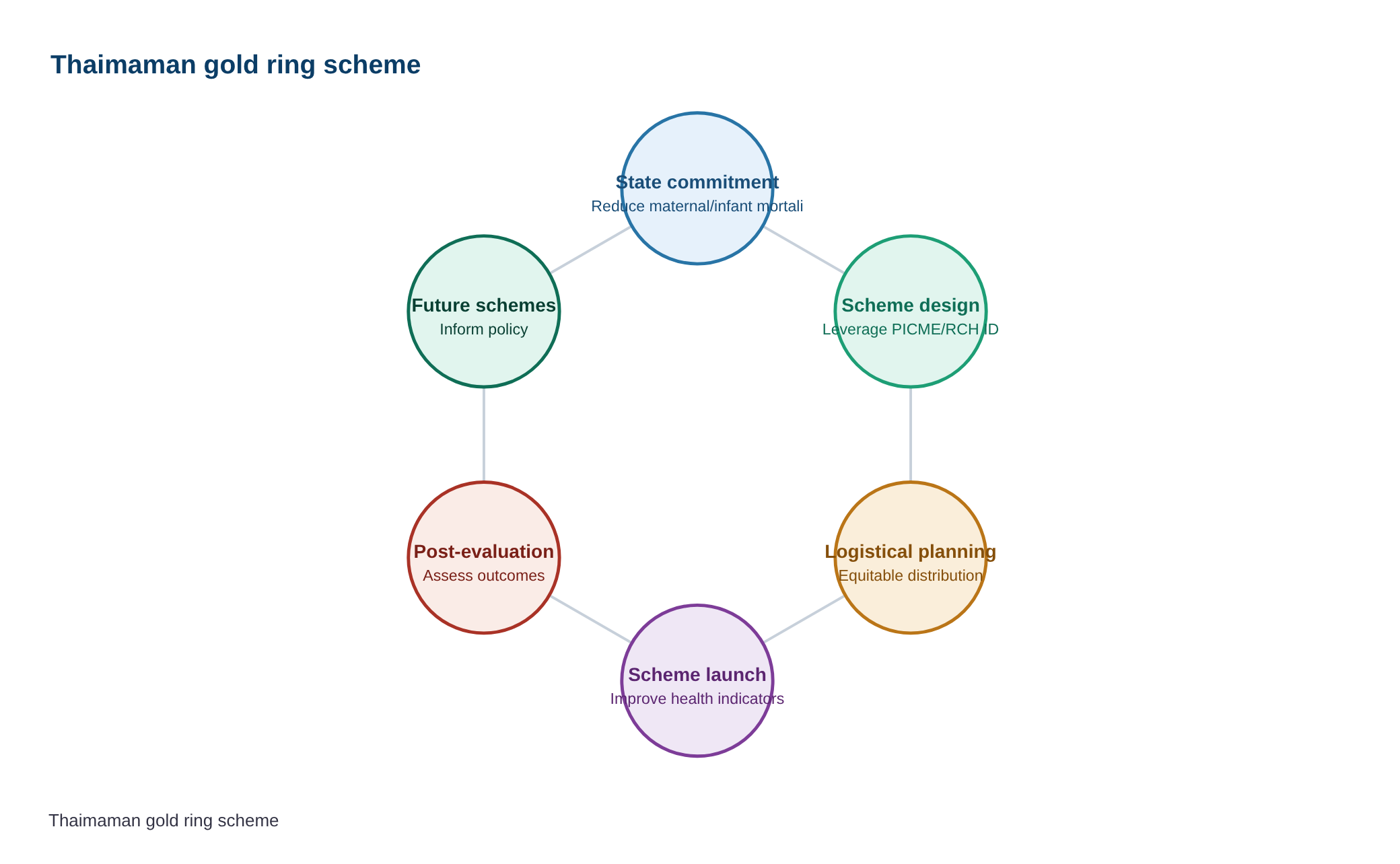
State recognises institutional delivery as a public health priority → Government announces symbolic incentive (gold ring) to reinforce utilisation → Scheme design leverages existing health monitoring systems (PICME/RCH ID) → Logistical planning ensures equitable distribution → Scheme launch aims to improve maternal and child health indicators → Post-implementation evaluation assesses behavioural and health outcomes → Lessons inform future welfare schemes in healthcare.
Prelims Practice Questions
Q1. Consider the following statements regarding the Thaimaman Gold Ring Scheme launched by the Government of Tamil Nadu:
1. The scheme provides a one-gram gold ring to every child born in a government hospital.
2. The scheme is applicable only to children born in private hospitals.
3. The gold ring carries a unique serial number and is supplied in tamper-proof packaging.
4. Mothers must be registered on the PICME portal and possess an RCH identification number to avail the benefit.
How many of the above statements are correct?
- Only one
- Only two
- Only three
- All four
Answer: Only three — Statements 1, 3, and 4 are correct. Statement 2 is incorrect as the scheme applies to children born in government hospitals, not private hospitals.
Q2. Assertion (A): The Thaimaman Gold Ring Scheme aims to strengthen public confidence in government medical services.
Reason (R): The scheme includes provisions for financial assistance to pregnant women and free delivery care under the existing maternal health initiatives.
Options:
A. Both A and R are true, and R is the correct explanation of A.
B. Both A and R are true, but R is NOT the correct explanation of A.
C. A is true, but R is false.
D. A is false, but R is true.
Answer: ? — Both A and R are true, and R correctly explains A as the scheme builds trust by combining symbolic recognition (gold ring) with tangible healthcare support.
Q3. Match the following welfare initiatives of Tamil Nadu with their respective objectives:
Column I (Initiative) | Column II (Objective)
1. Thaimaman Gold Ring Scheme | A. Financial assistance for pregnant women
2. PICME portal | B. Distribution of gold rings to newborns
3. Comprehensive Emergency Obstetric and Newborn Care (CEmONC) | C. Integrated monitoring of pregnant women and infants
4. Reproductive and Child Health (RCH) identification number | D. Emergency obstetric treatment and newborn care
Select the correct match:
A. 1-B, 2-C, 3-D, 4-A
B. 1-B, 2-A, 3-D, 4-C
C. 1-C, 2-B, 3-A, 4-D
D. 1-D, 2-C, 3-B, 4-A
- A
- B
- C
- D
Answer: A — Correct matches: 1-B (Thaimaman Gold Ring Scheme distributes gold rings), 2-C (PICME portal is for integrated monitoring), 3-D (CEmONC provides emergency obstetric treatment), 4-A (RCH identification is linked to financial assistance).
Mains Practice Question
✍ Critically examine the significance of the Thaimaman Gold Ring Scheme in the context of Tamil Nadu’s public health governance and its broader implications for maternal and child health policies in India. (15 Marks)
Approach: MODEL-ANSWER SKELETON:
1. Introduction: Define the scheme and its symbolic-cum-material objectives (1 mark).
2. Governance Framework: Link to Tamil Nadu’s existing maternal health initiatives (PICME portal, CEmONC centres, financial assistance) and the role of integrated monitoring (Art. 47, Directive Principles of State Policy; National Health Mission) (3 marks).
3. Impact on Maternal and Child Health Indicators: Cite NFHS-6 data (99.9% institutional deliveries, 53% in government hospitals) and argue how symbolic recognition (gold ring) complements tangible healthcare (4 marks).
4. Cultural and Psychological Dimensions: Discuss the role of the maternal uncle tradition in Tamil culture and the psychological impact of symbolic rewards on maternal confidence (2 marks).
5. Challenges and Criticisms: Address concerns such as sustainability, equitable distribution, and potential misuse (e.g., tamper-proof packaging, serial numbers) (3 marks).
6. Broader Implications for India: Compare with similar schemes (e.g., PMMVY) and argue for a balanced approach combining symbolic and material incentives in public health governance (2 marks).
Source: orissapost.com
Tamil Nadu PCS (TNPSC) — State PCS Practice
Prelims: With reference to the ‘Thaimaman gold ring’ scheme launched by the Tamil Nadu government in September 2024, which of the following statements is correct?
- The scheme aims to provide gold rings to all pregnant women in Tamil Nadu as a symbol of maternal health and safety.
- The scheme is part of the ‘Makkalai Thedi Maruthuvam’ initiative to distribute gold rings to economically weaker sections for financial security.
- The scheme was launched by the Chief Minister of Tamil Nadu on September 28, 2024, to honor mothers and promote family welfare.
- The scheme includes the distribution of gold rings to school-going girls to encourage higher education and reduce dropout rates.
Answer: The scheme was launched by the Chief Minister of Tamil Nadu on September 28, 2024, to honor mothers and promote family welfare. — The ‘Thaimaman gold ring’ scheme was launched by Tamil Nadu CM M.K. Stalin on September 28, 2024, to honor mothers and promote family welfare as part of social welfare initiatives.
Mains: Discuss the significance of the ‘Thaimaman gold ring’ scheme in the context of Tamil Nadu’s social welfare policies and its potential impact on maternal and child health outcomes. (250 words)
Generated by AanyaAi for educational purpose.
Related guides on our sites
- Best PSIR optional coaching for upsc
- Best PSIR optional teacher for upsc
- Best teacher of PSIR optional for upsc
- Best PSIR optional coaching in delhi for UPSC

- मत्स्यपालन विभाग का विशेष अभियान 6.0: स्वच्छता एवं सुशासन की नई पहल - September 19, 2026
- मत्स्यपालन विभाग ने विशेष अभियान 6.0 के तहत स्वच्छता एवं सुशासन पर बल दिया - September 19, 2026
- तमिलनाडु में जन्मे हर बच्चे को मिलेगा सोने की अंगूठी: मुख्यमंत्री विजय का नया योजना - September 19, 2026

No Comments