


09 Aug Tamil Nadu Releases English Version of Union-State Relations Report for Public Access
✎ The High-Level Committee on Union-State Relations examines the constitutional and administrative dimensions of Centre-State relations, with a focus on federal balance, state autonomy, and the distribution of legislative…
Subject Relevance — Where This Topic Fits
- GS Paper II — Polity — Federalism, Centre-State Relations | GS Paper II — Polity — Constitutional and Non-Constitutional Bodies
- Prelims: Federalism, Centre-State Relations, Union-State Relations, High-Level Committee, Constitutional Bodies, Copyright Act 1957, Right to Information (RTI)
- Essay: Federalism and the Challenges of Cooperative Governance in India
Quick Revision: The High-Level Committee on Union-State Relations examines the constitutional and administrative dimensions of Centre-State relations, with a focus on federal balance, state autonomy, and the distribution of legislative, administrative, and financial powers as per Articles 245–255 and the Seventh Schedule of the Constitution.
Why is this in the news?
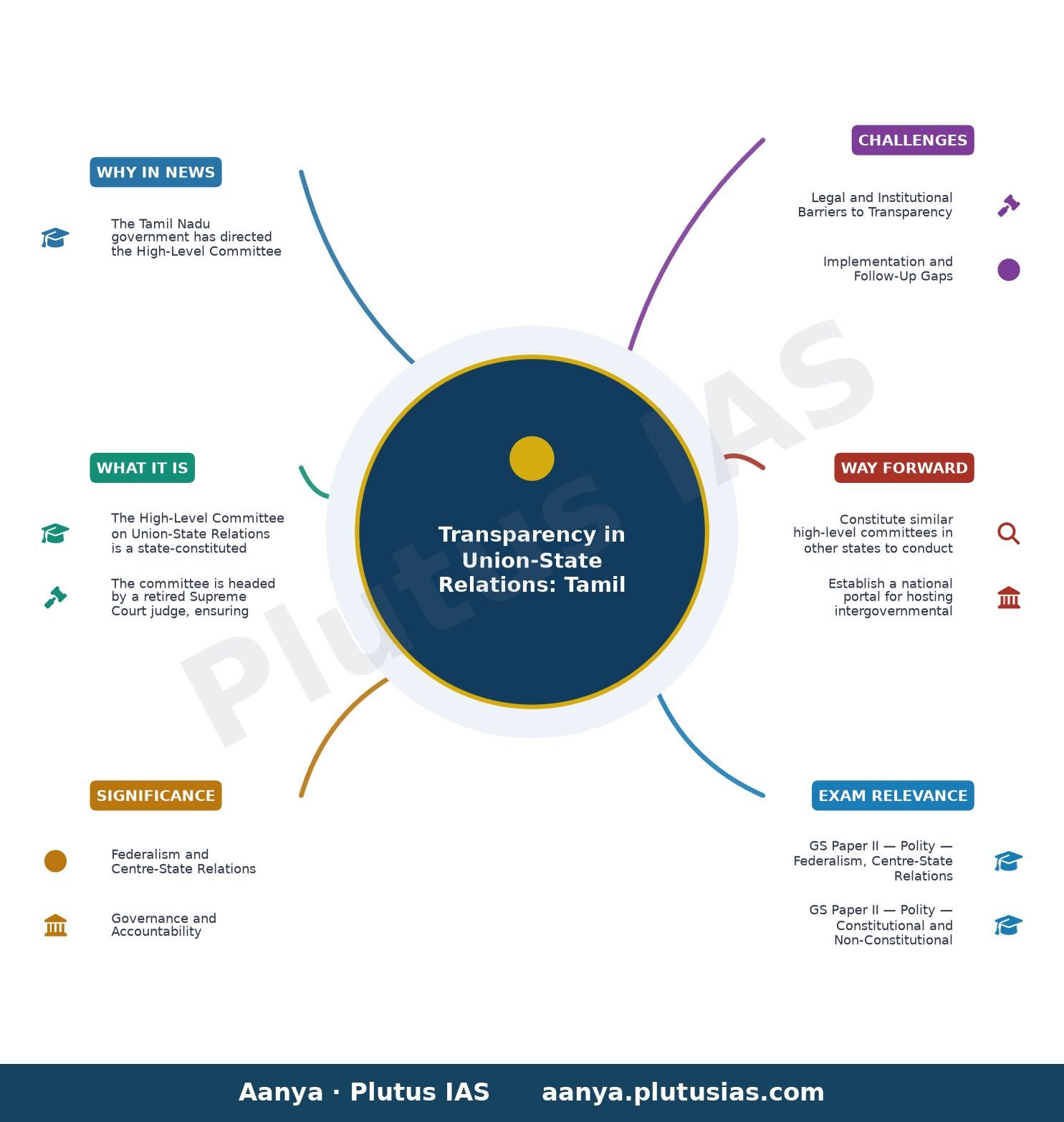
The Tamil Nadu government has directed the High-Level Committee on Union-State Relations to release the English version of Part I of its report into the public domain, aligning with the transparency principles enshrined in the Constitution. This move underscores the state’s commitment to fostering informed public discourse on federal governance, particularly in light of the committee’s mandate to examine the distribution of legislative, administrative, and financial powers between the Union and the States as per Articles 245–255 of the Constitution.
Background
- The High-Level Committee on Union-State Relations was constituted by the previous DMK government on April 15, 2025, under the chairmanship of retired Supreme Court judge Justice Kurian Joseph, to assess the efficacy of existing constitutional provisions governing Centre-State relations.
- Part I of the committee’s report, submitted on February 16, 2026, to the then Chief Minister M.K. Stalin, was tabled in the Tamil Nadu Legislative Assembly on February 18, 2026, marking a significant step toward evidence-based policymaking in federal governance.
- The Tamil Nadu government’s decision to release the English version of Part I of the report in the public domain reflects a broader trend toward transparency in governance, particularly in matters concerning federal structures and inter-governmental relations.
- The Government Order (GO) issued on July 30, 2026, not only mandates the public release of the English report but also cancels the exclusive copyright for the English version, ensuring unrestricted access for researchers, policymakers, and citizens.
- This initiative aligns with the principles of cooperative federalism as envisaged in the Constitution, where states play an active role in shaping inter-governmental policies and reforms.
What is the High-Level Committee on Union-State Relations?
- The High-Level Committee on Union-State Relations is a state-constituted body tasked with examining the constitutional and administrative dimensions of Centre-State relations, with a focus on federal balance and state autonomy.
- The committee is headed by a retired Supreme Court judge, ensuring judicial oversight and adherence to constitutional principles in its recommendations.
- The release of the report in the public domain is a step toward enhancing transparency and enabling evidence-based policymaking in matters of inter-governmental relations.
Key Features
| Feature | Significance |
|---|---|
| Public release of English version of Part I of the Union-State Relations report | Ensures transparency and accessibility of governance documents, aligning with principles of open government and participatory democracy. |
| Immediate hosting on official portal (hlcusr.tn.gov.in) | Facilitates real-time access for stakeholders, including civil society, researchers, and policymakers, without delay. |
| Cancellation of exclusive copyright for the English version | Removes legal barriers to dissemination, reinforcing the public good nature of government reports. |
| Constitution of High-Level Committee on Union-State Relations | Provides a constitutional mechanism for examining federalism-related issues, ensuring structured dialogue between Centre and States. |
| Submission and tabling of Part I report in the Assembly | Demonstrates legislative accountability and enables democratic scrutiny of the committee’s findings. |
Why it Matters
Federalism and Centre-State Relations
- The release of the report underscores Tamil Nadu’s commitment to transparency in federal governance, particularly in matters of intergovernmental relations.
- By making the report public, the state reinforces the principle of cooperative federalism, encouraging other states to adopt similar practices.
- The report’s findings on Union-State relations may influence policy debates on fiscal federalism, administrative autonomy, and dispute resolution mechanisms.
- The committee’s work exemplifies the role of state-constituted bodies in addressing federal imbalances, a critical aspect of India’s quasi-federal structure.
Governance and Accountability
- The public release of the report aligns with the Right to Information (RTI) framework, enhancing citizen oversight of government processes.
- Transparency in governance documents fosters trust between the state and its citizens, particularly in matters of intergovernmental coordination.
- The cancellation of copyright restrictions ensures that the report can be freely analyzed, quoted, and disseminated, promoting academic and policy research.
Judicial and Administrative Reforms
- The committee, headed by a retired Supreme Court judge, demonstrates the role of the judiciary in addressing federal disputes and policy gaps.
- The report’s recommendations may inform future judicial interventions in Centre-State disputes, particularly on subjects like Article 256 (Obligation of States to comply with Union laws).
- The inclusion of retired civil servants and planning commission members ensures a blend of judicial, administrative, and policy expertise in the committee’s work.
Challenges
1. Legal and Institutional Barriers to Transparency
- Historical reluctance among some states to disclose intergovernmental reports due to political sensitivities or concerns over Centre-State disputes.
- Potential resistance from the Union government in sharing or acknowledging state-level findings on federalism issues.
- Legal ambiguities in copyright laws governing government reports, particularly when prepared by committees with external members.
- Risk of selective disclosure or delayed release of reports in other states, undermining uniformity in transparency practices.
UPSC Link: Constitutional provisions on Centre-State relations
2. Implementation and Follow-Up Gaps
- Ensuring that the report’s recommendations are acted upon by both the state and Union governments, rather than remaining symbolic.
- Monitoring the impact of the report’s findings on policy decisions, particularly in fiscal federalism and administrative autonomy.
- Addressing potential conflicts between state autonomy and Union directives, as highlighted in the report.
UPSC Link: Role of Inter-State Councils
3. Public Engagement and Awareness
- Limited public awareness about the significance of Union-State relations reports, leading to low engagement with the document.
- Difficulty in translating complex federalism issues into accessible language for non-expert stakeholders.
- Risk of misinterpretation or misuse of the report’s findings by political actors or media outlets.
UPSC Link: Citizen-centric governance
Challenges — UPSC Perspective
| Issue | Concern |
|---|---|
| Selective transparency | States may release reports selectively to avoid political or legal controversies, undermining the principle of open governance. |
| Legal ambiguity in copyright | Government reports prepared by committees with external members may face copyright disputes, delaying public access. |
| Centre-State coordination gaps | Lack of consensus between the Union and states on federalism issues may hinder implementation of report recommendations. |
| Public apathy and awareness deficits | Low public engagement with federalism reports due to complex subject matter and limited outreach efforts. |
| Risk of politicization | Reports on Union-State relations may be used for political narratives rather than constructive policy debates. |
| Implementation delays | Recommendations may remain unimplemented due to bureaucratic inertia or lack of political will. |
Way Forward
- Constitute similar high-level committees in other states to conduct reviews on Union-State relations and publish reports in regional languages for wider accessibility.
- Establish a national portal for hosting intergovernmental reports from all states to centralize transparency efforts.
- Encourage academic institutions and think tanks to analyze the report’s findings and submit policy briefs to the state and Union governments.
- Organize public forums or webinars to discuss the report’s recommendations with civil society, media, and policymakers.
- Strengthen the Inter-State Council to facilitate structured dialogue on federalism issues raised in the report.
- Develop a standardized template for state-level Union-State relations reports to ensure consistency and comparability across states.
- Promote digital literacy programs to enhance public understanding of federalism and intergovernmental relations.
- Advocate for legislative amendments to clarify copyright provisions for government reports prepared by external committees.
UPSC Value Addition
Keywords for Mains Answer-Writing
Union-State Relations · High-Level Committee on Union-State Relations · Justice Kurian Joseph · Inter-State Council · cooperative federalism · transparency in governance · public domain · DMK government Tamil Nadu · constitutional provisions on Centre-State relations · federalism in India · Government of India Act 1935 · Article 263 of the Constitution · inter-state disputes resolution · access to government reports · executive-legislature relations in Tamil Nadu
Constitutional & Policy Linkages
- {‘article’: ‘Article 131’, ‘note’: ‘Original jurisdiction of Supreme Court’}
- {‘article’: ‘Article 256’, ‘note’: ‘Obligation of States to comply with Union laws’}
- {‘article’: ‘Article 263’, ‘note’: ‘Inter-State Council provisions’}
- {‘article’: ‘Seventh Schedule’, ‘note’: ‘Division of powers between Union and States’}
Concept Flow
Formation of High-Level Committee on Union-State Relations by Tamil Nadu government → → Committee submits Part I report to the Chief Minister → → Report tabled in the State Assembly, demonstrating legislative accountability → → Government issues order to release English version in public domain → → English report hosted on official portal, ensuring accessibility → → Cancellation of exclusive copyright removes legal barriers to dissemination → → Public and stakeholders access report, enabling scrutiny and policy debates → → Recommendations inform future Centre-State relations and governance reforms
Prelims Practice Questions
Q1. Consider the following statements regarding the High-Level Committee on Union-State Relations constituted by the Tamil Nadu government:
1. The committee was headed by a retired Chief Justice of India.
2. Part I of its report was submitted to the then Chief Minister M.K. Stalin on February 16, 2026.
3. The committee was constituted on April 15, 2025.
4. The report was tabled in the Tamil Nadu Assembly on February 18, 2026.
How many of the above statements are correct?
- Only one
- Only two
- Only three
- All four
Answer: All four — Statements 1, 3, and 4 are correct. Statement 1 is incorrect as the committee was headed by a retired Supreme Court judge, not necessarily the Chief Justice of India. The report was tabled in the Assembly on February 18, 2026, as stated.
Q2. Assertion (A): The Tamil Nadu government directed the High-Level Committee on Union-State Relations to host the English version of Part I of its report in the public domain.
Reason (R): This directive was issued to ensure transparency and grant open access to the report.
Options:
A. Both A and R are true, and R is the correct explanation of A.
B. Both A and R are true, but R is not the correct explanation of A.
C. A is true, but R is false.
D. A is false, but R is true.
Answer: ? — Both the Assertion (A) and Reason (R) are true, and R correctly explains A. The directive was indeed issued to ensure transparency by making the report publicly accessible.
Q3. Match the following columns related to Union-State Relations in India:
Column I (Committee/Body)
A. Sarkaria Commission
B. Punchhi Commission
C. High-Level Committee on Union-State Relations (Tamil Nadu)
D. Inter-State Council
Column II (Year of Constitution)
1. 2007
2. 1983
3. 2025
4. 1990
Options:
A. A-2, B-1, C-3, D-4
B. A-1, B-2, C-3, D-4
C. A-4, B-1, C-2, D-3
D. A-2, B-4, C-1, D-3
Answer: ? — The correct matches are: A. Sarkaria Commission (1983), B. Punchhi Commission (2007), C. High-Level Committee on Union-State Relations (Tamil Nadu, 2025), D. Inter-State Council (1990).
Mains Practice Question
✍ Critically examine the significance of the Tamil Nadu government’s decision to place the English version of Part I of the High-Level Committee on Union-State Relations report in the public domain. (15 Marks)
Approach: MODEL-ANSWER SKELETON:
1. **Context and Background**: Briefly introduce the High-Level Committee on Union-State Relations, its constitution (Justice Kurian Joseph, K. Ashok Vardhan Shetty, M. Naganathan), and the submission of Part I of the report to the Tamil Nadu Assembly in February 2026.
2. **Legal and Constitutional Framework**: Discuss the constitutional provisions governing Centre-State relations (Articles 263, 280, 293) and the role of inter-state institutions like the Inter-State Council. Highlight the importance of transparency in governance as a facet of cooperative federalism.
3. **Significance of the Decision**:
– **Transparency and Accountability**: Explain how making the report publicly accessible aligns with the principles of democratic governance and accountability.
– **Federalism and State Autonomy**: Discuss how such measures strengthen the federal structure by ensuring that state-level initiatives are visible and open to scrutiny.
– **Precedent for Other States**: Argue how this decision could set a precedent for other states to adopt similar measures, fostering a culture of openness in inter-state relations.
4. **Challenges and Criticisms**:
– **Potential Resistance**: Discuss any potential resistance from the Union government or other states regarding the sharing of such reports.
– **Implementation Gaps**: Highlight the need for ensuring that such transparency measures are consistently implemented and not merely symbolic.
5. **Conclusion**: Summarize the broader implications of the decision for India’s federal structure and the evolving dynamics of Centre-State relations in contemporary Indian politics.
Source: The Hindu
Generated by AanyaAi for educational purpose.

- आंध्र प्रदेश में चार नए पुलिस आयुक्तालयों को कैबिनेट की मंजूरी, जानिए क्या होंगे फायदे - September 23, 2026
- Andhra Pradesh to get 4 new Police Commissionerates: Key UPSC insights - September 23, 2026
- AI आधारित ‘HEADS’ से भारत में अवसाद जांच में क्रांति: जानिए कैसे होगा मदद - September 23, 2026

No Comments