


08 Aug Tamil Nadu releases English version of Union-State Relations Report for public access
✎ The Tamil Nadu government’s decision to release the English version of the High-Level Committee on Union-State Relations report into the public domain is a significant step toward enhancing transparency and inclusive governance…
Subject Relevance — Where This Topic Fits
- GS Paper II — Polity and Governance (Union-State Relations, Federalism, Inter-State Relations)
- Prelims: Federalism, Union-State Relations, Inter-State Council, Constitutional Provisions (Articles 263, 264-293), Tamil Nadu High-Level Committee on Union-State Relations, Government Orders (GOs), Copyright Act, 1957 (Section 21, 24), Judicial Review of Federal Disputes
- Essay: Federalism in India: Challenges and Opportunities, Transparency and Governance: The Role of Public Access to Government Reports
Quick Revision: The Tamil Nadu government’s decision to release the English version of the High-Level Committee on Union-State Relations report into the public domain is a significant step toward enhancing transparency and inclusive governance in federal matters.
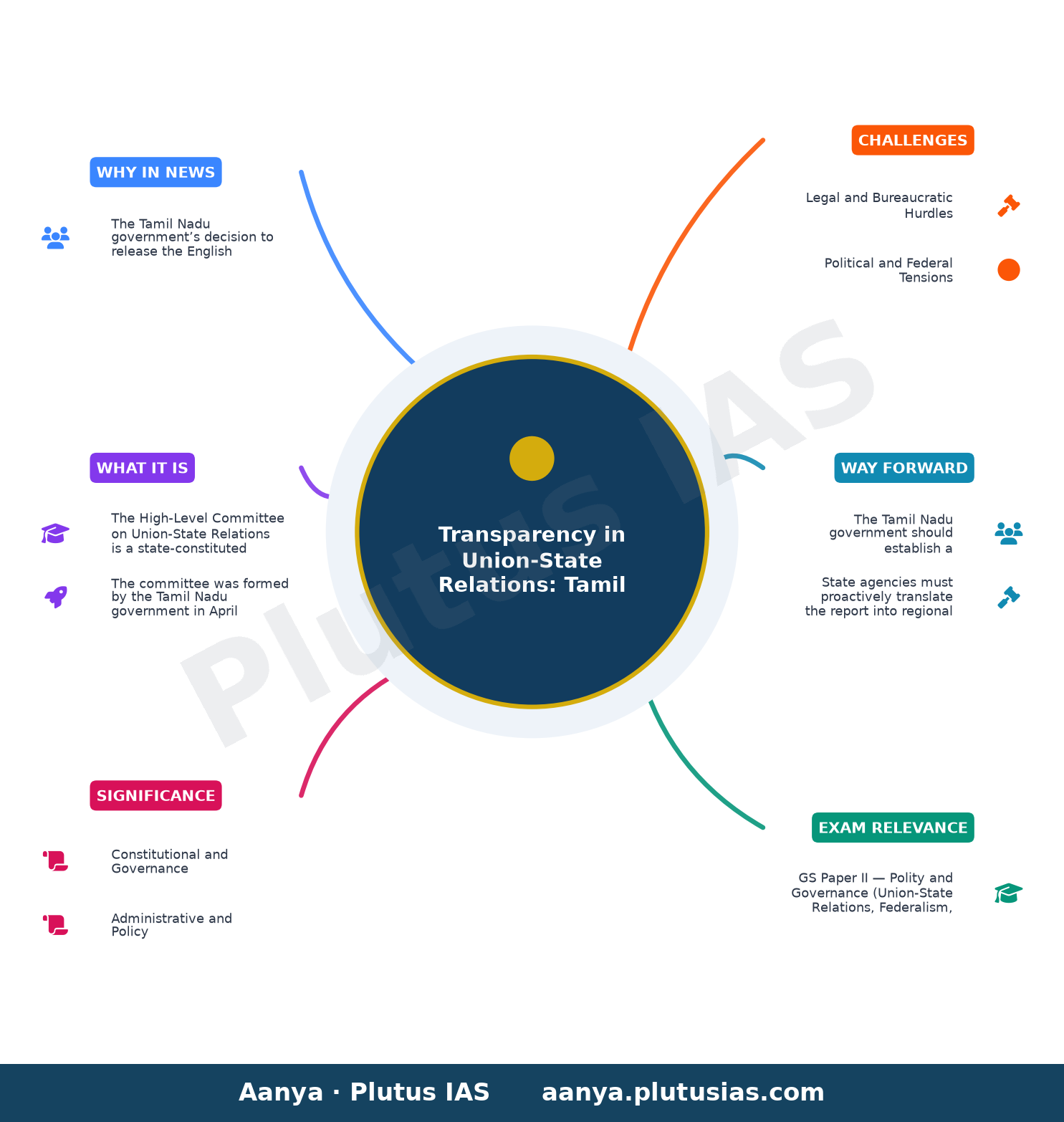
Why is this in the news?
The Tamil Nadu government’s decision to release the English version of Part I of the High-Level Committee on Union-State Relations report into the public domain underscores the state’s commitment to transparency in governance. This move, formalised via a Government Order on July 30, 2026, aligns with broader principles of federalism by ensuring equitable access to critical policy documents across linguistic divides. The action also reflects the state’s proactive stance in addressing federal disputes through evidence-based discourse, particularly in the context of evolving Centre-State dynamics.
Background
- The High-Level Committee on Union-State Relations was constituted by the Tamil Nadu government on April 15, 2025, under the leadership of retired Supreme Court judge Justice Kurian Joseph, to examine the Centre-State relationship and recommend measures for equitable federalism.
- The committee’s mandate included assessing the implementation of constitutional provisions governing Union-State relations, inter-state disputes, and the role of institutions such as the Inter-State Council.
- The report was initially released in Tamil, with the English version restricted by exclusive copyright, prompting criticism over limited accessibility.
- The Tamil Nadu government’s directive to host the English version publicly and waive copyright restrictions is a significant step toward fostering transparency and inclusive policy discourse.
- This initiative is part of a broader trend among states to assert their federal rights and engage in evidence-based advocacy for constitutional federalism.
What is the High-Level Committee on Union-State Relations?
- The High-Level Committee on Union-State Relations is a state-constituted body tasked with examining the Centre-State relationship, inter-state disputes, and the implementation of constitutional provisions governing federalism.
- The committee was formed by the Tamil Nadu government in April 2025, headed by retired Supreme Court judge Justice Kurian Joseph, with members including retired IAS officer K. Ashok Vardhan Shetty and former Vice-Chairman of the Tamil Nadu State Planning Commission M. Naganathan.
- The committee’s report is divided into parts, with Part I focusing on the constitutional framework, Centre-State financial relations, and institutional mechanisms such as the Inter-State Council.
- The report examines issues such as the distribution of financial resources, the role of the Finance Commission, and the functioning of the Goods and Services Tax (GST) Council in the context of federalism.
- The committee’s recommendations are expected to inform state-level policy on Centre-State relations, including advocacy for greater fiscal autonomy and institutional reforms.
- The committee’s work is aligned with the constitutional principle of cooperative federalism, as enshrined in Articles 263 and 264-293 of the Constitution.
- The release of the English version of the report into the public domain is a proactive measure to ensure that policy recommendations are accessible to a wider audience, including policymakers, researchers, and civil society.
- The committee’s report is not legally binding but serves as a critical input for state-level advocacy and policy formulation in matters of federal relations.
Key Features
| Feature | Significance |
|---|---|
| Open access to report | Enhances transparency in governance by making the English version of Part I of the Union-State Relations report publicly accessible, aligning with democratic principles of accountability. |
| Cancellation of exclusive copyright | Ensures the report is free from proprietary restrictions, enabling wider dissemination and utilisation by researchers, policymakers, and the public. |
| Hosting on official portal | Facilitates easy access and download for stakeholders, reducing barriers to information and promoting evidence-based discourse. |
| Constitutional context of Union-State Relations | Part I of the report likely addresses the distribution of legislative, administrative, and financial powers between the Union and States, a core subject under the Indian Constitution. |
| Committee composition | The inclusion of a retired Supreme Court judge and former civil servants ensures the report is grounded in constitutional expertise and administrative experience. |
Why it Matters
Constitutional and Governance
- The directive underscores the Tamil Nadu government’s commitment to federal transparency, a critical aspect of cooperative federalism under the Indian Constitution.
- Open access to the report enables public scrutiny of Union-State relations, fostering informed debates on fiscal federalism, inter-state disputes, and cooperative mechanisms.
- The move aligns with the 73rd and 74th Constitutional Amendments, which emphasise decentralisation and participatory governance at the State level.
Administrative and Policy
- The High-Level Committee’s report, now publicly available, can serve as a reference for other States to assess their Union-State dynamics and advocate for reforms.
- Cancellation of exclusive copyright ensures the report can be translated, adapted, or cited without legal constraints, promoting knowledge-sharing across linguistic and regional boundaries.
- The committee’s findings may inform future policy interventions in areas such as resource allocation, devolution of funds, and dispute resolution between the Union and States.
Academic and Research
- The report provides empirical data and analysis on Union-State relations, valuable for scholars studying Indian federalism, comparative governance, and constitutional law.
- Public availability of the report supports research on fiscal federalism, Centre-State conflicts, and the implementation of constitutional provisions such as Articles 263, 280, and 293.
- The committee’s methodology and recommendations can be critically evaluated by researchers, contributing to evidence-based policymaking.
Societal and Democratic
- Transparency in governance strengthens democratic institutions by enabling citizens to hold the government accountable for its actions and decisions.
- The move reflects a broader trend of digital governance, where public documents are made accessible online to reduce information asymmetry and promote inclusivity.
- Open access to the report empowers civil society organisations, journalists, and activists to engage with issues of federalism and advocate for reforms.
Challenges
1. Legal and Bureaucratic Hurdles
- Ensuring the report’s findings are implemented in policy may face resistance from the Union government or other States, given the sensitive nature of Centre-State relations.
- Bureaucratic delays in translating or disseminating the report in regional languages could limit its reach among non-English-speaking stakeholders.
- Legal challenges may arise if the Union government contests the State’s authority to release the report or impose restrictions on its content.
UPSC Link: Constitutional provisions on Centre-State relations (Articles 263, 280, 293)
2. Political and Federal Tensions
- The report may highlight contentious issues such as fiscal imbalances, devolution of funds, or disputes over legislative powers, potentially straining Centre-State relations.
- Opposition parties or the Union government might politicise the report’s findings, framing them as anti-national or biased against their policies.
- Differences in political ideologies between the State and Union governments could impede the adoption of the report’s recommendations.
UPSC Link: Cooperative vs. competitive federalism (Sarkaria Commission, Punchhi Commission)
3. Implementation and Follow-Up
- The State government must ensure the report’s recommendations are translated into actionable policies, which requires political will and administrative capacity.
- Monitoring the report’s impact on governance and policy outcomes may be challenging due to the lack of a structured feedback mechanism.
- Ensuring the report’s findings are accessible to marginalised communities, including those with limited digital literacy, requires targeted outreach.
UPSC Link: Role of NITI Aayog in Centre-State coordination
4. Data Accuracy and Neutrality
- The report’s credibility depends on the accuracy and neutrality of its data, which could be questioned if perceived as politically motivated or factually flawed.
- Disputes may arise over the interpretation of constitutional provisions or the methodology used in the report, requiring independent verification.
- Ensuring the report remains relevant over time may necessitate periodic updates, which could be resource-intensive.
UPSC Link: Role of the Finance Commission in fiscal federalism
5. Public Awareness and Engagement
- Despite open access, low public awareness about the report’s existence or its significance may limit its impact on democratic discourse.
- Encouraging public participation in debates on Union-State relations requires proactive engagement by civil society, media, and educational institutions.
- Misinterpretation of the report’s findings by media or political actors could distort public understanding of Centre-State dynamics.
UPSC Link: Role of the Press Council of India in promoting informed discourse
Challenges — UPSC Perspective
| Issue | Concern |
|---|---|
| Legal challenges to report’s release | Potential disputes over the State’s authority to publish the report or its contents. |
| Politicisation of findings | Opposition or Union government framing the report’s content as biased or anti-national. |
| Implementation gaps | Risk of the report’s recommendations remaining unimplemented due to lack of political will or administrative capacity. |
| Data accuracy disputes | Challenges in verifying the report’s data or methodology, leading to credibility issues. |
| Public engagement barriers | Low awareness or misinterpretation of the report’s findings among stakeholders. |
| Bureaucratic delays | Slow translation or dissemination of the report in regional languages, limiting its reach. |
Way Forward
- The Tamil Nadu government should establish a multi-stakeholder committee to monitor the implementation of the report’s recommendations and address implementation gaps.
- State agencies must proactively translate the report into regional languages and disseminate it through offline and digital channels to ensure inclusivity.
- Civil society organisations and academic institutions should be encouraged to analyse the report and publish critiques or supplementary studies to foster evidence-based discourse.
- The Union government should be engaged in a constructive dialogue to address concerns raised in the report and explore collaborative solutions to Centre-State disputes.
- The High-Level Committee should be tasked with updating the report periodically, incorporating new data and addressing emerging challenges in Union-State relations.
- Educational institutions, particularly law and public administration departments, should integrate the report into their curricula to sensitise future policymakers and administrators.
- Media outlets should be encouraged to publish explainers and analyses of the report to enhance public understanding of federalism and governance issues.
- A grievance redressal mechanism should be established to address concerns raised by stakeholders regarding the report’s content or implementation.
UPSC Value Addition
Keywords for Mains Answer-Writing
Union-State Relations · High-Level Committee on Union-State Relations · Article 263 of the Constitution · cooperative federalism · intergovernmental relations · transparency in governance · public domain access to reports · Government of India (Allocation of Business) Rules, 1961 · inter-state council · federalism in India · Justice Kurian Joseph · Tamil Nadu government’s directive · executive-legislative relations · constitutional provisions on federalism
Constitutional & Policy Linkages
- {‘Article 263’: ‘Provisions for inter-State Councils’}
- {‘Article 280’: ‘Finance Commission and fiscal federalism’}
- {‘Article 293’: ‘Borrowing powers of States’}
- {‘Article 356’: ‘Provisions for State Emergency (indirect relevance)’}
Concept Flow
Constitution of High-Level Committee on Union-State Relations (April 2025) → → Submission of Part I of the report to the State government (February 2026) → → Tabling of the report in the State Assembly (February 2026) → → Decision to grant open access to the English version (July 2026) → → Cancellation of exclusive copyright and hosting on official portal → → Public scrutiny and academic/research utilisation → → Potential policy implementation and Centre-State dialogue
Prelims Practice Questions
Q1. Consider the following statements regarding the High-Level Committee on Union-State Relations:
1. It was constituted by the Government of Tamil Nadu in 2025.
2. The committee is headed by a retired Supreme Court judge.
3. The committee submitted Part I of its report to the Chief Minister of Tamil Nadu in February 2026.
4. The committee has exclusive copyright over the English version of Part I of its report.
How many of the above statements are correct?
- Only one
- Only two
- Only three
- All four
Answer: Only three — Statements 1, 2, and 3 are correct. Statement 4 is incorrect as the Tamil Nadu government has directed the cancellation of exclusive copyright for the English version of Part I of the report.
Q2. Assertion (A): The High-Level Committee on Union-State Relations was constituted under Article 263 of the Constitution.
Reason (R): Article 263 empowers the President to establish an inter-State Council to investigate and discuss subjects of common interest between the Union and the States.
Options:
A. Both A and R are true, and R is the correct explanation of A.
B. Both A and R are true, but R is not the correct explanation of A.
C. A is true, but R is false.
D. A is false, but R is true.
Answer: ? — Assertion (A) is false because the committee was constituted by the Tamil Nadu government, not under Article 263. Reason (R) is true as it correctly states the provision under Article 263.
Q3. Match the following committees with their respective functions:
Column I
A. Sarkaria Commission
B. Punchhi Commission
C. High-Level Committee on Union-State Relations (Tamil Nadu)
D. Inter-State Council
Column II
1. Reviewed Centre-State relations and recommended structural changes
2. Investigated and discussed subjects of common interest between the Union and the States
3. Examined issues of Centre-State relations with a focus on federalism
4. Constituted by a State government to study Union-State relations
Options:
A. A-3, B-1, C-4, D-2
B. A-1, B-3, C-2, D-4
C. A-2, B-4, C-1, D-3
D. A-4, B-2, C-3, D-1
Answer: ? — A. Sarkaria Commission (1983) reviewed Centre-State relations and recommended structural changes.
B. Punchhi Commission (2007) examined issues of Centre-State relations with a focus on federalism.
C. High-Level Committee on Union-State Relations (Tamil Nadu) was constituted by a State government to study Union-State relations.
D. Inter-State Council (Article 263) investigates and discusses subjects of common interest between the Union and the States.
Mains Practice Question
✍ Critically examine the significance of the Tamil Nadu government’s directive to place the English version of Part I of the High-Level Committee on Union-State Relations report in the public domain. Also, discuss the constitutional and federal dimensions of such transparency in intergovernmental relations. (15 Marks)
Approach: MODEL-ANSWER SKELETON:
1. **Introduction (2 marks)**: Define Union-State relations and the constitutional framework (Article 263, cooperative federalism, and the role of intergovernmental bodies). Mention the Tamil Nadu government’s directive and its immediate context.
2. **Significance of the Directive (5 marks)**:
– **Transparency and Accountability**: Link to the Right to Information (RTI) Act, 2005, and the principle of open governance.
– **Federalism and State Autonomy**: Discuss how transparency strengthens cooperative federalism and reduces asymmetries in information between the Union and States.
– **Public Participation**: Highlight the role of civil society and academia in engaging with the report for evidence-based policymaking.
– **Comparative Perspective**: Reference similar initiatives by other States (e.g., Kerala, Karnataka) or the Union government (e.g., NITI Aayog reports).
3. **Constitutional and Federal Dimensions (5 marks)**:
– **Article 263**: Explain the provision for an Inter-State Council and its role in facilitating dialogue between the Union and States.
– **Government of India (Allocation of Business) Rules, 1961**: Discuss how the Union and States share responsibilities under the Seventh Schedule.
– **Judicial Precedents**: Cite cases like *S.R. Bommai v. Union of India* (1994) on federalism or *State of West Bengal v. Union of India* (1963) on Centre-State relations.
– **Challenges**: Address potential conflicts over jurisdiction, data sovereignty, or political sensitivities in sharing such reports.
4. **Conclusion (3 marks)**: Summarize the broader implications for federalism in India, including the need for standardized protocols for sharing intergovernmental reports. Emphasize the balance between transparency and the protection of sensitive information.
Source: The Hindu
Generated by AanyaAi for educational purpose.

- आंध्र प्रदेश में चार नए पुलिस आयुक्तालयों को कैबिनेट की मंजूरी, जानिए क्या होंगे फायदे - September 23, 2026
- Andhra Pradesh to get 4 new Police Commissionerates: Key UPSC insights - September 23, 2026
- AI आधारित ‘HEADS’ से भारत में अवसाद जांच में क्रांति: जानिए कैसे होगा मदद - September 23, 2026

No Comments