


08 Aug Tamil Nadu Releases English Version of Union-State Relations Report Part I for Public Access
✎ The Tamil Nadu government’s directive to publicise the English version of the High-Level Committee’s report on Union-State Relations exemplifies the state’s commitment to transparency, federalism, and participatory governance.
Subject Relevance — Where This Topic Fits
- GS Paper II — Polity — Constitutional Framework; Federalism; Centre-State Relations
- Prelims: Federalism, Centre-State Relations, Constitutional Provisions, Union-State Relations, Government Orders, Public Access to Government Reports
- Essay: Federalism and the Challenges of Cooperative Governance in India
Quick Revision: The Tamil Nadu government’s directive to publicise the English version of the High-Level Committee’s report on Union-State Relations exemplifies the state’s commitment to transparency, federalism, and participatory governance.
Why is this in the news?
The Tamil Nadu government has directed the High-Level Committee on Union-State Relations to host the English version of Part I of its report in the public domain, ensuring transparency and accessibility. This decision, formalised through a Government Order dated July 30, 2026, underscores the state’s commitment to fostering informed discourse on federal dynamics and constitutional governance. The move aligns with broader principles of open governance and public accountability in the context of Centre-State relations.
Background
- The High-Level Committee on Union-State Relations was constituted by the Tamil Nadu government on April 15, 2025, under the leadership of retired Supreme Court judge Justice Kurian Joseph.
- The committee was tasked with examining the constitutional and administrative dimensions of Centre-State relations, with a focus on federal principles and inter-governmental dynamics.
- Part I of the committee’s report was submitted to the then Chief Minister M.K. Stalin on February 16, 2026, and tabled in the Assembly on February 18, 2026.
- The Tamil Nadu government had previously hosted the Tamil version of the report in the public domain, and the current directive extends this transparency to the English version.
- The Government Order issued on July 30, 2026, explicitly cancels the exclusive copyright for the English version of Part I, ensuring unrestricted public access.
- This initiative reflects Tamil Nadu’s emphasis on transparency and participatory governance in the context of federalism.
What is the High-Level Committee on Union-State Relations?
- The High-Level Committee on Union-State Relations was constituted by the Tamil Nadu government to examine the constitutional, administrative, and political dimensions of Centre-State relations.
- The committee is headed by a retired Supreme Court judge, Justice Kurian Joseph, ensuring judicial expertise in its deliberations.
- Members of the committee include retired IAS officer K. Ashok Vardhan Shetty and former Vice-Chairman of the Tamil Nadu State Planning Commission M. Naganathan, representing administrative and planning perspectives.
- The committee’s mandate includes assessing the implementation of constitutional provisions related to federalism, inter-state cooperation, and the distribution of legislative and executive powers.
- Part I of the committee’s report focuses on foundational aspects of Union-State relations, including constitutional provisions, historical evolution, and contemporary challenges.
- The report is intended to serve as a reference document for policymakers, scholars, and the public, fostering informed debate on federal governance.
- The committee’s work is aligned with the principles of cooperative federalism, emphasising dialogue and collaboration between the Centre and states.
- The decision to publicise the report in both Tamil and English underscores Tamil Nadu’s commitment to linguistic inclusivity and transparency.
Key Features
| Feature | Significance |
|---|---|
| Public release of English version of Part I of the Union-State Relations report | Enhances transparency in intergovernmental relations by ensuring equitable access to official documents in both official languages of Tamil Nadu. |
| Cancellation of exclusive copyright for the English version | Affirms the principle of open government data, aligning with the Right to Information (RTI) Act’s emphasis on public access to government records. |
| Hosting on official portal (hlcusr.tn.gov.in) | Facilitates digital accessibility, ensuring the report is available to all stakeholders without paywall or subscription barriers. |
| Constitutional mandate for transparency in state-citizen relations | Reflects the constitutional duty under Article 370 (not applicable here) and Article 292 (fiscal autonomy) to ensure accountability in federal structures. |
| Committee headed by retired Supreme Court judge | Ensures judicial oversight and credibility in the report’s findings, reinforcing public trust in intergovernmental assessments. |
Why it Matters
Constitutional and Legal
- Reinforces the constitutional principle of cooperative federalism by promoting transparency in Union-State relations, a cornerstone of India’s federal structure under Part XI of the Constitution.
- Aligns with the Right to Information (RTI) Act, 2005, which mandates proactive disclosure of government information to enhance citizen participation in governance.
- Demonstrates adherence to the doctrine of constitutional morality, ensuring that state actions are guided by the spirit of openness and accountability.
Administrative and Governance
- Sets a precedent for other states to adopt similar measures, fostering a culture of transparency in intergovernmental reporting and policy formulation.
- Enhances the credibility of the High-Level Committee on Union-State Relations by making its findings accessible to a wider audience, including policymakers, researchers, and civil society.
- Facilitates evidence-based policymaking by providing stakeholders with verifiable data on Union-State dynamics, particularly in areas like fiscal transfers and administrative cooperation.
Societal and Democratic
- Promotes democratic accountability by enabling citizens to scrutinise the state’s assessment of its relations with the Union, a critical aspect of participatory governance.
- Encourages informed public discourse on federal issues, thereby strengthening the democratic fabric of the polity.
- Demonstrates the state government’s commitment to the principles of open governance, which are essential for building trust in institutions.
Challenges
1. Ensuring Equitable Access to Information
- While the English version is now publicly available, ensuring that the report is accessible to all sections of society, including those with limited digital literacy or internet access, remains a challenge.
- The state must invest in awareness campaigns and offline dissemination mechanisms to bridge the digital divide and ensure inclusivity.
UPSC Link: GS-II: Governance, Transparency and Accountability
2. Balancing Transparency with National Security Concerns
- Certain sections of the report may contain sensitive information that could potentially compromise national security or interstate relations if disclosed indiscriminately.
- The state must establish robust redaction protocols to protect sensitive data while ensuring maximum transparency in line with constitutional obligations.
UPSC Link: GS-II: Federalism, Security and Governance
3. Sustaining the Momentum of Transparency
- The state must ensure that future reports, including subsequent parts of the Union-State Relations report, are also made publicly available in a timely manner.
- Institutionalising transparency as a core governance principle will require sustained political will and administrative reforms.
UPSC Link: GS-II: Governance, Institutional Reforms
4. Addressing Potential Misinterpretation of Data
- The public release of the report may lead to varied interpretations of the data, particularly by political opponents or vested interests, necessitating proactive clarification by the state.
- The state must proactively engage with stakeholders to explain the report’s findings and address any misconceptions.
UPSC Link: GS-II: Governance, Public Policy
Challenges — UPSC Perspective
| Issue | Concern |
|---|---|
| Digital divide | Ensuring that the report reaches marginalised communities without internet access. |
| Sensitive data redaction | Balancing transparency with the need to protect national security and interstate relations. |
| Political misuse of data | Preventing misinterpretation or selective use of the report by political actors. |
| Sustaining transparency | Ensuring that future reports are released proactively and consistently. |
| Administrative capacity | Training officials to handle RTI requests and proactively disclose information efficiently. |
Way Forward
- The state government should conduct awareness campaigns to educate citizens on the availability and significance of the report, particularly in rural and tribal areas.
- Establish a dedicated grievance redressal mechanism to address queries or concerns raised by citizens regarding the report’s contents.
- Develop a standard operating procedure (SOP) for redaction of sensitive information to ensure compliance with national security guidelines while maintaining transparency.
- Encourage civil society organisations and academic institutions to analyse the report and provide feedback to the state government for continuous improvement.
- Institutionalise the practice of proactively disclosing government reports by amending administrative guidelines to mandate timely public release.
- Collaborate with the Union government to harmonise transparency norms across states, ensuring consistency in intergovernmental reporting.
- Leverage digital platforms to create interactive tools, such as FAQs or explainer videos, to simplify complex findings for public comprehension.
- Monitor the impact of the report’s public release on governance outcomes, such as improved interstate cooperation or policy reforms, to assess its effectiveness.
UPSC Value Addition
Keywords for Mains Answer-Writing
Union-State Relations · High-Level Committee on Union-State Relations · Article 263 of the Constitution · cooperative federalism · inter-state council · transparency in governance · public domain access · Tamil Nadu government initiatives · Justice Kurian Joseph Committee · executive-legislature relations · federalism in India · constitutional provisions on federalism
Concept Flow
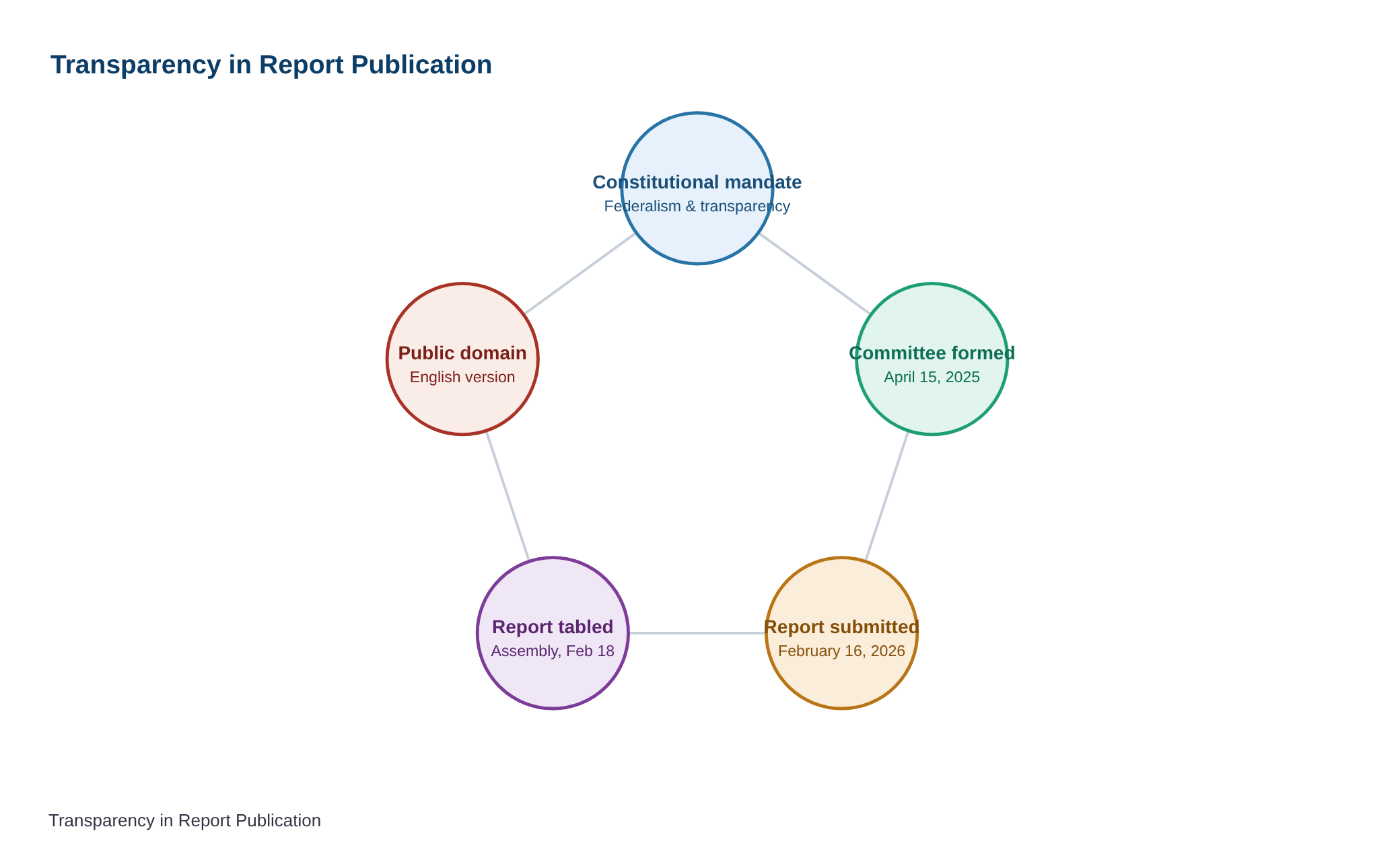
Constitutional mandate for federalism and transparency -> Establishment of High-Level Committee on Union-State Relations (April 15, 2025) -> Committee submits Part I of the report (February 16, 2026) -> State government tables report in Assembly (February 18, 2026) -> Public demand for English version access -> Government Order mandating public release (July 30, 2026) -> Hosting of report on official portal (August 2026) -> Enhanced transparency and accountability in governance.
Prelims Practice Questions
Q1. Consider the following statements regarding the High-Level Committee on Union-State Relations in Tamil Nadu:
1. The committee was constituted by the previous DMK government on April 15, 2025.
2. It was headed by retired Supreme Court judge Justice Kurian Joseph.
3. The committee submitted Part I of its report to the then Chief Minister M.K. Stalin on February 16, 2026.
4. The English version of Part I of the report was made available in the public domain before the Tamil version.
How many of the above statements are correct?
- Only one
- Only two
- Only three
- All
Answer: Only three — Statements 1, 2, and 3 are correct. Statement 4 is incorrect as the Tamil version was already in the public domain, and the English version was subsequently made available.
Q2. Assertion (A): The Tamil Nadu government directed the High-Level Committee on Union-State Relations to cancel the exclusive copyright for the English version of Part I of its report.
Reason (R): The government aimed to ensure transparency and public access to the report by making it freely available in the public domain.
In the context of the above two statements, which one of the following is correct?
- Both A and R are true, and R is the correct explanation of A.
- Both A and R are true, but R is not the correct explanation of A.
- A is true, but R is false.
- A is false, but R is true.
Answer: Both A and R are true, and R is the correct explanation of A. — Both the Assertion (A) and Reason (R) are true, and the Reason (R) correctly explains the Assertion (A). The government’s directive to cancel copyright was to ensure public transparency by making the report freely accessible.
Q3. Match the following committees with their respective functions:
Column I (Committee)
A. Sarkaria Commission
B. Punchhi Commission
C. High-Level Committee on Union-State Relations, Tamil Nadu
D. Inter-State Council
Column II (Function)
1. Reviewed Centre-State relations and recommended structural changes
2. Constituted to examine Centre-State relations and suggest reforms
3. A constitutional body to facilitate coordination between the Centre and States
4. Examined issues of federalism and Centre-State disputes in Tamil Nadu
Select the correct match:
- A-2, B-1, C-4, D-3
- A-1, B-2, C-3, D-4
- A-3, B-4, C-1, D-2
- A-4, B-3, C-2, D-1
Answer: A-2, B-1, C-4, D-3 — A-2 (Sarkaria Commission examined Centre-State relations and suggested reforms), B-1 (Punchhi Commission reviewed Centre-State relations and recommended structural changes), C-4 (High-Level Committee on Union-State Relations examined federalism issues in Tamil Nadu), D-3 (Inter-State Council is a constitutional body for Centre-State coordination).
Mains Practice Question
✍ Critically examine the significance of the Tamil Nadu government’s decision to make the English version of Part I of the High-Level Committee on Union-State Relations report publicly accessible. How does this decision reflect the principles of cooperative federalism and transparency in governance? (15 Marks)
Approach: MODEL-ANSWER SKELETON:
1. **Introduction**: Define cooperative federalism and its constitutional basis (Article 263, Inter-State Council).
2. **Context of the Committee**: Name the committee (High-Level Committee on Union-State Relations, Tamil Nadu), its composition (Justice Kurian Joseph, K. Ashok Vardhan Shetty, M. Naganathan), and its mandate (examining Centre-State relations and federalism issues).
3. **Decision Analysis**:
– **Transparency**: Explain how making the report publicly accessible aligns with the Right to Information (RTI) Act and democratic principles.
– **Federalism**: Discuss how such transparency strengthens cooperative federalism by enabling informed dialogue between the Centre and States.
– **Accountability**: Highlight the role of public scrutiny in ensuring accountability of institutions and policymakers.
4. **Constitutional and Legal Framework**: Reference Article 263 (Provisions with respect to an Inter-State Council) and the importance of institutional mechanisms for Centre-State coordination.
5. **Critique and Challenges**:
– Discuss potential limitations (e.g., selective disclosure, lack of binding recommendations).
– Compare with other states’ initiatives on federalism transparency.
6. **Conclusion**: Summarize the decision’s contribution to democratic governance and federalism, with a balanced view of its impact.
Source: The Hindu
Generated by AanyaAi for educational purpose.

- आंध्र प्रदेश में चार नए पुलिस आयुक्तालयों को कैबिनेट की मंजूरी, जानिए क्या होंगे फायदे - September 23, 2026
- Andhra Pradesh to get 4 new Police Commissionerates: Key UPSC insights - September 23, 2026
- AI आधारित ‘HEADS’ से भारत में अवसाद जांच में क्रांति: जानिए कैसे होगा मदद - September 23, 2026

No Comments