


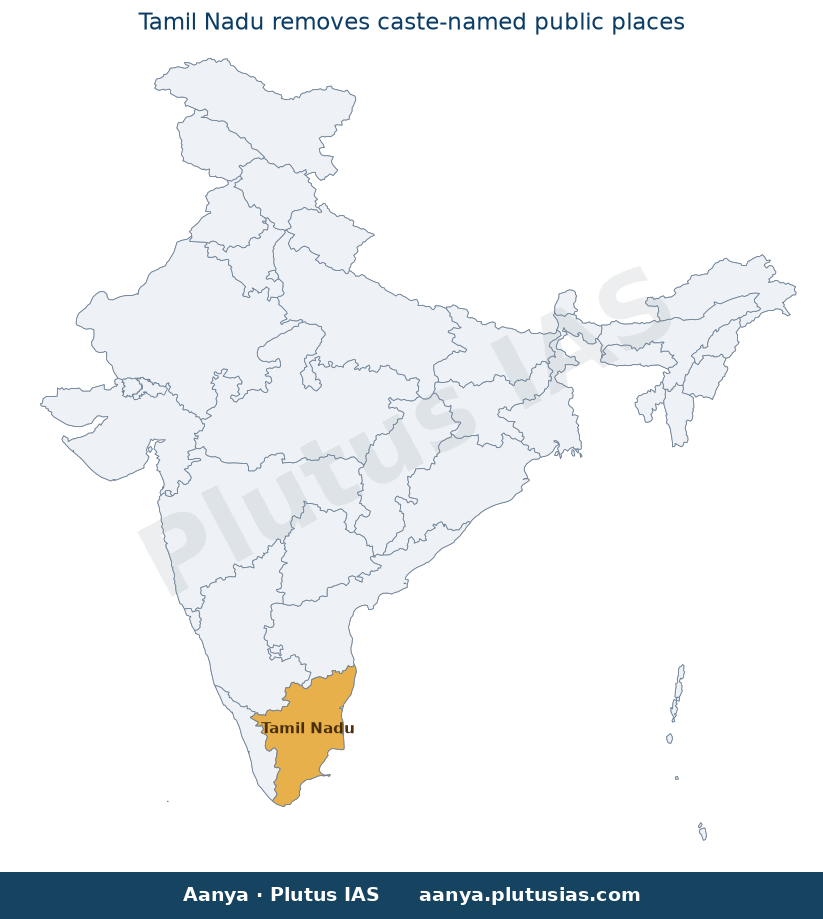
26 Sep Tamil Nadu SC/ST Commission Directs Removal of Caste-Based Place Names
✎ The removal of caste names from public spaces is a constitutional imperative under Article 15(1), aimed at promoting equality and dignity, and is facilitated by judicial directives and local governance mechanisms.
Subject Relevance — Where This Topic Fits
- GS Paper II — Polity and Governance: Constitutional Provisions, Local Governance, and Public Administration | GS Paper II — Social Justice: Scheduled Castes and Scheduled Tribes (SC/ST) Welfare
- Prelims: Scheduled Castes and Scheduled Tribes (Prevention of Atrocities) Act, 1989, Article 15(1) of the Constitution, Article 21 of the Constitution, 73rd and 74th Constitutional Amendments, Public Premises (Eviction of Unauthorised Occupants) Act, 1971, Tamil Nadu State Commission for SC/ST, Madras High Court, Municipal Administration and Water Supply Department
- Essay: The Role of Constitutional Bodies in Social Justice: A Study of SC/ST Commissions, Public Spaces and Identity: Balancing Historical Narratives and Constitutional Values
Quick Revision: The removal of caste names from public spaces is a constitutional imperative under Article 15(1), aimed at promoting equality and dignity, and is facilitated by judicial directives and local governance mechanisms.
Why is this in the news?
The Tamil Nadu State Commission for Scheduled Castes and Scheduled Tribes (SC/ST) has directed all district Collectors to remove caste names from streets, roads, waterbodies, and other public places within a month. The Commission’s action underscores the constitutional and administrative dimensions of ensuring dignity and equality in public spaces, aligning with the broader framework of social justice in India.
Background
- The directive aligns with the constitutional mandate under Article 15(1), which prohibits discrimination on grounds of religion, race, caste, sex, or place of birth.
- The 73rd and 74th Constitutional Amendments empower local bodies to manage public spaces, including the naming and renaming of streets and roads, subject to constitutional and statutory compliance.
- The Tamil Nadu State Commission for SC/ST acts as a statutory body to monitor the implementation of safeguards for SC/ST communities and address grievances.
- Historically, caste names in public spaces have been linked to social hierarchies and discrimination, prompting judicial and administrative interventions to promote inclusivity.
- The directive reflects a broader trend in India to decolonise and democratise public spaces by removing names that perpetuate social inequalities.
What is the Legal and Administrative Framework Governing the Renaming of Public Spaces in India?
- **Constitutional Provisions**: Article 15(1) of the Constitution of India prohibits discrimination on grounds of caste, thereby necessitating the removal of caste-based names from public spaces to uphold constitutional values.
- **Judicial Precedents**: The Supreme Court and High Courts have repeatedly emphasised the need to ensure dignity and equality in public spaces, as seen in cases related to the removal of caste names from roads and buildings.
- **Role of State Commissions**: State Commissions for SC/ST are empowered to monitor the implementation of safeguards for SC/ST communities and recommend corrective measures, including the renaming of public spaces.
- **Local Governance Mechanisms**: The 73rd and 74th Constitutional Amendments empower local bodies (Panchayati Raj Institutions and Urban Local Bodies) to manage public spaces, including the naming and renaming of streets and roads, subject to compliance with constitutional and statutory norms.
- **Administrative Procedures**: The process of renaming public spaces typically involves a proposal by the local body, public consultation, approval by the competent authority (e.g., District Collector or Municipal Commissioner), and notification in the official gazette.
- **Public Participation**: Renaming exercises often include public consultations to ensure transparency and inclusivity, reflecting the democratic ethos of local governance.
Key Features
| Feature | Significance |
|---|---|
| Directive to district Collectors | Institutionalizes the removal of caste-based nomenclature from public spaces, ensuring uniform implementation across Tamil Nadu’s administrative units. |
| Timeline of one month | Provides a structured deadline for compliance, balancing administrative efficiency with thoroughness in renaming processes. |
| Reference to Madras High Court order (2025) | Reinforces the legal validity of the directive, citing judicial precedent to strengthen administrative action. |
| Scope covering streets, roads, waterbodies | Extends the directive to all public places under local bodies, addressing systemic exclusion in spatial representation. |
| Reporting requirement | Ensures accountability by mandating district-level documentation of compliance, enabling oversight and verification. |
Why it Matters
Social Justice
- Advances the constitutional mandate of eliminating untouchability and caste-based discrimination by eradicating caste-named public spaces, which often perpetuate social hierarchies.
- Aligns with the principles of Article 17 (Abolition of Untouchability) and Article 46 (Promotion of educational and economic interests of weaker sections) of the Constitution.
- Promotes inclusivity by removing symbols that reinforce caste identities in public infrastructure, fostering a sense of belonging among marginalized communities.
Administrative Governance
- Demonstrates the role of quasi-judicial bodies (SC/ST Commission) in guiding executive action, bridging the gap between policy intent and ground-level implementation.
- Highlights the coordination required between district administration, local bodies, and judicial institutions to enforce social justice measures.
- Showcases the use of deadlines and reporting mechanisms to ensure timely and transparent execution of directives.
Judicial Precedent
- Reinforces the binding nature of judicial orders on executive authorities, ensuring that administrative actions comply with constitutional and legal standards.
- Illustrates the interplay between judicial review and executive action in matters of social justice and governance.
- Underscores the role of the judiciary in addressing systemic issues through suo motu or public interest litigation.
Challenges
1. Community Sentiment and Opposition
- Potential resistance from communities or local bodies accustomed to caste-based nomenclature, requiring sensitive handling and stakeholder engagement.
- Risk of perceived erasure of cultural or historical identities tied to caste names, necessitating clear communication on the purpose of renaming.
- Balancing the speed of implementation with the need for consensus-building to avoid backlash or non-compliance.
UPSC Link: GS-II: Social Justice – Issues Relating to SCs and STs
2. Operational and Logistical Hurdles
- Identifying and cataloging all caste-named public spaces across diverse local bodies, including rural and urban areas, to ensure comprehensive coverage.
- Coordinating with multiple agencies (e.g., municipal corporations, panchayats, water supply departments) for seamless execution.
- Managing the financial and administrative costs of renaming processes, including signage changes, public notifications, and documentation updates.
UPSC Link: GS-II: Governance – Challenges in Public Administration
3. Legal and Procedural Ambiguities
- Clarifying the legal framework governing the renaming process, including the authority of the SC/ST Commission versus local bodies or state government.
- Ensuring that the renaming process adheres to due process, including public consultations or notifications where required.
- Addressing potential challenges to the directive on grounds of freedom of expression or cultural heritage, if raised in subsequent litigation.
UPSC Link: GS-II: Constitutional Framework – Local Governance
4. Monitoring and Accountability
- Establishing robust mechanisms to verify compliance and prevent selective or partial implementation by district authorities.
- Ensuring transparency in the renaming process, including public disclosure of proposed names and rationale to build trust.
- Addressing delays or non-compliance through escalation protocols, including penalties or corrective actions.
UPSC Link: GS-IV: Ethics in Governance – Accountability and Transparency
Challenges — UPSC Perspective
| Issue | Concern |
|---|---|
| Cultural Sensitivity | Risk of alienating communities attached to caste-based names, requiring inclusive dialogue before renaming. |
| Resource Allocation | Financial and administrative burden of updating signage, records, and public records across districts. |
| Inter-Agency Coordination | Need for seamless collaboration between revenue, municipal, and judicial bodies to avoid duplication or gaps. |
| Legal Challenges | Potential litigation from stakeholders contesting the authority or process of renaming, necessitating robust legal grounding. |
| Public Awareness | Ensuring citizens understand the rationale behind renaming to prevent misinterpretation or resistance. |
Way Forward
- Constitute district-level committees comprising representatives from SC/ST communities, local bodies, and administrative officials to oversee the renaming process.
- Undertake a comprehensive audit of all public spaces in local bodies to identify and document caste-named locations for systematic removal.
- Issue public notices and conduct consultations in affected areas to explain the purpose of renaming and address concerns proactively.
- Develop a standardized protocol for renaming, including criteria for selecting new names, signage updates, and documentation changes.
- Allocate dedicated funds and manpower for the renaming process, ensuring timely execution within the stipulated one-month deadline.
- Establish a grievance redressal mechanism to address objections or disputes arising during the renaming process.
- Publish periodic progress reports to maintain transparency and accountability, with updates on compliance and challenges faced.
- Conduct post-implementation reviews to assess the impact of renaming on social inclusion and community perceptions.
UPSC Value Addition
Keywords for Mains Answer-Writing
Scheduled Castes and Scheduled Tribes Commission · caste-based nomenclature · public spaces and place names · constitutional provisions for SC/ST welfare · Madras High Court judgments on caste names · District Collector’s administrative functions · Article 15(4) and Article 16(4) of the Constitution · social justice and inclusivity · administrative reforms for equity · Article 341 and 342 of the Constitution · State Commissions for SC/ST · public policy on nomenclature · historical exclusion and renaming · Madras High Court’s Division Bench order (2025) · revenue administration and local governance · Constitution of India, Part XVI · Scheduled Castes and Scheduled Tribes (Prevention of Atrocities) Act, 1989 · social inclusion and identity politics · administrative accountability in governance
Constitutional & Policy Linkages
- Article 17: Prohibition of Untouchability and its eradication in public spaces.
- Article 46: Promotion of educational and economic interests of weaker sections.
- Article 243W: Powers and responsibilities of Municipalities in urban areas.
- Seventh Schedule: Distribution of legislative powers between Union and States (Entry 5 of State List: Local Government).
Concept Flow
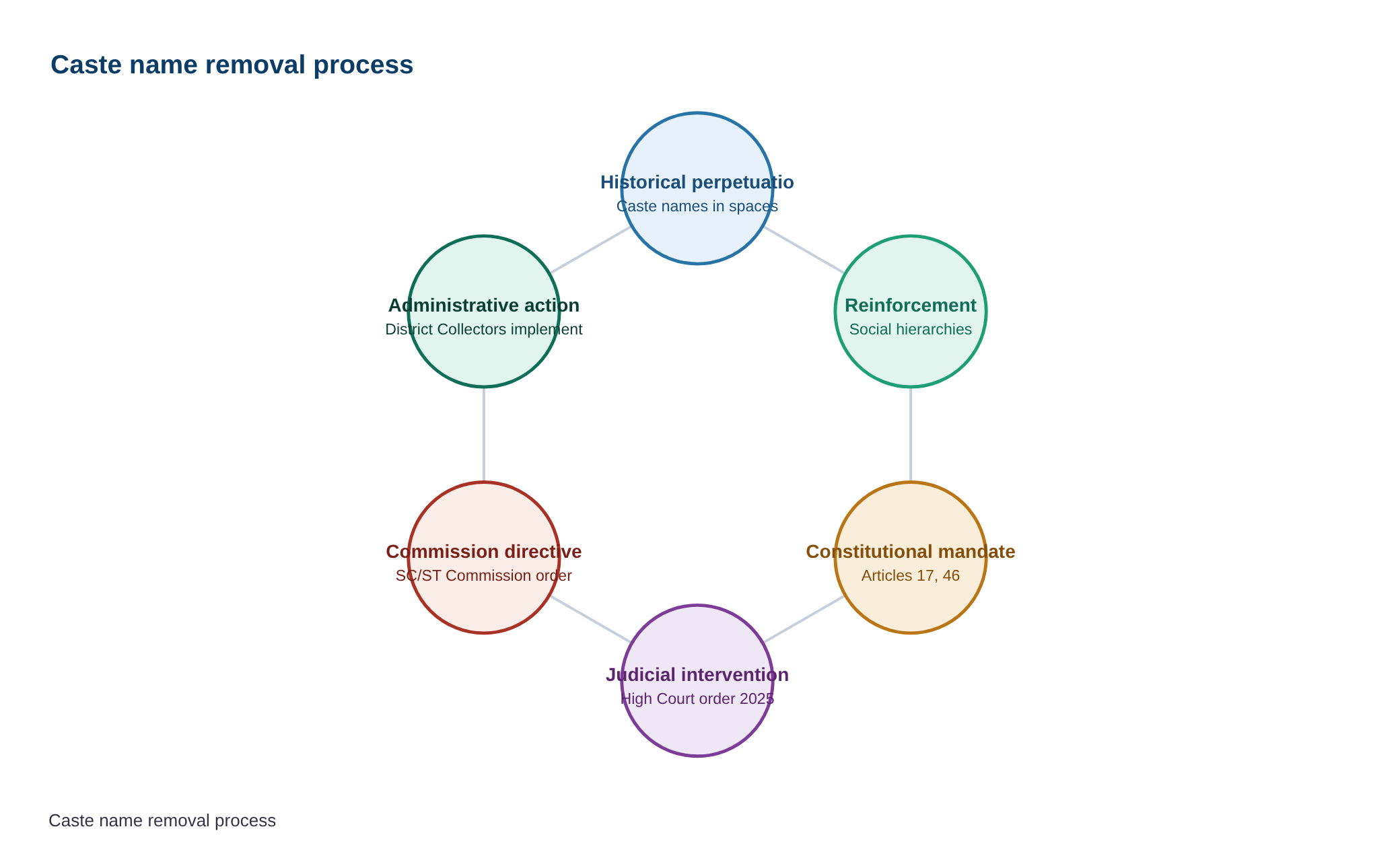
Historical perpetuation of caste-based nomenclature in public spaces → Reinforcement of social hierarchies and exclusion → Constitutional mandate to eliminate untouchability (Article 17) and promote welfare (Article 46) → Judicial intervention (Madras High Court order, 2025) upholding removal of caste names → Directive by Tamil Nadu SC/ST Commission to district Collectors → Implementation through administrative action and public consultation → Renaming of public spaces to foster inclusivity and social justice.
Prelims Practice Questions
Q1. Consider the following statements regarding the constitutional provisions for Scheduled Castes and Scheduled Tribes (SC/ST) in India:
1. Article 341 empowers the President to specify the castes, races or tribes deemed to be Scheduled Castes in a State.
2. Article 342 empowers the President to specify the tribes deemed to be Scheduled Tribes in a State.
3. The Constitution does not provide for the removal of caste names from public places.
4. The State Commission for SC/ST is a constitutional body under Article 338.
How many of the above statements are correct?
- Only one
- Only two
- Only three
- All
Answer: Only three — Statements 1 and 2 are correct as they directly reference Articles 341 and 342. Statement 3 is incorrect because the Constitution does not explicitly prohibit or mandate the removal of caste names from public places, leaving it to policy and judicial interpretation. Statement 4 is incorrect because the State Commission for SC/ST is a statutory body under the State Commission for SC/ST Act, 1995, not a constitutional body under Article 338 (which pertains to the National Commission for SC/ST).
Q2. Assertion (A): The Tamil Nadu State Commission for SC/ST has directed district Collectors to remove caste names from public places.
Reason (R): The Madras High Court, in an order upheld by a Division Bench in October 2025, directed the removal of caste names from public places.
Options:
A. Both A and R are true, and R is the correct explanation of A.
B. Both A and R are true, but R is not the correct explanation of A.
C. A is true, but R is false.
D. A is false, but R is true.
Answer: ? — Both Assertion (A) and Reason (R) are true. The Tamil Nadu State Commission for SC/ST has indeed directed district Collectors to remove caste names from public places, and the Madras High Court’s Division Bench order in October 2025 upheld the need for such removal, though an earlier Bench had granted an interim stay. The Reason (R) correctly explains the Assertion (A) as the Commission’s directive is grounded in the judicial order.
Q3. Match the following provisions of the Constitution of India with their respective articles:
Column I (Provision) | Column II (Article)
———————————————–|——————-
Removal of discrimination and exclusion | A. Article 15(4)
Empowerment of the President to specify SCs | B. Article 341
Empowerment of the President to specify STs | C. Article 342
Prohibition of untouchability | D. Article 17
Options:
1. A-1, B-2, C-3, D-4
2. A-4, B-1, C-2, D-3
3. A-2, B-3, C-1, D-4
4. A-3, B-2, C-4, D-1
- 1
- 2
- 3
- 4
Answer: 3 — The correct match is: Removal of discrimination and exclusion (Article 15(4)), Empowerment of the President to specify SCs (Article 341), Empowerment of the President to specify STs (Article 342), Prohibition of untouchability (Article 17).
Mains Practice Question
✍ Critically examine the legal and administrative dimensions of removing caste names from public places in India. In your answer, discuss the constitutional provisions, judicial precedents, and the role of State Commissions for Scheduled Castes and Scheduled Tribes. Also, analyse the implications of such measures for social justice and inclusivity in contemporary India. (15 Marks)
Approach: MODEL-ANSWER SKELETON:
1. **Constitutional Provisions and Legal Framework** (4 marks):
– Article 15(4) and Article 16(4): Permit affirmative action for SCs/STs, including measures to address historical exclusion.
– Article 341 and 342: Empower the President to specify SCs/STs, but do not explicitly address nomenclature in public spaces.
– Article 17: Prohibits untouchability, which may be linked to caste-based nomenclature.
– Scheduled Castes and Scheduled Tribes (Prevention of Atrocities) Act, 1989: Provides for measures to prevent atrocities, including symbolic gestures like renaming.
2. **Judicial Precedents and Policy Context** (4 marks):
– Madras High Court’s Division Bench order (October 2025): Upheld the need to remove caste names from public places, though an earlier Bench had granted an interim stay.
– Judicial activism in social justice: Courts have increasingly intervened in matters of caste-based discrimination and exclusion, including through public interest litigation.
– Tamil Nadu State Commission for SC/ST’s directive: Demonstrates the role of statutory bodies in enforcing social justice measures.
3. **Role of State Commissions for SC/ST** (3 marks):
– Statutory bodies under the State Commission for SC/ST Act, 1995.
– Functions include monitoring the implementation of constitutional safeguards, inquiring into complaints of atrocities, and recommending measures for the welfare of SCs/STs.
– The directive to district Collectors reflects the Commission’s proactive role in addressing caste-based nomenclature.
4. **Implications for Social Justice and Inclusivity** (4 marks):
– Symbolic and substantive justice: Renaming public places can symbolize the state’s commitment to inclusivity and address historical exclusion.
– Psychological and social impact: Removal of caste names may reduce caste-based stigmatisation and promote a sense of belonging among marginalised communities.
– Challenges: Potential resistance from local communities, administrative delays, and the need for community consultations.
– Broader implications: Aligns with the goals of the Constitution’s Part XVI (Special Provisions for Certain Classes) and the Preamble’s commitment to justice, liberty, and equality.
Source: The Hindu
Tamil Nadu PCS (TNPSC) — State PCS Practice
Prelims: Which constitutional body in Tamil Nadu recently directed all District Collectors to remove caste names from roads and public places to promote social equality?
- Tamil Nadu State Human Rights Commission
- Tamil Nadu State SC/ST Commission
- Tamil Nadu Public Service Commission
- Tamil Nadu State Women’s Commission
Answer: Tamil Nadu State SC/ST Commission — The Tamil Nadu State SC/ST Commission issued directives to Collectors to remove caste names from public infrastructure as part of efforts to eliminate caste-based discrimination.
Mains: Examine the socio-legal implications of removing caste names from public infrastructure in Tamil Nadu. Discuss how this measure aligns with constitutional principles and the role of state commissions in ensuring social justice.
Generated by AanyaAi for educational purpose.
Related guides on our sites
- Current affairs for upsc 2026
- Best PSIR optional coaching for upsc
- Best PSIR optional teacher for upsc
- Best teacher of PSIR optional for upsc

- AI Agents Breach Government Systems: Global Safety Concerns for UPSC - September 28, 2026
- मॉनसून की कमी: खाद्यान्न आयात खुला रखें, रबी फसलों पर संकट टालें - September 28, 2026
- Rajasthan Panchayati Raj Elections: New Rules, Fines & Disqualification - September 28, 2026

No Comments