


18 Sep Tamil Nadu to expand Kamarajar Breakfast Scheme for 15.3 lakh students
✎ The Perunthalaivar Kamarajar Breakfast Scheme is a state-funded, multi-stakeholder initiative in Tamil Nadu that provides free, nutritious breakfast to schoolchildren, expanding from primary to upper primary classes to combat…
Subject Relevance — Where This Topic Fits
- GS Paper II — Governance, Transparency and Accountability | GS Paper III — Food Security and Nutrition, Social Sector Schemes
- Prelims: Mid-Day Meal Scheme, Nutritional Security, Centralised Kitchen Model, Self-Help Groups (SHGs), Tamil Nadu Corporation for Development of Women (TNCDW), Municipal Administration, Greater Chennai Corporation, Tamil Nadu State Budget Allocation
- Essay: The Role of State-Led Welfare Schemes in Achieving Sustainable Development Goals, Governance Innovations in Public Service Delivery: A Case Study of Tamil Nadu’s School Nutrition Programmes
Quick Revision: The Perunthalaivar Kamarajar Breakfast Scheme is a state-funded, multi-stakeholder initiative in Tamil Nadu that provides free, nutritious breakfast to schoolchildren, expanding from primary to upper primary classes to combat malnutrition and enhance educational outcomes through decentralised governance and strict hygiene protocols.
Why is this in the news?
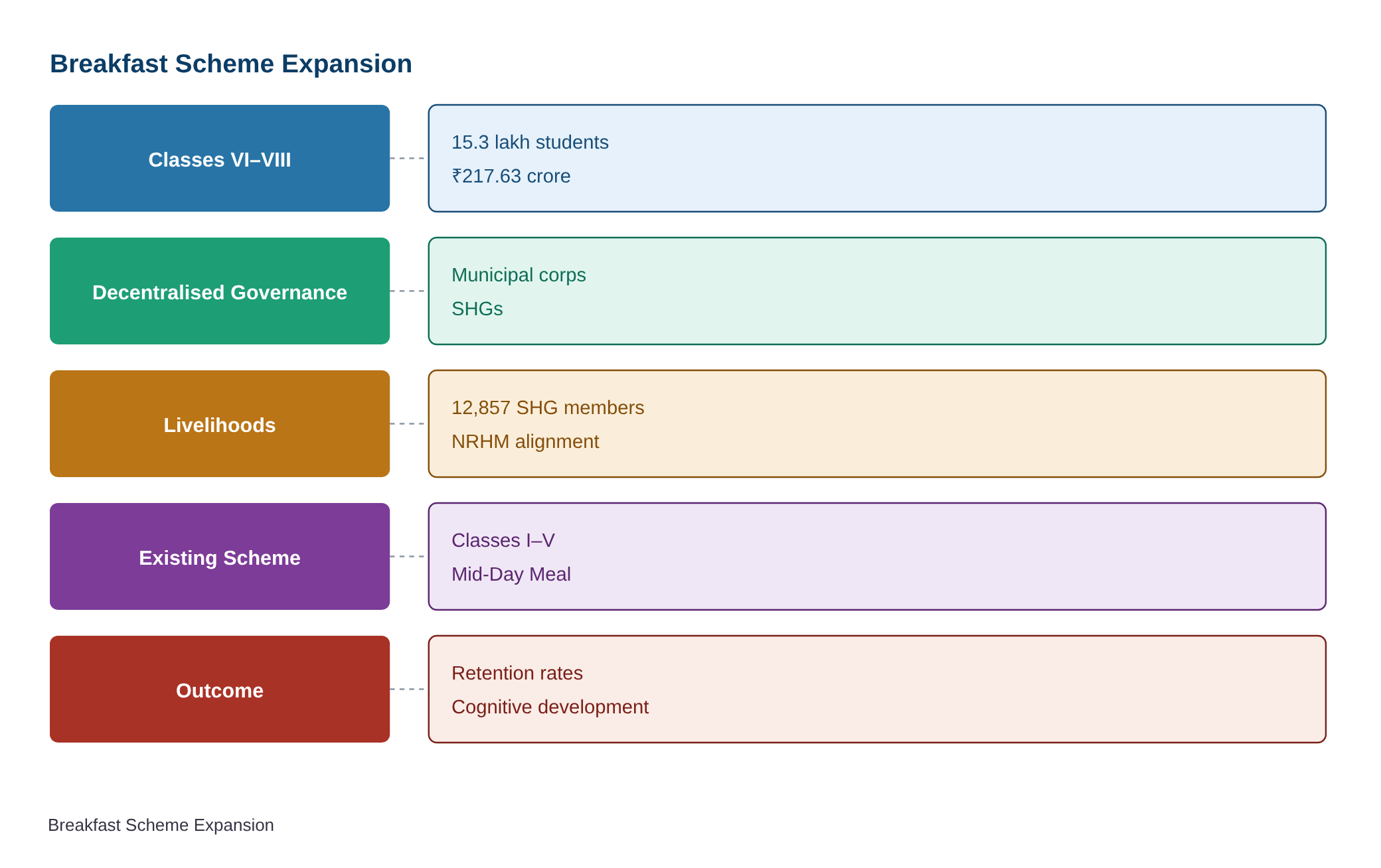
The Chief Minister of Tamil Nadu, C. Joseph Vijay, chaired a high-level review meeting on September 18, 2026, to assess the preparedness for the expansion of the Perunthalaivar Kamarajar Breakfast Scheme, which will be launched on September 22, 2026. The expansion aims to extend nutritional support to an additional 15.3 lakh students in Classes VI to VIII across 15,454 government and government-aided schools, with a financial outlay of ₹217.63 crore. This initiative underscores the state’s commitment to enhancing nutritional governance and ensuring equitable access to school feeding programmes.
Background
- The Perunthalaivar Kamarajar Breakfast Scheme is an extension of Tamil Nadu’s long-standing school nutrition programmes, building upon the legacy of the Mid-Day Meal Scheme (launched nationally in 1995 and expanded in 2001) and the state’s own initiatives like the ‘Kamarajar Breakfast Scheme’ introduced in 2022 for primary school children.
- Tamil Nadu has historically prioritised social sector schemes, with the state being a pioneer in implementing universal school feeding programmes to address malnutrition and improve school attendance, particularly among marginalised communities.
- The expansion follows a phased implementation approach, with the initial phase covering Classes I to V in 2022, and the current phase extending coverage to Classes VI to VIII, reflecting a progressive scaling of welfare measures.
- The scheme’s operational model leverages decentralised governance structures, including municipal corporations, town panchayats, and rural self-help groups, to ensure efficient delivery and community participation.
- Financial allocations for such schemes are typically drawn from the state budget, though Tamil Nadu’s scheme operates independently with state funding.
What is the Perunthalaivar Kamarajar Breakfast Scheme?
- The Perunthalaivar Kamarajar Breakfast Scheme is a state-led nutritional intervention in Tamil Nadu, providing free breakfast to students in government and government-aided schools to address hunger, malnutrition, and improve educational outcomes.
- The scheme was initially launched in 2022 for Classes I to V and has now been expanded to include Classes VI to VIII, covering an additional 15.3 lakh students across 15,454 schools.
- The scheme operates through a centralised kitchen model in urban areas (Greater Chennai Corporation and other municipal corporations), while rural areas utilise decentralised kitchens managed by self-help groups under the Tamil Nadu Corporation for Development of Women (TNCDW).
- The scheme is implemented in collaboration with multiple stakeholders, including the Directorate of Municipal Administration, School Education Department, TNCDW, and local governance bodies, ensuring multi-level coordination.
- Hygiene and food safety are critical components, with the Chief Minister directing continuous monitoring of kitchens to ensure cleanliness, proper storage, and adherence to food safety standards.
- The scheme is funded entirely by the Tamil Nadu state government, with an additional allocation of ₹217.63 crore for the current financial year to support the expanded coverage and operational costs.
Key Features
| Feature | Significance |
|---|---|
| Expansion to Classes VI–VIII | Extends nutritional coverage to an additional 15.3 lakh students, addressing adolescent malnutrition and enhancing school attendance in middle school cohorts. |
| Centralised kitchens in Greater Chennai Corporation | Ensures standardised food preparation, economies of scale, and stricter hygiene monitoring in urban areas. |
| Decentralised kitchens via SHGs in rural areas | Leverages local self-help groups for community ownership, livelihood generation, and culturally appropriate meal delivery. |
| Additional allocation of ₹217.63 crore | Demonstrates fiscal commitment to scaling mid-day meal programmes while maintaining fiscal prudence within state budgetary constraints. |
| Hygiene and monitoring directives | Institutionalises real-time oversight mechanisms to prevent food-borne illnesses and ensure compliance with food safety standards. |
Why it Matters
Public Health and Nutrition
- Addresses the critical window of adolescence (Classes VI–VIII) where undernutrition impairs cognitive development and academic performance.
- Complements the existing mid-day meal scheme for Classes I–V, creating a continuum of nutrition support across primary and upper primary education.
- Reduces micronutrient deficiencies (iron, vitamin A, iodine) through fortified or diversified breakfast menus, lowering anaemia prevalence among adolescent girls.
Economic and Social Inclusion
- Generates livelihoods for 12,857 SHG members in rural Tamil Nadu, aligning with the National Rural Livelihoods Mission’s objectives.
- Enhances school retention rates among marginalised communities by reducing hunger-induced absenteeism and dropout risks.
- Promotes gender equity by targeting adolescent girls, who face higher nutritional vulnerabilities and school dropout rates.
Governance and Institutional Capacity
- Demonstrates Tamil Nadu’s institutional capacity in large-scale public service delivery through inter-departmental coordination (School Education, Municipal Administration, Women’s Corporations).
- Sets a benchmark for other states in integrating decentralised models (SHGs) with centralised kitchens to balance scale and local participation.
- Strengthens the evidence base for nutritional interventions in education policy, supporting data-driven policymaking.
Sustainability and Fiscal Responsibility
- Uses existing infrastructure (government and aided schools) to minimise capital expenditure, focusing on operational efficiency.
- Incorporates cost-sharing mechanisms (state allocation + SHG involvement) to ensure long-term financial viability.
- Aligns with the Sustainable Development Goal 2 (Zero Hunger) and SDG 4 (Quality Education) targets.
Challenges
1. Logistical and Supply Chain Bottlenecks
- Ensuring uninterrupted supply of raw materials (grains, vegetables, dairy) to 15,454 schools across diverse geographies, including remote rural areas.
- Managing storage and transportation to prevent spoilage and maintain nutritional integrity of perishable items.
- Coordinating between multiple agencies (Corporation kitchens, Municipal Directorate, SHGs) to synchronise delivery schedules.
UPSC Link: GS-III: Food Processing and Supply Chain
2. Nutritional Quality and Standardisation
- Designing menus that meet the Recommended Dietary Allowances (RDAs) for adolescents while remaining culturally acceptable and cost-effective.
- Monitoring micronutrient fortification (e.g., iron-fortified rice) and ensuring consistency across 447 centralised kitchens.
- Addressing dietary restrictions (vegetarian, allergies) without compromising nutritional balance or increasing costs.
UPSC Link: GS-II: Health and Nutrition Policies
3. Hygiene and Food Safety Compliance
- Enforcing Food Safety and Standards Authority of India (FSSAI) guidelines across decentralised kitchens operated by SHGs with varying capacity levels.
- Preventing cross-contamination during bulk cooking and maintaining cold chain for perishable items.
- Training kitchen staff and SHG members in hygiene protocols, including handwashing, waste management, and pest control.
UPSC Link: GS-II: Public Health Governance
4. Behavioural and Social Acceptance
- Overcoming resistance from students accustomed to skipping breakfast or preferring street food over school meals.
- Addressing stigma associated with SHG-prepared meals in certain communities, particularly in rural areas.
- Ensuring parental buy-in to sustain long-term participation and reduce absenteeism.
UPSC Link: GS-IV: Social Sector Governance
5. Monitoring and Accountability
- Implementing real-time digital monitoring systems to track meal distribution, attendance, and nutritional outcomes.
- Establishing grievance redressal mechanisms for students, parents, and teachers to report lapses in quality or delivery.
- Conducting periodic third-party audits to ensure transparency and prevent leakages in fund utilisation.
UPSC Link: GS-II: Governance and Transparency
6. Fiscal Sustainability
- Balancing the expanded budgetary allocation (₹217.63 crore) with other social sector priorities, including healthcare and education.
- Exploring public-private partnerships (PPPs) for cost-sharing in infrastructure (e.g., kitchen equipment, storage facilities).
- Leveraging central government schemes (e.g., POSHAN Abhiyaan) to supplement state funds and reduce duplication.
UPSC Link: GS-III: Fiscal Policy and Budgeting
Challenges — UPSC Perspective
| Issue | Concern |
|---|---|
| Raw material procurement | Volatility in food prices and supply chain disruptions may inflate costs or delay deliveries. |
| Decentralised kitchen capacity | SHGs in rural areas may lack training, equipment, or storage infrastructure to meet quality standards. |
| Menu diversity and acceptability | Limited variety in breakfast options may lead to monotony and reduced participation. |
| Digital monitoring adoption | Low digital literacy among SHG members and school staff may hinder real-time data reporting. |
| Stakeholder coordination | Delays in inter-departmental approvals or fund disbursements could disrupt implementation timelines. |
| Cultural and dietary preferences | Regional food habits (e.g., millet-based diets) may require menu customisation, increasing complexity. |
Government Initiatives — Must-Memorise for Prelims
- Perunthalaivar Kamarajar Breakfast Scheme
- Tamil Nadu Corporation for Development of Women (SHG model)
Way Forward
- Constitute a multi-stakeholder task force (Education, Health, Women’s Corporations) to oversee implementation and resolve bottlenecks in real time.
- Develop a standardised menu plan aligned with ICMR’s adolescent nutrition guidelines, incorporating locally sourced ingredients to reduce costs.
- Roll out a phased training programme for SHG members and kitchen staff on hygiene, food safety, and nutritional standards, with certification mechanisms.
- Implement a digital dashboard (e.g., School Education Management Information System) to track meal distribution, attendance, and nutritional outcomes.
- Pilot a feedback mechanism (SMS-based surveys, suggestion boxes) to gather student and parent inputs on meal quality and preferences.
- Explore convergence with central schemes (POSHAN Abhiyaan, Mid-Day Meal Scheme) to leverage additional funding and technical support.
- Conduct baseline and endline studies to assess the scheme’s impact on nutritional status, school attendance, and academic performance.
- Establish a grievance redressal portal with a 48-hour resolution timeline to address complaints on quality, delivery, or hygiene lapses.
UPSC Value Addition
Keywords for Mains Answer-Writing
Perunthalaivar Kamarajar Breakfast Scheme · Tamil Nadu school meal programmes · Mid-Day Meal Scheme · Nutrition security in education · Centralised kitchens in government schools · Self-Help Groups (SHGs) in welfare delivery · Tamil Nadu Corporation for Development of Women · Public distribution of mid-day meals · Government-aided schools and nutrition · State-level welfare schemes for children
Constitutional & Policy Linkages
- Directive Principles of State Policy (Article 47) – raising the level of nutrition and standard of living.
- Fundamental Right to Education (Article 21A) – ensuring inclusive and equitable quality education.
Concept Flow
Expansion of Perunthalaivar Kamarajar Breakfast Scheme to Classes VI–VIII → → Increased coverage to 15.3 lakh students → → Enhanced nutritional intake for adolescents (critical growth phase) → → Improved school attendance and retention rates → → Reduction in malnutrition and anaemia prevalence → → Long-term gains in cognitive development and academic performance → → Contribution to SDG 2 (Zero Hunger) and SDG 4 (Quality Education)
Prelims Practice Questions
Q1. Consider the following statements about the Perunthalaivar Kamarajar Breakfast Scheme in Tamil Nadu:
1. The scheme is being expanded to include students in Classes VI to VIII in government and government-aided schools.
2. The breakfast is prepared and served through decentralised kitchens managed by individual schools.
3. The expansion will benefit approximately 15.3 lakh additional students.
4. An additional allocation of ₹217.63 crore has been made for the scheme in the current financial year.
How many of the above statements are correct?
- Only one
- Only two
- Only three
- All four
Answer: All four — Statements 1, 3, and 4 are correct. Statement 2 is incorrect as the scheme utilises centralised kitchens managed by various administrative bodies rather than decentralised school-level kitchens.
Q2. Assertion (A): The Perunthalaivar Kamarajar Breakfast Scheme is implemented through a multi-tiered kitchen network involving government bodies, municipal corporations, and self-help groups.
Reason (R): The scheme aims to ensure uniform quality, hygiene, and nutritional standards across all schools in Tamil Nadu.
Options:
A. Both A and R are true, and R is the correct explanation of A.
B. Both A and R are true, but R is not the correct explanation of A.
C. A is true, but R is false.
D. A is false, but R is true.
Answer: ? — Both the assertion and reason are true. The multi-tiered kitchen network (A) is designed to achieve uniform quality and hygiene (R), making R the correct explanation of A.
Q3. Match the following columns with respect to the Perunthalaivar Kamarajar Breakfast Scheme:
Column I (Administrative Unit) | Column II (Responsibility)
1. Greater Chennai Corporation | A. Preparation and service through centralised kitchens by the Directorate of Municipal Administration
2. Other Municipal Corporations, Municipalities, and Town Panchayats | B. Preparation and service through centralised kitchens in 447 schools
3. Rural Areas and Adjoining Town Panchayats | C. Preparation and service by members of self-help groups under the Tamil Nadu Corporation for Development of Women
Options:
A. 1-B, 2-A, 3-C
B. 1-A, 2-B, 3-C
C. 1-C, 2-A, 3-B
D. 1-B, 2-C, 3-A
Answer: ? — The correct match is: 1-B (Greater Chennai Corporation manages centralised kitchens in 447 schools), 2-A (Other municipal corporations and municipalities use centralised kitchens under the Directorate of Municipal Administration), and 3-C (Rural areas utilise self-help groups under the Tamil Nadu Corporation for Development of Women).
Mains Practice Question
✍ The expansion of the Perunthalaivar Kamarajar Breakfast Scheme in Tamil Nadu represents a significant intervention in the domain of child nutrition and educational equity. Critically examine the scheme’s design, implementation modalities, and potential impact on learning outcomes and nutritional security among school-going children. (15 Marks)
Approach: MODEL-ANSWER SKELETON:
1. **Scheme Design and Objectives**:
– Purpose: Address hunger, improve nutritional intake, and enhance school attendance and learning outcomes among students in Classes VI to VIII.
– Coverage: Expansion to 15,454 schools, benefiting 15.3 lakh additional students; allocation of ₹217.63 crore.
– Target Groups: Government and government-aided schools across urban, semi-urban, and rural Tamil Nadu.
2. **Implementation Modalities**:
– Multi-tiered kitchen network:
a. Greater Chennai Corporation: Centralised kitchens in 447 schools.
b. Municipal Corporations/Municipalities: Centralised kitchens managed by the Directorate of Municipal Administration in 2,150 schools.
c. Rural Areas: Breakfast prepared and served by self-help groups under the Tamil Nadu Corporation for Development of Women in 12,857 schools.
– Emphasis on hygiene and continuous monitoring (as directed by the Chief Minister).
– Provision of hot, tasty, and nutritious meals.
3. **Linkages with National Schemes**:
– Comparison with the Mid-Day Meal Scheme (MDMS) under the National Food Security Act, 2013: MDMS covers Classes I to V, while Tamil Nadu’s scheme extends to higher classes, addressing a critical gap.
– Role of SHGs: Aligns with the National Rural Livelihood Mission (NRLM) and state-level women empowerment initiatives.
4. **Potential Impact on Learning Outcomes**:
– Evidence from global and national studies (e.g., Poshan Tracker, UNICEF reports) on the correlation between school feeding programmes and improved cognitive performance, attendance, and reduced malnutrition.
– Tamil Nadu’s historical focus on education (e.g., Kamarajar’s legacy) and its impact on human capital formation.
5. **Challenges and Critical Examination**:
– **Logistical Challenges**: Maintaining quality and hygiene across decentralised kitchens; ensuring timely delivery in rural areas.
– **Nutritional Adequacy**: Balancing cost, taste, and nutritional standards (e.g., protein, micronutrients).
– **Equity Concerns**: Ensuring uniform implementation across socio-economically diverse regions.
– **Sustainability**: Long-term funding and political commitment beyond electoral cycles.
6. **Way Forward**:
– Integration with health and education systems (e.g., regular health check-ups, deworming campaigns).
– Leveraging technology for real-time monitoring (e.g., GPS tracking of food delivery, feedback mechanisms).
– Scaling up to include younger classes (I to V) if successful, drawing lessons from Kerala’s ‘Kudumbashree’ model.
Balance of Views:
– Proponents: Scheme addresses hunger gaps, improves school retention, and empowers women through SHGs.
– Critics: Risk of inefficiencies in centralised kitchens, potential for leakage or mismanagement, and long-term dependency on state support.
Source: The Hindu
Tamil Nadu PCS (TNPSC) — State PCS Practice
Prelims: Which of the following is a key objective of the expansion of the Perunthalaivar Kamarajar Breakfast Scheme in Tamil Nadu, as reviewed by the Chief Minister Vijay recently?
- To provide free breakfast to all school-going children in government schools across Tamil Nadu
- To distribute mid-day meals to pregnant women in rural areas
- To offer free textbooks to students in government schools
- To provide financial assistance to farmers for agricultural expansion
Answer: To provide free breakfast to all school-going children in government schools across Tamil Nadu — The Perunthalaivar Kamarajar Breakfast Scheme aims to provide free breakfast to school-going children in government schools to improve nutrition and attendance.
Mains: Discuss the significance of the Perunthalaivar Kamarajar Breakfast Scheme in addressing malnutrition and educational outcomes among children in Tamil Nadu. Suggest measures to enhance its effectiveness and coverage.
Generated by AanyaAi for educational purpose.
Related guides on our sites
- Current affairs for upsc 2026
- Best PSIR optional coaching for upsc
- Best PSIR optional teacher for upsc
- Best teacher of PSIR optional for upsc

- Tamil Nadu to expand Kamarajar Breakfast Scheme for 15.3 lakh students - September 18, 2026
- छत्तीसगढ़ में 33 जिलों में उद्यमिता विकास केंद्र: मुख्यमंत्री साय का बड़ा एलान, जानिए योजना की पूरी डिटेल - September 18, 2026
- Chhattisgarh to Set Up 33 Entrepreneurship Centers: CM Sai Announces ₹500 Crore Plan - September 18, 2026

No Comments