


27 Sep Tamil Nadu to provide ₹50 daily food allowance to sanitation workers
✎ The Greater Chennai Corporation’s ₹50 daily food allowance for conservancy workers exemplifies the shift from wage-in-kind to wage-in-cash models in urban labour welfare, addressing systemic inefficiencies while enhancing worker…
Subject Relevance — Where This Topic Fits
- GS Paper II — Governance, Welfare Schemes for Vulnerable Sections | GS Paper III — Labour Welfare and Social Security Measures
- Prelims: conservancy workers, Greater Chennai Corporation (GCC), food allowance, wage in-kind vs wage in-cash, Mahatma Gandhi National Rural Employment Guarantee Scheme (MGNREGS) provisions on wages, National Urban Livelihoods Mission (NULM), Pradhan Mantri Garib Kalyan Anna Yojana (PM-GKAY), Directive Principles of State Policy (DPSP) under Articles 38, 39, 41, 42, 43
- Essay: The Role of Urban Local Bodies in Ensuring Dignified Livelihoods, Balancing Efficiency and Equity in Public Service Delivery
Quick Revision: The Greater Chennai Corporation’s ₹50 daily food allowance for conservancy workers exemplifies the shift from wage-in-kind to wage-in-cash models in urban labour welfare, addressing systemic inefficiencies while enhancing worker autonomy and dignity.
Why is this in the news?
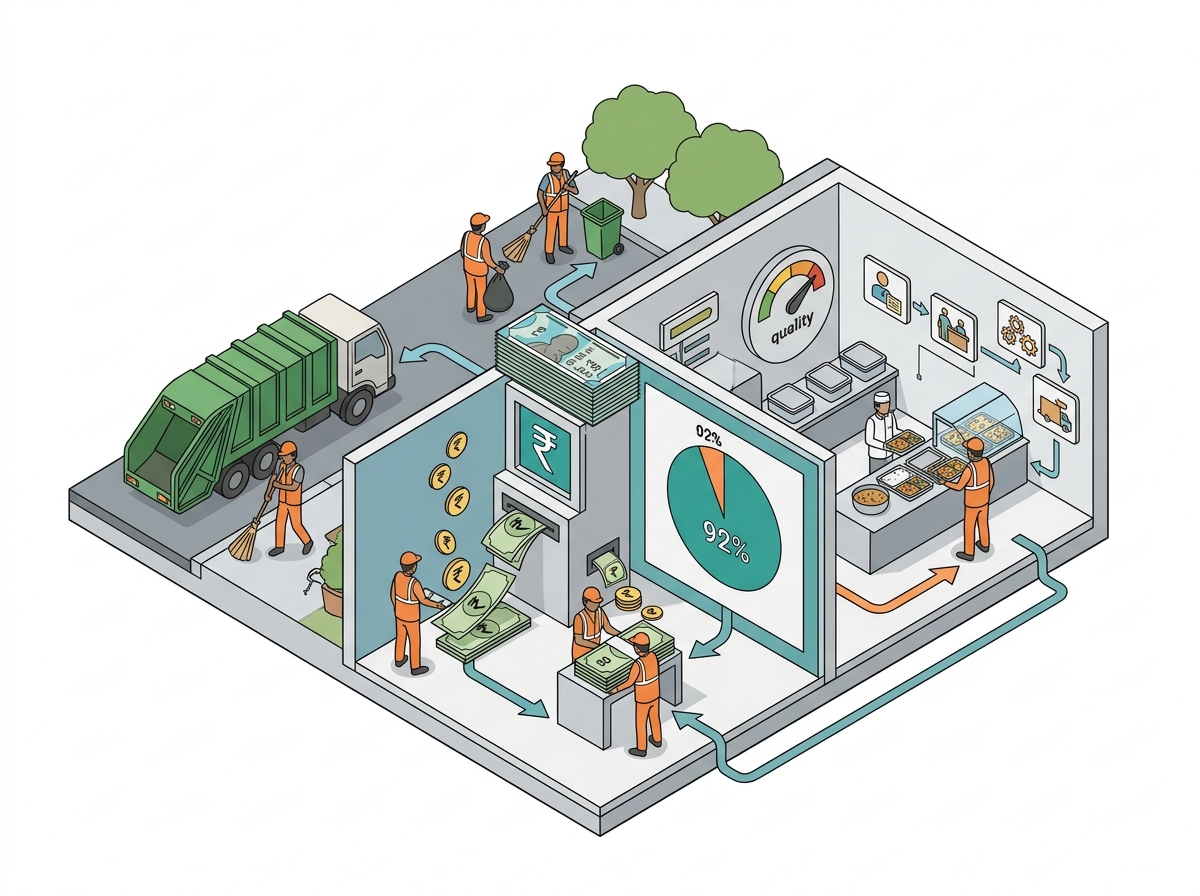
This decision, based on a worker preference survey indicating 92% support for cash over meals, underscores the evolving discourse on labour welfare in urban sanitation, particularly the shift from wage-in-kind to wage-in-cash models and the administrative challenges in ensuring quality and timeliness in public service delivery.
Background
- Conservancy workers, engaged in sanitation and waste management, form a critical yet often marginalised segment of the urban workforce, performing essential public health functions.
- Urban local bodies (ULBs) like the Greater Chennai Corporation are constitutionally mandated under the 74th Constitutional Amendment Act, 1992, to ensure welfare and social justice for such workers.
- The existing system of providing meals through contractors has historically faced criticism for issues related to quality, hygiene, and timeliness of distribution, as highlighted in the GCC order.
- The shift to a cash-based food allowance aligns with broader trends in labour welfare policy, including the codification of minimum wages and the preference for direct benefit transfers (DBT) under schemes like MGNREGS.
- The annual financial implication of ₹44.28 crore for the allowance is to be borne by the GCC’s own funds, reflecting fiscal federalism in urban governance.
The Food Allowance Mechanism for Conservancy Workers in Chennai
- The food allowance of ₹50 per day is payable only for working days attended by conservancy workers, ensuring a direct linkage between attendance and remuneration.
- The allowance is to be disbursed in cash as an alternative to the existing meals provided by contractor firms (Urbaser Sumeet and Chennai Enviro Solutions Private Limited), addressing systemic inefficiencies in meal distribution.
- The decision is based on a survey conducted across Zones 1 to 15 of the GCC, where 92% of workers expressed a preference for cash over meals, citing practical utility and autonomy in utilisation.
- The administrative rationale for the shift includes persistent complaints regarding food quality, hygiene deficiencies in kitchens, substandard raw materials, and delays in meal distribution under the contractor-led model.
- The allowance is to be added to the monthly salary of workers and disbursed through the existing payroll mechanisms of the GCC, ensuring seamless integration with existing labour welfare systems.
- The financial allocation of ₹44.28 crore annually is estimated to cover all 24,264 conservancy workers, including those employed through self-help groups and private agencies, ensuring equitable coverage.
- This initiative reflects a broader trend in urban governance towards direct benefit transfers (DBT), reducing leakages and enhancing the dignity of labour by empowering workers to make their own consumption choices.
- The GCC’s order also highlights the role of Project Management Consultants (PMCs) in monitoring the implementation, ensuring accountability and transparency in the transition process.
UPSC Value Addition
Keywords for Mains Answer-Writing
Sanitation workers · conservancy workers · food allowance · welfare of unorganised sector workers · Greater Chennai Corporation · labour welfare policy · cash transfers vs in-kind benefits · occupational health and safety · informal labour · municipal governance · social security for sanitation workers · Right to Food · wage supplementation · urban local bodies · public health and hygiene · labour rights in India
Prelims Practice Questions
Q1. Consider the following statements regarding the food allowance provided to sanitation workers in the Greater Chennai Corporation (GCC):
1. The allowance is ₹50 per worker per day and is paid in cash.
2. The allowance is provided only for working days attended by the worker.
3. The annual expenditure for the allowance is estimated to be ₹44.28 crore.
4. The allowance is provided as an alternative to meals supplied by contractors.
How many of the above statements are correct?
- Only one
- Only two
- Only three
- All
Answer: All — Statements 1, 2, and 4 are correct. Statement 3 is incorrect as the annual expenditure is estimated at ₹44.28 crore, but this is not explicitly stated to be the total annual cost for the allowance alone in the given context.
Q2. Assertion (A): The Tamil Nadu government’s decision to provide a food allowance to sanitation workers is an example of a cash transfer welfare measure.
Reason (R): Cash transfers are generally considered more efficient and empowering than in-kind benefits like meals provided by contractors.
Code:
- Both A and R are true, and R is the correct explanation of A
- Both A and R are true, but R is NOT the correct explanation of A
- A is true, but R is false
- A is false, but R is true
Answer: Both A and R are true, but R is NOT the correct explanation of A — Assertion (A) is true as the food allowance is a cash transfer. Reason (R) is also true and correctly explains the rationale behind cash transfers over in-kind benefits, as they provide flexibility and address quality concerns.
Q3. Match the following welfare measures with their respective beneficiaries:
Column I (Welfare Measure)
A. Food allowance for sanitation workers
B. Mid-Day Meal Scheme
C. MGNREGA wage supplementation
D. Ayushman Bharat
Column II (Beneficiary Group)
1. School children
2. Unorganised sector workers
3. Rural poor
4. Urban informal workers
Select the correct match:
- A-4, B-1, C-3, D-2
- A-2, B-1, C-3, D-4
- A-4, B-2, C-1, D-3
- A-1, B-4, C-2, D-3
Answer: A-4, B-1, C-3, D-2 — A. Food allowance for sanitation workers — Urban informal workers (4). B. Mid-Day Meal Scheme — School children (1). C. MGNREGA wage supplementation — Rural poor (3). D. Ayushman Bharat — Unorganised sector workers (2).
Mains Practice Question
✍ The provision of a daily food allowance of ₹50 to sanitation workers by the Greater Chennai Corporation (GCC) represents a shift from in-kind welfare to cash transfers. Critically examine the merits and demerits of this policy shift in the context of India’s urban informal labour force. (15 Marks)
Approach: MODEL-ANSWER SKELETON:
1. **Introduction (2 Marks)**
– Define the urban informal labour force and sanitation workers as a subset.
– Contextualise the GCC’s decision within broader trends of labour welfare reforms in India.
2. **Merits of the Policy Shift (5 Marks)**
– **Autonomy and Dignity**: Cash transfers empower workers to choose their food, addressing quality and hygiene concerns raised in the GCC’s survey (e.g., substandard raw materials, untimely distribution).
– **Efficiency**: Reduces administrative overheads associated with meal distribution through contractors.
– **Social Security**: Aligns with the National Urban Livelihoods Mission (NULM) and the Code on Social Security, 2020, which advocate for direct benefit transfers (DBT) for informal workers.
– **Economic Multiplier Effect**: Cash infusions into the local economy, especially in urban areas.
– **Flexibility**: Workers can allocate funds based on household needs (e.g., children’s nutrition, medical expenses).
3. **Demerits and Challenges (5 Marks)**
– **Volatility of Income**: Informal workers face irregular earnings; cash transfers may not guarantee consistent nutrition.
– **Inflation Risk**: ₹50/day may not suffice in high-inflation urban settings, leading to undernutrition.
– **Accountability Gaps**: Lack of monitoring mechanisms to ensure the allowance is used for food, unlike in-kind benefits.
– **Contractor Resistance**: Potential pushback from meal contractors, disrupting existing supply chains.
– **Implementation Hurdles**: Requires robust banking infrastructure and financial literacy among workers.
4. **Comparative Analysis (2 Marks)**
– Contrast with other welfare models (e.g., Mid-Day Meal Scheme for school children, MGNREGA wage supplementation) to highlight trade-offs between cash and in-kind benefits.
5. **Way Forward (1 Mark)**
– Suggest hybrid models (e.g., cash transfers with conditionalities for nutrition education) or pilot studies to evaluate long-term impact.
**Balanced Conclusion**: The policy is a progressive step but requires safeguards to mitigate risks, particularly for the most vulnerable segments of the informal workforce.
Source: The Hindu
Generated by AanyaAi for educational purpose.
Related guides on our sites
- Current affairs for upsc 2026
- Best sociology optional coaching for upsc
- Which is best sociology optional coaching for upsc
- Best teacher of sociology optional for upsc

- तमिलनाडु में सफाई कर्मियों को मिलेगा ₹50 का खाद्य भत्ता, जानिए पूरी योजना - September 27, 2026
- Tamil Nadu to provide ₹50 daily food allowance to sanitation workers - September 27, 2026
- चीन ने बताया युद्धोत्तर वैश्विक व्यवस्था को बचाने का तरीका, UNGA में रखा पक्ष - September 27, 2026

No Comments