


21 Sep Tamil Nadu’s DGP Clarifies: No Blanket Ban on Rooster Fights, Only Anti-Cruelty & Gambling Rules
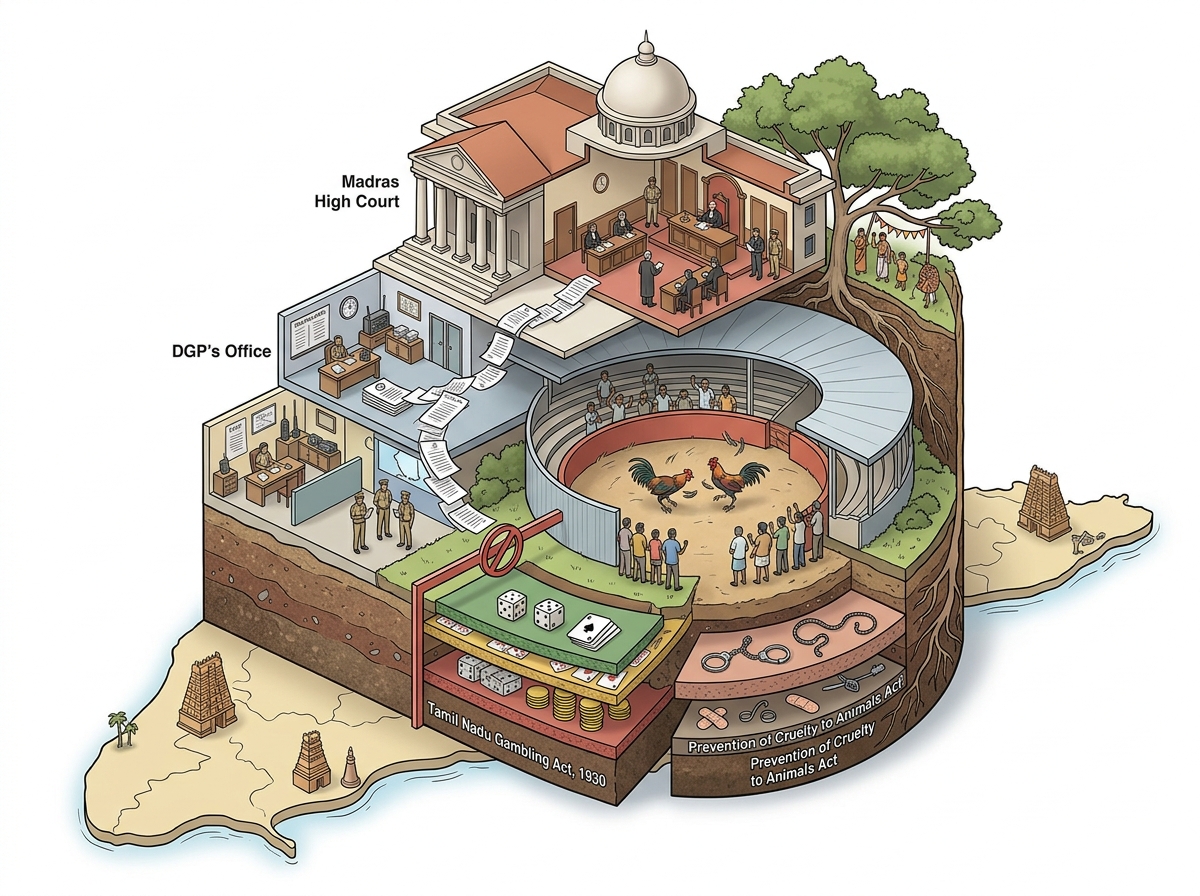
✎ The 2025 Tamil Nadu Police circular on rooster fights was issued to prevent cruelty to animals and illegal gambling, not to impose a blanket ban, as clarified by the DGP’s office before the Madras High Court.
Subject Relevance — Where This Topic Fits
- GS Paper II — Governance, Constitution and Polity (Animal Welfare Laws, Judicial Review, Police Powers) | GS Paper III — Environment and Biodiversity (Animal Cruelty, Wildlife Protection)
- Prelims: Tamil Nadu Gambling Act, 1930, Section 12 of the Tamil Nadu Gambling Act, Madras High Court, Director General of Police (DGP), Animal Welfare Board of India, Prevention of Cruelty to Animals Act, 1960, Judicial Review, Executive Circulars, Police Jurisdiction, Writ Petition (Quo Warranto)
- Essay: Ethical governance and the balance between tradition and animal welfare, Judicial activism in protecting animal rights vis-à-vis cultural practices
Quick Revision: The 2025 Tamil Nadu Police circular on rooster fights was issued to prevent cruelty to animals and illegal gambling, not to impose a blanket ban, as clarified by the DGP’s office before the Madras High Court.
Why is this in the news?
The Madras High Court’s recent clarification regarding the 2025 circular issued by the Tamil Nadu Police on rooster fights has brought into focus the legal and ethical complexities surrounding animal cruelty, gambling, and traditional practices. The court’s scrutiny of the circular’s intent—whether it constitutes a blanket ban or merely a directive to prevent cruelty and illegal betting—highlights the interplay between executive instructions, judicial directives, and statutory provisions in regulating contentious cultural activities.
Background
- The Tamil Nadu Gambling Act, 1930, explicitly prohibits gambling activities, including those associated with rooster fights, under Section 12.
- The Madras High Court, in its May 21, 2024 order, noted complaints of rooster fights being conducted for gambling purposes despite the legal prohibition under the Tamil Nadu Gambling Act, 1930.
- The August 13, 2025 order of the Madras High Court directed the police to ensure that neither gambling nor cruelty occurs during rooster fights, necessitating a clarificatory circular from the DGP’s office.
- The 2025 circular, while aiming to curb cruelty and illegal betting, was misinterpreted by some sections as a blanket ban on rooster fights, prompting legal challenges.
What is the legal and ethical framework governing rooster fights in Tamil Nadu?
- The Tamil Nadu Gambling Act, 1930, prohibits gambling, including betting on rooster fights, under Section 12, making such activities punishable by law.
- The Madras High Court, in its judicial capacity, has the power to issue directions to the executive to enforce existing laws, as seen in its May 21, 2024 and August 13, 2025 orders, which prompted the 2025 circular.
- The 2025 circular issued by the Tamil Nadu Police was intended to operationalise the court’s directives by instructing police officers to prevent cruelty and illegal betting during rooster fights, rather than imposing a blanket ban.
- The clarification by the DGP’s office to the Madras High Court on September 21, 2026, underscores that the circular was not an exercise of independent legislative power but a measure to align with judicial and statutory obligations.
- The writ petition filed by R. Arun Kumar sought to quash the 2025 circular and permit rooster fights during temple festivals, reflecting the tension between cultural practices and legal prohibitions on animal cruelty and gambling.
- The judicial process in this case exemplifies the role of the judiciary in interpreting executive actions in light of constitutional and statutory provisions, ensuring that executive instructions do not exceed their legal mandate.
Key Features
| Feature | Significance |
|---|---|
| 2025 Tamil Nadu DGP Circular (September 12, 2025) | Clarified scope of executive action to prevent cruelty and gambling in rooster fights, not a blanket ban; aligned with judicial directives. |
| Madras High Court Orders (May 21, 2024; August 13, 2025) | Directed police to prevent gambling and cruelty during rooster fights, forming the legal basis for the DGP circular. |
| Section 12 of Tamil Nadu Gambling Act, 1930 | Prohibits gambling activities, including betting on rooster fights, providing statutory basis for police action. |
| Writ Petition (R. Arun Kumar v. State of Tamil Nadu) | Challenged the 2025 circular, seeking permission for rooster fights during temple festivals; disposed after DGP clarification. |
| Police Jurisdiction and Executive Action | Highlights the role of police in enforcing judicial directives and statutory prohibitions within their territorial limits. |
Why it Matters
Legal and Judicial
- The case underscores the interplay between executive action and judicial directives in regulating traditional practices.
- Judicial orders have compelled executive agencies to act against cruelty and illegal betting, reinforcing the rule of law.
- Clarifies that executive circulars must align with statutory provisions and court rulings to avoid overreach.
Animal Welfare
- Focuses attention on the ethical treatment of animals in cultural or traditional activities.
- Highlights the need for balanced regulation that distinguishes between cruelty and permissible cultural practices.
- Raises questions about the enforcement of existing animal welfare laws in rural and traditional contexts.
Public Order and Morality
- Gambling associated with rooster fights poses risks to public order and financial integrity of individuals.
- Police action aims to curb illegal betting networks that exploit cultural events for financial gain.
- Balancing tradition with legal and moral obligations remains a persistent challenge for authorities.
Administrative Governance
- Demonstrates the role of the DGP/HoPF in interpreting and implementing judicial orders through executive circulars.
- Shows how administrative instructions must be precise to avoid ambiguity in enforcement.
- Emphasises the need for inter-departmental coordination between police, judiciary, and local authorities.
Challenges
1. Balancing Tradition and Legal Compliance
- Distinguishing between permissible cultural practices and illegal activities like gambling and cruelty.
- Addressing the emotional and social significance of rooster fights in rural communities while enforcing the law.
- Ensuring that enforcement does not alienate local populations or fuel resistance to legal reforms.
UPSC Link: GS II: Governance, GS III: Environment
2. Enforcement of Animal Welfare Laws
- Difficulty in monitoring and preventing cruelty in rural and remote areas where traditional practices are prevalent.
- Lack of standardized protocols for identifying and penalizing cruelty in animal-based activities.
- Need for capacity-building among police and local authorities to detect and address animal welfare violations.
UPSC Link: GS III: Environment
3. Preventing Illegal Gambling Networks
- Underground betting networks often operate through cultural events, exploiting legal loopholes.
- Limited resources for police to track and dismantle illegal gambling operations linked to rooster fights.
- Cooperation between state agencies and financial intelligence units to curb money laundering and illegal betting.
UPSC Link: GS III: Economy
4. Judicial-Executive Coordination
- Ensuring that executive actions are consistent with judicial directives and statutory provisions.
- Avoiding conflicts between court orders and administrative circulars that may lead to legal challenges.
- Streamlining communication between courts, police, and local authorities for effective implementation.
UPSC Link: GS II: Governance
5. Public Perception and Social Resistance
- Cultural sensitivity requires careful handling to avoid perceptions of insensitivity or overreach by authorities.
- Educating communities about the legal and ethical implications of cruelty and gambling in traditional practices.
- Building trust between law enforcement and local populations to facilitate voluntary compliance.
UPSC Link: GS II: Governance
Challenges — UPSC Perspective
| Issue | Concern |
|---|---|
| Ambiguity in Circular Language | Risk of misinterpretation leading to either over-enforcement or under-enforcement of the law. |
| Rural Enforcement Gaps | Limited police presence and resources in rural areas hinder effective monitoring of rooster fights. |
| Cultural Sensitivity vs. Legal Mandate | Balancing respect for tradition with the imperative to enforce animal welfare and anti-gambling laws. |
| Judicial Overreach Concerns | Potential for courts to encroach on executive or legislative domains in regulating traditional practices. |
| Resource Constraints for Police | Insufficient manpower, training, and infrastructure to address illegal gambling and cruelty comprehensively. |
| Community Resistance to Enforcement | Local opposition to police actions may hinder compliance and lead to social tensions. |
Way Forward
- Conduct targeted awareness campaigns in rural Tamil Nadu to educate communities on legal prohibitions against cruelty and gambling in rooster fights.
- Strengthen inter-departmental coordination between police, animal welfare authorities, and local governance bodies for holistic enforcement.
- Develop standard operating procedures (SOPs) for police to identify and penalize cruelty in animal-based activities without alienating communities.
- Enhance financial intelligence mechanisms to track and dismantle illegal betting networks linked to traditional events.
- Establish mobile courts or special squads in high-risk areas to ensure swift justice and reduce delays in legal proceedings.
- Promote alternative livelihoods for communities dependent on rooster fights to reduce reliance on traditional practices.
- Encourage research on humane alternatives to traditional animal-based sports to preserve cultural heritage without compromising welfare.
- Foster dialogue between cultural practitioners, animal rights activists, and legal experts to develop community-led solutions.
UPSC Value Addition
Keywords for Mains Answer-Writing
Animal Welfare Board of India · Prevention of Cruelty to Animals Act, 1960 · Tamil Nadu Gambling Act, 1930 · Madras High Court · Judicial review of executive circulars · Constitutional morality · Directive Principles of State Policy · Fundamental Duties · Wild Life Protection Act, 1972 · Judicial activism in animal rights · Executive discretion vs judicial oversight · Cultural practices vs animal welfare
Concept Flow
Traditional practice of rooster fights → Associated risks of cruelty (e.g., blade attachment, eye stitching) and illegal gambling → Judicial intervention via Madras High Court orders (2024, 2025) → DGP circular (2025) to enforce judicial directives → Executive clarification to avoid blanket ban → Legal challenge via writ petition → Disposal of petition based on executive clarification → Reinforcement of need for balanced regulation between tradition and law → Identification of enforcement challenges → Formulation of way forward for governance and welfare.
Prelims Practice Questions
Q1. Consider the following statements regarding the Prevention of Cruelty to Animals Act, 1960:
1. The Act empowers the Animal Welfare Board of India to frame rules for the prevention of cruelty to animals.
2. Section 11 of the Act prohibits the practice of animal fighting, including rooster fights.
3. The Act applies uniformly across all states and union territories of India without any state-specific modifications.
How many of the above statements are correct?
- Only one
- Only two
- All three
- None
Answer: Only two — Statement 1 is correct as the Animal Welfare Board of India is empowered under Section 4 of the Act to frame rules. Statement 2 is correct as Section 11(1)(m) explicitly prohibits animal fighting. Statement 3 is incorrect because states can enact their own rules under Entry 17 of the State List (Seventh Schedule) of the Constitution.
Q2. Assertion (A): The Tamil Nadu Gambling Act, 1930, prohibits all forms of gambling, including those associated with rooster fights.
Reason (R): The Act empowers the police to take suo motu action against any gambling activity, including those conducted during cultural or religious events.
In the context of the above statements, which of the following is correct?
- Both A and R are true, and R is the correct explanation of A
- Both A and R are true, but R is not the correct explanation of A
- A is true, but R is false
- A is false, but R is true
Answer: A is true, but R is false — Assertion (A) is true as Section 12 of the Tamil Nadu Gambling Act, 1930, prohibits gambling, including those associated with rooster fights. Reason (R) is partially correct but misleading because while the Act empowers police action, suo motu powers are not absolute and are subject to judicial review and statutory constraints.
Mains Practice Question
✍ The Madras High Court’s clarification on the 2025 circular issued by the Tamil Nadu DGP/HoPF underscores the tension between cultural practices and statutory provisions governing animal welfare and gambling. Critically examine the legal and ethical dimensions of this issue, with particular reference to the Prevention of Cruelty to Animals Act, 1960, and the Tamil Nadu Gambling Act, 1930. (15 Marks)
Approach: MODEL-ANSWER SKELETON:
1. **Legal Framework**:
– Prevention of Cruelty to Animals Act, 1960: Key provisions (Sections 3, 4, 11) and role of the Animal Welfare Board of India (AWBI).
– Tamil Nadu Gambling Act, 1930: Section 12 prohibition on gambling and its applicability to rooster fights.
– Wild Life Protection Act, 1972: Prohibition of animal fighting under Section 39(3).
2. **Executive vs Judicial Role**:
– The 2025 circular: Purpose (preventing cruelty and gambling) vs perceived blanket ban.
– Judicial review of executive circulars: Principles laid down in *S.G. Jaisingh v. Union of India* (2006) and *Common Cause v. Union of India* (2018).
– Doctrine of constitutional morality and Fundamental Duties (Article 51A(g)).
3. **Cultural Practices vs Animal Welfare**:
– Balancing cultural rights (Article 29) with animal welfare (Directive Principles, Article 48).
– Judicial precedents: *Animal Welfare Board of India v. A. Nagaraja* (2014) (Jallikattu case) and *State of Tamil Nadu v. Suhas Katti* (2021) on cultural practices.
– Role of AWBI guidelines and state-specific regulations.
4. **Ethical Dimensions**:
– Utilitarian vs rights-based approaches to animal welfare.
– Cultural relativism vs universal ethical standards.
– Role of public opinion and stakeholder consultations.
5. **Conclusion**:
– Need for a nuanced approach: Prohibiting cruelty while accommodating cultural practices within legal limits.
– Role of AWBI in framing state-specific rules under Entry 17 of the State List.
– Suggest reforms: Strengthening AWBI, state-level animal welfare boards, and judicial oversight.
Source: The Hindu
Tamil Nadu PCS (TNPSC) — State PCS Practice
Prelims: Regarding the recent Madras High Court case on rooster fights in Tamil Nadu, what was the stance of the Director General of Police (DGP) office as per the affidavit filed?
- A. Supported a blanket ban on rooster fights across Tamil Nadu
- B. Opposed any ban and cited cultural significance of the sport
- C. Stated that no blanket ban has been imposed on rooster fights in Tamil Nadu
- D. Recommended a partial ban during specific seasons only
Answer: C. Stated that no blanket ban has been imposed on rooster fights in Tamil Nadu — The DGP’s office clarified in its affidavit that no blanket ban has been imposed on rooster fights in Tamil Nadu, addressing the court’s query.
Mains: Examine the socio-cultural and legal dimensions of the issue of rooster fights in Tamil Nadu, highlighting the role of state authorities in regulating or banning such practices while balancing cultural traditions and animal welfare concerns.
Generated by AanyaAi for educational purpose.
Related guides on our sites
- Current affairs for upsc 2026
- Best PSIR optional coaching for upsc
- Best PSIR optional teacher for upsc
- Best teacher of PSIR optional for upsc

- Tamil Nadu’s DGP Clarifies: No Blanket Ban on Rooster Fights, Only Anti-Cruelty & Gambling Rules - September 21, 2026
- ग्वालियर में दूरसंचार विनिर्माण क्षेत्र: बेंगलुरु में निवेशकों की बैठक आयोजित - September 21, 2026
- Gwalior Telecom Manufacturing Zone: ₹5,500 Cr Investments & Job Opportunities Explained for UPSC - September 21, 2026

No Comments