


12 Nov Tamil Nadu’s Liquor Bottle Buyback Scheme: UPSC Analysis
✎ Tamil Nadu's liquor bottle buyback scheme incentivizes consumers to return empty bottles for a refund, aiming to reduce glass waste and promote circular economy principles statewide.
Subject Relevance — Where This Topic Fits
- GS Paper III — Environment and Ecology, Waste Management, Circular Economy | GS Paper II — Government Policies and Interventions for Development in various sectors
- Prelims: Liquor bottle buyback scheme, Tamil Nadu State Marketing Corporation (TASMAC), Circular economy principles, Glass waste management, Extended Producer Responsibility (EPR), QR code-based tracking
- Essay: Environmental sustainability through policy interventions, The role of state governments in promoting circular economy practices
Quick Revision: Tamil Nadu’s liquor bottle buyback scheme incentivizes consumers to return empty bottles for a refund, aiming to reduce glass waste and promote circular economy principles statewide.
Why is this in the news?
Tamil Nadu’s liquor bottle buyback scheme, initially launched as a conservation measure in the Nilgiris to protect wildlife, has been expanded statewide. The initiative encourages consumers to return empty liquor bottles to designated outlets for a refund, aiming to mitigate glass waste and promote environmental sustainability across the state.
Background
- The scheme originated as a targeted intervention in the Nilgiris district, a ecologically sensitive region, to prevent discarded liquor bottles from harming wildlife, particularly elephants.
- The Tamil Nadu State Marketing Corporation (TASMAC) is the sole retailer of alcoholic beverages in the state, making it a pivotal agency for implementing such a scheme.
- Improper disposal of glass bottles contributes significantly to environmental pollution, including soil degradation, water contamination, and hazards to wildlife and human populations.
- Circular economy principles advocate for reducing waste, reusing products, and recycling materials, thereby minimizing resource depletion and environmental impact.
- Effective waste management strategies are crucial for urban and rural areas alike, addressing public health concerns and aesthetic degradation.
- The scheme seeks to leverage consumer participation by offering a monetary incentive, thereby transforming waste disposal into a responsible civic action.
- The scheme is an example of Extended Producer Responsibility (EPR), where manufacturers or importers of products are responsible for the entire lifecycle of their products, including their take-back, recycling, and final disposal.
- The scheme’s expansion reflects a broader governmental commitment to environmental protection and sustainable waste management practices.
- The implementation involves a QR-code-based system to track the bottles, ensuring transparency and accountability in the collection and recycling process.
- The scheme addresses the challenge of managing non-biodegradable waste, specifically glass, which can persist in the environment for thousands of years.
- The initiative aligns with national and international goals for sustainable development and environmental conservation.
- The scheme’s success hinges on robust logistical support, public awareness, and effective enforcement mechanisms.
What is Tamil Nadu’s Liquor Bottle Buyback Scheme?
- The Tamil Nadu Liquor Bottle Buyback Scheme is an environmental initiative implemented by the Tamil Nadu government, primarily through the Tamil Nadu State Marketing Corporation (TASMAC).
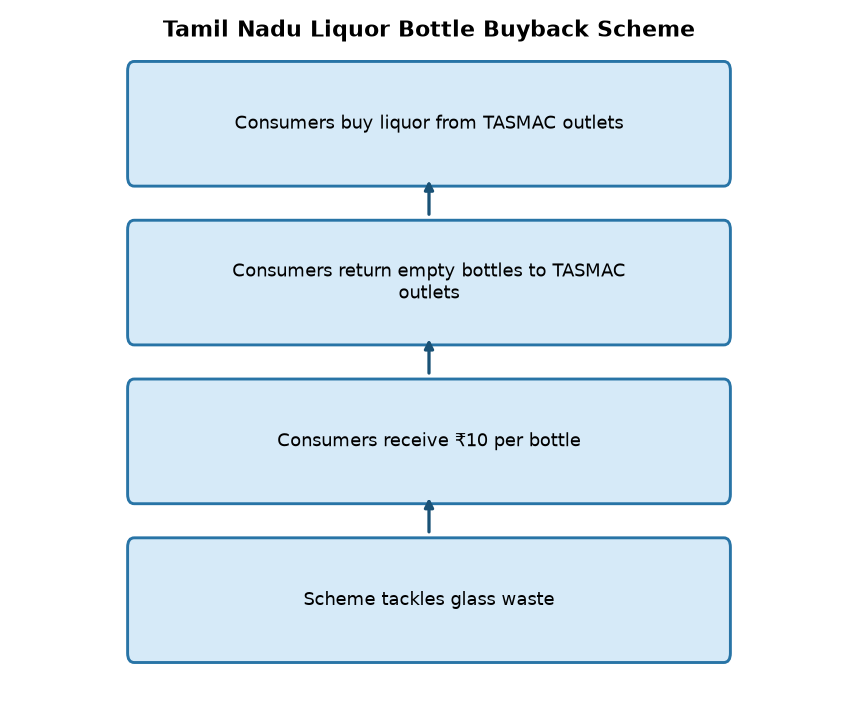
- Under this scheme, consumers are incentivized to return empty liquor bottles to TASMAC retail outlets.
- A fixed amount, specifically ₹10 per bottle, is refunded to the consumer upon the return of an empty bottle.
- The scheme was initially piloted in the Nilgiris district with the primary objective of protecting wildlife, particularly elephants, from injuries or ingestion of discarded glass.
- Following its initial success and demonstrated environmental benefits, the scheme has been expanded to cover the entire state of Tamil Nadu.
- A key operational aspect of the scheme involves the use of QR codes on liquor bottles, which facilitates tracking and management of the returned bottles.
- The collected bottles are intended for proper recycling, thereby reducing glass waste in landfills and preventing environmental pollution.
- The initiative embodies principles of the circular economy by promoting the reuse and recycling of materials, minimizing resource consumption, and reducing waste generation.
- The scheme aims to foster greater public participation in waste management efforts by providing a direct financial incentive for responsible disposal.
- Challenges in implementation include ensuring widespread awareness, establishing efficient collection logistics, preventing fraudulent practices, and securing adequate recycling infrastructure.
- The scheme represents a governmental effort to address the environmental impact of consumer products and promote sustainable consumption patterns.
- It is a practical application of the ‘polluter pays’ principle and Extended Producer Responsibility (EPR), where the responsibility for waste management is extended to the product’s end-of-life.
Key Features
| Feature | Significance |
|---|---|
| Statewide Implementation | Expands the scope of environmental protection beyond specific ecological zones to cover the entire state of Tamil Nadu. |
| ₹10 Buyback Incentive | Provides a direct financial incentive to consumers, encouraging participation and promoting responsible disposal of glass waste. |
| QR-code Based Rollout | Enhances traceability and accountability in the collection process, facilitating efficient management and monitoring of returned bottles. |
| TASMAC Outlets as Collection Points | Leverages existing infrastructure for widespread accessibility, making it convenient for consumers to return empty bottles. |
| Origin in Elephant Protection | Demonstrates an adaptive policy evolution, where an initial specific conservation effort transforms into a broader environmental initiative. |
Why it Matters
Environmental Significance
- Mitigates glass waste accumulation, reducing landfill burden and preventing environmental pollution.
- Contributes to resource conservation by promoting the recycling and reuse of glass bottles, thereby decreasing the demand for virgin materials.
- Addresses specific ecological concerns, such as the impact of discarded bottles on wildlife habitats, particularly in sensitive areas like the Nilgiris.
Socio-Economic Significance
- Fosters a sense of environmental responsibility among consumers through direct participation in waste management.
- Potentially creates employment opportunities in the collection, sorting, and processing sectors of recycled glass.
- Reduces public health risks associated with improper waste disposal, such as disease vectors and injury from broken glass.
Governance and Policy Significance
- Showcases an innovative approach to extended producer responsibility (EPR) by involving consumers and leveraging existing retail networks.
- Provides a model for other states or regions to adopt similar incentive-based waste management schemes.
- Demonstrates the capacity of state governments to implement targeted environmental policies with measurable outcomes.
Challenges
1. Logistical Complexity
- Managing the collection, storage, and transportation of a large volume of empty glass bottles across numerous TASMAC outlets.
- Ensuring adequate infrastructure and personnel are available at collection points to handle the influx of returned bottles efficiently.
UPSC Link: Infrastructure; Waste Management
2. Consumer Compliance and Awareness
- Sustaining consumer participation over the long term, especially for a relatively small incentive.
- Ensuring widespread awareness of the scheme’s mechanics, particularly the QR-code system, among diverse consumer groups.
UPSC Link: Public Policy; Behavioural Economics
3. Financial Viability
- Balancing the cost of the buyback incentive and operational expenses against the environmental benefits and potential revenue from recycled glass.
- Preventing fraudulent practices or misuse of the incentive system.
UPSC Link: Public Finance; Environmental Economics
4. Processing and Recycling Capacity
- Ensuring sufficient capacity for the recycling and processing of collected glass bottles to prevent secondary waste accumulation.
- Maintaining the quality of collected glass for effective recycling into new products.
UPSC Link: Industrial Policy; Circular Economy
Challenges — UPSC Perspective
| Issue | Concern |
|---|---|
| Storage at TASMAC Outlets | Limited space at retail outlets for storing large quantities of returned bottles can impede efficient collection. |
| Transportation Logistics | The cost and environmental footprint associated with transporting empty bottles from numerous collection points to recycling facilities. |
| QR Code System Integrity | Potential for technical glitches, misuse, or lack of universal adoption impacting the scheme’s traceability and effectiveness. |
| Contamination of Recyclables | Ensuring that returned bottles are clean and free from contaminants to maintain the quality of recycled glass. |
| Public Engagement Longevity | Sustaining high levels of public engagement and compliance beyond the initial enthusiasm for the scheme. |
Way Forward
- Establish dedicated collection and sorting centres to streamline the logistics of bottle retrieval and preparation for recycling.
- Launch comprehensive public awareness campaigns utilising multiple media channels to educate citizens on the scheme’s benefits and operational details.
- Integrate advanced digital solutions, such as mobile applications, to enhance the QR-code system’s efficiency and user experience.
- Explore partnerships with private recycling industries to ensure adequate processing capacity and promote a circular economy for glass waste.
- Implement a robust monitoring and evaluation framework to assess the scheme’s environmental and economic impact, allowing for adaptive policy adjustments.
- Consider differential incentive structures based on bottle type or volume to further optimise collection efficiency and resource recovery.
- Conduct regular audits of collection points and recycling facilities to ensure compliance with environmental standards and operational integrity.
UPSC Value Addition
Keywords for Mains Answer-Writing
Circular Economy · Waste Management · Extended Producer Responsibility · Plastic Waste Management Rules · Sustainable Development Goals · Environmental Governance · Resource Efficiency · Public-Private Partnerships · Behavioural Economics · Urban Local Bodies
Constitutional & Policy Linkages
- {‘Article 48A’: ‘Protection and improvement of environment’}
- {‘Article 51A(g)’: ‘Duty to protect and improve natural environment’}
Concept Flow
Discarded liquor bottles pose environmental threat. → Tamil Nadu implements ₹10 buyback scheme. → Consumers return bottles to TASMAC outlets. → QR-code system tracks bottle returns. → Collected bottles are sent for recycling. → Reduces glass waste and promotes circular economy.
Prelims Practice Questions
Q1. Consider the following statements regarding Extended Producer Responsibility (EPR) in India:
1. EPR mandates producers to manage the end-of-life of their products.
2. The Plastic Waste Management Rules, 2016, include provisions for EPR.
3. EPR primarily focuses on financial contributions from producers, not physical collection.
How many of the above statements are correct?
- Only one
- Only two
- All three
- None
Answer: Only two — Statement 1 is correct: EPR is a policy approach where producers are given a significant responsibility for the treatment or disposal of post-consumer products. Statement 2 is correct: The Plastic Waste Management Rules, 2016, as amended, explicitly incorporate EPR for plastic waste. Statement 3 is incorrect: EPR can involve both financial contributions and physical collection, processing, and recycling of waste by producers or through Producer Responsibility Organisations (PROs).
Q2. Which of the following best describes the ‘Circular Economy’ concept?
- A system focused on maximizing the lifespan of products through repair and reuse.
- An economic model aimed at eliminating waste and the continual use of resources.
- A framework for promoting international trade in recycled materials.
- A policy approach for regulating industrial emissions and pollution.
Answer: An economic model aimed at eliminating waste and the continual use of resources. — The Circular Economy is an economic model that aims to decouple economic activity from the consumption of finite resources. It is based on three principles: design out waste and pollution, keep products and materials in use, and regenerate natural systems. This contrasts with the traditional linear ‘take-make-dispose’ model.
Mains Practice Question
✍ Examine the potential of ‘take-back’ schemes, such as the Tamil Nadu liquor bottle buyback initiative, in fostering a circular economy. Discuss the challenges in their implementation and suggest measures for enhancing their effectiveness. (15 Marks)
Approach: INTRODUCTION: Define ‘take-back’ schemes and their relevance to the circular economy. Briefly mention the Tamil Nadu scheme as a contemporary example.
POTENTIAL OF TAKE-BACK SCHEMES (Body Part 1):
1. Resource Conservation: Reduction in virgin material extraction.
2. Waste Reduction: Diverting waste from landfills, especially non-biodegradable materials like glass.
3. Environmental Protection: Mitigating pollution (e.g., plastic/glass litter, impact on wildlife).
4. Economic Benefits: Creation of green jobs, value recovery from waste, reduced disposal costs.
5. Behavioural Change: Encouraging consumer participation in responsible waste management.
6. Extended Producer Responsibility (EPR) Linkage: How such schemes can complement broader EPR frameworks.
CHALLENGES IN IMPLEMENTATION (Body Part 2):
1. Logistical Hurdles: Collection infrastructure, transportation, storage, and processing of returned items.
2. Financial Viability: Cost of collection, sorting, cleaning, and recycling versus market value of recycled material. Subsidy dependence.
3. Consumer Participation: Awareness, convenience, and incentive adequacy.
4. Quality Control: Ensuring the cleanliness and integrity of returned items for recycling.
5. Regulatory Framework: Need for clear guidelines, enforcement, and integration with existing waste management systems.
6. Informal Sector Integration: Balancing formal schemes with existing informal recycling networks.
MEASURES FOR ENHANCING EFFECTIVENESS (Body Part 3):
1. Robust Infrastructure: Investment in collection points, reverse logistics, and recycling facilities.
2. Public Awareness Campaigns: Educating consumers on environmental benefits and scheme mechanics.
3. Adequate Incentives: Financial (e.g., higher buyback value) and non-financial (e.g., loyalty points).
4. Technology Integration: Use of QR codes, digital platforms for tracking and transparency.
5. Policy Support: Clear EPR mandates, subsidies, and tax incentives for recycling industries.
6. Multi-stakeholder Collaboration: Involvement of government, producers, consumers, and waste management entities.
CONCLUSION: Summarise the dual benefits of environmental protection and economic sustainability offered by such schemes, reiterating the need for comprehensive strategies for successful implementation.
Source: The Hindu
Tamil Nadu PCS (TNPSC) — State PCS Practice
Prelims: Which of the following statements is/are correct regarding the liquor bottle buyback scheme implemented in Tamil Nadu?
1. The scheme aims to reduce environmental pollution caused by discarded liquor bottles.
2. Consumers receive a refund of ₹10 for each empty liquor bottle returned.
3. Only bottles purchased from TASMAC outlets are eligible for the buyback.
4. The collected bottles are primarily used for recycling into new glass products.
- A. 1 and 2 only
- B. 1, 3 and 4 only
- C. 1, 2, 3 and 4
- D. 1 and 4 only
Answer: D. 1 and 4 only — The liquor bottle buyback scheme in Tamil Nadu focuses on environmental protection through recycling and involves a refund for returned bottles from TASMAC outlets.
Mains: Discuss the objectives and potential socio-economic and environmental impacts of the liquor bottle buyback scheme implemented by the Government of Tamil Nadu. Suggest measures for its effective implementation and expansion.
Generated by AanyaAi for educational purpose.
Related guides on our sites
- Current affairs for upsc 2026
- Best PSIR optional coaching for upsc
- Best PSIR optional teacher for upsc
- Best teacher of PSIR optional for upsc

- NAMASTE Scheme: Enhancing Sanitation Workers’ Livelihoods & Safety - November 14, 2026
- एमएसएमई का विशेष अभियान 6.0: स्वच्छता और लंबित मामलों का निपटारा - November 14, 2026
- Sea Vigil-26: Coastal Defence Drills Off Visakhapatnam - November 14, 2026

No Comments