


26 Sep Tamil Nadu’s ‘One Degree, Six Skills’ Scheme: Key Features for UPSC Exams
✎ The ‘One Degree, Six Skills’ programme integrates one industry-relevant skill per semester into Tamil Nadu’s undergraduate curriculum, replacing traditional examinations with competency-based assessments to enhance employability.
Subject Relevance — Where This Topic Fits
- GS Paper II — Governance, Administration and Public Policy | GS Paper III — Human Resource Development and Skill Development
- Prelims: Naan Mudhalvan Scheme, TANSCHE, Directorate of Collegiate Education, Skill-based education, Industry-academia linkage, Undergraduate curriculum reform, Employability-focused pedagogy, Practical assessment in higher education
- Essay: The interplay between academic knowledge and vocational skills in India’s higher education system, Reimagining education policy for the 21st-century workforce
Quick Revision: The ‘One Degree, Six Skills’ programme integrates one industry-relevant skill per semester into Tamil Nadu’s undergraduate curriculum, replacing traditional examinations with competency-based assessments to enhance employability.
Why is this in the news?
Tamil Nadu’s Directorate of Collegiate Education, in collaboration with the Tamil Nadu State Council for Higher Education (TANSCHE), has announced the ‘One Degree, Six Skills’ programme, a skill-per-semester initiative for undergraduate students in the state’s 181 government arts and science colleges. Scheduled to commence from the even semester of January 2027, the programme aims to integrate industry-oriented training into the conventional three-year undergraduate curriculum, thereby enhancing employability without compromising academic rigour. The initiative reflects a growing policy emphasis on aligning higher education with labour market demands through structured skill acquisition.
Background
- Tamil Nadu hosts 181 government arts and science colleges under the Directorate of Collegiate Education, forming the backbone of its higher education system for undergraduate programmes.
- The State Council for Higher Education (TANSCHE) serves as the apex body for policy formulation and coordination in higher education within Tamil Nadu.
- India’s higher education system faces a persistent employability gap, with graduates often lacking practical, industry-relevant skills despite academic qualifications.
- The National Education Policy (NEP) 2020 advocates for multidisciplinary and skill-based education, encouraging states to reform curricula to include vocational and technical training.
- The scheme aligns with the broader ‘Skill India Mission’ and the ‘National Skill Qualification Framework (NSQF)’, which categorises skills into levels for certification and recognition.
What is the ‘One Degree, Six Skills’ programme?
- The programme mandates that undergraduate students in Tamil Nadu’s government arts and science colleges acquire one industry-oriented skill per semester, culminating in six skills over a three-year degree programme.
- The initiative is designed to supplement, rather than replace, the existing academic curriculum, ensuring that students graduate with both a formal degree and demonstrable vocational competencies.
- A basket of 20 skill courses has been identified across arts and basic sciences disciplines, from which colleges will select offerings based on local industry demand and institutional capacity.
- Each skill course will require approximately 30 to 45 hours of learning, delivered through a blend of classroom instruction, hands-on training, and project-based learning.
- Assessment is entirely competency-based, with 40% weightage given to skill exercises, 30% to individual competency demonstration, and 30% to a final project or output that showcases practical application.
- There will be no conventional written examinations; instead, students must demonstrate their ability to apply the skill in real-world contexts, aligning with outcomes-based education principles.
- Colleges are required to nominate expert trainers for each skill course and establish Memoranda of Understanding (MoUs) with at least three industry partners to facilitate curriculum co-design, internships, and placement opportunities.
Key Features
| Feature | Significance |
|---|---|
| One skill per semester model | Ensures systematic, incremental acquisition of employability skills alongside academic degrees, aligning with the National Education Policy (NEP) 2020’s emphasis on skill integration. |
| Industry-oriented curriculum design | Shifts assessment from theoretical recall to practical application, addressing the gap between academic learning and industry requirements. |
| Industry-academia partnerships via MoUs | Facilitates curriculum relevance through sector-specific inputs, internships, and placement opportunities, enhancing graduate employability. |
| Non-examinational assessment structure (40% skill exercises, 30% competency, 30% output) | Prioritises demonstrable skill application over rote learning, fostering hands-on learning environments. |
| Basket of 20 skill courses across arts and basic sciences | Provides colleges flexibility to tailor offerings to local and sectoral needs while maintaining a broad skill base. |
Why it Matters
Educational Reform
- Represents a structural shift in higher education from degree-centric to skill-integrated models, in line with NEP 2020’s multidisciplinary and vocational integration objectives.
- Demonstrates state-level implementation of the National Skill Qualification Framework (NSQF) at the undergraduate level, ensuring standardised skill recognition.
- Encourages colleges to adopt outcome-based education (OBE) principles, with a focus on measurable competencies rather than theoretical knowledge.
Economic Development
- Aims to reduce the employability gap by equipping graduates with sector-relevant skills, potentially lowering youth unemployment and underemployment in Tamil Nadu.
- Strengthens the state’s human capital pipeline for industries such as IT, manufacturing, and services, aligning with Tamil Nadu’s industrial policy priorities.
- Enhances the competitiveness of Tamil Nadu’s workforce in national and global markets by embedding industry-aligned certifications.
Governance and Policy
- Illustrates the role of state councils (TANSCHE) in curriculum innovation and inter-departmental coordination (Directorate of Collegiate Education, TNSDC).
- Showcases the use of memoranda of understanding (MoUs) as a tool for public-private partnerships in skill development, a model replicable across states.
- Demonstrates the integration of vocational education into mainstream higher education, aligning with the Skill India Mission’s objectives.
Challenges
1. Implementation Capacity
- Ensuring uniform quality across 181 colleges, particularly given the diversity in faculty expertise and infrastructure.
- Balancing the additional workload for faculty, who must design, deliver, and assess skill courses alongside traditional academic duties.
- Addressing potential disparities in industry partnerships, where colleges in less industrialised regions may struggle to secure MoUs.
UPSC Link: GS2: Governance, GS3: Skill Development
2. Curriculum Relevance
- Maintaining the dynamism of skill courses to keep pace with rapidly evolving industry requirements, particularly in technology-driven sectors.
- Avoiding the creation of a parallel skill ecosystem that duplicates existing vocational training programmes (e.g., ITIs, NSDC courses).
- Ensuring that the basket of 20 skills is broad enough to cover diverse sectors while remaining focused enough to avoid dilution of quality.
UPSC Link: GS2: Education Policy, GS3: Industrial Growth
3. Equity and Access
- Preventing socio-economic disparities in access to skill courses, where students from marginalised backgrounds may face barriers to participation.
- Ensuring that skill courses do not become a substitute for academic rigour, particularly in disciplines where foundational knowledge is critical.
- Addressing the potential for urban-rural divides in industry partnerships and internship opportunities.
UPSC Link: GS1: Social Justice, GS2: Inclusive Growth
4. Assessment and Certification
- Standardising assessment criteria across colleges to ensure comparability and credibility of skill certifications.
- Integrating skill certifications with national frameworks (e.g., NSQF) to ensure portability and recognition beyond state boundaries.
- Avoiding the perception of skill courses as
- easy credits
- by maintaining rigorous yet practical assessment standards.
UPSC Link: GS2: Education Policy, GS3: Skill Development
Challenges — UPSC Perspective
| Issue | Concern |
|---|---|
| Faculty readiness | Insufficient training or expertise among faculty to design and deliver skill-based courses effectively. |
| Infrastructure gaps | Lack of labs, equipment, or digital tools required for practical skill training in colleges. |
| Industry engagement variability | Uneven participation from industries, particularly in sectors with lower employment potential. |
| Student motivation | Risk of low student engagement if skill courses are perceived as non-essential or burdensome. |
| Resource allocation | Limited financial and administrative resources to support the scale and complexity of the programme. |
Way Forward
- Constitute a state-level oversight committee under TANSCHE to monitor implementation, resolve bottlenecks, and ensure standardisation across colleges.
- Develop a phased faculty training programme in collaboration with industry bodies (e.g., CII, FICCI) to build capacity for skill course delivery.
- Establish a digital platform for skill course management, including curriculum repositories, assessment tools, and industry collaboration portals.
- Pilot the programme in a subset of colleges (e.g., 20-30) in the 2026-27 academic year to identify challenges before full rollout in January 2027.
- Create a feedback mechanism involving students, faculty, and industry partners to iteratively refine course offerings and assessment methods.
- Align skill certifications with national frameworks (e.g., NSQF) to ensure recognition and portability, facilitating seamless integration into the job market.
- Incentivise industry participation through tax benefits, recognition schemes, or preferential procurement policies for colleges with strong industry ties.
UPSC Value Addition
Keywords for Mains Answer-Writing
Tamil Nadu higher education reforms · One Degree Six Skills programme · TANSCHE skill development initiative · Undergraduate curriculum enhancement · Industry-academia collaboration in education · Skill-based education model · Outcome-based assessment in higher education · Government arts and science colleges · Naan Mudhalvan scheme · Practical competency assessment · Tamil Nadu State Council for Higher Education · Vocational training in undergraduate studies
Concept Flow
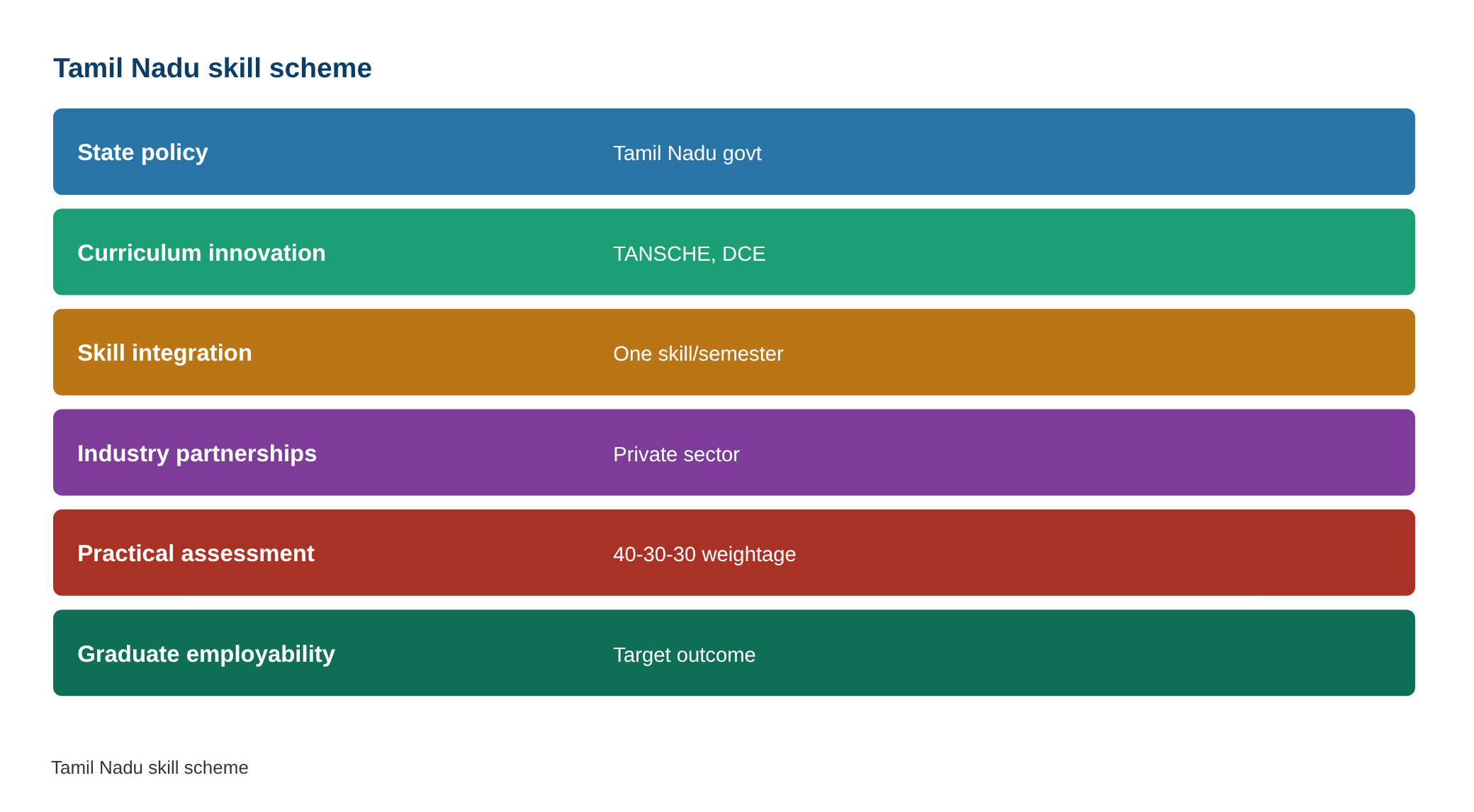
State-level policy initiative (Tamil Nadu government) → Curriculum innovation (TANSCHE, Directorate of Collegiate Education) → Skill integration (One skill per semester model) → Industry partnerships (MoUs with private sector) → Practical assessment (40-30-30 weightage) → Graduate employability (reduced skills gap) → Economic growth (skilled workforce for industries). → Higher education reform (NEP 2020) → Skill development mandate (Skill India Mission) → State implementation (Tamil Nadu’s programme) → Industry alignment (sector-specific skills) → Workforce readiness (graduates with employable skills). → Public-private partnership (MoUs) → Curriculum co-creation (industry inputs) → Internships and placements (employer engagement) → Skill certification (industry-recognised) → Career progression (enhanced employability). → Assessment reform (non-examinational) → Outcome-based education (demonstrable competencies) → Skill application (practical exercises) → Industry validation (employer feedback) → Continuous improvement (iterative refinement). → Equity considerations (access to skills) → Inclusive design (rural-urban balance) → Social justice (marginalised groups) → Policy safeguards (equitable participation) → Sustainable outcomes (long-term benefits).
Prelims Practice Questions
Q1. Consider the following statements regarding Tamil Nadu’s ‘One Degree, Six Skills’ programme:
1. The programme is applicable to all undergraduate students in Tamil Nadu, including private colleges.
2. Each skill course under the programme involves approximately 30 to 45 hours of learning.
3. Assessment is based on a conventional written examination with equal weightage to theory and practical components.
How many of the above statements are correct?
- Only one
- Only two
- All
- None
Answer: Only one — Statement 1 is incorrect as the programme is limited to students in Tamil Nadu’s 181 government arts and science colleges. Statement 2 is correct as each skill course involves 30 to 45 hours of learning. Statement 3 is incorrect as assessment focuses on practical application with no conventional written examination.
Q2. Assertion (A): The ‘One Degree, Six Skills’ programme in Tamil Nadu is designed to replace the existing undergraduate curriculum with skill-based courses.
Reason (R): The programme aims to integrate industry-oriented training alongside the regular degree course without altering the core academic curriculum.
- Both A and R are true, and R is the correct explanation of A
- Both A and R are true, but R is not the correct explanation of A
- A is true but R is false
- A is false but R is true
Answer: A is false but R is true — Assertion (A) is false because the programme does not replace the existing curriculum but adds skill-based courses alongside it. Reason (R) is true as the programme integrates industry-oriented training without altering the core academic curriculum.
Q3. Match the following columns related to Tamil Nadu’s ‘One Degree, Six Skills’ programme:
Column I (Component) | Column II (Description)
———————|———————-
A. Skill Courses | 1. Focuses on practical application with 40% weightage to skill exercises
B. Assessment Structure| 2. Designed to provide six industry-oriented skills over three years
C. Industry Partners | 3. Involves 30 to 45 hours of learning per course
D. Programme Outcome | 4. Expected to collaborate with colleges for curriculum updates and placements
- A-3, B-1, C-4, D-2; A-2, B-1, C-4, D-3; A-3, B-2, C-1, D-4; A-1, B-3, C-2, D-4
Answer: A-3, B-1, C-4, D-2; A-2, B-1, C-4, D-3; A-3, B-2, C-1, D-4; A-1, B-3, C-2, D-4 — A matches with 3 (skill courses involve 30 to 45 hours of learning), B matches with 1 (assessment structure focuses on practical application), C matches with 4 (industry partners collaborate for curriculum updates and placements), and D matches with 2 (programme outcome is to provide six industry-oriented skills over three years).
Mains Practice Question
✍ Critically analyse the ‘One Degree, Six Skills’ programme of Tamil Nadu in the context of higher education reforms aimed at enhancing employability. How does this initiative address the challenges of traditional undergraduate education? Also, examine the potential limitations and implementation challenges of the programme. (15 Marks)
Approach: MODEL-ANSWER SKELETON:
1. **Introduction (2 Marks)**
– Briefly describe the ‘One Degree, Six Skills’ programme: a skill-per-semester model for undergraduate students in Tamil Nadu’s government arts and science colleges, developed with TANSCHE.
– State the objective: to enhance employability by integrating industry-oriented skills alongside the regular degree curriculum.
2. **Addressing Challenges of Traditional Education (5 Marks)**
– **Curriculum Relevance**: Traditional undergraduate education often lacks alignment with industry needs. This programme bridges the gap by embedding practical, job-oriented skills (e.g., digital literacy, data analysis, soft skills) directly into the curriculum.
– **Outcome-Based Assessment**: Shifts focus from rote learning to competency-based evaluation (40% skill exercises, 30% individual competency, 30% final output), addressing the criticism of conventional examination systems.
– **Industry-Academia Linkage**: Encourages collaboration with industries for curriculum updates, internships, and placements, fostering a direct pathway from education to employment.
– **Student Engagement**: Addresses the employability paradox by equipping students with tangible skills early in their academic journey.
3. **Potential Limitations (5 Marks)**
– **Resource Constraints**: Limited faculty expertise in diverse skill domains and the need for industry trainers may pose challenges, particularly in rural colleges.
– **Standardisation vs. Flexibility**: While a basket of 20 skill courses is proposed, ensuring quality and relevance across 181 colleges may be difficult without robust oversight.
– **Assessment Challenges**: Practical assessment requires significant resources, infrastructure, and trained evaluators, which may not be uniformly available.
– **Equity Concerns**: Students in government colleges may face disparities in access to resources compared to private institutions, potentially widening the employability gap.
4. **Implementation Challenges (3 Marks)**
– **Time Management**: Balancing skill courses alongside regular academic workload may strain students and faculty.
– **Industry Buy-In**: Ensuring sustained industry participation for curriculum updates and placements requires strong institutional mechanisms and incentives.
– **Monitoring and Evaluation**: Lack of a clear framework for tracking outcomes (e.g., placement rates, skill retention) may hinder the programme’s long-term impact assessment.
5. **Conclusion (2 Marks)**
– Acknowledge the programme’s innovative approach in addressing employability gaps but stress the need for robust implementation, resource allocation, and continuous evaluation to realise its full potential.
Source: The Indian Express
Tamil Nadu PCS (TNPSC) — State PCS Practice
Prelims: Which of the following best describes Tamil Nadu’s ‘One Degree, Six Skills’ scheme launched in 2023?
- A scheme providing one degree certificate along with six additional skill certificates to college students
- A program offering six skill development courses per semester to students pursuing any degree
- A government initiative to provide six different degrees in one academic year
- A scholarship scheme for students excelling in six specific technical skills
Answer: A program offering six skill development courses per semester to students pursuing any degree — The scheme aims to integrate six skill development courses into the curriculum of degree programs, ensuring students gain practical skills alongside academic qualifications.
Mains: Examine the significance of Tamil Nadu’s ‘One Degree, Six Skills’ scheme in addressing the employability gap among graduates. Suggest measures to enhance its effectiveness in aligning with the state’s industrial and economic needs.
Generated by AanyaAi for educational purpose.
Related guides on our sites
- Best PSIR optional coaching for upsc
- Best PSIR optional teacher for upsc
- Best teacher of PSIR optional for upsc
- Best PSIR optional coaching in delhi for UPSC

- कैसे पुलिस की AI तकनीक पहचान कर रही है अस्पष्ट शवों को - September 27, 2026
- Jai Jyoti: 106 km Bisalpur Pipeline to End Jaipur Water Crisis - September 27, 2026
- यूक्रेन का रोबोट सेना अभियान: युद्ध में मानव हानि कम करने की रणनीति - September 27, 2026

No Comments