


10 Sep Tamil Nadu’s Private University Bill 2026: Teachers Protest Commercialisation Risks
✎ The Tamil Nadu Private Universities (Amendment) Bill, 2026, reduces land and endowment fund requirements for private universities, aiming to attract investment but raising concerns about commercialisation and equity in higher…
Subject Relevance — Where This Topic Fits
- GS Paper II — Governance, Administration and Challenges (Education Sector) | GS Paper III — Issues Relating to Development and Management of Social Sector/Services relating to Education
- Prelims: Private Universities (Establishment and Regulation) Act, 2016, National Education Policy (NEP) 2020, University Grants Commission (UGC) norms, State List (Education) under Seventh Schedule, Commercialisation of Education, Land requirement norms for educational institutions, Permanent endowment fund for universities
- Essay: The tension between equity and excellence in higher education: A case study of Tamil Nadu’s policy shift, Marketisation of education and its impact on access and affordability for marginalised communities
Quick Revision: The Tamil Nadu Private Universities (Amendment) Bill, 2026, reduces land and endowment fund requirements for private universities, aiming to attract investment but raising concerns about commercialisation and equity in higher education.
Why is this in the news?
The Tamil Nadu Legislative Assembly passed the Tamil Nadu Private Universities (Amendment) Bill, 2026 on September 8, 2026, which has sparked significant opposition from college and university teachers across the state. The Bill seeks to relax land requirements and reduce the permanent endowment fund for establishing private universities, a move critics argue will accelerate commercialisation of higher education and undermine the state-run education system, which traditionally provides affordable access to higher education for underprivileged sections of society.
Background
- The Tamil Nadu Private Universities Act, 2019, was enacted to regulate the establishment and functioning of private universities in the state, ensuring compliance with academic and financial standards while balancing the need for accessibility and quality.
- The National Education Policy (NEP) 2020 advocates for greater private sector participation in higher education to enhance quality, innovation, and employability, while also emphasising inclusivity and equity.
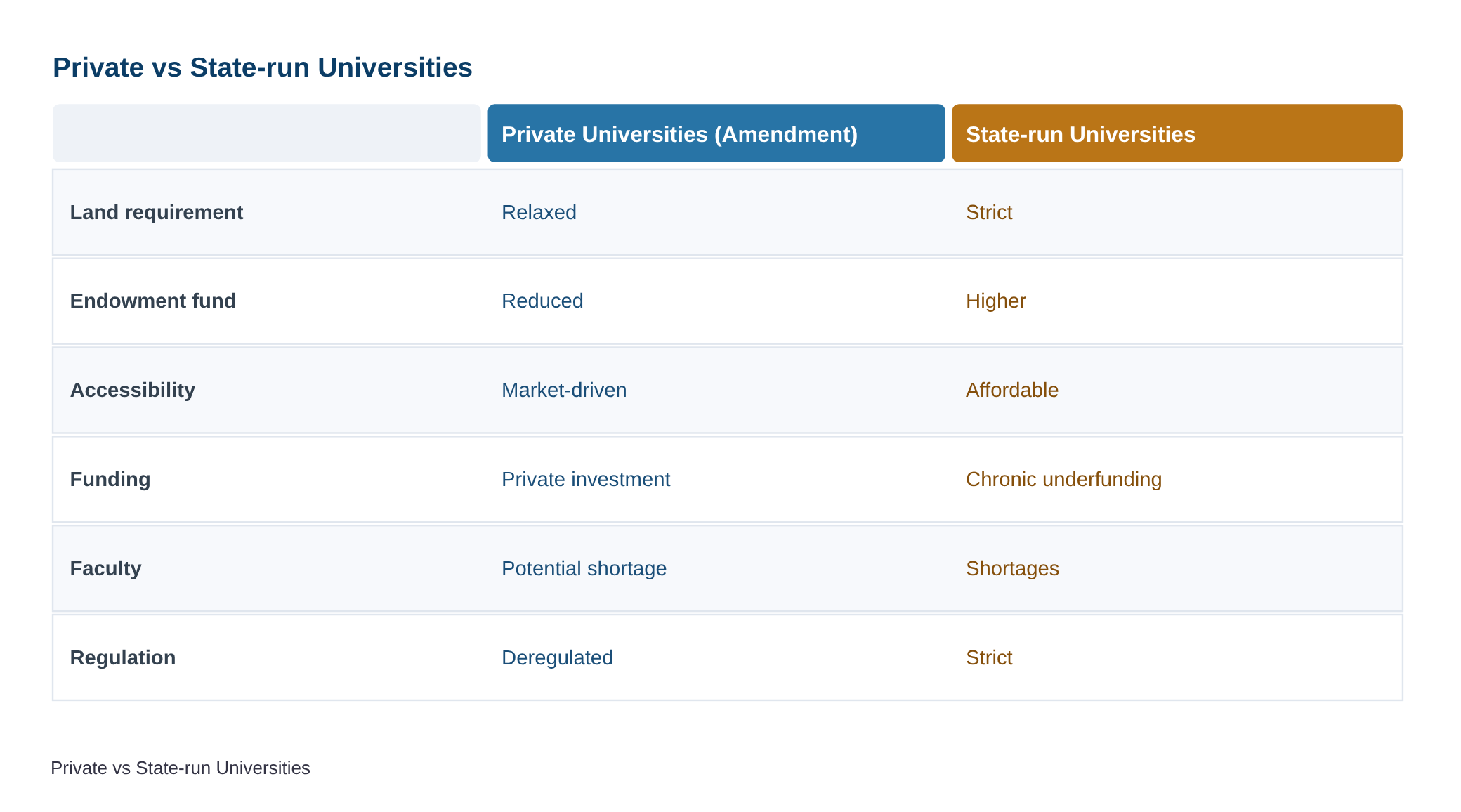
- State-run universities in Tamil Nadu have faced chronic underfunding, faculty shortages, and restricted admissions to doctoral programmes for over a decade, exacerbating disparities in access to higher education.
- The amendment aligns with broader national trends where states are recalibrating regulatory frameworks to attract private investment in higher education, often leading to debates on commercialisation versus public welfare.
What is the Tamil Nadu Private Universities (Amendment) Bill, 2026?
- The Bill amends the Tamil Nadu Private Universities Act, 2019, to relax regulatory norms for the establishment of private universities in the state.
- Key amendments include reducing land requirements: from 25 acres to 12 acres in Greater Chennai Corporation (GCC) areas, 18 acres in other municipal corporations and municipal councils, and 25 acres in remaining areas.
- The Bill lowers the permanent endowment fund requirement from ₹50 crore to ₹25 crore, reducing the financial barrier for establishing private universities.
- The amendments aim to attract private investment in higher education, aligning with the state’s economic development goals and the NEP 2020’s emphasis on private sector participation.
- Critics argue that the relaxed norms may lead to the proliferation of low-quality, commercially-driven institutions, disproportionately benefiting affluent sections of society.
- The Bill does not alter the academic autonomy of universities but focuses on regulatory compliance, including faculty qualifications, infrastructure, and financial sustainability.
- The state government retains oversight through periodic inspections and compliance audits to ensure adherence to prescribed standards.
- The amendments reflect a broader policy shift in Tamil Nadu towards deregulation in the higher education sector, though concerns persist about equity and affordability.
Key Features
| Feature | Significance |
|---|---|
| Reduction in land requirement for private universities | Lowers entry barriers for private players, potentially accelerating the establishment of new institutions but raising concerns about urban land use and commercialisation of education. |
| Decrease in permanent endowment fund requirement (₹50 crore to ₹25 crore) | Reduces financial commitment for promoters, incentivising private investment but risking undercapitalisation and quality compromise in higher education institutions. |
| Relaxation of regulatory conditions for private university establishment | Simplifies the process for private entities to enter higher education, aligning with market-driven education policies but potentially diluting accountability and public accountability standards. |
| Focus on Greater Chennai Corporation (GCC) area relaxation (12 acres) | Encourages private university presence in urban centres, catering to demand but exacerbating regional disparities in higher education access. |
| Amendment to Tamil Nadu Private Universities Act, 2019 | Represents a legislative shift in the governance of private higher education, reflecting evolving state priorities in education policy and funding models. |
Why it Matters
Governance and Policy
- The amendment reflects a broader trend in state-level education policy towards deregulation and marketisation, consistent with the National Education Policy (NEP) 2020’s emphasis on private sector participation in higher education.
- It underscores the tension between state-run and private education systems, particularly in ensuring equitable access to higher education for underprivileged sections.
- The legislative changes highlight the role of state governments in shaping higher education ecosystems, distinct from centralised initiatives like the Viksit Bharat Shiksha Adhishthan Bill.
- The amendments may accelerate the commercialisation of higher education, raising questions about the balance between profit motives and educational equity.
Economic Implications
- Lower financial thresholds for private universities could stimulate investment in the education sector, potentially creating jobs and infrastructure development.
- However, reduced capital requirements may lead to underfunded institutions, compromising academic quality and research output.
- The relaxation of land norms in urban areas (e.g., GCC) could drive real estate demand, impacting land prices and urban planning in metropolitan regions.
- Commercialisation may result in higher tuition fees, limiting access for economically disadvantaged students.
Social and Equity Dimensions
- State-run universities historically provide affordable higher education to marginalised communities; reduced funding and faculty shortages exacerbate inequities.
- Commercialisation risks widening the gap between elite private institutions and underfunded public universities, undermining social mobility.
- The amendments may further marginalise government-aided colleges, which have faced restrictions on doctoral admissions and faculty appointments for over a decade.
Legal and Regulatory Framework
- The amendments modify the Tamil Nadu Private Universities Act, 2019, altering the regulatory landscape for private higher education in the state.
- The changes raise questions about the adequacy of oversight mechanisms to prevent exploitation of relaxed norms, particularly in land acquisition and financial endowments.
- The shift aligns with broader national trends, such as the NEP 2020, which encourages private sector involvement in higher education.
Challenges
1. Commercialisation of Higher Education
- Risk of prioritising profit over academic excellence and social equity in private universities.
- Potential for increased tuition fees, reducing access for students from economically weaker sections.
- Undermining of state-run universities, which serve as the primary avenue for affordable higher education.
- Erosion of public accountability in education, with private entities prioritising market-driven outcomes.
UPSC Link: GS2: Government policies and interventions for development in various sectors
2. Regulatory and Oversight Gaps
- Relaxation of land and financial norms may lead to undercapitalised institutions, compromising educational quality.
- Inadequate monitoring mechanisms to ensure compliance with relaxed norms, particularly in urban areas.
- Lack of transparency in the approval process for private universities, raising concerns about cronyism or vested interests.
- Potential for exploitation of relaxed norms by entities with limited educational expertise.
UPSC Link: GS2: Role of civil services in policy implementation
3. Equity and Access Concerns
- State-run universities, which cater to underprivileged students, face chronic underfunding and faculty shortages.
- Commercialisation may exacerbate regional disparities, with private institutions concentrated in urban centres.
- Restrictions on doctoral admissions in government colleges further limit opportunities for research and advanced studies.
- Long-term marginalisation of government-aided colleges, which have historically provided accessible education.
UPSC Link: GS1: Social empowerment and inclusion
4. Urbanisation and Land Use Pressures
- Relaxation of land norms in Greater Chennai Corporation (GCC) area may intensify urban land use conflicts.
- Potential for speculative real estate activity, driving up land prices and displacing other urban priorities.
- Risk of poor urban planning, with private universities prioritising commercial viability over community needs.
UPSC Link: GS3: Land reforms and urban development
5. Alignment with National Education Policy (NEP) 2020
- The amendments reflect the NEP 2020’s push for private sector participation in higher education, but may not address equity concerns.
- Risk of state-level policies outpacing national frameworks, leading to inconsistencies in education governance.
- Need for harmonisation between state and central policies to ensure a cohesive higher education ecosystem.
UPSC Link: GS2: Issues relating to development and management of Social Sector/Services
Challenges — UPSC Perspective
| Issue | Concern |
|---|---|
| Commercialisation of education | Prioritisation of profit over academic and social equity, leading to higher costs and reduced access. |
| Regulatory oversight gaps | Inadequate monitoring of relaxed norms, risking undercapitalised and low-quality institutions. |
| Urban land use pressures | Intensification of land demand in GCC area, exacerbating urbanisation challenges. |
| Equity and access disparities | Marginalisation of state-run universities, limiting opportunities for underprivileged students. |
| Alignment with NEP 2020 | Potential inconsistencies between state and national education policies, complicating governance. |
Way Forward
- Conduct a comprehensive impact assessment of the amendments on access, quality, and equity in higher education.
- Strengthen regulatory oversight mechanisms to monitor compliance with relaxed norms, particularly in land acquisition and financial endowments.
- Ensure adequate funding and faculty appointments in state-run universities to maintain their role as inclusive higher education providers.
- Develop policies to mitigate urban land use pressures, such as incentivising private universities to locate in non-urban areas.
- Harmonise state-level amendments with national frameworks like NEP 2020 to ensure a cohesive and equitable higher education system.
- Promote transparency in the approval process for private universities, including public disclosure of criteria and rationale.
- Expand doctoral research opportunities in government and government-aided colleges to address existing restrictions.
- Encourage public-private partnerships that prioritise social equity and academic excellence over commercial gains.
UPSC Value Addition
Keywords for Mains Answer-Writing
Tamil Nadu Private Universities (Amendment) Bill, 2026 · commercialisation of higher education · land requirement norms for private universities · permanent endowment fund for private universities · State-run education system · National Education Policy 2020 · Viksit Bharat Shiksha Adhishthan Bill · higher education governance · affordable higher education · underprivileged sections in education · privatisation of education · regulatory oversight in education
Concept Flow
State-run universities face chronic underfunding and faculty shortages, limiting access for underprivileged students. → Legislative amendments relax norms for private university establishment (land, financial requirements), lowering barriers to entry. → Relaxed norms incentivise private investment but risk commercialisation and undercapitalisation of institutions. → Commercialisation may exacerbate equity gaps, with private institutions prioritising profit over social inclusion. → Urban land use pressures intensify, particularly in GCC area, reflecting broader urbanisation challenges. → Regulatory oversight gaps emerge, raising concerns about accountability and quality in higher education. → Long-term implications include a bifurcated higher education system, with elite private institutions and marginalised state-run universities.
Prelims Practice Questions
Q1. Consider the following statements regarding the Tamil Nadu Private Universities (Amendment) Bill, 2026:
1. The Bill reduces the land requirement for setting up private universities in the Greater Chennai Corporation (GCC) area from 25 acres to 12 acres.
2. The Bill increases the permanent endowment fund requirement for private universities from ₹25 crore to ₹50 crore.
3. The Bill aims to promote commercialisation of higher education by relaxing regulatory norms.
How many of the above statements are correct?
- Only one
- Only two
- All three
- None
Answer: Only two — Statement 1 is correct as the Bill reduces the land requirement in GCC area to 12 acres. Statement 2 is incorrect because the Bill reduces the permanent endowment fund requirement from ₹50 crore to ₹25 crore. Statement 3 is correct as the Bill seeks to relax conditions for setting up private universities, which critics argue promotes commercialisation.
Q2. Assertion (A): The Tamil Nadu Private Universities (Amendment) Bill, 2026, seeks to reduce the land requirement for private universities in municipal corporations from 25 acres to 18 acres.
Reason (R): The Bill aims to facilitate easier establishment of private universities in urban areas, aligning with the National Education Policy 2020.
In the context of the above two statements, which one of the following is correct?
- Both A and R are true, and R is the correct explanation of A.
- Both A and R are true, but R is not the correct explanation of A.
- A is true, but R is false.
- A is false, but R is true.
Answer: Both A and R are true, but R is not the correct explanation of A. — Both statements are true. The Bill does reduce the land requirement for private universities in municipal corporations to 18 acres (A). The reduction is intended to facilitate easier establishment of private universities, which aligns with the broader goals of the National Education Policy 2020 (R). However, R is not the direct explanation for A as it provides a broader policy context rather than a procedural one.
Q3. Match the following land requirement norms for private universities as proposed in the Tamil Nadu Private Universities (Amendment) Bill, 2026:
Column I (Area Type) Column II (Land Requirement in Acres)
A. Greater Chennai Corporation (GCC) area 1. 25
B. Other municipal corporations 2. 18
C. Municipal councils 3. 12
D. Rest of the areas 4. 15
Select the correct match:
- A-3, B-2, C-2, D-1
- A-1, B-4, C-3, D-2
- A-2, B-1, C-4, D-3
- A-3, B-2, C-4, D-1
Answer: A-3, B-2, C-2, D-1 — The correct match is: A-3 (GCC area: 12 acres), B-2 (Other municipal corporations: 18 acres), C-2 (Municipal councils: 18 acres), D-1 (Rest of the areas: 25 acres).
Mains Practice Question
✍ The Tamil Nadu Private Universities (Amendment) Bill, 2026, seeks to relax regulatory norms for the establishment of private universities in the state. Critically examine the implications of such amendments for the higher education ecosystem in Tamil Nadu, with particular reference to equity, accessibility, and the role of the state in education. (15 Marks)
Approach: MODEL-ANSWER SKELETON:
1. **Introduction (2 marks)**: Define the Tamil Nadu Private Universities (Amendment) Bill, 2026, and its key provisions (reduction in land requirement, permanent endowment fund, and regulatory relaxation). Contextualise within the broader debate on privatisation vs. state-run education.
2. **Equity and Accessibility (4 marks)**:
– Analyse how reduced land norms may lead to concentration of private universities in urban areas (e.g., GCC area), potentially marginalising rural and underprivileged sections.
– Discuss the risk of commercialisation disproportionately affecting lower-income groups due to higher tuition fees in private institutions.
– Reference the National Education Policy 2020’s emphasis on inclusivity and equitable access to higher education.
3. **Role of the State (4 marks)**:
– Examine the constitutional obligation of the state under Article 41 (Right to Education) and Directive Principles of State Policy (DPSP) to provide affordable and accessible higher education.
– Critique the state’s simultaneous reduction in funding and faculty appointments in government universities, which may exacerbate inequities.
– Compare with the Union government’s Viksit Bharat Shiksha Adhishthan Bill to highlight the broader trend of centralisation and commercialisation of education.
4. **Regulatory Oversight and Quality Concerns (3 marks)**:
– Discuss the potential dilution of regulatory oversight due to relaxed norms, leading to concerns about quality and accountability in private universities.
– Reference the UGC’s regulatory framework and the need for robust accreditation mechanisms.
5. **Balancing Views and Conclusion (2 marks)**:
– Present arguments in favour of the Bill: increased access to higher education, innovation, and reduced bureaucratic hurdles.
– Present counterarguments: commercialisation, inequity, and the erosion of the state’s role in education.
– Conclude with a balanced view, suggesting measures to mitigate adverse effects (e.g., stricter accreditation, state-funded scholarships, and equitable distribution of private universities).
Source: The Hindu
Tamil Nadu PCS (TNPSC) — State PCS Practice
Prelims: The Tamil Nadu Private Universities (Amendment) Bill, 2026, which seeks to amend certain provisions related to private universities in the state, has faced opposition primarily from which group?
- A. College and university teachers
- B. Private university management
- C. State government officials
- D. Student unions
Answer: A. College and university teachers — The opposition to the bill has been led by college and university teachers’ associations, citing concerns over autonomy and academic standards.
Mains: Critically analyze the key provisions of the Tamil Nadu Private Universities (Amendment) Bill, 2026, and discuss the concerns raised by college and university teachers regarding its potential impact on higher education in the state.
Generated by AanyaAi for educational purpose.
Related guides on our sites
- Current affairs for upsc 2026
- Best PSIR optional coaching for upsc
- Best PSIR optional teacher for upsc
- Best teacher of PSIR optional for upsc

- Tamil Nadu’s Private University Bill 2026: Teachers Protest Commercialisation Risks - September 10, 2026
- तेलंगाना सरकार ने कर्मचारियों के लिए बनाया 240 करोड़ रुपये का स्वास्थ्य कोष - September 10, 2026
- Telangana launches ₹240 crore Employees Health Scheme for 12.91 lakh staff - September 10, 2026

No Comments