


26 Sep Tamil Nadu’s Rising Drought Crisis: UPSC Geography Current Affairs 2024
✎ The Standardised Precipitation-Evapotranspiration Index (SPEI) is the most reliable drought metric for South Peninsular India due to its inclusion of temperature-driven evapotranspiration, which directly impacts water…
Subject Relevance — Where This Topic Fits
- GS Paper I — Geography (Climate Change and Drought Patterns) | GS Paper III — Environment and Disaster Management (Climate Extremes and Water Scarcity)
- Prelims: Drought Hotspots, Standardised Precipitation-Evapotranspiration Index (SPEI), Heat Index, Urban Heat Island Effect, Bay of Bengal SSTs, Climate Extremes Index (IndCEI)
- Essay: Climate Change and Its Socio-Economic Impacts: A Case Study of Drought-Prone Regions in India, Water Security in India: Challenges and Policy Responses in the Context of Climate Variability
Quick Revision: The Standardised Precipitation-Evapotranspiration Index (SPEI) is the most reliable drought metric for South Peninsular India due to its inclusion of temperature-driven evapotranspiration, which directly impacts water availability in a warming climate.
Why is this in the news?
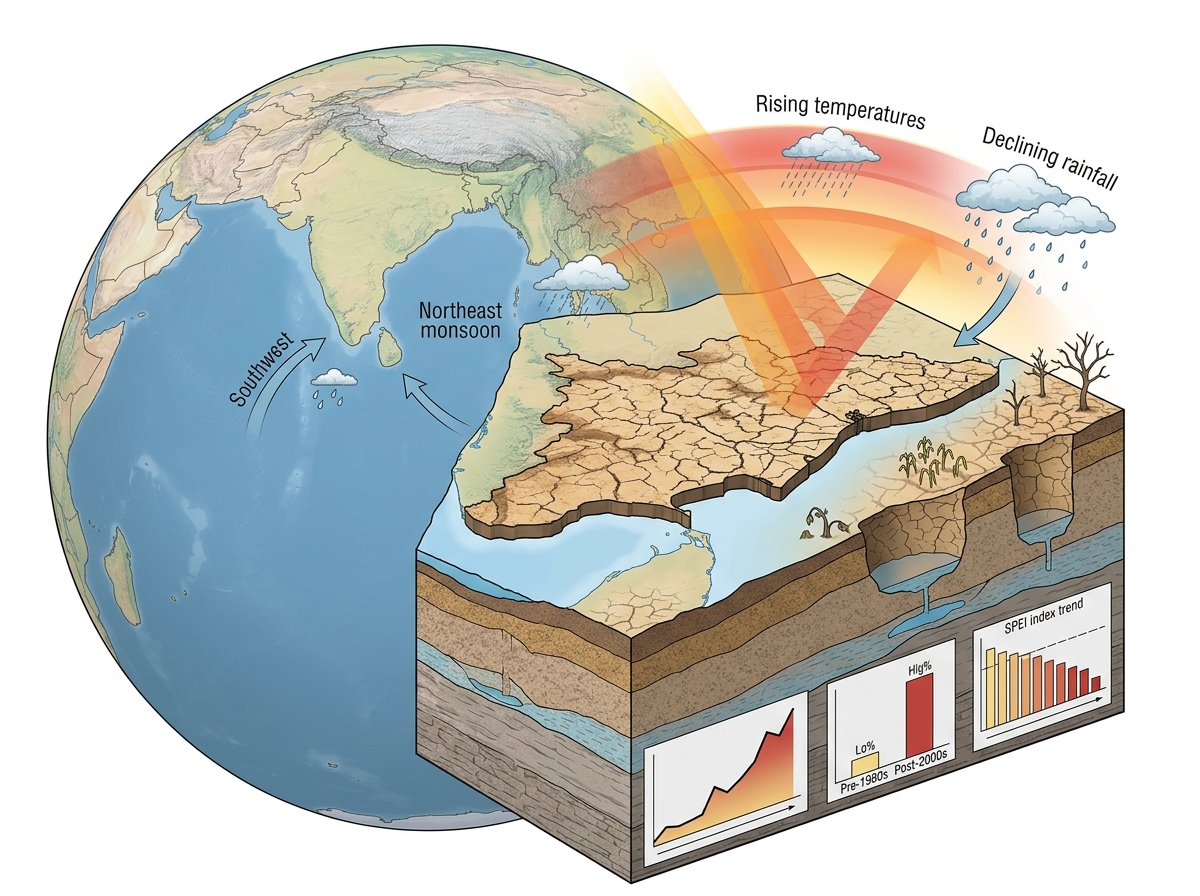
A recent 52-year study published in the *International Journal of Climatology* has identified Tamil Nadu as a pronounced drought hotspot within South Peninsular India, where the area affected by drought has surged from under 10% pre-1990s to over 40% in several post-2000 years. The findings highlight the region’s vulnerability to climate extremes, with severe drought conditions persisting through the 2010s and early 2020s. The study’s use of the Standardised Precipitation-Evapotranspiration Index (SPEI) underscores the compounded impact of declining rainfall and rising temperatures on water availability, necessitating an integrated policy response.
Background
- The region’s drought vulnerability is exacerbated by its reliance on monsoon rainfall, particularly the Northeast and Southwest monsoons, which are increasingly erratic due to climate change.
- Tamil Nadu, with its dense population and agrarian economy, faces heightened water stress, as evidenced by recurring droughts in districts such as Dindigul, Virudhunagar, and Ramanathapuram.
- Urbanisation and land-use changes, including deforestation and encroachment of water bodies, have further diminished the region’s resilience to droughts.
Understanding Drought and Climate Extremes in South Peninsular India
- Drought is a prolonged deficiency in precipitation relative to normal levels, leading to water scarcity for agriculture, ecosystems, and human consumption. It is classified into meteorological, hydrological, agricultural, and socio-economic droughts based on its impact.
- The Standardised Precipitation-Evapotranspiration Index (SPEI) is a multi-scalar drought index that accounts for both precipitation deficits and potential evapotranspiration (PET), which is influenced by temperature. SPEI is more robust than the Standardised Precipitation Index (SPI) as it incorporates the effects of rising temperatures on water demand.
- The India Climate Extremes Index (IndCEI), revised in this study, integrates seven climate indicators, including drought, heat, dry spells, and heavy rainfall, to provide a comprehensive assessment of climate extremes across India.
- South Peninsular India has exhibited the strongest long-term increase in drought-affected area among India’s four climatic regions, with Tamil Nadu, Odisha, and Andhra Pradesh recording a 20-30% rise in drought-affected areas during 2011–2021 compared to the 1980s.
- The study attributes the intensification of droughts to a combination of declining monsoon rainfall and increasing temperatures, which elevate evapotranspiration rates and reduce soil moisture.
- Urban heat island effects, driven by concrete surfaces and reduced green cover, exacerbate heat stress in cities, further straining water resources.
- The Heat Index, which combines temperature and humidity to measure human-perceived heat stress, has shown a steady increase over South Peninsular India, particularly since the 2010s, posing risks to public health and agricultural productivity.
- The study highlights strong year-to-year variability, with extreme drought years in the early 2020s standing out.
Key Features
| Feature | Significance |
|---|---|
| South Peninsular India as drought hotspot | Identifies Tamil Nadu, Odisha, and Andhra Pradesh as regions experiencing the strongest long-term increase in drought-affected area among India’s four climatic regions, with over 40% of the region under drought conditions post-2000. |
| Standardised Precipitation-Evapotranspiration Index (SPEI) | A multi-indicator metric incorporating both precipitation and evapotranspiration, capturing the compounded impact of declining rainfall and rising temperatures on water availability. |
| Heat Index increase | Demonstrates a steady rise in heat stress over South Peninsular India since the 2010s, linked to urbanisation, warmer sea-surface temperatures, and higher minimum temperatures. |
| Year-to-year variability in dry spells | Highlights strong inter-annual fluctuations in dry-day frequency, including a notable peak in 2002, despite an overall flat long-term trend. |
| Urban heat-island effects | Contributes to elevated heat exposure in South Peninsular India, particularly in urban centres, exacerbating drought impacts. |
Why it Matters
Agricultural Productivity
- Prolonged drought conditions reduce soil moisture, directly impacting crop yields, particularly for rain-fed agriculture dominant in Tamil Nadu and coastal Andhra Pradesh.
Water Resource Management
- Diminished precipitation and increased evapotranspiration strain groundwater reserves and surface water bodies, necessitating adaptive water conservation and distribution strategies.
Public Health
- Elevated Heat Index and heat stress pose health risks, especially for vulnerable populations, requiring targeted heat action plans and healthcare infrastructure augmentation.
Economic Stability
- Agricultural and allied sector downturns can trigger rural distress, migration, and inflationary pressures, impacting GDP growth and employment in drought-prone states.
Climate Resilience
- The study underscores the urgency of integrating climate adaptation into development planning, particularly for states with high drought vulnerability.
Challenges
1. Groundwater Depletion
- Intensified extraction due to reduced rainfall and increased evapotranspiration accelerates depletion of aquifers, threatening long-term water security.
UPSC Link: GS-III: Water Resources
2. Agricultural Vulnerability
- Rain-fed farming systems face heightened risk of crop failure, necessitating shifts toward drought-resistant varieties and sustainable agricultural practices.
UPSC Link: GS-III: Agriculture
3. Urban Heat Stress
- Rising minimum temperatures and urbanisation amplify heat exposure in cities, requiring heat mitigation measures and public health interventions.
UPSC Link: GS-III: Urbanisation
4. Water Supply Disruptions
- Drought-induced shortages in surface and groundwater sources disrupt domestic, industrial, and agricultural water supply chains.
UPSC Link: GS-III: Water Resources
5. Ecosystem Degradation
- Prolonged drought conditions degrade soil quality, reduce biodiversity, and disrupt ecological balance in drought-prone regions.
UPSC Link: GS-III: Environment
6. Policy Implementation Gaps
- Existing drought management frameworks may lack adaptive capacity to address worsening climate extremes, necessitating institutional strengthening.
UPSC Link: GS-II: Governance
Challenges — UPSC Perspective
| Issue | Concern |
|---|---|
| Groundwater Depletion | Accelerated extraction due to reduced recharge threatens long-term water security. |
| Agricultural Vulnerability | Rain-fed systems face heightened risk of crop failure and rural distress. |
| Urban Heat Stress | Rising temperatures and urbanisation amplify heat exposure in cities. |
| Water Supply Disruptions | Drought-induced shortages disrupt domestic and industrial water supply chains. |
| Ecosystem Degradation | Prolonged drought degrades soil quality and reduces biodiversity. |
| Policy Implementation Gaps | Existing frameworks may lack adaptive capacity to address worsening climate extremes. |
Way Forward
- Integrate SPEI and Heat Index data into state-level drought and heat action plans for real-time monitoring and response.
- Promote drought-resistant crop varieties and water-efficient irrigation techniques in vulnerable regions.
- Strengthen groundwater recharge mechanisms through watershed development and artificial recharge projects.
- Expand urban heat mitigation strategies, including green spaces, cool roofs, and public cooling centres.
- Enhance inter-state coordination for water resource management, particularly for transboundary river basins.
- Invest in climate-resilient infrastructure for agriculture, water supply, and public health systems.
- Develop community-based drought preparedness and early warning systems with local stakeholder participation.
- Incorporate climate projections into long-term agricultural and urban planning to reduce vulnerability.
UPSC Value Addition
Keywords for Mains Answer-Writing
Drought vulnerability in South Peninsular India · Standardised Precipitation-Evapotranspiration Index (SPEI) · Climate Extremes Index (IndCEI) · Urban heat island effect · Bay of Bengal’s influence on monsoon variability · Drought mitigation strategies in Tamil Nadu · Climate change and water stress · Heat Index and public health · South Peninsular India’s climatic trends · Sustainable water resource management
Concept Flow
Declining monsoon rainfall → Reduced soil moisture and groundwater recharge → Increased SPEI drought severity → Agricultural yield decline and water scarcity → Rural distress and urban migration → Policy response gaps → Institutional strengthening for adaptive governance → Integration of climate resilience into development planning
Prelims Practice Questions
Q1. Consider the following statements regarding drought assessment in India:
1. The Standardised Precipitation-Evapotranspiration Index (SPEI) incorporates both precipitation and potential evapotranspiration to assess drought.
2. The India Climate Extremes Index (IndCEI) is a composite index that includes indicators such as heat, drought, dry spells, and heavy rainfall.
3. The Heat Index is solely based on maximum temperature and does not account for humidity.
How many of the above statements are correct?
- Only one
- Only two
- All three
- None
Answer: Only two — Statement 1 and 2 are correct as SPEI combines precipitation and evapotranspiration, and IndCEI includes multiple climate extremes. Statement 3 is incorrect because the Heat Index combines temperature and humidity to indicate heat stress.
Q2. Assertion (A): The Standardised Precipitation-Evapotranspiration Index (SPEI) is a more comprehensive drought indicator than the Standardised Precipitation Index (SPI).
Reason (R): SPEI accounts for the influence of temperature on water availability by incorporating evapotranspiration, whereas SPI relies solely on precipitation data.
- Both A and R are true, and R is the correct explanation of A
- Both A and R are true, but R is not the correct explanation of A
- A is true, but R is false
- A is false, but R is true
Answer: Both A and R are true, and R is the correct explanation of A — Both A and R are true, and R correctly explains why SPEI is more comprehensive than SPI, as it includes temperature-driven evapotranspiration.
Q3. Match the following climatic regions of India with their respective drought trends as identified in recent studies:
Column I (Climatic Region) | Column II (Drought Trend)
1. South Peninsular India | A. Strongest long-term increase in drought-affected area
2. Northwest India | B. Moderate increase in drought-affected area
3. Northeast India | C. Minimal change in drought-affected area
4. Central India | D. Decreasing drought trend
- 1-A, 2-B, 3-C, 4-D; 1-A, 2-D, 3-C, 4-B; 1-B, 2-A, 3-D, 4-C; 1-D, 2-B, 3-A, 4-C
- answer_string_mapping_table
- answer_mapping_table
Answer: ? — South Peninsular India shows the strongest long-term increase in drought-affected area. Northwest India exhibits a moderate increase, Northeast India shows minimal change, and Central India has a decreasing drought trend.
Mains Practice Question
✍ Critically examine the assertion that South Peninsular India, including Tamil Nadu, has witnessed a significant intensification of drought conditions in recent decades. Substantiate your answer with reference to the Standardised Precipitation-Evapotranspiration Index (SPEI), the India Climate Extremes Index (IndCEI), and the role of urbanisation and climate change. (15 Marks)
Approach: MODEL-ANSWER SKELETON:
1. **Introduction (2 marks)**: Define drought and its measurement tools (SPEI, IndCEI). Briefly state the regional focus on South Peninsular India.
2. **Trends in Drought Intensity (4 marks)**: Use data from the study to highlight the shift from <10% drought-affected area pre-1990s to >40% post-2000. Reference SPEI’s incorporation of evapotranspiration and temperature.
3. **Contributing Factors (5 marks)**:
– **Climate Change**: Rising temperatures, altered monsoon patterns, and Bay of Bengal’s influence.
– **Urbanisation**: Urban heat island effect and land-use changes.
– **IndCEI Indicators**: Link to heat, dry spells, and heavy rainfall variability.
4. **Regional Specifics (2 marks)**: Focus on Tamil Nadu’s vulnerability, citing the 20%–30% increase in drought-affected area (2011–2021 vs. 1980s).
5. **Conclusion (2 marks)**: Summarise the multi-dimensional drivers and the need for integrated drought mitigation strategies (e.g., water conservation, afforestation, climate-resilient agriculture).
**Key Data Points to Include**:
– SPEI’s advantage over SPI (evapotranspiration inclusion).
– IndCEI’s seven indicators and their relevance.
– Bay of Bengal’s role in humidity and heat stress.
– Urbanisation’s contribution to heat islands.
**Balance of Views**: Acknowledge natural variability (e.g., 2002 peak) but emphasise anthropogenic drivers (urbanisation, climate change).
Source: The Hindu
Tamil Nadu PCS (TNPSC) — State PCS Practice
Prelims: According to recent studies, Tamil Nadu is identified as one of the pronounced drought hotspots in South Peninsular India. Which of the following factors is NOT a primary contributor to this trend in Tamil Nadu?
- Increasing frequency of El Niño events disrupting monsoon patterns
- Over-extraction of groundwater for agricultural and industrial use
- Rapid urbanization leading to reduced percolation of rainwater
- Consistent increase in annual rainfall due to climate change
Answer: Consistent increase in annual rainfall due to climate change — While climate change is causing erratic rainfall patterns, studies indicate a decline in overall annual rainfall in Tamil Nadu, not a consistent increase.
Mains: Examine the socio-economic impacts of prolonged drought conditions in Tamil Nadu, with a focus on rural livelihoods, agricultural productivity, and government interventions. Suggest measures to mitigate these impacts in the context of climate change.
Generated by AanyaAi for educational purpose.
Related guides on our sites
- Current affairs for upsc 2026
- How to prepare for GS paper 1 for UPSC CSE mains exam
- Best UPSC coaching for IFOS exam
- Best geography optional coaching

- Tamil Nadu’s Rising Drought Crisis: UPSC Geography Current Affairs 2024 - September 26, 2026
- ट्रम्प ने ईरान के होर्मुज स्ट्रेट खोलने के प्रस्ताव को किया खारिज, जानिए क्यों है महत्वपूर्ण - September 26, 2026
- Trump Rejects Iran’s Strait of Hormuz Reopening Proposal: UPSC Geography Insights - September 26, 2026

No Comments