


06 Sep Tamil Nadu’s Underwater Archaeology: Poompuhar’s 3rd Phase Explained for UPSC
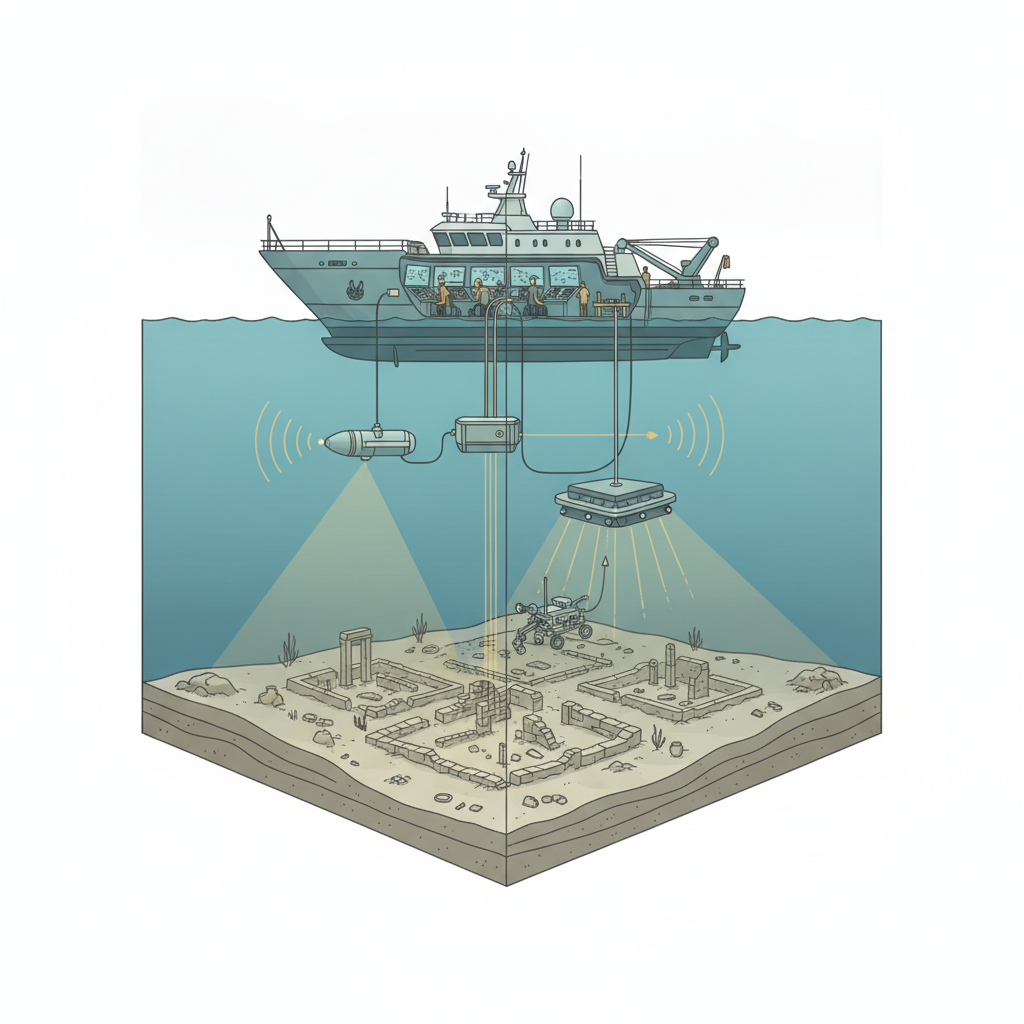
✎ Underwater archaeology at Poompuhar employs side-scan sonar, sub-bottom profilers, multibeam scanners, and ROVs to map submerged structures linked to the Sangam-period port city, aiding in the reconstruction of ancient maritime…
Subject Relevance — Where This Topic Fits
- GS Paper I — Ancient History and Culture | GS Paper I — Indian Heritage and Culture | GS Paper II — Governance, Transparency and Accountability in Archaeological Research
- Prelims: Underwater archaeology, Poompuhar (Kaveripoompattinam), Sangam literature, Maritime archaeology, Side-scan sonar, Sub-bottom profiler, Multibeam scanner, Remotely Operated Vehicle (ROV), Northeast Monsoon, Tamil Nadu State Department of Archaeology (TNSDA)
- Essay: The role of archaeology in reconstructing India’s maritime heritage, Conservation of submerged cultural heritage: challenges and opportunities
Quick Revision: Underwater archaeology at Poompuhar employs side-scan sonar, sub-bottom profilers, multibeam scanners, and ROVs to map submerged structures linked to the Sangam-period port city, aiding in the reconstruction of ancient maritime trade networks.
Why is this in the news?
The Tamil Nadu State Department of Archaeology (TNSDA) has initiated the third phase of underwater archaeological exploration off the coast of Poompuhar, an ancient port city linked to the Sangam period. This systematic marine survey, planned for 20 days, employs advanced technologies such as side-scan sonar, sub-bottom profilers, multibeam scanners, and remotely operated vehicles to map the ocean floor and identify submerged structures. The initiative underscores the state’s commitment to preserving and interpreting India’s maritime heritage, building on earlier explorations conducted in collaboration with the Indian Maritime University.
Background
- Poompuhar, historically known as Kaveripoompattinam, was a major port city during the Sangam period (3rd century BCE to 3rd century CE) and served as a hub for maritime trade between India, Sri Lanka, Southeast Asia, and the West.
- Ancient Tamil literary works such as *Pattinappaalai*, *Silappadikaram*, and *Manimekalai* provide detailed accounts of Poompuhar’s urban layout, trade networks, and cultural exchanges.
- Underwater archaeology involves the systematic exploration of submerged sites using non-invasive technologies to document and preserve cultural heritage without altering its context.
- The Northeast Monsoon season (October–December) influences ocean currents and visibility, necessitating careful planning of underwater surveys to ensure safety and data accuracy.
What is Underwater Archaeology and How is it Conducted at Poompuhar?
- Underwater archaeology is the scientific study of submerged cultural heritage, including shipwrecks, port structures, and ancient settlements, using specialized equipment and methodologies.
- The Poompuhar exploration employs a suite of advanced marine geophysical instruments: side-scan sonar (for high-resolution seabed imaging), sub-bottom profilers (to detect buried structures), multibeam scanners (for 3D mapping), and remotely operated vehicles (ROVs) for close-up inspection and documentation.
- The survey is conducted in phases, with each phase lasting approximately 20 days, to account for seasonal variations in ocean currents and monsoon patterns, ensuring optimal conditions for data collection.
- The exploration team includes trained divers, marine archaeologists, geophysicists, and technicians, who work in coordination to record, photograph, and map submerged features while adhering to ethical standards of heritage conservation.
- Poompuhar’s underwater landscape is believed to contain remnants of ancient docks, warehouses, and possibly shipwrecks, which could provide evidence of the city’s role as a key node in the Indian Ocean trade network.
- Data collected during the survey is analyzed to reconstruct the historical geography of Poompuhar, including its port infrastructure, trade routes, and urban development, contributing to a deeper understanding of Tamil civilization during the Sangam era.
Key Features
| Feature | Significance |
|---|---|
| Underwater archaeological exploration off Poompuhar coast | Aims to trace maritime trade links of ancient Tamils and uncover submerged archaeological structures, enhancing historical understanding of the region’s maritime heritage. |
| Third phase of exploration | Builds on previous phases (e.g., September 2025) using advanced marine exploration instruments to map the ocean floor and identify submerged artifacts or structures. |
| Duration of 20 days | Planned considering ocean currents and Northeast monsoon patterns to ensure optimal conditions for underwater exploration and data collection. |
| Use of advanced marine exploration instruments | Includes remotely operated vehicle (ROV), side-scan sonar, sub-bottom profiler, and multibeam scanner to enhance precision in mapping and artifact detection. |
| Collaboration with Indian Maritime University | Leverages academic and technical expertise to improve the efficacy of underwater archaeological surveys and data interpretation. |
Why it Matters
Historical and Cultural Significance
- Poompuhar (ancient Kaveripoompattinam) was a major port city during the Sangam period, referenced in literary works such as Pattinappaalai, Silappadikaram, and Manimekalai, highlighting its role in maritime trade.
- The exploration aims to validate historical accounts of maritime trade links with Sri Lanka, Southeast Asia, and the West, providing empirical evidence for ancient Tamil civilization’s global connectivity.
- Discovery of submerged structures or artifacts could redefine the understanding of Tamil maritime history and its contributions to global trade networks.
Scientific and Technological Advancement
- The use of modern marine exploration tools (e.g., ROV, sonar) demonstrates the integration of technology in archaeological research, setting a precedent for future underwater explorations in India.
- The exploration contributes to the field of maritime archaeology, which remains underdeveloped in India compared to terrestrial archaeology, fostering interdisciplinary research.
- Data collected could support climate change studies by analyzing sediment layers and historical sea-level changes in the region.
Economic and Tourism Potential
- Successful discoveries could enhance tourism by promoting Poompuhar as a heritage site, attracting both domestic and international visitors interested in ancient maritime history.
- The project may stimulate local economies through employment in tourism, hospitality, and allied sectors, particularly in the Mayiladuthurai district.
- Potential for public-private partnerships in preserving and showcasing underwater heritage, aligning with the ‘Dekho Apna Desh’ initiative for cultural tourism.
Policy and Governance Implications
- The project underscores the role of state departments in preserving cultural heritage, aligning with the National Culture Policy and the UNESCO Convention for the Protection of the Underwater Cultural Heritage (2001).
- It highlights the need for inter-departmental coordination between archaeology, maritime, and environmental agencies to ensure sustainable exploration and conservation.
- The initiative reflects the Tamil Nadu government’s commitment to documenting and protecting its rich maritime heritage as part of broader cultural preservation efforts.
Educational and Research Impact
- The exploration provides opportunities for students and researchers in archaeology, marine science, and history to engage in fieldwork and data analysis, fostering academic growth.
- Findings could be integrated into school and university curricula, enriching the study of ancient Tamil civilization and maritime trade.
- Collaboration with institutions like the Indian Maritime University enhances academic-industry linkages, promoting research in underwater archaeology.
Challenges
1. Technical and Logistical Challenges
- Limited underwater visibility due to sediment and marine conditions may hinder the identification and documentation of submerged structures or artifacts.
- Depth of exploration (up to 10 meters) poses risks to divers and requires advanced equipment, increasing operational costs and complexity.
- Ocean currents and monsoon patterns necessitate precise planning to ensure safety and maximize data collection efficiency.
UPSC Link: GS Paper 1: Ancient History & Culture
2. Preservation and Conservation Risks
- Exposure of submerged artifacts to oxygen and marine organisms may accelerate decay, requiring immediate conservation measures upon discovery.
- Lack of standardized protocols for underwater heritage conservation in India may lead to ad-hoc preservation efforts, risking long-term damage.
- Climate change-induced sea-level rise and coastal erosion could threaten the stability of submerged archaeological sites.
UPSC Link: GS Paper 1: Heritage Conservation
3. Funding and Resource Constraints
- High costs associated with underwater exploration, including equipment rental, diver training, and data analysis, may limit the scope or duration of the project.
- Dependence on government funding may lead to delays or interruptions if budgetary allocations are prioritized elsewhere.
- Sustaining long-term exploration phases requires consistent investment in technology and human resources.
UPSC Link: GS Paper 3: Government Budgeting & Resource Allocation
4. Legal and Ethical Considerations
- The absence of a dedicated legal framework for underwater heritage in India may create ambiguities in ownership, exploration rights, and artifact recovery.
- Ethical concerns arise regarding the commercialization of discoveries, balancing public interest with private or corporate involvement in heritage preservation.
- International collaborations must adhere to the UNESCO Convention for the Protection of the Underwater Cultural Heritage to ensure ethical and sustainable practices.
UPSC Link: GS Paper 2: International Treaties & Conventions
5. Public Awareness and Engagement
- Limited public awareness about underwater archaeology may reduce community support or interest in the project’s outcomes.
- Ensuring transparency in findings and their dissemination is crucial to maintain trust and avoid misinformation or sensationalism.
- Engaging local communities in the exploration process can foster a sense of ownership and pride in heritage preservation.
UPSC Link: GS Paper 4: Ethics & Governance
6. Data Interpretation and Validation
- Interpreting sonar and ROV data requires specialized expertise, and misinterpretation could lead to incorrect conclusions about submerged structures.
- Cross-verifying findings with historical texts and terrestrial archaeological evidence is essential to validate discoveries.
- Publishing peer-reviewed research ensures academic rigor and prevents premature claims about discoveries.
UPSC Link: GS Paper 1: Research Methodology in History
Challenges — UPSC Perspective
| Issue | Concern |
|---|---|
| Underwater visibility | Hampers accurate identification and documentation of submerged structures or artifacts. |
| Ocean currents and monsoon | Complicate planning and execution, increasing operational risks and costs. |
| Preservation of artifacts | Exposure to marine conditions may accelerate decay without immediate conservation. |
| Legal framework | Ambiguities in ownership and exploration rights may hinder project implementation. |
| Funding constraints | High costs limit the scope or duration of exploration phases. |
| Public engagement | Low awareness may reduce community support and interest in the project’s outcomes. |
Way Forward
- Establish a dedicated underwater archaeology unit within the Tamil Nadu State Department of Archaeology to ensure sustained exploration and research.
- Develop standardized protocols for underwater heritage conservation, in line with UNESCO guidelines, to ensure long-term preservation of discoveries.
- Invest in training programs for divers and archaeologists in advanced marine exploration techniques to enhance local expertise.
- Foster collaborations with national and international institutions (e.g., Indian Maritime University, UNESCO) to leverage technical and academic resources.
- Create a public portal or museum exhibit to showcase findings, fostering awareness and pride in Tamil Nadu’s maritime heritage.
- Integrate exploration data into school and university curricula to enrich historical education and research.
- Formulate a legal framework for underwater heritage management, clarifying ownership, exploration rights, and artifact recovery processes.
- Conduct periodic reviews of the project’s progress and outcomes to ensure alignment with conservation and research goals.
UPSC Value Addition
Keywords for Mains Answer-Writing
Underwater archaeology · Poompuhar · Kaveripoompattinam · Tamil Nadu State Department of Archaeology (TNSDA) · maritime heritage · Sangam literature · ancient port cities · underwater cultural heritage · Northeast monsoon and archaeological surveys · maritime trade links · Indian Maritime University · remotely operated vehicle (ROV) · side-scan sonar · sub-bottom profiler · multibeam scanner · maritime archaeology in India · conservation of submerged heritage
Constitutional & Policy Linkages
- [‘Article 49: Protection of monuments and places of national importance’, ‘Mandates the preservation of cultural heritage, including underwater sites.’]
- [‘Article 51A(f): Fundamental Duties’, ‘Encourages citizens to value and preserve the rich heritage of composite culture.’]
Concept Flow
Ancient Tamil literary references (Sangam period) → Historical significance of Poompuhar as a maritime trade hub → Need for empirical validation of historical accounts → Tamil Nadu State Department of Archaeology (TNSDA) initiates underwater exploration → Use of advanced marine exploration instruments (ROV, sonar) → Data collection and mapping of ocean floor → Discovery of submerged structures/artifacts → Conservation and preservation challenges → Policy and governance implications → Public awareness and tourism potential → Integration into educational and research frameworks.
Prelims Practice Questions
Q1. Consider the following statements regarding the underwater archaeological exploration off Poompuhar coast:
1. The exploration is being conducted by the Tamil Nadu State Department of Archaeology (TNSDA) in collaboration with the Indian Maritime University.
2. The exploration uses advanced marine exploration instruments such as a remotely operated vehicle (ROV), side-scan sonar, sub-bottom profiler, and multibeam scanner.
3. The exploration is planned to last for nearly 20 days, considering ocean currents and the Northeast monsoon.
How many of the above statements are correct?
- Only one
- Only two
- Only three
- None
Answer: Only three — Statements 1 and 2 are correct as the exploration is conducted by TNSDA in collaboration with the Indian Maritime University and uses advanced marine exploration instruments. Statement 3 is also correct as the exploration is planned for nearly 20 days considering ocean currents and the Northeast monsoon. Thus, all three statements are correct.
Q2. Assertion (A): The ancient port city of Poompuhar, also known as Kaveripoompattinam, is mentioned in Sangam literature.
Reason (R): Sangam literature includes works such as Pattinappaalai, Silappadikaram, and Manimekalai, which reference Poompuhar and its maritime trade links.
- Both A and R are true, and R is the correct explanation of A
- Both A and R are true, but R is not the correct explanation of A
- A is true, but R is false
- A is false, but R is true
Answer: Both A and R are true, and R is the correct explanation of A — Both the Assertion (A) and Reason (R) are true, and the Reason (R) correctly explains the Assertion (A). Sangam literature indeed references Poompuhar, and the works mentioned are accurate.
Q3. Match the following marine exploration instruments with their respective functions:
Column I
1. Remotely Operated Vehicle (ROV)
2. Side-scan sonar
3. Sub-bottom profiler
4. Multibeam scanner
Column II
A. Maps the ocean floor in high resolution
B. Provides detailed images of the seabed
C. Captures real-time video and collects samples underwater
D. Penetrates the seabed to reveal sediment layers
Select the correct match:
- 1-C, 2-B, 3-D, 4-A
- 1-B, 2-A, 3-C, 4-D
- 1-A, 2-D, 3-B, 4-C
- 1-D, 2-C, 3-A, 4-B
Answer: 1-C, 2-B, 3-D, 4-A — The correct matches are: 1-C (ROV captures real-time video and collects samples underwater), 2-B (Side-scan sonar provides detailed images of the seabed), 3-D (Sub-bottom profiler penetrates the seabed to reveal sediment layers), and 4-A (Multibeam scanner maps the ocean floor in high resolution).
Mains Practice Question
✍ The preservation and study of underwater cultural heritage, such as the submerged archaeological remains off the Poompuhar coast, are pivotal for reconstructing ancient maritime trade networks and cultural exchanges. Critically examine the significance of underwater archaeology in India, with particular reference to the Poompuhar exploration. Also, outline the key challenges faced by such initiatives in the context of India’s maritime heritage conservation. (15 Marks)
Approach: MODEL-ANSWER SKELETON:
1. **Introduction (2 Marks)**
– Define underwater archaeology and its relevance to India’s maritime heritage.
– Briefly introduce Poompuhar (Kaveripoompattinam) as an ancient port city referenced in Sangam literature.
2. **Significance of Underwater Archaeology (5 Marks)**
– **Reconstructing Maritime Trade**: Role in tracing trade links with Sri Lanka, Southeast Asia, and the West, as evidenced by literary references (e.g., Pattinappaalai, Silappadikaram).
– **Cultural and Historical Insights**: Provides evidence of urban planning, architecture, and socio-economic structures of ancient Tamil society.
– **Legal and Policy Framework**: Reference to UNESCO Convention on the Protection of the Underwater Cultural Heritage (2001) and India’s obligations under it.
– **Technological Advancements**: Highlight the use of advanced instruments (ROV, side-scan sonar, sub-bottom profiler, multibeam scanner) in the Poompuhar exploration.
3. **Challenges in Underwater Archaeology (5 Marks)**
– **Environmental Factors**: Impact of ocean currents, monsoons, and underwater visibility on exploration.
– **Technological Limitations**: High costs, expertise requirements, and maintenance of equipment.
– **Legal and Administrative Hurdles**: Coordination between central and state agencies, funding constraints, and regulatory frameworks.
– **Preservation Concerns**: Threats from natural degradation, illegal salvage operations, and lack of dedicated conservation infrastructure.
4. **Way Forward (3 Marks)**
– Strengthening collaboration between TNSDA, Indian Maritime University, and international bodies.
– Enhancing public-private partnerships for funding and technology.
– Developing a national framework for the protection and study of submerged heritage.
– Promoting interdisciplinary research involving historians, archaeologists, and marine scientists.
Source: The Hindu
Generated by AanyaAi for educational purpose.
Related guides on our sites
- UPSC History optional
- Is history a good optional for upsc exam
- Best history optional teacher for UPSC
- How to prepare for GS paper 1 for UPSC CSE mains exam

- Tamil Nadu’s Underwater Archaeology: Poompuhar’s 3rd Phase Explained for UPSC - September 6, 2026
- संयुक्त राष्ट्र ने 27 नवंबर को वैश्विक बाल विवाह विरोधी दिवस घोषित किया, जानिए इसके महत्व - September 6, 2026
- UN Declares Nov 27 as Global Day Against Child Marriage: UPSC Analysis - September 6, 2026

No Comments