


04 Aug Taxation and Other Laws (Amendment) Bill 2026: Key Provisions for UPSC
✎ The Taxation and Other Laws (Amendment) Bill, 2026, seeks to amend the Payment and Settlement Systems Act, 2007, the Income-tax Act, 2025, and the Finance Act, 2026, to modernise fiscal and regulatory frameworks in alignment with…
Subject Relevance — Where This Topic Fits
- GS Paper II — Parliament and State Legislatures — Structure, Functioning, Conduct of Business, Powers & Privileges and Issues Arising out of these | GS Paper III — Indian Economy and Issues Relating to Planning, Mobilisation of Resources, Growth, Development and Employment
- Prelims: Taxation and Other Laws (Amendment) Bill, 2026, Payment and Settlement Systems Act, 2007, Income-tax Act, 2025, Finance Act, 2026, Supreme Court (Number of Judges) Amendment Bill, 2026, Anti-Defection Law, Parliamentary procedure, Fiscal policy, Direct taxes, Indirect taxes
- Essay: The evolving interface between legislative efficiency and democratic accountability in India’s parliamentary system, Fiscal federalism and the role of Parliament in economic governance
Quick Revision: The Taxation and Other Laws (Amendment) Bill, 2026, seeks to amend the Payment and Settlement Systems Act, 2007, the Income-tax Act, 2025, and the Finance Act, 2026, to modernise fiscal and regulatory frameworks in alignment with digital transformation and global standards.
Why is this in the news?
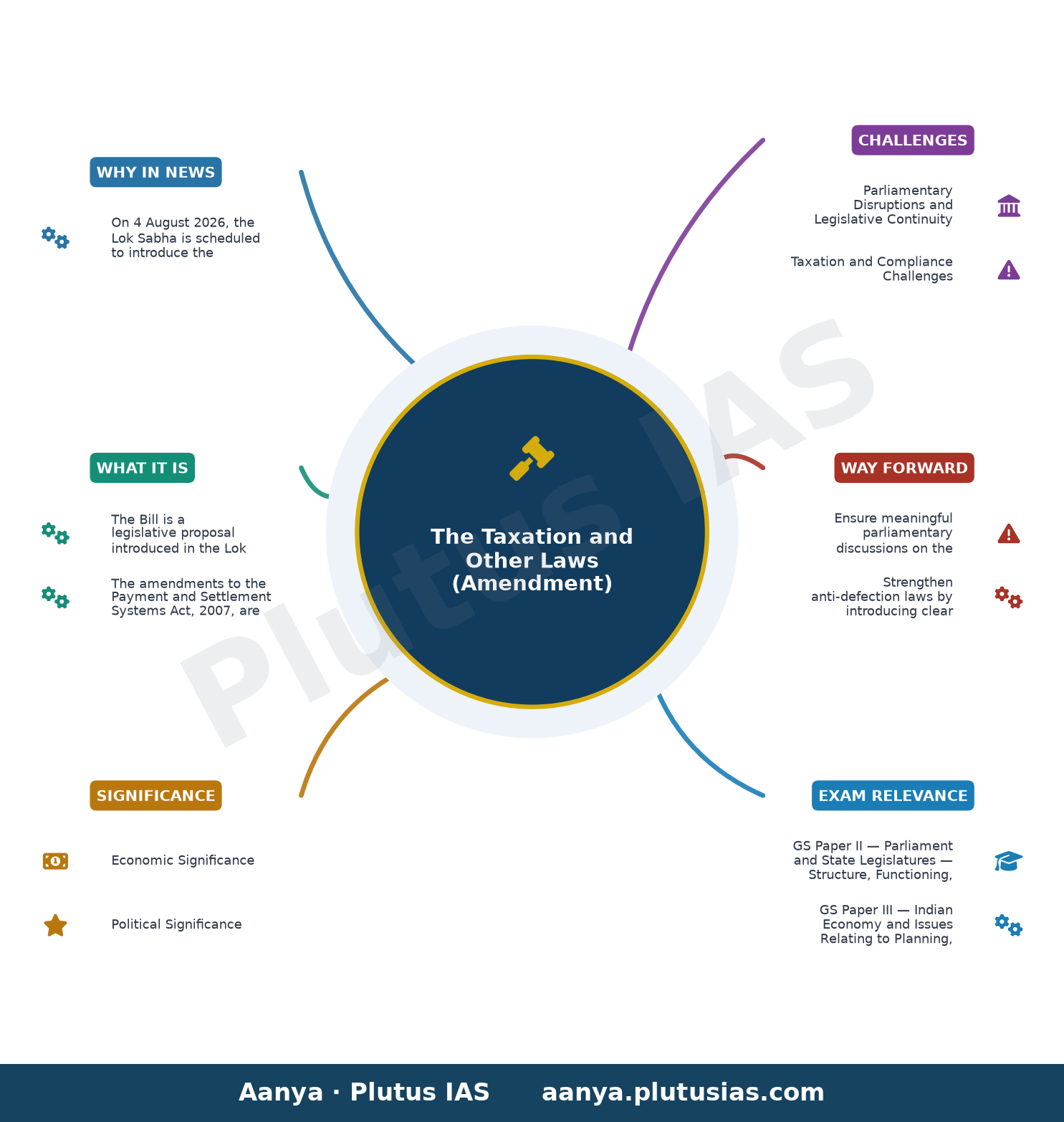
On 4 August 2026, the Lok Sabha is scheduled to introduce the Taxation and Other Laws (Amendment) Bill, 2026, a legislative measure aimed at amending the Payment and Settlement Systems Act, 2007, the Income-tax Act, 2025, and the Finance Act, 2026. This development assumes significance as it occurs during the Monsoon Session of Parliament, amidst disruptions over unrelated issues such as protests related to the Ram Temple donation controversy and student agitations. The Bill reflects the government’s intent to recalibrate fiscal and regulatory frameworks, particularly in the digital payments ecosystem and direct taxation, while navigating complex parliamentary dynamics.
Background
- The Payment and Settlement Systems Act, 2007, governs the regulation and supervision of payment systems in India, including digital payment mechanisms such as UPI, IMPS, and card networks, ensuring systemic stability and consumer protection.
- The Income-tax Act, 2025, represents the latest iteration of India’s direct tax legislation, incorporating amendments from the Finance Act of the preceding year and reflecting evolving fiscal priorities such as digital taxation and compliance simplification.
- The Finance Act, 2026, serves as the legislative vehicle for implementing the Union Budget proposals for the fiscal year 2026–27, including changes to tax rates, exemptions, and procedural norms.
- Parliamentary sessions in India are structured around three main sessions: Budget Session, Monsoon Session, and Winter Session, with the Monsoon Session typically focusing on legislative business, discussions on demands for grants, and consideration of Bills.
- The Monsoon Session of 2026 has been marked by disruptions, including protests by Opposition members over issues unrelated to the legislative agenda, such as the alleged embezzlement of donations at the Ram Temple in Ayodhya and police action against protesting students at Jantar Mantar.
- The Supreme Court (Number of Judges) Amendment Bill, 2026, which was passed by the Lok Sabha on 3 August 2026 without discussion, underscores the government’s focus on judicial reforms and the augmentation of judicial capacity to address case backlog.
What is the Taxation and Other Laws (Amendment) Bill, 2026?
- The Bill is a legislative proposal introduced in the Lok Sabha on 4 August 2026, seeking to amend three key statutes: the Payment and Settlement Systems Act, 2007; the Income-tax Act, 2025; and the Finance Act, 2026.
- The amendments to the Payment and Settlement Systems Act, 2007, are likely aimed at enhancing regulatory oversight of digital payment systems, addressing issues such as data localisation, cybersecurity, and interoperability to align with global best practices and India’s Digital India vision.
- Proposed changes to the Income-tax Act, 2025, may include rationalisation of tax slabs, simplification of compliance procedures, and measures to curb tax evasion, particularly in the context of the digital economy and cross-border transactions.
- Amendments to the Finance Act, 2026, are expected to incorporate budgetary proposals for the fiscal year 2026–27, including adjustments to tax exemptions, deductions, and procedural timelines to facilitate ease of doing business.
- The Bill is part of the government’s broader strategy to modernise India’s tax and regulatory frameworks, ensuring alignment with technological advancements and international standards while maintaining fiscal prudence.
- The legislative process involves the introduction of the Bill in the Lok Sabha, followed by a debate, scrutiny by the Standing Committee on Finance (if referred), and passage by both Houses of Parliament before receiving the President’s assent.
- The Bill’s introduction coincides with broader parliamentary discussions on judicial reforms, as evidenced by the passage of the Supreme Court (Number of Judges) Amendment Bill, 2026, highlighting the government’s multi-pronged legislative agenda.
- The Bill’s success in Parliament may be influenced by the ongoing disruptions, which reflect deeper political tensions and underscore the challenges of legislative efficiency in a fragmented parliamentary landscape.
Key Features
| Feature | Significance |
|---|---|
| Amendment to Payment and Settlement Systems Act, 2007 | Enhances regulatory oversight of digital payment systems, aligning with India’s push for a cashless economy and financial inclusion under the Payment Systems Vision 2025. |
| Amendment to Income-tax Act, 2025 | Introduces provisions to rationalise tax administration, address loopholes, and streamline compliance, reflecting the government’s emphasis on ease of doing business and tax buoyancy. |
| Amendment to Finance Act, 2026 | Modifies fiscal provisions to ensure revenue buoyancy and address emerging economic challenges, including inflation management and fiscal deficit targets. |
| Bankers’ Books Evidence Bill, 2026 | Strengthens legal provisions for the admissibility of bank records as evidence in courts, aiding in financial crime detection and judicial efficiency. |
| Anti-defection law amendment proposal | Seeks to curb opportunistic political defections by introducing stricter provisions, reinforcing the stability of democratic institutions and party discipline. |
Why it Matters
Economic Significance
- The amendments to the Payment and Settlement Systems Act, 2007, and Income-tax Act, 2025, are aligned with India’s broader economic agenda of formalising the economy and enhancing tax compliance, which is critical for sustaining high growth rates and fiscal consolidation.
- The amendments to the Finance Act, 2026, reflect the government’s commitment to maintaining fiscal discipline while addressing inflationary pressures and ensuring revenue buoyancy, particularly in the context of post-pandemic economic recovery.
- The Bankers’ Books Evidence Bill, 2026, strengthens the legal framework for financial crime detection, which is essential for maintaining investor confidence and macroeconomic stability.
Political Significance
- The introduction of the Taxation and Other Laws (Amendment) Bill, 2026, amidst disruptions in Parliament, underscores the government’s focus on legislative continuity and economic reforms, despite political opposition.
- The adjournment motion on anti-defection law reforms highlights the ongoing debate on political ethics and institutional integrity, particularly in the context of rising opportunistic defections in Indian politics.
- The NDA’s ‘Mangal Milan’ meeting signals strategic cohesion within the ruling coalition, which is crucial for maintaining legislative momentum and policy implementation.
Judicial Significance
- The amendments to the Payment and Settlement Systems Act, 2007, and the introduction of the Bankers’ Books Evidence Bill, 2026, enhance the legal framework for financial dispute resolution, reducing judicial delays and improving efficiency in financial litigation.
- The Supreme Court judges’ strength amendment, passed without debate, reflects the judiciary’s need for expanded capacity to handle the growing backlog of cases, which is critical for upholding constitutional rights and rule of law.
Administrative Significance
- The amendments to the Income-tax Act, 2025, and Finance Act, 2026, aim to simplify tax administration and reduce compliance burdens on taxpayers, aligning with the government’s ‘Minimum Government, Maximum Governance’ agenda.
- The Bankers’ Books Evidence Bill, 2026, streamlines evidence collection in financial crimes, reducing the burden on investigative agencies and improving inter-agency coordination.
Challenges
1. Parliamentary Disruptions and Legislative Continuity
- Persistent disruptions in Parliament, driven by political protests, hinder legislative productivity and delay critical reforms, undermining the government’s agenda.
- The adjournment motion on anti-defection law reforms highlights the lack of consensus on political ethics, which could further stall legislative progress.
- The need to pass amendments without debate, as seen with the Supreme Court judges’ strength increase, reflects a broader challenge in ensuring meaningful parliamentary discussions.
UPSC Link: GS-II: Parliament and State Legislatures—Structure, Functioning, Conduct of Business, Powers & Privileges
2. Taxation and Compliance Challenges
- Amendments to the Income-tax Act, 2025, and Finance Act, 2026, must balance revenue generation with taxpayer convenience to avoid unintended economic distortions.
- The Payment and Settlement Systems Act, 2007, amendments require careful implementation to avoid stifling innovation in digital payments while ensuring robust oversight.
- The Bankers’ Books Evidence Bill, 2026, must address privacy concerns and ensure that expanded investigative powers do not infringe on individual rights.
UPSC Link: GS-III: Indian Economy and Issues Relating to Planning, Mobilisation of Resources, Growth, Development and Employment
3. Political Instability and Defection Culture
- The rise of opportunistic political defections poses a threat to democratic stability and party discipline, necessitating stricter anti-defection laws.
- The lack of ideological clarity in defections complicates the enforcement of anti-defection provisions, requiring a nuanced legal framework.
- The adjournment motion on anti-defection law reforms highlights the need for cross-party consensus to address this challenge effectively.
UPSC Link: GS-II: Parliament and State Legislatures—Structure, Functioning, Conduct of Business, Powers & Privileges
4. Judicial Backlog and Institutional Capacity
- The amendment to increase the Supreme Court’s sanctioned strength reflects the judiciary’s struggle to manage the growing backlog of cases, which delays justice delivery.
- The amendments to financial laws and the Bankers’ Books Evidence Bill, 2026, will increase the burden on courts to interpret and enforce new provisions, necessitating capacity building.
- The lack of debate on the Supreme Court judges’ strength amendment underscores the need for greater transparency and accountability in judicial appointments and reforms.
UPSC Link: GS-II: Judiciary—Structure, Organisation and Functioning
5. Economic Uncertainty and Fiscal Management
- The amendments to the Finance Act, 2026, must align with broader fiscal policies to avoid conflicts with the government’s inflation and deficit targets.
- The Payment and Settlement Systems Act, 2007, amendments require coordination with the Reserve Bank of India to ensure seamless integration with monetary policy.
- The Bankers’ Books Evidence Bill, 2026, must be implemented in a manner that does not disrupt financial markets or deter foreign investment.
UPSC Link: GS-III: Indian Economy and Issues Relating to Planning, Mobilisation of Resources, Growth, Development and Employment
Challenges — UPSC Perspective
| Issue | Concern |
|---|---|
| Parliamentary Disruptions | Delays in legislative progress and reforms due to political protests and lack of consensus. |
| Taxation and Compliance | Balancing revenue generation with taxpayer convenience and avoiding economic distortions. |
| Political Instability | Rise of opportunistic defections threatening democratic stability and party discipline. |
| Judicial Backlog | Increased burden on courts to interpret and enforce new financial laws and reforms. |
| Economic Uncertainty | Aligning fiscal amendments with inflation and deficit targets without disrupting financial markets. |
| Privacy and Rights | Ensuring expanded investigative powers do not infringe on individual rights under the Bankers’ Books Evidence Bill, 2026. |
Way Forward
- Ensure meaningful parliamentary discussions on the Taxation and Other Laws (Amendment) Bill, 2026, by addressing opposition concerns through structured debates and consultations.
- Strengthen anti-defection laws by introducing clear definitions of ‘opportunistic defections’ and mechanisms for cross-party consensus on reforms.
- Enhance the capacity of the judiciary to handle increased caseloads by expediting the appointment of additional Supreme Court judges and improving court infrastructure.
- Align amendments to the Payment and Settlement Systems Act, 2007, with the Reserve Bank of India’s digital payment policies to ensure seamless integration and innovation.
- Implement the Bankers’ Books Evidence Bill, 2026, with robust safeguards to protect individual privacy and prevent misuse of investigative powers.
- Streamline tax administration by simplifying compliance procedures under the Income-tax Act, 2025, and Finance Act, 2026, to reduce burdens on taxpayers and businesses.
- Promote inter-agency coordination between the judiciary, investigative agencies, and financial regulators to ensure effective implementation of financial crime laws.
- Address parliamentary disruptions by exploring structured formats for discussions on contentious issues to maintain legislative productivity.
UPSC Value Addition
Keywords for Mains Answer-Writing
Taxation and Other Laws (Amendment) Bill, 2026 · Payment and Settlement Systems Act, 2007 · Income-tax Act, 2025 · Finance Act, 2026 · Parliamentary Monsoon Session 2026 · Anti-defection law · Supreme Court judges’ sanctioned strength · Parliamentary procedures · Financial legislation · Constitutional amendments
Concept Flow
Parliamentary disruptions → Delay in legislative progress → Need for structured debates and consensus-building → Introduction of the Taxation and Other Laws (Amendment) Bill, 2026 → Political instability due to opportunistic defections → Adjournment motion on anti-defection law reforms → Need for stricter provisions to uphold democratic stability → Amendments to financial laws → Enhanced regulatory oversight → Strengthened legal framework for financial crime detection → Bankers’ Books Evidence Bill, 2026 → Supreme Court judges’ strength amendment → Increased judicial capacity → Faster disposal of cases → Improved access to justice → Amendments to Payment and Settlement Systems Act, 2007 → Alignment with digital payment policies → Enhanced financial inclusion → Support for cashless economy
Prelims Practice Questions
Q1. Consider the following statements regarding the Taxation and Other Laws (Amendment) Bill, 2026:
1. It seeks to amend the Payment and Settlement Systems Act, 2007.
2. The Bill introduces provisions to increase the sanctioned strength of judges in the Supreme Court.
3. It also proposes amendments to the Income-tax Act, 2025 and the Finance Act, 2026.
How many of the above statements are correct?
- Only one
- Only two
- All three
- None
Answer: Only two — Statement 1 and 3 are correct as the Bill aims to amend the Payment and Settlement Systems Act, 2007, the Income-tax Act, 2025, and the Finance Act, 2026. Statement 2 is incorrect because the Bill does not address the sanctioned strength of judges in the Supreme Court; this was addressed in a separate Bill passed earlier.
Q2. Assertion (A): The Taxation and Other Laws (Amendment) Bill, 2026, is introduced to amend fiscal and financial laws.
Reason (R): The Bill seeks to introduce changes to the Payment and Settlement Systems Act, 2007, and the Income-tax Act, 2025.
Options:
A. Both A and R are true, and R is the correct explanation of A.
B. Both A and R are true, but R is not the correct explanation of A.
C. A is true, but R is false.
D. A is false, but R is true.
Answer: ? — Both the Assertion (A) and Reason (R) are true. The Bill is indeed introduced to amend fiscal and financial laws, and the specific amendments include changes to the Payment and Settlement Systems Act, 2007, and the Income-tax Act, 2025. Thus, R correctly explains A.
Q3. Match the following columns with reference to recent legislative actions in the Parliament Monsoon Session 2026:
Column I
1. Taxation and Other Laws (Amendment) Bill, 2026
2. Bankers’ Books Evidence Bill, 2026
3. Supreme Court (Number of Judges) Amendment Bill
4. Micro, Small and Medium Enterprises Development (Amendment) Bill, 2026
Column II
A. Amends fiscal and financial laws
B. Increases the sanctioned strength of judges in the Supreme Court
C. Amends provisions related to banking and financial records
D. Amends provisions related to MSMEs
Options:
1. 1-A, 2-C, 3-B, 4-D
2. 1-B, 2-A, 3-C, 4-D
3. 1-D, 2-C, 3-A, 4-B
4. 1-A, 2-D, 3-B, 4-C
Answer: ? — The correct matches are: 1-A (Taxation and Other Laws (Amendment) Bill amends fiscal and financial laws), 2-C (Bankers’ Books Evidence Bill relates to banking and financial records), 3-B (Supreme Court (Number of Judges) Amendment Bill increases the sanctioned strength of judges), and 4-D (MSME Development (Amendment) Bill relates to MSMEs).
Mains Practice Question
✍ The Taxation and Other Laws (Amendment) Bill, 2026, introduced in the Lok Sabha, seeks to amend multiple financial and fiscal legislations. Critically examine the constitutional and legislative significance of such omnibus amendments in India’s parliamentary democracy. Also, analyse the procedural safeguards available to Parliament to ensure scrutiny and accountability in the passage of such Bills. (15 Marks)
Approach: MODEL-ANSWER SKELETON:
1. **Constitutional and Legislative Significance**:
– Define omnibus amendments and their constitutional basis under Article 107 and Article 108 (Joint Sitting) of the Constitution.
– Discuss the rationale: efficiency vs. dilution of parliamentary scrutiny; cite the Sarkaria Commission (1983) and Punchhi Commission (2010) on the need for focused amendments.
– Highlight the Bill’s scope: amendments to the Payment and Settlement Systems Act, 2007; Income-tax Act, 2025; and Finance Act, 2026. Link to the doctrine of ‘pith and substance’ (e.g., State of Bombay v. F.N. Balsara, 1951) to justify legislative competence.
– **Critical Perspective**: Evaluate the risk of legislative overreach and the potential for bypassing specialised committee scrutiny (e.g., Standing Committee on Finance).
2. **Procedural Safeguards and Accountability**:
– **Parliamentary Scrutiny**: Role of the Department-Related Standing Committees (e.g., Standing Committee on Finance) in examining financial Bills. Cite Rule 274 of the Rules of Procedure and Conduct of Business in Lok Sabha.
– **Constitutional Safeguards**: Article 110(3) (Money Bills) and the distinction between Money Bills and Financial Bills; discuss the Speaker’s certification under Article 110.
– **Judicial Review**: Reference to judicial precedents on legislative procedures (e.g., In Re: Special Reference No. 1 of 2012 on the 2G case; Subhash Kumar v. State of Bihar, 1991) to underscore the judiciary’s role in ensuring procedural compliance.
– **Public Accountability**: Role of the Comptroller and Auditor General (CAG) and the Public Accounts Committee (PAC) in post-legislative scrutiny.
3. **Contemporary Context**:
– Link to recent legislative trends: cite the Taxation Laws (Amendment) Act, 2021, and the Finance Act, 2023, to highlight the frequency of such amendments.
– **Balanced View**: Acknowledge the executive’s need for flexibility in fiscal policy while stressing the importance of transparency and parliamentary oversight.
4. **Conclusion**:
– Summarise the need for a balanced approach: omnibus amendments may serve policy objectives but must not compromise parliamentary democracy.
– Propose reforms: mandatory referral to Standing Committees for financial Bills, pre-legislative consultation, and post-legislative review mechanisms.
Source: The Hindu
Generated by AanyaAi for educational purpose.

- मैसूर को वैश्विक पर्यटन मिशन में शामिल करने के लिए केंद्र से मांग - August 4, 2026
- Mysuru’s Bid for Global Tourism Mission: Centre’s Nod Sought - August 4, 2026
- लोकसभा में कराधान विधेयक पेश करेगी सीतारमण; कांग्रेस ने दलबदल कानून पर बहस की मांग की - August 4, 2026

No Comments