


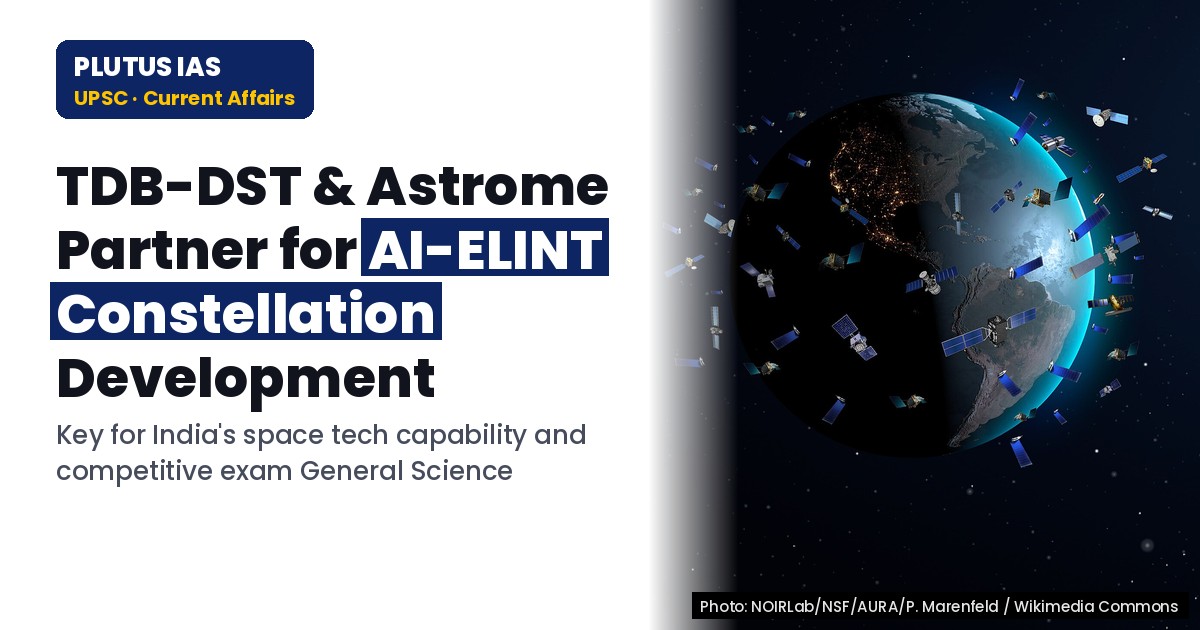
12 Nov TDB-DST & Astrome Partner for AI-ELINT Constellation
✎ The Technology Development Board (TDB) under DST is funding Astrome for a ₹64.05 crore project to develop India's sovereign space-based AI-ELINT constellation, reinforcing indigenous capabilities in strategic intelligence and…
Subject Relevance — Where This Topic Fits
- GS Paper III — Science and Technology — Developments and their applications and effects in everyday life; Indigenization of technology and developing new technology. | GS Paper III — Economy — Mobilization of resources, growth, development and employment; Investment models. | GS Paper III — Security — Science and Technology in defence.
- Prelims: Technology Development Board (TDB), Department of Science and Technology (DST), Astrome, AI-ELINT constellation, Space-based intelligence, Indigenous technology development, Research and Development (R&D) funding, Electronic Intelligence (ELINT)
- Essay: The imperative of indigenous technological advancement for national security and economic sovereignty., Leveraging public-private partnerships to foster innovation and self-reliance in critical sectors.
Quick Revision: The Technology Development Board (TDB) under DST is funding Astrome for a ₹64.05 crore project to develop India’s sovereign space-based AI-ELINT constellation, reinforcing indigenous capabilities in strategic intelligence and space technology.
Why is this in the news?
The Technology Development Board (TDB), a statutory body under the Department of Science and Technology (DST), has formally entered into an agreement with Astrome, a private entity, to provide financial assistance amounting to ₹64.05 crore. This support is specifically allocated for the research, development, and indigenization of a sovereign space-based Artificial Intelligence (AI) and Electronic Intelligence (ELINT) constellation, signifying a strategic national initiative to bolster indigenous capabilities in advanced space technology and intelligence gathering.
Background
- The Government of India has consistently emphasized the critical importance of ‘Atmanirbhar Bharat’ (Self-Reliant India) across various strategic sectors, including space and defence technology.
- Space-based assets are increasingly vital for national security, communication, navigation, and Earth observation, necessitating robust indigenous capabilities to reduce reliance on foreign systems.
- Electronic Intelligence (ELINT) involves the interception and analysis of electromagnetic signals, providing crucial data for strategic intelligence, surveillance, and reconnaissance (ISR) operations.
- Artificial Intelligence (AI) integration in space systems enhances data processing, autonomous operations, and the efficiency of intelligence analysis, offering a significant technological advantage.
- The Technology Development Board (TDB) plays a pivotal role in promoting and commercializing indigenous technologies by providing financial assistance to industrial concerns and other agencies.
- Public-private partnerships are being actively encouraged to accelerate technological development, leverage private sector innovation, and optimize resource utilization in high-tech domains.
What is the Technology Development Board (TDB)?
- The Technology Development Board (TDB) is a statutory body established by the Government of India under the Technology Development Board Act, 1995.
- It operates under the aegis of the Department of Science and Technology (DST), Ministry of Science and Technology.
- The primary mandate of TDB is to promote and commercialize indigenous technologies and adapt imported technologies for wider application.
- It provides financial assistance to industrial concerns and other agencies for undertaking projects involving the development and commercialization of indigenous technology or adapting imported technology.
- TDB acts as a catalyst for innovation, fostering a strong link between research and development (R&D) and industrial application.
- The Board identifies and supports promising technologies that have potential for socio-economic benefits and strategic importance, often through equity participation, soft loans, or grants.
- Its activities are crucial for achieving technological self-reliance and enhancing India’s competitive edge in various sectors.
- The current project exemplifies TDB’s role in supporting cutting-edge, strategically important technological initiatives like space-based AI-ELINT constellations.
Key Features
| Feature | Significance |
|---|---|
| Sovereign Space-based AI-ELINT Constellation | Establishes indigenous capability in advanced space-based intelligence gathering, reducing reliance on foreign systems and enhancing national security. |
| Artificial Intelligence (AI) Integration | Enables sophisticated analysis of electronic signals, improving data processing speed, accuracy, and the ability to detect and classify complex threats. |
| Electronic Intelligence (ELINT) Capabilities | Provides critical insights into adversary radar, communication, and electronic warfare systems, essential for strategic planning and tactical operations. |
| Technology Development Board (TDB) Support | Facilitates financial assistance and strategic guidance for domestic R&D, fostering innovation and commercialisation of cutting-edge technologies. |
| Public-Private Partnership Model | Leverages the agility and innovation of private enterprises (Astrome) with government support (TDB-DST) to accelerate technological advancements in critical sectors. |
Why it Matters
National Security and Strategic Autonomy
- The development of an indigenous AI-ELINT constellation significantly bolsters India’s intelligence, surveillance, and reconnaissance (ISR) capabilities, providing real-time, actionable intelligence.
- Achieves strategic autonomy in space-based electronic intelligence, reducing dependence on external sources and safeguarding sensitive national security information.
- Enhances India’s capacity to monitor and respond to evolving geopolitical challenges and threats in the electromagnetic spectrum.
Technological Advancement and Innovation
- Promotes cutting-edge research and development in artificial intelligence, space technology, and electronic warfare systems within India.
- Fosters a robust ecosystem for deep technology startups, encouraging innovation and job creation in high-tech sectors.
- Positions India as a leader in advanced space-based intelligence solutions, contributing to global technological progress.
Economic Development and Industrial Growth
- The substantial investment by TDB-DST stimulates economic activity in the space and defence sectors, creating opportunities for ancillary industries and skilled workforce development.
- Supports the ‘Make in India’ initiative by promoting indigenous manufacturing and reducing import reliance for critical defence and space components.
- Enhances the competitiveness of Indian companies in the global space market, potentially leading to export opportunities for advanced technologies.
Challenges
1. Technological Complexity and Integration
- Developing a sophisticated AI-ELINT constellation involves integrating diverse advanced technologies, including satellite platforms, AI algorithms, signal processing, and secure data transmission.
- Ensuring seamless interoperability and robust performance of all components in the harsh space environment presents significant engineering challenges.
UPSC Link: Science and Technology-Space
2. Funding and Sustained Investment
- The substantial capital outlay required for space-based projects necessitates sustained financial commitment and efficient resource allocation.
- Ensuring long-term funding for maintenance, upgrades, and future iterations of the constellation is crucial for its operational longevity and effectiveness.
UPSC Link: Economy-Investment Models
3. Talent Acquisition and Retention
- The specialised nature of AI, space technology, and ELINT demands a highly skilled workforce, which can be challenging to recruit and retain within the domestic market.
- Developing a pipeline of qualified engineers, scientists, and AI specialists is essential for the project’s success and future technological advancements.
UPSC Link: Human Resource Development
4. Cybersecurity and Data Protection
- Space-based assets are vulnerable to cyberattacks and electronic warfare, necessitating robust cybersecurity measures to protect sensitive intelligence data.
- Ensuring the integrity, confidentiality, and availability of collected ELINT data is paramount for national security.
UPSC Link: Internal Security-Cybersecurity
Challenges — UPSC Perspective
| Issue | Concern |
|---|---|
| Spectrum Management | Efficient allocation and management of the electromagnetic spectrum are critical for ELINT operations, requiring international coordination and domestic regulatory frameworks. |
| Space Debris Mitigation | The increasing congestion in low Earth orbit poses a threat to satellite constellations, necessitating adherence to space debris mitigation guidelines and active avoidance strategies. |
| Data Processing Overload | The vast amount of data generated by ELINT sensors requires advanced AI and high-performance computing to process, analyse, and extract actionable intelligence efficiently. |
| International Regulations | Compliance with international space law and regulations, including those pertaining to the peaceful use of outer space and satellite registration, is essential. |
Way Forward
- Foster robust public-private partnerships to leverage private sector innovation and efficiency with government strategic direction and funding.
- Invest in advanced research and development in AI, quantum computing, and materials science to enhance future space-based intelligence capabilities.
- Develop a comprehensive talent development programme, including specialised academic courses and industry training, to build a skilled workforce in space and AI technologies.
- Establish stringent cybersecurity protocols and resilient communication infrastructure to protect sensitive intelligence data from evolving threats.
- Promote international collaboration in space technology and data sharing, while safeguarding national interests and proprietary information.
- Ensure long-term financial commitment and a clear roadmap for the constellation’s expansion, maintenance, and technological upgrades.
- Integrate the intelligence derived from the AI-ELINT constellation with existing national security frameworks for comprehensive threat assessment and response.
UPSC Value Addition
Keywords for Mains Answer-Writing
Space-based AI-ELINT constellation · Technology Development Board (TDB) · Department of Science & Technology (DST) · Research, Development, and Innovation (RDI) · Strategic autonomy in space technology · Dual-use technologies · Public-private partnership in R&D · Indigenous defence capabilities · Space sector reforms · Critical and emerging technologies
Concept Flow
Government identifies strategic need for sovereign ELINT capabilities. → Technology Development Board (TDB) provides R&D funding to Astrome. → Astrome develops AI-ELINT satellite constellation technology. → Indigenous constellation deployed for electronic intelligence gathering. → AI processes ELINT data for national security and strategic insights.
Prelims Practice Questions
Q1. Consider the following statements regarding the Technology Development Board (TDB):
1. The TDB is a statutory body established under the Ministry of Science and Technology.
2. Its primary mandate is to promote the development and commercialisation of indigenous technology.
3. It provides financial assistance to industrial concerns and other agencies for technology development.
How many of the above statements are correct?
- Only one
- Only two
- All three
- None
Answer: All three — Statement 1 is correct: The TDB is a statutory body established under the Technology Development Board Act, 1995, functioning under the Department of Science & Technology, Ministry of Science and Technology. Statement 2 is correct: Its primary mandate includes promoting the development and commercialisation of indigenous technology and adapting imported technology for wider application. Statement 3 is correct: TDB provides financial assistance in the form of equity, soft loans, or grants to industrial concerns and other agencies for technology development and commercialisation.
Q2. Which of the following best describes the term ‘AI-ELINT’ in the context of space technology?
- Artificial Intelligence for Electronic Intelligence
- Advanced Imaging for Earth Observation and Navigation Technology
- Automated Information for Environmental and Land Integrated Systems
- Aerospace Infrastructure for Enhanced Logistics and International Networking
Answer: Artificial Intelligence for Electronic Intelligence — AI-ELINT stands for Artificial Intelligence for Electronic Intelligence. It refers to the application of artificial intelligence techniques to analyse and interpret electronic signals gathered from various sources, particularly in a defence and surveillance context, often involving space-based platforms.
Mains Practice Question
✍ The development of sovereign space-based AI-ELINT constellations signifies India’s commitment to enhancing its strategic autonomy and indigenous capabilities in critical technologies. Discuss the significance of such initiatives for national security and economic development, and critically examine the challenges in fostering public-private partnerships for advanced technology development in India. (15 Marks)
Approach: Introduction: Briefly define AI-ELINT and its strategic importance, linking it to India’s pursuit of strategic autonomy.
Significance for National Security:
1. Enhanced Surveillance and Reconnaissance: Real-time intelligence gathering, border security, maritime domain awareness.
2. Strategic Deterrence: Improved early warning systems, missile defence capabilities.
3. Reduced Foreign Dependence: Self-reliance in critical intelligence infrastructure.
4. Dual-use Technology: Applications for both defence and civilian purposes.
Significance for Economic Development:
1. Innovation Ecosystem: Fosters R&D, job creation in high-tech sectors.
2. Spin-off Technologies: Commercial applications from space technology advancements.
3. Export Potential: Opportunities for India to become a global supplier of advanced space services.
4. Private Sector Growth: Encourages investment and participation of private players in the space economy.
Challenges in Fostering Public-Private Partnerships (PPPs):
1. Funding and Investment: High capital requirements, risk aversion from private sector.
2. Regulatory Framework: Need for clear, stable, and predictable policies.
3. Technology Transfer: Balancing intellectual property rights and national security concerns.
4. Skill Gap: Availability of specialised human resources.
5. Bureaucratic Hurdles: Delays in approvals, procedural complexities.
6. Market Access: Ensuring a level playing field for private players.
Conclusion: Summarise the importance of such projects and suggest policy measures to overcome challenges, emphasising a collaborative approach for future technological advancements.
Source: PIB (Press Information Bureau)
Generated by AanyaAi for educational purpose.
Related guides on our sites
- How to prepare for GS paper 1 for UPSC CSE mains exam
- Best UPSC coaching for IFOS exam
- Best mentorship programme for upsc
- UPSC+BA degree

- TDB-DST & Astrome Partner for AI-ELINT Constellation - November 12, 2026
- आंध्र प्रदेश: वैश्विक निवेश हब और व्यापार सुगमता पर जोर - November 12, 2026
- Indian Army Delegation Boosts India-Indonesia Defence Ties - November 12, 2026

No Comments