


25 Sep Technical Committee Formed for ₹25 Lakh Oommen Chandy Health Scheme DPR
✎ The Oommen Chandy Health Insurance Scheme aims to provide ₹25 lakh cover per family in Kerala, with the technical committee tasked to design a financially sustainable, equitably accessible, and institutionally robust health…
Subject Relevance — Where This Topic Fits
- GS Paper II — Governance, Transparency and Accountability | GS Paper III — Indian Economy and Issues relating to Planning, Mobilisation of Resources, Growth, Development and Employment | GS Paper III — Issues relating to Health, Education, Human Resources
- Prelims: Health insurance schemes, Kerala Health Policy, Universal Health Coverage (UHC), Detailed Project Report (DPR), Insurance Regulatory and Development Authority of India (IRDAI), State Health Agency, Health Technology Assessment (HTA), Public-Private Partnership (PPP) in healthcare
- Essay: Universal Health Coverage: A Governance Imperative for India, Balancing Equity and Efficiency in Public Health Financing: Lessons from Kerala
Quick Revision: The Oommen Chandy Health Insurance Scheme aims to provide ₹25 lakh cover per family in Kerala, with the technical committee tasked to design a financially sustainable, equitably accessible, and institutionally robust health insurance framework within four months.
Why is this in the news?
The constitution of a technical committee by the Kerala government to prepare a Detailed Project Report (DPR) for the Oommen Chandy Health Insurance Scheme has brought renewed focus on the state’s efforts to enhance financial protection against catastrophic health expenditures. This initiative, announced in the Revised Budget 2026–27, aims to provide an enhanced insurance cover of ₹25 lakh per family, reflecting a significant expansion of existing health insurance mechanisms in Kerala. The committee’s mandate includes designing a robust, financially sustainable, and equitably accessible health insurance framework, which is critical for advancing Universal Health Coverage (UHC) in the state.
Background
- Kerala has historically been a pioneer in health sector reforms in India, with initiatives such as the Karunya Benevolent Fund (2012) and Arogya Keralam (2016) serving as foundational schemes for health insurance and financial protection.
- The Oommen Chandy Health Insurance Scheme was announced as a key poll promise by the United Democratic Front (UDF) in the 2026 elections, indicating a political commitment to expanding health coverage in the state.
- The Revised Budget 2026–27 of Kerala earmarked funds for the scheme, signalling the government’s intent to operationalise it within the fiscal framework.
- The technical committee’s formation underscores the state’s emphasis on evidence-based policymaking, drawing on expertise from insurance regulators, public sector insurers, and domain specialists.
- Kerala’s health indicators, including high life expectancy and low infant mortality, contrast with the growing challenge of non-communicable diseases and rising healthcare costs, necessitating robust health financing mechanisms.
What is the Oommen Chandy Health Insurance Scheme?
- The Oommen Chandy Health Insurance Scheme is a proposed health insurance initiative by the Government of Kerala, aimed at providing enhanced financial protection against high out-of-pocket health expenditures.
- The scheme proposes to offer an insurance cover of ₹25 lakh per family.
- The scheme is expected to be implemented through a mix of public and private healthcare providers, with empanelment and strategic purchasing mechanisms to ensure quality and cost-effectiveness.
- The scheme aligns with Kerala’s broader health policy objectives, including the achievement of Universal Health Coverage (UHC) and the reduction of catastrophic health expenditures.
Key Features
| Feature | Significance |
|---|---|
| Enhanced Insurance Cover of ₹25 lakh | Expands financial protection for beneficiaries, addressing high-cost medical treatments and reducing out-of-pocket expenditure. |
| Technical Committee Composition | Includes domain experts from insurance, finance, and health sectors to ensure robust design and implementation. |
| Detailed Project Report (DPR) Preparation | Ensures systematic planning with phased implementation, resource allocation, and risk mitigation strategies. |
| IT Platform and Digital Architecture | Facilitates beneficiary identification, claims processing, fraud control, and interoperability with existing health systems. |
| Phased Implementation Plan | Allows for gradual rollout, pilot testing, and scaling based on lessons learned from initial phases. |
Why it Matters
Healthcare Governance
- Demonstrates a structured approach to health financing, integrating technical expertise with policy objectives.
- Strengthens institutional capacity through the State Health Agency and inter-departmental coordination.
- Aligns with universal health coverage goals by expanding insurance coverage and reducing financial barriers to healthcare.
Economic Implications
- Potential to reduce catastrophic health expenditure, thereby improving household economic resilience.
- Requires careful fiscal planning to balance enhanced coverage with sustainable funding mechanisms.
- May stimulate demand for healthcare services, necessitating infrastructure and workforce preparedments.
Policy Integration
- Complements existing health-financing schemes by defining clear roles and avoiding duplication.
- Incorporates lessons from other States’ health insurance models to enhance effectiveness.
- Ensures alignment with national health policies while addressing State-specific needs.
Challenges
1. Financial Sustainability
- High insurance cover (₹25 lakh) increases the fiscal burden, requiring robust funding sources and cost-control measures.
- Risk of adverse selection if eligibility criteria are not carefully designed.
- Need for sustainable pooling mechanisms to prevent resource depletion over time.
UPSC Link: GS-III: Health, GS-III: Fiscal Policy
2. Implementation Complexity
- Coordinating multiple stakeholders—government, hospitals, insurers, and beneficiaries—requires strong governance.
- Ensuring quality assurance and fraud control in claims processing and hospital empanelment.
- Scaling the IT platform to handle high transaction volumes while maintaining data security.
UPSC Link: GS-II: Governance, GS-III: Technology
3. Equity and Accessibility
- Designing eligibility criteria to ensure inclusion of marginalised groups without creating exclusion errors.
- Addressing geographic disparities in healthcare access, particularly in rural and tribal areas.
- Preventing overutilisation of services by ensuring appropriate benefit packages and gatekeeping mechanisms.
UPSC Link: GS-II: Social Justice, GS-II: Welfare Schemes
4. Regulatory and Legal Compliance
- Ensuring compliance with IRDAI regulations while tailoring the scheme to State-specific needs.
- Addressing data privacy concerns under the Digital Personal Data Protection Act, 2023.
- Managing liability risks for public and private hospitals under the scheme.
UPSC Link: GS-II: Governance, GS-III: Economy
Challenges — UPSC Perspective
| Issue | Concern |
|---|---|
| Funding Mechanism | Identifying sustainable sources to cover the enhanced insurance cover without compromising other health priorities. |
| Hospital Empanelment | Ensuring adequate participation of public and private hospitals while maintaining quality standards. |
| Claims Management | Preventing delays, fraud, and disputes in claims processing to maintain beneficiary trust. |
| IT Infrastructure | Developing a scalable, secure, and interoperable digital platform for seamless operations. |
| Monitoring and Evaluation | Establishing robust mechanisms to track outcomes, utilisation, and impact over time. |
Way Forward
- Finalise the DPR with clear timelines, budgetary allocations, and phased rollout strategies.
- Constitute sub-committees for IT infrastructure, hospital empanelment, and claims management to expedite implementation.
- Pilot the scheme in select districts to test feasibility, identify bottlenecks, and refine processes.
- Develop a comprehensive communication strategy to educate beneficiaries, hospitals, and stakeholders.
- Establish a dedicated grievance redressal mechanism with transparent escalation pathways.
- Align the scheme with existing health programmes (e.g., Ayushman Bharat) to avoid duplication and leverage synergies.
- Conduct periodic reviews to assess financial sustainability and adjust premiums or coverage as needed.
UPSC Value Addition
Keywords for Mains Answer-Writing
Oommen Chandy Health Insurance Scheme · Kerala health insurance framework · Detailed Project Report (DPR) · Universal Health Coverage (UHC) · State Health Agency · Health insurance governance · Risk pooling in health financing · Hospital empanelment mechanisms · Claims management in health schemes · Digital architecture for health schemes · Kerala health sector reforms · Health financing modalities
Concept Flow
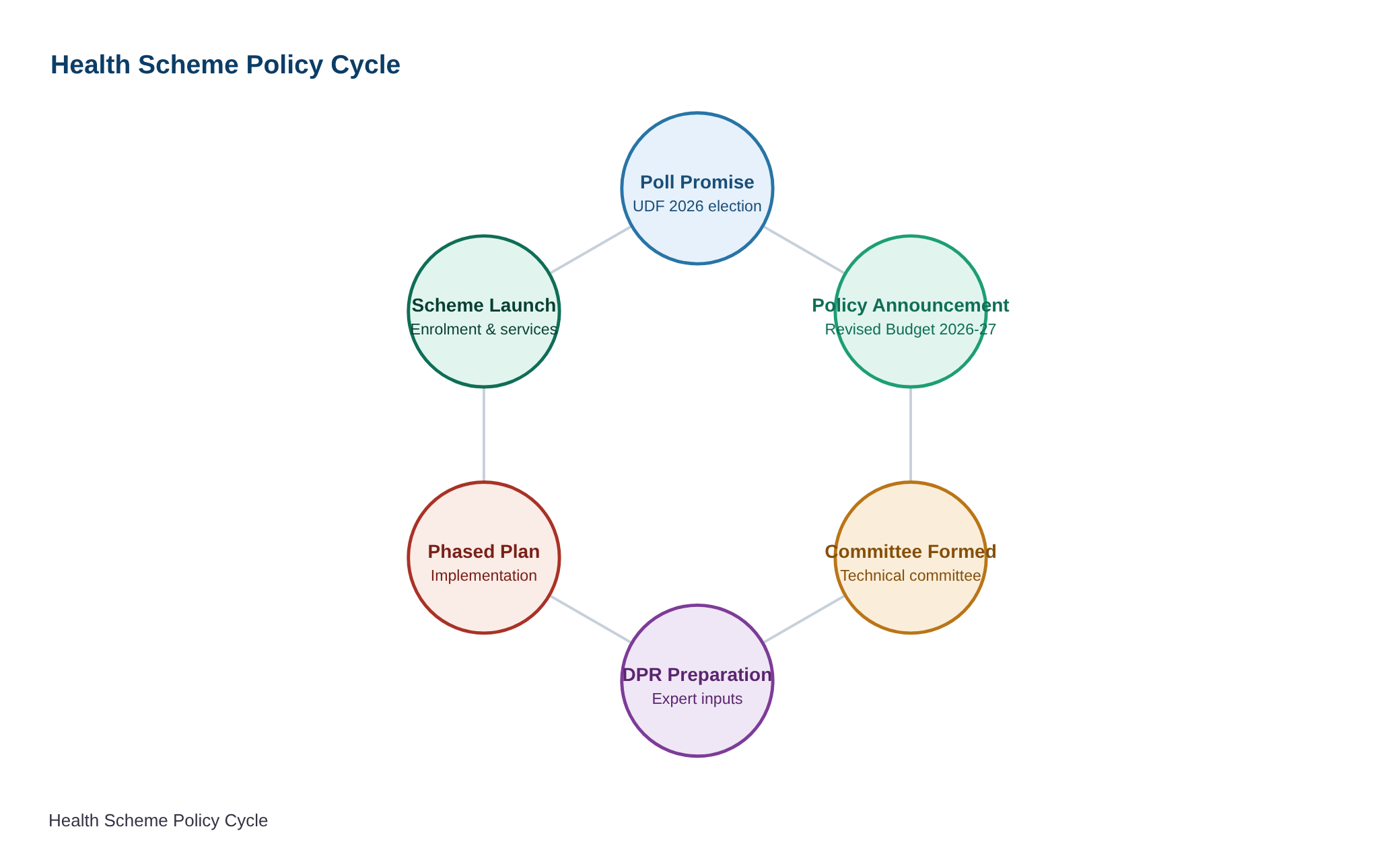
Poll Promise → Policy Announcement in Revised Budget 2026–27 → Constitution of Technical Committee → DPR Preparation with Expert Inputs → DPR Development → Phased Implementation Plan → IT Platform Design and Hospital Empanelment → Scheme Launch → Beneficiary Enrolment and Service Delivery → Claims Processing and Quality Assurance → Monitoring and Evaluation → Feedback Integration → Scheme Refinement and Scaling → Long-term Impact Assessment → Policy Adjustments for Sustainability and Equity
Prelims Practice Questions
Q1. Consider the following statements regarding the Oommen Chandy Health Insurance Scheme:
1. The scheme aims to provide an enhanced insurance cover of ₹25 lakh per beneficiary.
2. A technical committee has been constituted to prepare the Detailed Project Report (DPR) for the scheme.
3. The committee is chaired by the Principal Secretary (Health and Family Welfare).
4. The committee includes members from the Insurance Regulatory and Development Authority of India (IRDAI).
How many of the above statements are correct?
- Only one
- Only two
- Only three
- All four
Answer: All four — Statements 1, 2, and 3 are correct. Statement 4 is incorrect as the committee includes former members of IRDAI but not serving members.
Q2. Assertion (A): The Oommen Chandy Health Insurance Scheme is designed to achieve Universal Health Coverage (UHC) in Kerala.
Reason (R): The scheme proposes an enhanced insurance cover of ₹25 lakh and includes provisions for hospital empanelment and claims management.
Options:
A. Both A and R are true, and R is the correct explanation of A.
B. Both A and R are true, but R is not the correct explanation of A.
C. A is true, but R is false.
D. A is false, but R is true.
- A
- B
- C
- D
Answer: B — Both the assertion and reason are true. The scheme’s enhanced cover and institutional mechanisms are consistent with UHC objectives, and the reason correctly explains the assertion.
Q3. Match the following terms related to the Oommen Chandy Health Insurance Scheme with their correct descriptions:
Column I:
1. DPR
2. Risk pooling
3. Hospital empanelment
4. Claims management
Column II:
A. Process of selecting hospitals for participation in the scheme
B. Mechanism to manage financial resources collectively to cover health risks
C. Document detailing the scheme’s design, implementation, and financial projections
D. System for processing and reimbursing claims submitted by hospitals
Options:
A. 1-A, 2-B, 3-C, 4-D
B. 1-C, 2-B, 3-A, 4-D
C. 1-B, 2-C, 3-D, 4-A
D. 1-D, 2-A, 3-B, 4-C
- A
- B
- C
- D
Answer: B — 1-C (DPR is a detailed project report), 2-B (Risk pooling involves collective financial management), 3-A (Hospital empanelment is the selection process), 4-D (Claims management handles reimbursements).
Mains Practice Question
✍ The Oommen Chandy Health Insurance Scheme represents a significant step toward achieving Universal Health Coverage (UHC) in Kerala. Critically examine the scheme’s design, governance structure, and financial modalities in the context of India’s broader health financing landscape. Also, analyse the challenges in implementing such schemes and their potential impact on health outcomes. (15 Marks)
Approach: MODEL-ANSWER SKELETON:
1. **Introduction (2 marks)**: Define Universal Health Coverage (UHC) and its three dimensions (service coverage, financial protection, equity). Briefly introduce the Oommen Chandy Health Insurance Scheme as Kerala’s initiative toward UHC.
2. **Scheme Design and Objectives (3 marks)**:
– Enhanced insurance cover of ₹25 lakh per beneficiary.
– Population coverage (target groups: below poverty line, unorganized sector, etc.).
– Benefit package (inpatient care, pre-existing conditions, etc.).
– Relationship with existing schemes (e.g., Ayushman Bharat, Kerala’s earlier schemes like Karunya Benevolent Fund).
3. **Governance Structure (3 marks)**:
– Role of the technical committee (DPR preparation, expert recommendations).
– Institutional arrangements: State Health Agency, Health Department, Finance Department, and private/public hospitals.
– Mechanisms for hospital empanelment, strategic purchasing, and quality assurance.
4. **Financial Modalities (3 marks)**:
– Funding sources (state budget, central allocations, premium contributions).
– Risk pooling and cost-control measures.
– Phased implementation plan and financial sustainability.
5. **Challenges and Impact (4 marks)**:
– Challenges: High claim ratios, fraud control, private sector participation, and equity concerns.
– Potential impact: Reduction in out-of-pocket expenditure, improved health outcomes, and lessons for other states.
– Comparative analysis with other state-led UHC initiatives (e.g., Tamil Nadu’s Chief Minister’s Comprehensive Health Insurance Scheme).
Balance of views: Highlight both the potential benefits (financial protection, improved access) and risks (financial strain, implementation delays). Conclude with a balanced assessment of the scheme’s feasibility and scalability.
Source: The Hindu
Generated by AanyaAi for educational purpose.
Related guides on our sites
- Anthropology VS PSIR
- Best PSIR optional coaching
- Best PSIR optional coaching online
- Best PSIR optional teacher

- Technical Committee Formed for ₹25 Lakh Oommen Chandy Health Scheme DPR - September 25, 2026
- सुप्रीम कोर्ट ने ओबीसी क्रिमी लेयर नीति पर केंद्र के दो साल के समय का अनुरोध ठुकराया - September 25, 2026
- Supreme Court reserves orders on Centre’s plea for OBC creamy layer policy: Key UPSC insights - September 25, 2026

No Comments