


25 Sep Telangana Boosts Welfare Grants for Ex-Servicemen & Widows: Key Schemes Explained
✎ The Armed Forces Flag Day Fund in Telangana has enhanced welfare grants for ex-servicemen and dependents, including increased education grants, disability support, marriage assistance, and new schemes for mobility and special…
Subject Relevance — Where This Topic Fits
- GS Paper II — Governance, Welfare Schemes for Vulnerable Sections of the population by the Centre and States | GS Paper III — Issues relating to Development and Management of Social Sector/Services relating to Health, Education, Human Resources
- Prelims: Armed Forces Flag Day Fund, Ex-servicemen welfare schemes, Disability grants, Special Child Assistance Scheme, Direct Benefit Transfer (DBT), State Managing Committee of Armed Forces Flag Day Fund
- Essay: Social security nets for defence personnel: Balancing fiscal prudence and social justice, The role of federalism in delivering welfare: A case study of Telangana’s initiatives for ex-servicemen
Quick Revision: The Armed Forces Flag Day Fund in Telangana has enhanced welfare grants for ex-servicemen and dependents, including increased education grants, disability support, marriage assistance, and new schemes for mobility and special education, with a focus on streamlining benefit delivery through Direct Benefit Transfer (DBT).
Why is this in the news?
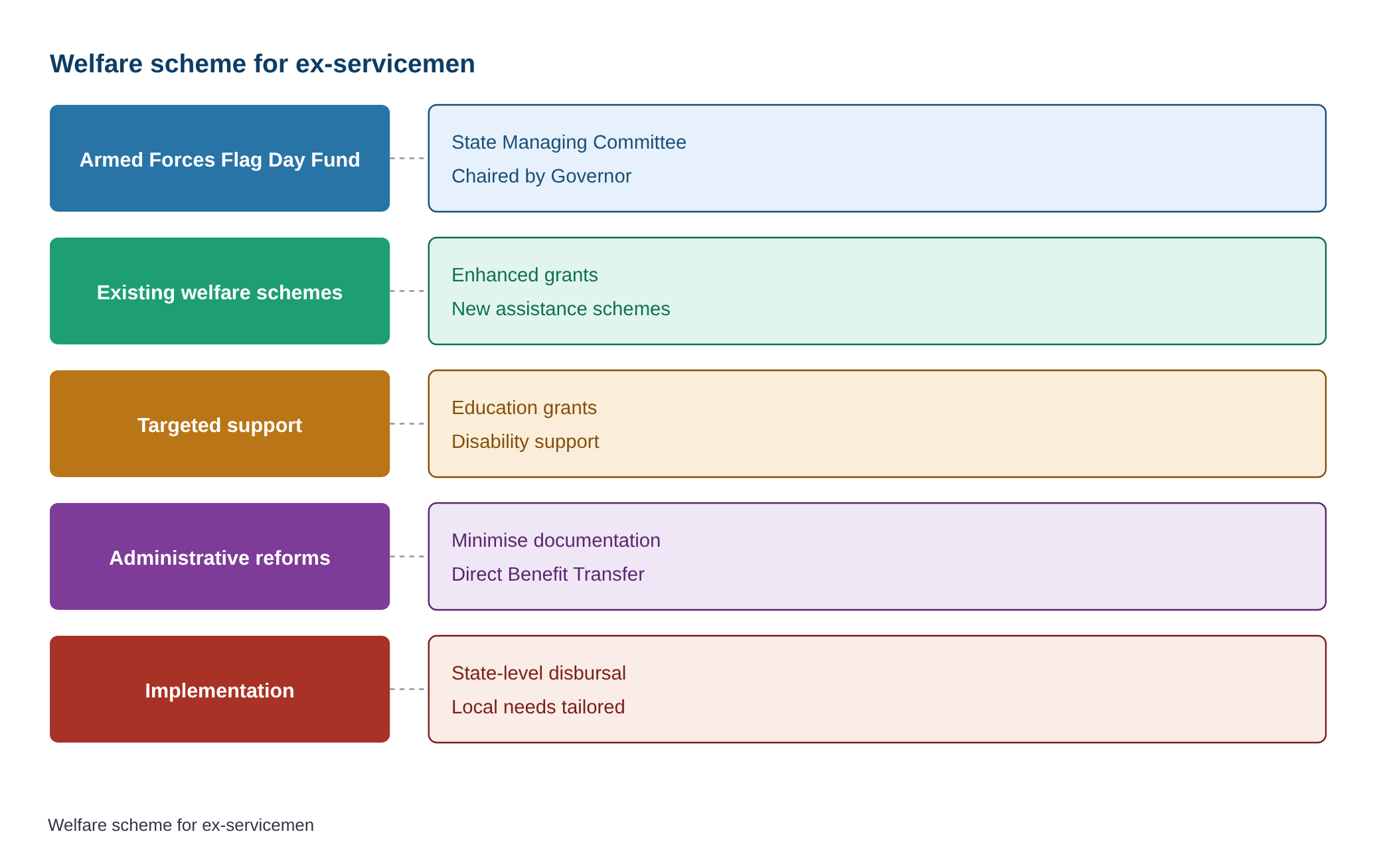
The State Managing Committee of the Armed Forces Flag Day Fund in Telangana, chaired by the Governor, approved significant enhancements to existing welfare schemes and introduced new initiatives for ex-servicemen, widows, and their dependents on September 24, 2026. These measures reflect a structured institutional response to address financial vulnerabilities among defence personnel post-retirement, particularly in areas such as education, disability support, marriage assistance, and mobility aids. The decisions underscore the state’s commitment to leveraging the Armed Forces Flag Day Fund for targeted social welfare, while also highlighting administrative reforms to streamline benefit delivery.
Background
- The Armed Forces Flag Day, observed annually on December 7, has historically been a platform for raising funds to support welfare activities for serving and retired defence personnel, including ex-servicemen, widows, and their dependents.
- The Armed Forces Flag Day Fund operates under the aegis of the Ministry of Defence, with state-level Managing Committees responsible for disbursing grants and implementing welfare schemes tailored to local needs.
- Telangana’s initiative aligns with the broader national framework of welfare schemes for ex-servicemen, such as the Ex-Servicemen Contributory Health Scheme (ECHS) and the Rajputana Rifles Welfare Fund, but introduces state-specific enhancements.
- The enhancement of grants and introduction of new schemes reflect a growing recognition of the financial and social challenges faced by ex-servicemen, particularly those with disabilities or special needs, in accessing education, healthcare, and livelihood opportunities.
- The Governor’s directive to minimise documentation and promote Direct Benefit Transfer (DBT) underscores the state’s emphasis on reducing administrative bottlenecks and ensuring timely disbursal of benefits.
- The meeting’s decisions also highlight the role of the Governor as the constitutional head of the state in chairing welfare committees, thereby ensuring high-level oversight and accountability in the implementation of social welfare measures.
What is the Armed Forces Flag Day Fund and its State Managing Committee?
- The Armed Forces Flag Day Fund is a national fund established to support welfare activities for serving and retired defence personnel, including ex-servicemen, widows, and their dependents. It operates under the Ministry of Defence.
- The State Managing Committee, chaired by the state Governor, is a statutory body responsible for overseeing the disbursement of grants and implementing welfare schemes at the state level. It ensures that funds are utilised for the intended beneficiaries and aligns with national welfare objectives.
- The Fund’s resources are derived from public contributions, government allocations, and other sources, and are utilised for education grants, disability pensions, marriage assistance, medical grants, and other welfare measures.
- The Fund’s governance structure includes representation from the state government, defence authorities, and civil society, ensuring a multi-stakeholder approach to welfare delivery.
- The Fund’s operations are guided by the principle of fiscal prudence, ensuring that welfare measures are sustainable and aligned with the state’s budgetary constraints.
- The State Managing Committee plays a pivotal role in identifying local needs and tailoring schemes to address specific challenges faced by ex-servicemen and their dependents, such as disability support, special education, and mobility assistance.
- The Fund’s activities are complemented by other national schemes, such as the Ex-Servicemen Contributory Health Scheme (ECHS) and the War Injured Soldiers Liberalized Pension Scheme, to provide a comprehensive welfare net for defence personnel.
- The Fund’s operations are subject to audit and review to ensure transparency, accountability, and efficient utilisation of resources.
Key Features
| Feature | Significance |
|---|---|
| Enhanced education grant for children of ex-servicemen (₹10,000 → ₹17,000) | Increases access to quality education for dependents of defence personnel, addressing socio-economic barriers and promoting human capital development. |
| Increased monthly assistance for 100% disabled ex-servicemen (₹15,000 → ₹18,000) | Strengthens social security for severely disabled veterans, aligning with constitutional directives on welfare for disabled citizens. |
| Enhanced marriage grant for daughters of ex-servicemen (₹50,000 → ₹75,000) | Provides financial security for daughters, reducing economic burdens on ex-servicemen families and promoting gender-sensitive welfare. |
| Mobility assistance scheme for immobile ex-servicemen (50% reimbursement for three-wheeler vehicles/wheelchairs) | Facilitates independence and mobility for disabled veterans, enhancing quality of life and integration into society. |
| Medical grant of ₹1 lakh for eligible ex-servicemen/widows without pension (subject to guidelines) | Addresses critical healthcare needs of non-pensioned beneficiaries, ensuring financial protection against medical emergencies. |
Why it Matters
Social Security and Inclusive Welfare
- Expands the scope of social security for ex-servicemen and their dependents, recognising their contributions to national security.
- Introduces targeted support for disabled veterans and special-needs children, aligning with the Rights of Persons with Disabilities Act, 2016.
- Enhances financial inclusion by simplifying documentation and promoting direct benefit transfers (DBT).
Human Capital Development
- Education grants for children of ex-servicemen improve intergenerational mobility and reduce poverty traps.
- Fee reimbursement for special-needs children in recognised schools promotes inclusive education and skill development.
Administrative Efficiency and Transparency
- Direct benefit transfers (DBT) and reduced documentation minimise leakages and administrative delays.
- Awareness campaigns ensure equitable access to welfare schemes, addressing information asymmetries.
Constitutional and Legal Framework
- The welfare measures operationalise the constitutional directive principles of state policy (Article 38, 39, 41) on social justice and welfare.
- Aligns with the Armed Forces (Special Powers) Act, 1958, and subsequent welfare policies for defence personnel.
Challenges
1. Implementation and Outreach Gaps
- Ensuring last-mile delivery of benefits to remote and marginalised ex-servicemen communities.
- Preventing exclusion errors due to stringent eligibility criteria or lack of awareness.
UPSC Link: GS-II: Welfare Schemes
2. Sustainability of Funding
- Long-term financial viability of state-funded welfare schemes amid competing fiscal priorities.
- Balancing increased grants with efficient resource allocation to avoid fiscal strain.
UPSC Link: GS-III: Fiscal Policy
3. Monitoring and Evaluation
- Establishing robust grievance redressal mechanisms for beneficiaries.
- Periodic audits to assess the impact and efficiency of welfare schemes.
UPSC Link: GS-II: Governance
4. Inter-State Disparities
- Addressing variations in welfare provisions across states to ensure uniformity in support for ex-servicemen.
- Coordinating with the Union government for standardised national-level welfare policies.
UPSC Link: GS-II: Federalism
5. Technology and Digital Divide
- Ensuring digital literacy among elderly ex-servicemen to access DBT and online applications.
- Bridging the digital divide in rural and tribal areas for equitable benefit delivery.
UPSC Link: GS-III: Science & Tech
Challenges — UPSC Perspective
| Issue | Concern |
|---|---|
| Eligibility verification | Risk of exclusion of deserving beneficiaries due to documentation gaps or bureaucratic hurdles. |
| Awareness campaigns | Limited reach in remote areas may leave eligible beneficiaries unaware of new schemes. |
| Fiscal sustainability | State budget constraints may limit scalability of enhanced welfare grants. |
| Monitoring mechanisms | Lack of real-time data on utilisation and impact of schemes. |
| Inter-departmental coordination | Delays in disbursement due to coordination gaps between state and central agencies. |
Government Initiatives — Must-Memorise for Prelims
- Armed Forces Flag Day Fund (State-level enhancements)
- Mobility Assistance Scheme for Disabled Ex-Servicemen
- Special Needs Children Education Support Scheme
- Medical Grant Scheme for Non-Pensioned Ex-Servicemen/Widows
Way Forward
- Conduct district-wise awareness campaigns in collaboration with ex-servicemen associations to ensure maximum outreach.
- Simplify application processes through single-window portals and mobile-based services to reduce bureaucratic delays.
- Establish a real-time monitoring dashboard to track disbursement, utilisation, and impact of welfare schemes.
- Strengthen inter-state coordination mechanisms to harmonise welfare provisions for ex-servicemen across India.
- Introduce periodic reviews of eligibility criteria to ensure inclusivity and responsiveness to evolving needs.
- Leverage Aadhaar-enabled payment systems to streamline direct benefit transfers and reduce leakages.
- Partner with NGOs and civil society organisations to enhance grassroots implementation and grievance redressal.
- Allocate dedicated funds in state budgets for sustained implementation and future enhancements of welfare schemes.
UPSC Value Addition
Keywords for Mains Answer-Writing
Armed Forces Flag Day Fund · ex-servicemen welfare · disability grants · education grants for children of ex-servicemen · special needs assistance · welfare schemes for widows · State Managing Committee of Armed Forces Flag Day Fund · Governor-led welfare governance · direct benefit transfer · social security for defence personnel · inclusive welfare policy · financial assistance schemes · disability compensation · special child education support
Constitutional & Policy Linkages
- Article 38: Directive Principle of State Policy on securing social order for welfare.
- Article 39: Directive Principle on securing equal pay and opportunities for citizens.
- Article 41: Directive Principle on public assistance in cases of unemployment, old age, sickness, and disablement.
Concept Flow
State Managing Committee approves enhanced welfare grants → → Increased financial assistance for education, disability, marriage, and special needs → → New schemes introduced for mobility and medical grants → → Direct benefit transfers and reduced documentation enhance accessibility → → Awareness campaigns ensure equitable reach to beneficiaries → → Implementation challenges addressed through monitoring and coordination → → Long-term impact on social security, human capital, and administrative efficiency.
Prelims Practice Questions
Q1. Consider the following statements regarding the Armed Forces Flag Day Fund (AFFDF):
1. The AFFDF is managed by the State Managing Committee chaired by the Governor.
2. The fund primarily provides financial assistance to ex-servicemen, widows, and their dependents.
3. The AFFDF operates under the Ministry of Defence, Government of India.
4. The fund disburses grants for education, disability, marriage, and special child needs.
How many of the above statements are correct?
- Only one
- Only two
- Only three
- All four
Answer: All four — Statements 1, 2, and 4 are correct. Statement 3 is incorrect as the AFFDF is a state-level fund managed by state committees, though it operates under the broader framework of the national AFFDF.
Q2. Assertion (A): The Armed Forces Flag Day Fund (AFFDF) provides financial assistance to ex-servicemen with disabilities.
Reason (R): The AFFDF is mandated to support the welfare of defence personnel and their families, including those with disabilities.
Options:
A. Both A and R are true, and R is the correct explanation of A.
B. Both A and R are true, but R is NOT the correct explanation of A.
C. A is true, but R is false.
D. A is false, but R is true.
Answer: ? — Both A and R are true, and R correctly explains A as the AFFDF explicitly includes disability grants as part of its welfare measures for ex-servicemen.
Q3. Match the following welfare schemes under the Armed Forces Flag Day Fund (AFFDF) with their beneficiaries:
Column I (Scheme) | Column II (Beneficiary)
—————– | ———————–
1. Mobility Assistance Scheme | A. Children of ex-servicemen with special needs
2. Education Grant | B. Ex-servicemen with 100% disability
3. Marriage Grant | C. Ex-servicemen unable to walk
4. Special Child Fee Reimbursement | D. Daughters of ex-servicemen
Options:
A. 1-C, 2-A, 3-D, 4-B
B. 1-C, 2-B, 3-D, 4-A
C. 1-B, 2-A, 3-D, 4-C
D. 1-A, 2-C, 3-B, 4-D
Answer: ? — The correct matches are: 1-C (Mobility Assistance Scheme for ex-servicemen unable to walk), 2-A (Education Grant for children of ex-servicemen), 3-D (Marriage Grant for daughters of ex-servicemen), 4-B (Special Child Fee Reimbursement for children with special needs).
Mains Practice Question
✍ Critically examine the role of the State Managing Committee of the Armed Forces Flag Day Fund (AFFDF) in enhancing social security for ex-servicemen and their dependents. Analyse the significance of recent enhancements in welfare grants, including education, disability, and special child support, in the context of inclusive welfare governance. (15 Marks)
Approach: MODEL-ANSWER SKELETON:
1. **Institutional Framework and Governance**:
– Define the Armed Forces Flag Day Fund (AFFDF) and its statutory/constitutional basis (if any).
– Explain the composition and role of the State Managing Committee, chaired by the Governor, in welfare governance.
– Reference: State-level welfare committees under national schemes (e.g., similar to State Social Welfare Boards).
2. **Recent Enhancements and Their Significance**:
– **Education Grants**: Increase from ₹10,000 to ₹17,000 for children of ex-servicemen (Class 1 to degree level). Discuss the impact on educational equity and social mobility.
– **Disability Grants**: Monthly assistance for 100% disabled ex-servicemen increased from ₹15,000 to ₹18,000. Analyse the alignment with the Rights of Persons with Disabilities Act, 2016.
– **Special Child Support**: Grants for children with special needs (below 15 years: ₹6,000 to ₹8,000; above 15 years: ₹9,000 to ₹10,000). Discuss the role in inclusive education.
– **New Schemes**: Mobility assistance (50% reimbursement for three-wheeler vehicles/wheelchairs) and school fee reimbursement (50% for special schools). Evaluate their contribution to accessibility and dignity.
3. **Governance Innovations**:
– Direct Benefit Transfer (DBT) and minimisation of documentation requirements. Reference the JAM trinity and Aadhaar-enabled welfare delivery.
– Role of the Governor in chairing the committee: Constitutional position (Article 153-156) and its impact on accountability and implementation.
4. **Challenges and Critique**:
– **Awareness Gaps**: Despite scheme availability, low uptake due to lack of awareness. Reference the Governor’s directive for extensive campaigns.
– **Implementation Bottlenecks**: Potential delays in disbursement, eligibility verification, and regional disparities.
– **Sustainability**: Funding sources (state budget, contributions, CSR) and long-term viability.
5. **Comparative Perspective**:
– Contrast with central schemes like the Ex-Servicemen Contributory Health Scheme (ECHS) or the National Defence Fund (NDF).
– Reference other state-level initiatives (e.g., Kerala’s welfare schemes for ex-servicemen).
6. **Conclusion**:
– Summarise the transformative potential of these enhancements in ensuring dignity and security for ex-servicemen.
– Emphasise the need for continuous monitoring, evaluation, and adaptive governance to address emerging needs.
Source: The Hindu
Telangana PCS (TGPSC (TSPSC)) — State PCS Practice
Prelims: Which of the following welfare schemes was recently approved by the Telangana government to provide higher grants to ex-servicemen and widows in the state?
- A. ‘Kalyana Lakshmi’ scheme for ex-servicemen and widows
- B. ‘Aasara’ pension enhancement for ex-servicemen and widows
- C. ‘Rythu Bandhu’ financial assistance for ex-servicemen and widows
- D. ‘Mana Ooru Mana Pranalika’ scheme for ex-servicemen and widows
Answer: B. ‘Aasara’ pension enhancement for ex-servicemen and widows — The Telangana government approved an enhancement in welfare grants under the ‘Aasara’ pension scheme for ex-servicemen and widows to provide higher financial assistance.
Mains: Discuss the significance of the recent Telangana government’s decision to enhance welfare grants for ex-servicemen and widows. Analyze how this initiative aligns with the state’s broader socio-economic policies and its impact on marginalized sections of society.
Generated by AanyaAi for educational purpose.
Related guides on our sites
- Current affairs for upsc 2026
- Best PSIR optional coaching for upsc
- Best PSIR optional teacher for upsc
- Best teacher of PSIR optional for upsc

- राजनाथ सिंह का बड़ा बयान: भारत किसी की ज़मीन कब्ज़ा नहीं करेगा, लेकिन सुरक्षा पर होगा कठोर - September 27, 2026
- Exercise Tarang Shakti 2026: India’s Mega Multi-Nation Air Power Showcase - September 27, 2026
- रबी अभियान 2026: राष्ट्रीय सम्मेलन में केंद्र-राज्य तालमेल पर होगा जोर - September 27, 2026

No Comments