


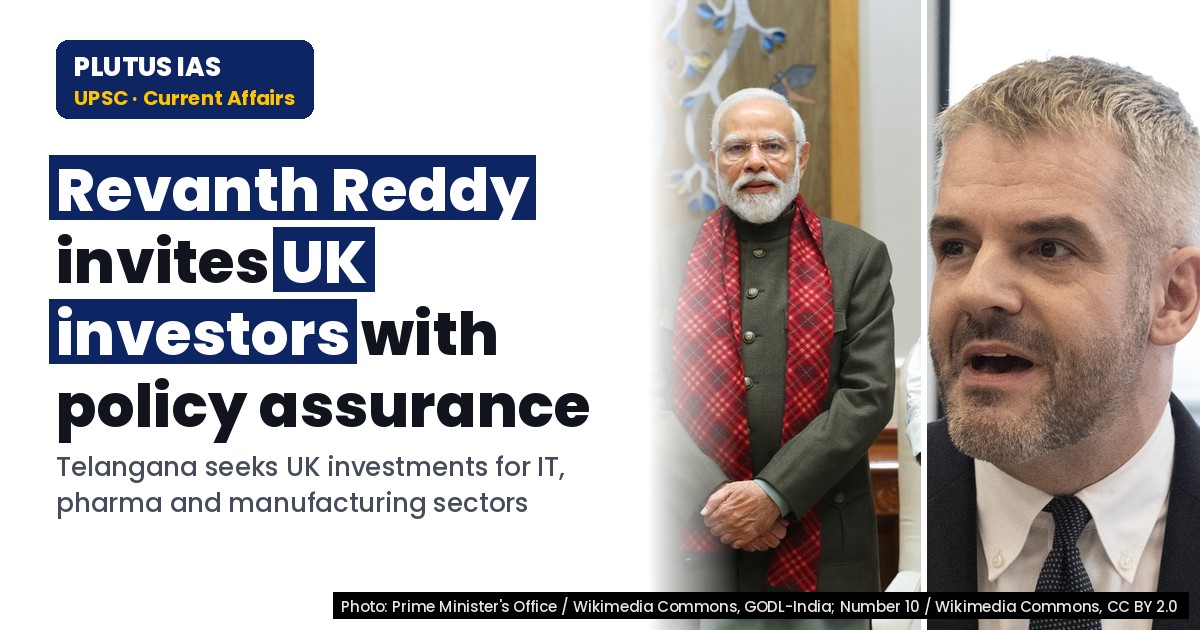
14 Oct Telangana CM Invites UK Investments with Policy Assurance for UPSC
✎ Telangana’s proactive engagement with the UK delegation underscores the state’s strategy to leverage the India–UK CETA for attracting FDI, fostering industrial partnerships, and enhancing its global economic footprint through…
Subject Relevance — Where This Topic Fits
- GS Paper II — International Relations (Bilateral Agreements, Regional Partnerships) | GS Paper III — Economy (Foreign Direct Investment, Industrial Policy, Economic Diplomacy)
- Prelims: Comprehensive Economic and Trade Agreement (CETA), Foreign Direct Investment (FDI), State-level industrial policy, Telangana Rising 2047, Genome Valley, Miss World Pageant 2025, Artificial Intelligence (AI) and skilling
- Essay: Globalisation and Regional Economic Integration, The Role of State Governments in India’s Economic Diplomacy
Quick Revision: Telangana’s proactive engagement with the UK delegation underscores the state’s strategy to leverage the India–UK CETA for attracting FDI, fostering industrial partnerships, and enhancing its global economic footprint through policy continuity, innovation, and skilling.
Why is this in the news?
The Chief Minister of Telangana recently engaged with a high-level delegation from the United Kingdom to discuss strengthening bilateral economic ties, particularly in the context of the India–UK Comprehensive Economic and Trade Agreement (CETA). This interaction underscores Telangana’s proactive approach to attracting foreign investment, leveraging its industrial strengths, and fostering regional partnerships in trade, innovation, and skills development. The meeting also highlighted the state’s strategic focus on advanced manufacturing, healthcare, digital technology, and R&D, aligning with global economic trends.
Background
- The India–UK Comprehensive Economic and Trade Agreement (CETA) was signed to enhance bilateral trade and investment by reducing tariffs, improving market access, and facilitating regulatory cooperation between the two nations.
- Telangana, established in 2014, has emerged as a key economic hub in India, particularly in sectors such as IT, pharmaceuticals, biotechnology, aerospace, and defence.
- The state government’s long-term development roadmap, ‘Telangana Rising 2047’, was formulated with inputs from global leaders, including former British Prime Minister Tony Blair, to guide sustainable and inclusive growth.
- Hyderabad, the state capital, has positioned itself as a global destination for innovation, hosting major events like the 72nd Miss World Pageant in 2025 and fostering a robust digital economy ecosystem.
- The state’s Genome Valley is a flagship initiative aimed at promoting biotechnology and life sciences research, aligning with global trends in healthcare and pharmaceutical innovation.
- Telangana’s per capita GDP is among the highest in India, reflecting its economic dynamism and attractiveness for investors.
What is the significance of Telangana’s engagement with the UK delegation?
- **Policy Continuity and Investor Confidence**: The Chief Minister’s assurance of policy continuity is critical for attracting long-term foreign investment, as investors prioritise stability and predictability in regulatory frameworks.
- **Leveraging CETA for Trade Expansion**: The India–UK CETA provides a structured framework for reducing trade barriers, enhancing market access, and facilitating smoother cross-border transactions, which Telangana aims to utilise for sectoral growth.
- **Industrial Synergy in Key Sectors**: The delegation’s focus on advanced manufacturing, healthcare, digital technology, defence, aerospace, and technical textiles aligns with Telangana’s existing industrial strengths, offering opportunities for collaboration and technology transfer.
- **Skilling and Talent Development**: Telangana’s emphasis on skilling the youth, particularly in emerging technologies like artificial intelligence, complements the UK’s demand for a skilled workforce, fostering mutual benefits in human capital development.
- **Innovation and R&D Partnerships**: The state’s Genome Valley and thriving innovation ecosystem present avenues for joint research projects, start-up collaborations, and knowledge-sharing initiatives with UK institutions and businesses.
- **Global Branding and Event Diplomacy**: Hosting high-profile events like the Miss World Pageant 2025 enhances Telangana’s global visibility, reinforcing its reputation as a dynamic and investor-friendly state.
- **Regional Economic Integration**: The engagement with UK mayors from Yorkshire and other regions highlights the potential for sub-national economic partnerships, which can drive grassroots-level trade and investment flows.
- **Invest Telangana Global Summit 2026**: The upcoming summit in December 2026 serves as a platform to showcase Telangana’s investment opportunities, fostering direct interactions between global investors and local industries.
Key Features
| Feature | Significance |
|---|---|
| Policy Continuity Assurance | Demonstrates a stable governance environment, critical for long-term foreign direct investment (FDI) commitments and industrial planning. |
| Talent Pool Availability | Highlights Telangana’s demographic dividend and skilled workforce, particularly in IT, biotechnology, and advanced manufacturing, as a key investment attraction. |
| Conducive Business Environment | Emphasises regulatory predictability, infrastructure readiness, and sectoral dominance (e.g., pharma, aerospace) to incentivise UK-based investors. |
| Regional Partnerships in CETA Context | Leverages the India-UK Comprehensive Economic and Trade Agreement (CETA) to deepen trade, investment, and institutional collaborations across sectors. |
| Invest Telangana Global Summit 2026 | A structured platform to showcase Telangana’s economic potential and facilitate direct engagement between investors and state stakeholders. |
| Digital Economy Ecosystem | Showcases Hyderabad’s scalable digital infrastructure and innovation hubs (e.g., Genome Valley) as enablers for high-tech industries and R&D collaborations. |
Why it Matters
Economic
- Telangana’s per capita GDP leadership in India positions it as a high-growth investment destination, particularly for UK firms seeking scalable markets.
- The state’s dominance in IT, pharma, aerospace, and biotechnology aligns with UK strengths in advanced manufacturing, healthcare, and digital technology, fostering complementary trade synergies.
- Policy continuity and a pro-business environment reduce transaction costs and risk premiums for foreign investors, enhancing FDI inflows.
Strategic
- The engagement with UK regional leaders (e.g., South Yorkshire, West Yorkshire) underscores the importance of sub-national diplomacy in trade and investment promotion.
- Leveraging CETA to deepen regional partnerships demonstrates India’s strategy to diversify trade partners beyond traditional hubs, mitigating geopolitical risks.
- Hyderabad’s hosting of the 72nd Miss World Pageant in 2025 symbolises the state’s global visibility and soft power, which can be harnessed for economic diplomacy.
Institutional
- Collaborations with UK universities and businesses, as highlighted by the Chief Minister’s recent UK visit, strengthen knowledge transfer and skill development in Telangana.
- The UK-India Business Council’s report on CETA and regional synergies provides a data-driven framework for future engagements, ensuring evidence-based policy formulation.
- Institutional partnerships in R&D (e.g., Genome Valley) and technical textiles can drive innovation-led growth, aligning with India’s ‘Viksit Bharat 2047’ vision.
Social
- Focus on skilling youth in AI and advanced technologies addresses the dual challenge of unemployment and industry demand for a future-ready workforce.
- The emphasis on healthcare and digital technology collaborations reflects Telangana’s commitment to inclusive growth and public service modernisation.
Challenges
1. Regulatory and Bureaucratic Hurdles
- Despite policy continuity assurances, investors may face delays in approvals or unclear regulatory frameworks for emerging sectors like AI and biotechnology.
- Differences in compliance standards between India and the UK could pose challenges in harmonising trade and investment processes under CETA.
UPSC Link: GS II: Government Policies and Interventions
2. Infrastructure Gaps
- While Hyderabad is a digital hub, other regions in Telangana may lack adequate infrastructure for high-tech industries, necessitating targeted investments.
- Logistics and connectivity bottlenecks could hinder the seamless movement of goods and services, particularly for export-oriented industries.
UPSC Link: GS III: Infrastructure
3. Skill Mismatch and Unemployment
- Rapid technological advancements (e.g., AI) may outpace the reskilling efforts of the state, leading to a talent deficit in critical sectors.
- High youth unemployment rates, despite a large talent pool, require sustained interventions in vocational training and higher education reforms.
UPSC Link: GS II: Social Sector / GS III: Employment
4. Geopolitical and Economic Volatility
- Global economic slowdowns or geopolitical tensions (e.g., trade wars) could dampen investor confidence, despite state-level assurances.
- Currency fluctuations and inflationary pressures may impact the cost competitiveness of Telangana’s exports to the UK.
UPSC Link: GS II: International Relations
5. Competition from Other States
- States like Karnataka, Maharashtra, and Tamil Nadu also vie for UK investments, offering similar incentives and sectoral strengths, necessitating differentiation.
- Telangana must continuously innovate its value proposition to retain investor interest amid rising competition.
UPSC Link: GS III: Economic Development
Challenges — UPSC Perspective
| Issue | Concern |
|---|---|
| Regulatory Delays | Potential investor frustration due to bureaucratic inefficiencies in approvals and compliance. |
| Infrastructure Deficits | Limited connectivity and logistics in non-urban areas may deter industrial expansion. |
| Skill Gaps in AI/Tech | Mismatch between industry needs and workforce capabilities could hinder growth in high-tech sectors. |
| Geopolitical Risks | External economic shocks may disrupt trade flows and investor confidence. |
| State Competition | Other Indian states with similar sectoral strengths may divert UK investments. |
Way Forward
- Constitute a dedicated ‘UK-Telangana Investment Facilitation Cell’ to streamline approvals, grievance redressal, and compliance for UK investors.
- Accelerate infrastructure projects in Tier-II cities (e.g., Warangal, Karimnagar) to decentralise industrial growth and reduce Hyderabad’s congestion.
- Expand public-private partnerships (PPPs) in skilling initiatives, collaborating with UK universities and tech firms to align curricula with industry demands.
- Leverage CETA’s provisions to negotiate sector-specific trade facilitation agreements, reducing non-tariff barriers for pharma, aerospace, and digital services.
- Launch a ‘Future Skills Mission’ targeting 1 million youth by 2027, with focus on AI, biotech, and advanced manufacturing, in partnership with UK counterparts.
- Develop a ‘State Export Promotion Strategy’ to diversify export baskets beyond IT and pharma, targeting UK markets in technical textiles and healthcare.
- Establish a ‘Telangana Innovation Fund’ to co-invest with UK firms in R&D projects, particularly in Genome Valley and aerospace clusters.
- Organise quarterly review meetings with UK investors to address operational challenges and adapt policies in real-time.
UPSC Value Addition
Keywords for Mains Answer-Writing
State-level economic diplomacy · Foreign Direct Investment (FDI) facilitation · India-UK Comprehensive Economic and Trade Agreement (CETA) · State-led industrial policy · Regional economic partnerships · Investment promotion agencies · Skilling and human capital development · Manufacturing sector growth · Global innovation ecosystems · Sub-national diplomacy in federal systems · Ease of Doing Business reforms · State-level GDP per capita disparities
Constitutional & Policy Linkages
- [‘Article 293: Borrowing by States’, ‘Empowers Telangana to raise loans for infrastructure development, critical for attracting investments.’]
Concept Flow
UK delegation’s visit to Telangana → Discussions on CETA-aligned partnerships → Assurance of policy continuity and business-friendly environment → Showcase of state’s economic strengths (IT, pharma, aerospace) → Invitation to Invest Telangana Global Summit 2026 → Potential FDI inflows and institutional collaborations → Long-term impact on Telangana’s GDP growth and employment generation.
Prelims Practice Questions
Q1. Consider the following statements regarding the India–UK Comprehensive Economic and Trade Agreement (CETA):
1. The CETA aims to eliminate tariffs on all goods traded between India and the UK.
2. The agreement includes provisions for mutual recognition of professional qualifications.
3. The CETA is a legally binding treaty ratified by the Indian Parliament.
4. The agreement facilitates cooperation in areas such as digital trade and intellectual property rights.
How many of the above statements are correct?
- Only one
- Only two
- Only three
- All
Answer: Only three — Statements 2 and 4 are correct as CETA includes provisions for mutual recognition of professional qualifications and cooperation in digital trade and IPR. Statements 1 and 3 are incorrect: CETA does not eliminate tariffs on all goods, and it is not a treaty ratified by Parliament but an agreement under negotiation.
Q2. Assertion (A): The Telangana government’s ‘Telangana Rising 2047’ roadmap was developed with inputs from global leaders, including former British Prime Minister Tony Blair.
Reason (R): The roadmap prioritises the IT, pharmaceuticals, and biotechnology sectors as key growth drivers for the State.
In the context of the above two statements, which one of the following is correct?
- Both A and R are true, and R is the correct explanation of A
- Both A and R are true, but R is NOT the correct explanation of A
- A is true, but R is false
- A is false, but R is true
Answer: A is true, but R is false — Assertion (A) is true as Tony Blair did contribute to the roadmap. Reason (R) is also true but does not explain (A), as the roadmap’s priorities are independent of Blair’s involvement.
Q3. Match the following pairs related to State-level economic initiatives in India:
Column I (State) | Column II (Initiative)
——————————–|—————————
A. Telangana | 1. Genome Valley
B. Karnataka | 2. Biotechnology parks
C. Gujarat | 3. Vibrant Gujarat
D. Maharashtra | 4. Mumbai-Ahmedabad High-Speed Rail
Select the correct match:
- A-1, B-2, C-3, D-4
- A-2, B-1, C-3, D-4
- A-3, B-2, C-1, D-4
- A-1, B-3, C-2, D-4
Answer: A-1, B-2, C-3, D-4 — Correct matches are: Telangana (Genome Valley), Karnataka (Biotechnology parks), Gujarat (Vibrant Gujarat), and Maharashtra (Mumbai-Ahmedabad High-Speed Rail).
Mains Practice Question
✍ Critically examine the role of sub-national governments in India in attracting Foreign Direct Investment (FDI) and fostering economic growth, with reference to the Telangana government’s recent engagement with the UK delegation. Also, analyse the constitutional and institutional mechanisms that enable such state-level economic diplomacy. (15 Marks)
Approach: MODEL-ANSWER SKELETON:
1. **Introduction (2 marks)**: Define sub-national economic diplomacy and its significance in India’s federal structure. Mention Telangana’s proactive engagement with the UK delegation as a case study.
2. **Mechanisms enabling state-level economic diplomacy (4 marks)**:
– **Constitutional provisions**: Art. 246 (7th Schedule), Art. 263 (Inter-State Council), and Art. 293 (loans to States).
– **Institutional frameworks**: State Investment Promotion Agencies (e.g., Telangana State Industrial Infrastructure Corporation), Single Window Clearance Systems, and Export Promotion Councils.
– **Policy tools**: State-level industrial policies, SEZs, and skill development initiatives (e.g., Telangana’s ‘Karma Siddhi’ programme).
3. **Telangana’s strategy and outcomes (4 marks)**:
– **Sectoral focus**: IT, pharma, biotechnology, aerospace, and defence manufacturing.
– **Institutional partnerships**: Genome Valley, collaboration with UK mayors, and the ‘Telangana Rising 2047’ roadmap.
– **Data points**: Per capita GDP (highest in India), FDI inflows, and the Invest Telangana Global Summit 2026.
4. **Challenges and limitations (3 marks)**:
– **Constitutional constraints**: Lack of exclusive FDI policy-making powers for States (Union List, Entry 18).
– **Coordination issues**: Centre-State friction in land acquisition, labour laws, and GST compliance.
– **Global constraints**: Geopolitical risks (e.g., UK-India CETA negotiations), competition from other States.
5. **Conclusion (2 marks)**: Balanced assessment of state-level economic diplomacy as a complementary tool to Centre-led FDI attraction, with recommendations for strengthening institutional mechanisms (e.g., formalising State-level trade offices abroad, harmonising labour laws).
Source: The Hindu
Generated by AanyaAi for educational purpose.
Related guides on our sites
- Current affairs for upsc 2026
- Best PSIR optional coaching for upsc
- Best PSIR optional teacher for upsc
- Best teacher of PSIR optional for upsc

- NAMASTE Scheme: Enhancing Sanitation Workers’ Livelihoods & Safety - November 14, 2026
- एमएसएमई का विशेष अभियान 6.0: स्वच्छता और लंबित मामलों का निपटारा - November 14, 2026
- Sea Vigil-26: Coastal Defence Drills Off Visakhapatnam - November 14, 2026

No Comments