


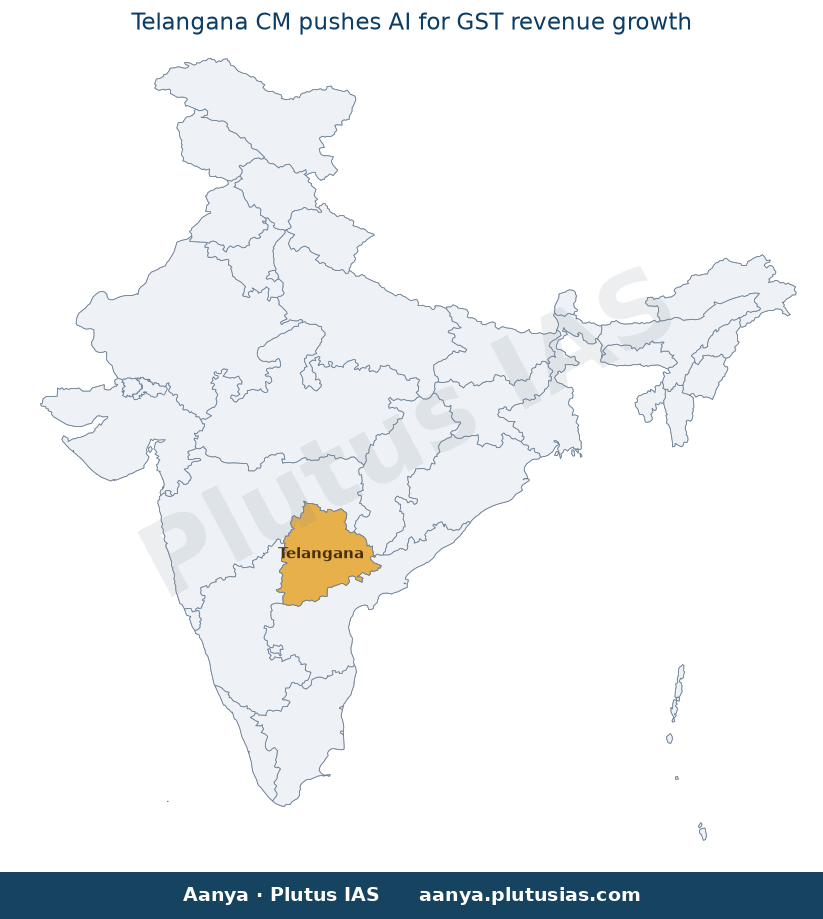
07 Aug Telangana CM Pushes AI to Boost GST Revenue: Key Strategy for UPSC
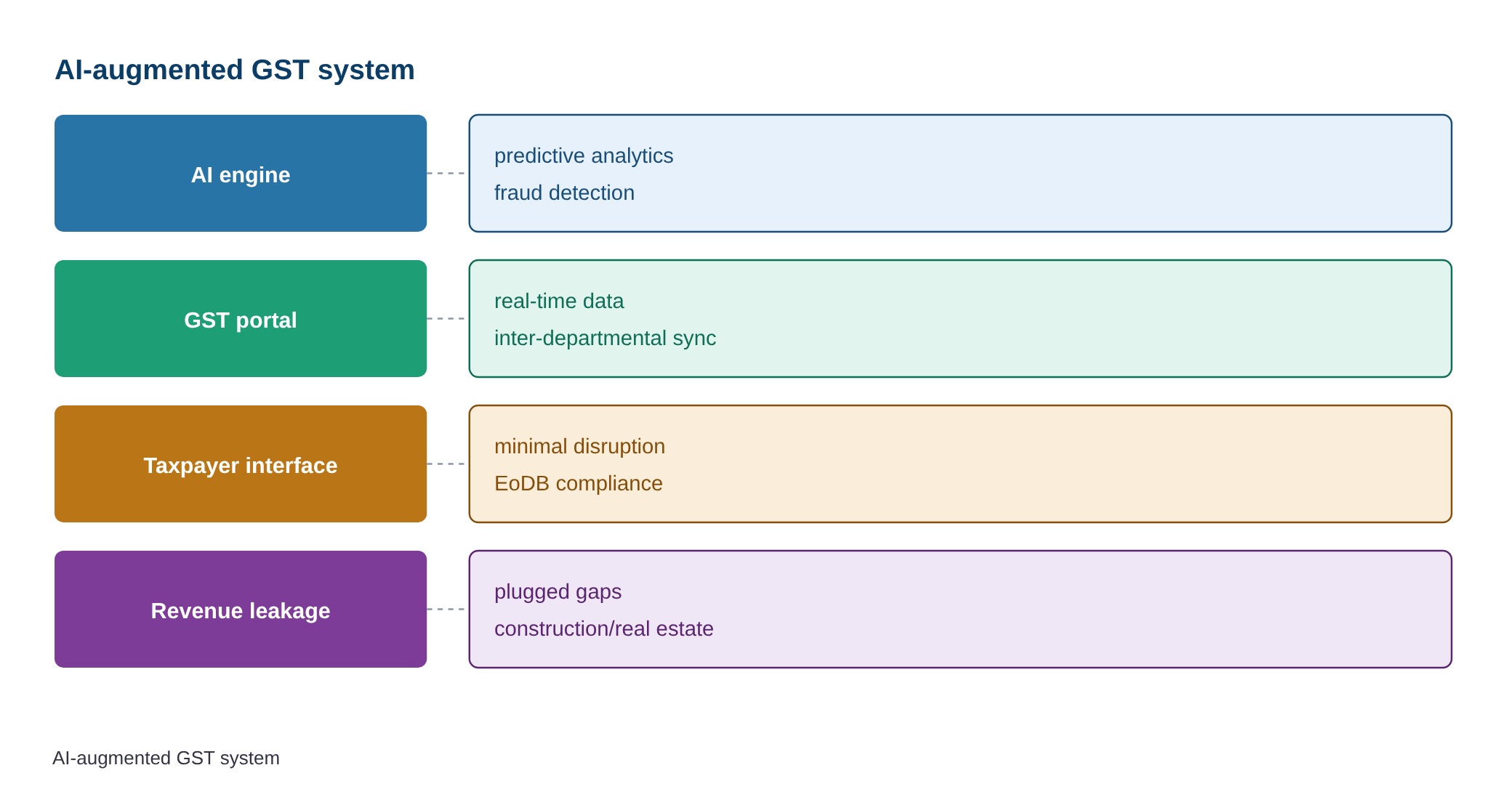
✎ Artificial Intelligence in GST administration aims to enhance revenue mobilisation through predictive analytics, inter-departmental data integration, and automation, while simultaneously improving ease of doing business by…
Subject Relevance — Where This Topic Fits
- GS Paper II — Governance, Transparency and Accountability | GS Paper III — Indian Economy and Issues Relating to Planning, Mobilisation of Resources, Growth, Development and Employment
- Prelims: Goods and Services Tax (GST), GST Council, GST Network (GSTN), Input Tax Credit (ITC), Ease of Doing Business (EoDB), Revenue Neutral Rate (RNR), GST evasion, tax buoyancy, Artificial Intelligence (AI), Machine Learning (ML), Data Analytics, Predictive Modelling, Telangana State Commercial Taxes Department, RERA, Aarogyasri, Mee Seva
- Essay: The Role of Technology in Governance: Balancing Revenue Augmentation and Ease of Doing Business, Ethical Governance and Fiscal Federalism: The Case for AI-Driven Tax Administration
Quick Revision: Artificial Intelligence in GST administration aims to enhance revenue mobilisation through predictive analytics, inter-departmental data integration, and automation, while simultaneously improving ease of doing business by reducing compliance burdens.
Why is this in the news?
The Chief Minister of Telangana, Mr. Revanth Reddy, has advocated for the deployment of Artificial Intelligence (AI) to augment Goods and Services Tax (GST) revenue while ensuring minimal disruption to businesses. The proposed initiative, developed in consultation with economist Arvind Subramanian, aims to streamline GST administration, curb revenue leakages, and promote ease of doing business through predictive analytics and inter-departmental coordination. This aligns with broader national efforts to leverage technology for fiscal efficiency and transparency in indirect taxation.
Background
- The Goods and Services Tax (GST) was introduced in India on 1st July 2017 to unify the indirect tax regime, replacing multiple central and state taxes. It is governed by the GST Council, a constitutional body comprising the Union Finance Minister and state Finance Ministers.
- GST revenue collection has been a critical fiscal parameter for states, with Telangana consistently contributing significantly to the national GST pool. However, challenges such as tax evasion, underreporting, and inefficiencies in tax administration persist.
- The Government of Telangana has been proactive in adopting digital governance solutions, including platforms like Mee Seva for citizen services and Aarogyasri for healthcare, to enhance administrative efficiency.
- The construction and real estate sector, a major revenue contributor, has faced issues like under-invoicing, undervaluation, and lack of real-time data integration across departments such as RERA, Municipal Administration, and Commercial Taxes.
- Global best practices in tax administration, including the use of AI for fraud detection and predictive analytics, have been adopted by several countries to improve tax compliance and revenue mobilisation.
- The proposed AI-driven GST administration model in Telangana is part of a broader strategy to align state-level fiscal policies with the ‘Ease of Doing Business’ (EoDB) rankings, where India has shown significant improvement in recent years.
Artificial Intelligence in GST Administration: Objectives, Mechanisms, and Implications
- Objective: The primary goal is to augment GST revenue by leveraging AI to identify tax leakages, predict non-compliance, and streamline tax administration while minimising the compliance burden on businesses.
- Mechanisms: AI tools such as Machine Learning (ML) and predictive modelling will be deployed to analyse transactional data, detect anomalies in tax filings, and flag potential evasion or underreporting. This includes real-time cross-verification of construction costs with RERA-registered projects and municipal records.
- Inter-Departmental Coordination: The initiative emphasises coordination among Commercial Taxes, Municipal Administration, Panchayat Raj, Energy, and RERA to ensure seamless data sharing and prevent revenue leakages in high-value sectors like construction and real estate.
- Ease of Doing Business (EoDB): The AI-driven system aims to reduce compliance costs by automating tax assessments, simplifying return filings, and providing businesses with predictive insights to avoid penalties. This aligns with the World Bank’s EoDB indicators, particularly in the ‘Paying Taxes’ sub-category.
- Revenue Leakage Prevention: Focus areas include arresting leakages in the construction sector by recording tax estimates at the time of permission applications, ensuring accurate valuation of high-rise projects, and integrating Aarogyasri and Chief Minister’s Relief Fund data to track compliance.
- Data Integration: The programme will utilise existing digital infrastructure such as Mee Seva, GSTN, and state-specific databases to create a unified tax administration system, reducing duplication and enhancing data accuracy.
- Stakeholder Engagement: The Chief Minister’s discussions with Arvind Subramanian highlight the importance of expert consultation in designing AI models that balance revenue augmentation with business facilitation, avoiding over-regulation.
- Pilot Phase: The government plans to roll out the AI programme in phases, starting with pilot projects in high-revenue sectors such as construction and real estate, before scaling it to other areas of GST administration.
Key Features
| Feature | Significance |
|---|---|
| AI-driven GST revenue augmentation | Enhances tax compliance by identifying anomalies, under-reporting, and fraudulent transactions in real-time. |
| Cross-departmental data integration | Facilitates seamless sharing of construction cost data between Commercial Taxes, Municipal Administration, Panchayat Raj, Energy, and RERA. |
| Ease of Doing Business (EoDB) compliance | Ensures AI-driven reforms do not impose additional compliance burdens on businesses. |
| Revenue leakage detection in construction sector | Targets high-risk areas like high-rises and contract works to prevent under-declaration of taxable value. |
| Citizen-centric service integration | Links Mee Seva, Aarogyasri, and CM’s Relief Fund for efficient administration and taxpayer convenience. |
Why it Matters
Economic Implications
- Augments State revenue by plugging leakages in GST collection, particularly in high-growth sectors like construction and real estate.
- Supports fiscal sustainability by ensuring efficient tax administration without increasing the tax burden on compliant taxpayers.
- Enhances predictability in revenue forecasting, enabling better budgetary planning and resource allocation.
Administrative Reforms
- Promotes inter-departmental coordination to address systemic inefficiencies in tax administration.
- Leverages technology to reduce human error and discretionary biases in tax assessment and collection.
- Aligns with the principle of ‘Minimum Government, Maximum Governance’ by automating compliance checks.
Business Environment
- Balances revenue augmentation with EoDB by minimizing compliance disruptions through AI-driven automation.
- Reduces transaction costs for businesses by streamlining tax-related processes.
- Encourages formalization of the economy by making tax evasion riskier and less profitable.
Challenges
1. Data Privacy and Security
- Risk of data breaches in cross-departmental data sharing, especially with sensitive taxpayer information.
- Need for robust encryption and anonymization protocols to comply with the Personal Data Protection Act (PDPA).
- Potential misuse of data by unauthorized entities if governance frameworks are weak.
UPSC Link: PDP Bill 2023 – Data Protection Principles
2. Resistance to Structural Reforms
- Bureaucratic inertia and resistance to adopting AI-driven processes in traditional tax administration.
- Skepticism among stakeholders regarding the efficacy of AI in detecting complex tax evasion schemes.
- Requirement for extensive capacity-building and training of officials to manage AI systems.
UPSC Link: Administrative Reforms Commission Reports
3. Technological Dependence and Vulnerabilities
- Over-reliance on AI systems may lead to operational disruptions due to technical failures or cyberattacks.
- High initial costs of implementing AI infrastructure and maintaining it over time.
- Need for continuous updates to AI models to adapt to evolving tax evasion tactics.
UPSC Link: Cybersecurity – National Cyber Security Policy
4. Legal and Ethical Concerns
- Potential conflicts with constitutional provisions on privacy (Article 21) if data collection is excessive.
- Risk of algorithmic bias leading to unfair targeting of certain taxpayers or sectors.
- Requirement for transparent audit trails to ensure accountability in AI-driven tax decisions.
UPSC Link: Article 21 – Right to Privacy
Challenges — UPSC Perspective
| Issue | Concern |
|---|---|
| Data Privacy | Risk of unauthorized access or misuse of taxpayer data in integrated systems. |
| Inter-departmental Coordination | Lack of seamless data sharing due to siloed administrative structures. |
| AI Model Accuracy | Potential for false positives or negatives in detecting tax evasion. |
| Cost of Implementation | High capital expenditure for AI infrastructure and maintenance. |
| Stakeholder Resistance | Reluctance among officials and taxpayers to adopt AI-driven processes. |
| Regulatory Compliance | Ensuring AI systems comply with evolving data protection laws. |
Way Forward
- Constitute a multi-departmental task force to oversee AI implementation in GST administration.
- Develop a phased rollout plan for AI-driven tax compliance, starting with high-risk sectors like construction.
- Invest in capacity-building programs to train officials in AI tools and data analytics.
- Establish a robust data governance framework to ensure privacy, security, and ethical use of taxpayer data.
- Pilot AI models in select districts to assess efficacy before statewide deployment.
- Strengthen inter-departmental data-sharing protocols to enable real-time cross-verification of tax records.
- Introduce incentives for businesses to adopt digital invoicing and e-way bills to facilitate AI monitoring.
UPSC Value Addition
Keywords for Mains Answer-Writing
Goods and Services Tax (GST) · Artificial Intelligence (AI) in taxation · Revenue augmentation · Ease of Doing Business (EoDB) · Tax administration reforms · GST revenue leakages · Construction sector taxation · Municipal Administration and Panchayati Raj · RERA and tax compliance · Meeseva and Aarogyasri integration · Commercial Taxes Department reforms · Economic growth and tax buoyancy · Tax policy and technology · State GST (SGST) administration · Inter-departmental coordination for tax compliance
Constitutional & Policy Linkages
- Article 265 – Taxation must be under authority of law
- Article 300A – Right to property (protection against arbitrary tax demands)
Concept Flow
Rapid economic growth in Telangana → Increased tax base and complexity → Need for efficient revenue augmentation → Adoption of AI in GST administration → Identification of revenue leakages in construction sector → Cross-departmental data integration → AI-driven anomaly detection → Targeted enforcement → Implementation of AI systems → Enhanced tax compliance → Increased revenue collection → Reinvestment in public services → EoDB considerations → AI reforms designed to minimize business disruptions → Sustained economic growth → Long-term fiscal sustainability → Data privacy concerns → Robust governance frameworks → Compliance with PDPA → Trust in AI-driven tax administration
Prelims Practice Questions
Q1. Consider the following statements regarding the Goods and Services Tax (GST) in India:
1. GST is a destination-based tax levied on the supply of goods and services.
2. The GST Council is chaired by the Union Finance Minister.
3. GST has subsumed all indirect taxes including customs duty.
4. The GST Network (GSTN) is a government-owned entity managing the GST portal.
How many of the above statements are correct?
- Only one
- Only two
- Only three
- All four
Answer: Only three — Statement 1 is correct as GST is a destination-based tax. Statement 2 is correct as the GST Council is chaired by the Union Finance Minister. Statement 3 is incorrect because customs duty is not subsumed under GST. Statement 4 is incorrect as GSTN is a private entity with government equity participation.
Q2. Assertion (A): Artificial Intelligence can significantly reduce tax evasion by detecting anomalies in tax filings.
Reason (R): AI models trained on historical tax data can identify patterns of non-compliance and flag suspicious transactions for further scrutiny.
Options:
A. Both A and R are true, and R is the correct explanation of A.
B. Both A and R are true, but R is not the correct explanation of A.
C. A is true, but R is false.
D. A is false, but R is true.
Answer: ? — AI can indeed reduce tax evasion by detecting anomalies, and the reason correctly explains how AI achieves this by leveraging historical data to identify non-compliance patterns.
Q3. Match the following pairs related to GST administration in India:
Column I (Institution/Body)
1. GST Council
2. GST Network (GSTN)
3. State Commercial Taxes Department
4. RERA
Column II (Function/Role)
A. Manages the GST portal and IT infrastructure
B. Formulates policies and tax rates for GST
C. Enforces GST compliance at the state level
D. Regulates real estate projects and ensures tax compliance
Options:
A. 1-B, 2-A, 3-C, 4-D
B. 1-A, 2-B, 3-C, 4-D
C. 1-B, 2-C, 3-A, 4-D
D. 1-D, 2-A, 3-B, 4-C
Answer: ? — 1-B: GST Council formulates policies and tax rates. 2-A: GSTN manages the GST portal. 3-C: State Commercial Taxes Department enforces GST compliance. 4-D: RERA regulates real estate projects.
Mains Practice Question
✍ The integration of Artificial Intelligence (AI) in Goods and Services Tax (GST) administration presents a transformative opportunity to enhance revenue collection while promoting the Ease of Doing Business (EoDB). Critically analyse the potential benefits and challenges of leveraging AI for GST revenue augmentation in India. Also, examine the role of inter-departmental coordination in addressing tax leakages, particularly in the construction sector. (15 Marks)
Approach: MODEL-ANSWER SKELETON:
1. **Introduction (2 marks)**
– Define GST and its significance in India’s tax regime.
– Briefly introduce AI and its applications in tax administration.
– Contextualise the current discussion with the Chief Minister’s proposal for AI-driven GST reforms in Telangana.
2. **Benefits of AI in GST Revenue Augmentation (5 marks)**
– **Revenue Leakage Detection**: AI models can analyse transaction patterns to identify underreporting, fake invoices, and misclassification of goods/services.
– **Automated Compliance**: AI-driven chatbots and virtual assistants can assist taxpayers in filing returns, reducing errors and non-compliance.
– **Predictive Analytics**: AI can forecast tax revenues based on economic indicators, enabling proactive policy adjustments.
– **Ease of Doing Business (EoDB)**: AI streamlines processes like refunds, registrations, and audits, reducing bureaucratic delays.
– **Cross-verification**: AI can cross-reference data from GSTN, RERA, municipal authorities, and land records to detect discrepancies.
3. **Challenges and Limitations (4 marks)**
– **Data Privacy and Security**: AI systems require vast datasets, raising concerns about data protection under the Digital Personal Data Protection Act, 2023.
– **Algorithmic Bias**: Risk of false positives in flagging taxpayers, leading to harassment or litigation.
– **High Initial Costs**: Implementation of AI infrastructure requires significant investment in technology and training.
– **Resistance to Change**: Tax officials and businesses may resist adoption due to unfamiliarity or fear of job displacement.
– **Legal and Ethical Concerns**: Need for clear regulatory frameworks governing AI’s role in tax administration.
4. **Role of Inter-departmental Coordination (3 marks)**
– **Construction Sector Leakages**: High-value projects often underreport costs; AI can integrate data from RERA, municipal bodies, and energy departments to verify construction costs.
– **Municipal Administration and Panchayati Raj**: Local bodies can provide ground-level data on property tax, land use, and construction permits.
– **Meeseva and Aarogyasri Integration**: Linking these platforms can help verify taxpayer identities, business registrations, and welfare eligibility, reducing fraud.
– **RERA’s Role**: Ensuring real-time data on project approvals, delays, and compliance can help track tax liabilities.
5. **Conclusion (1 mark)**
– AI offers a powerful tool for GST revenue augmentation but must be implemented with safeguards for transparency, accountability, and fairness.
– Emphasise the need for a phased rollout, stakeholder consultations, and capacity-building for tax officials.
Source: The Hindu
Generated by AanyaAi for educational purpose.

- राजस्थान हाईकोर्ट ने ई-सिगरेट प्रतिबंध पर राज्य सरकार से पूछा जवाब - September 19, 2026
- राजस्थान हाईकोर्ट ने ई-सिगरेट बिक्री पर राज्य सरकार से मांगी रिपोर्ट, जानें पूरा मामला - September 19, 2026
- यूक्रेन को EU से 3.3 अरब यूरो का रक्षा अनुदान: जानिए UPSC के लिए महत्वपूर्ण बिंदु - September 19, 2026

No Comments