


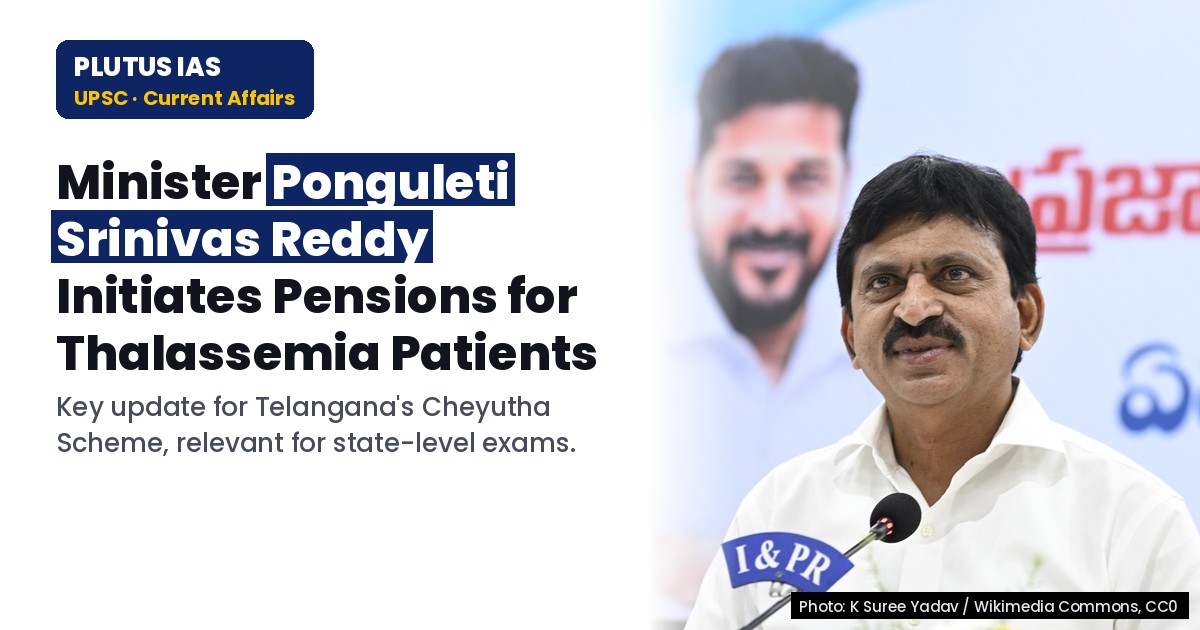
13 Nov Telangana’s Cheyutha Scheme: Pensions for Thalassemia Patients
✎ Thalassemia is a genetic blood disorder requiring significant medical care, and social security pensions, such as those under the 'Cheyutha Scheme', are crucial governmental provisions for supporting affected individuals and…
Subject Relevance — Where This Topic Fits
- GS Paper II — Governance, Social Justice | GS Paper III — Health, Inclusive Growth
- Prelims: Thalassemia, Cheyutha Scheme, Social Security Pensions, Genetic Disorders, Public Health Initiatives, Vulnerable Sections
- Essay: Healthcare Access and Equity in India, The Role of Social Security in Poverty Alleviation and Vulnerable Group Protection
Quick Revision: Thalassemia is a genetic blood disorder requiring significant medical care, and social security pensions, such as those under the ‘Cheyutha Scheme’, are crucial governmental provisions for supporting affected individuals and other vulnerable sections of society.
Why is this in the news?
Children affected by thalassemia have expressed gratitude towards a state minister for the sanction of pensions under the ‘Cheyutha Scheme’. This initiative highlights governmental efforts to provide financial assistance and social security to individuals suffering from chronic diseases and other vulnerable sections of society, including the elderly, widows, weavers, and toddy tappers.
Background
- Thalassemia is a group of inherited blood disorders characterized by abnormal hemoglobin production, leading to anemia.
- The management of thalassemia often requires lifelong blood transfusions and chelation therapy, imposing significant financial and logistical burdens on affected individuals and their families.
- Social security schemes in India aim to provide a safety net for various vulnerable populations, addressing issues such as old age, widowhood, disability, and chronic illness.
- The ‘Cheyutha Scheme’ is a state-specific welfare initiative designed to provide financial assistance in the form of pensions to eligible beneficiaries, including those with chronic diseases like thalassemia.
- Governmental intervention through pension schemes is crucial for ensuring the well-being and improved quality of life for individuals facing health challenges and economic hardship.
- The recognition of thalassemia patients as beneficiaries under such schemes underscores a growing emphasis on inclusive social welfare policies.
Understanding Thalassemia and Social Security Pensions
- Thalassemia is a genetic blood disorder that reduces the production of hemoglobin, the protein in red blood cells that carries oxygen throughout the body.
- It is inherited in an autosomal recessive pattern, meaning both parents must carry the gene for a child to be affected.
- Symptoms range from mild to severe, including fatigue, weakness, pale skin, and growth failure, with severe forms requiring regular blood transfusions.
- Social security pensions are periodic financial payments provided by the government to individuals who are unable to support themselves due to age, disability, widowhood, or other specific vulnerabilities.
- These pensions aim to provide a basic income, reduce poverty, and enhance the social and economic security of beneficiaries.
- In India, social security schemes are implemented at both central and state levels, with varying eligibility criteria and benefit structures.
- The ‘Cheyutha Scheme’ exemplifies a state-level initiative focused on extending financial support to a broad spectrum of vulnerable groups, including those with chronic medical conditions.
- Such schemes are vital components of a welfare state, contributing to the realization of socio-economic justice and the right to an adequate standard of living.
Key Features
| Feature | Significance |
|---|---|
| Targeted Beneficiary Support | The initiative specifically addresses the financial needs of individuals affected by Thalassemia, a chronic genetic blood disorder, thereby mitigating the economic burden associated with long-term medical care. |
| Inclusion under Cheyutha Scheme | Integrating Thalassemia patients into an existing welfare framework like the Cheyutha Scheme streamlines the delivery of social security benefits, ensuring broader coverage and administrative efficiency for vulnerable populations. |
| Multi-Category Pension Distribution | The scheme’s extension to diverse vulnerable groups, including widows, elderly persons, weavers, and toddy tappers, demonstrates a comprehensive approach to social welfare, aiming to reduce poverty and enhance livelihood security across various demographics. |
| Role of Public Representation | The acknowledgement of the Minister’s prior advocacy in Parliament highlights the critical role of elected representatives in bringing specific community concerns to policy-making forums and influencing welfare initiatives. |
| NGO Collaboration | The involvement of NGOs like Sankalpa in facilitating beneficiary interaction and advocating for specific groups underscores the importance of civil society organisations in identifying needs and ensuring effective scheme implementation. |
Why it Matters
Social Welfare
- Provides crucial financial assistance to individuals suffering from chronic debilitating diseases, thereby improving their quality of life and reducing familial distress.
- Promotes social inclusion by extending support to marginalized and vulnerable sections of society, fostering a sense of security and belonging.
- Strengthens the social safety net, ensuring that basic needs are met for those unable to sustain themselves due to age, disability, or socio-economic factors.
Public Health
- Alleviates the economic strain associated with managing chronic health conditions like Thalassemia, which often require expensive and continuous medical interventions.
- Encourages better disease management by reducing financial barriers to treatment, potentially leading to improved health outcomes for beneficiaries.
- Raises awareness about specific genetic disorders and the need for sustained support systems for affected individuals.
Governance and Policy
- Demonstrates responsive governance by addressing specific needs identified through public representation and community feedback mechanisms.
- Highlights the effective implementation of welfare schemes, showcasing the government’s commitment to its social security mandate.
- Reinforces the importance of a multi-stakeholder approach, involving government, NGOs, and community representatives, in policy formulation and delivery.
Challenges
1. Sustainability of Funding
- Ensuring consistent and adequate budgetary allocations for long-term pension schemes, especially for chronic conditions, can be challenging amidst competing fiscal priorities.
- The increasing number of beneficiaries across various categories may strain financial resources, necessitating robust and sustainable funding models.
UPSC Link: Government Budgeting; Social Sector Schemes
2. Identification and Verification of Beneficiaries
- Accurate identification of eligible beneficiaries, particularly for specific medical conditions like Thalassemia, requires robust diagnostic and verification processes.
- Preventing fraudulent claims and ensuring that benefits reach only the intended recipients is a continuous administrative challenge.
UPSC Link: Transparency & Accountability; Governance
3. Accessibility and Awareness
- Ensuring that all eligible individuals, especially in remote or underserved areas, are aware of the scheme and can access its benefits effectively remains a hurdle.
- Simplifying application procedures and reducing bureaucratic barriers are crucial for maximizing outreach and impact.
UPSC Link: Welfare Schemes; Public Service Delivery
4. Holistic Support Beyond Pensions
- While pensions provide financial relief, Thalassemia patients require comprehensive medical support, including regular transfusions, chelation therapy, and genetic counselling, which may not be fully covered by a pension scheme.
- Integrating financial aid with broader healthcare services is essential for holistic patient care.
UPSC Link: Health & Family Welfare; Social Justice
Challenges — UPSC Perspective
| Issue | Concern |
|---|---|
| Fiscal Burden | The long-term financial commitment for chronic disease pensions and broad welfare schemes can strain state budgets, particularly for developing economies. |
| Administrative Efficiency | Streamlining the application, verification, and disbursement processes for diverse beneficiary groups to minimize delays and errors. |
| Equity in Access | Ensuring that all eligible individuals, irrespective of geographical location or socio-economic status, can effectively access and benefit from the scheme. |
| Data Management | Maintaining accurate and updated databases of beneficiaries, especially for health-related conditions, to facilitate targeted and continuous support. |
| Inter-sectoral Coordination | Integrating pension schemes with other essential services like healthcare, education, and skill development for comprehensive beneficiary empowerment. |
Government Initiatives — Must-Memorise for Prelims
- Cheyutha Scheme
Way Forward
- Establish a dedicated corpus fund for chronic disease pensions to ensure long-term financial sustainability, potentially through public-private partnerships or specific taxation measures.
- Implement a robust digital platform for beneficiary registration, verification, and pension disbursement, leveraging Aadhaar and direct benefit transfer (DBT) for enhanced transparency and efficiency.
- Launch comprehensive awareness campaigns, utilizing local languages and community health workers, to inform all eligible citizens about available welfare schemes and application procedures.
- Integrate pension support with existing public health infrastructure to provide holistic care, including subsidized medical treatments, counselling, and rehabilitation services for Thalassemia patients.
- Conduct regular impact assessments and beneficiary feedback surveys to evaluate the effectiveness of the scheme and identify areas for policy refinement and improvement.
- Foster greater collaboration between government agencies, medical professionals, and non-governmental organizations to enhance outreach, advocacy, and service delivery for vulnerable populations.
- Explore innovative financing mechanisms, such as social impact bonds or dedicated health cesses, to augment resources for specialized healthcare and welfare provisions.
UPSC Value Addition
Keywords for Mains Answer-Writing
Thalassemia management · Rare diseases policy · Social security schemes · Disability welfare · Public health initiatives · Healthcare access · Financial inclusion · Government welfare programs · Chronic disease support · State-sponsored pensions
Constitutional & Policy Linkages
- Article 38: State to secure a social order for the promotion of welfare of the people.
- Article 39(e): Health and strength of workers, men and women, and the tender age of children are not abused.
- Article 41: Right to public assistance in cases of sickness and disablement.
- Article 47: Duty of the State to raise the level of nutrition and the standard of living and to improve public health.
Concept Flow
Identification of specific vulnerable groups (e.g., Thalassemia patients, elderly, widows). → Advocacy by public representatives and civil society organizations for policy intervention. → Formulation or extension of social security schemes (e.g., Cheyutha Scheme) to include these groups. → Sanction and distribution of financial assistance/pensions to eligible beneficiaries. → Improved socio-economic well-being and access to basic necessities for the vulnerable.
Prelims Practice Questions
Q1. Consider the following statements regarding Thalassemia:
1. It is an inherited blood disorder that causes the body to make an abnormal form of hemoglobin.
2. Individuals with Thalassemia major often require regular blood transfusions.
3. Iron overload is a common complication in patients undergoing frequent blood transfusions for Thalassemia.
How many of the above statements are correct?
- Only one
- Only two
- All three
- None
Answer: All three — Statement 1 is correct: Thalassemia is indeed an inherited blood disorder characterized by abnormal hemoglobin production, leading to excessive destruction of red blood cells. Statement 2 is correct: Thalassemia major, the most severe form, necessitates lifelong regular blood transfusions to manage severe anemia. Statement 3 is correct: Frequent blood transfusions can lead to iron overload, a serious complication requiring chelation therapy to remove excess iron from the body.
Q2. Which of the following is a key component of the National Policy for Rare Diseases, 2021?
- Mandatory genetic screening for all newborns.
- Focus on promoting indigenous research and development for rare disease treatments.
- Complete reimbursement for all rare disease treatments by the central government.
- Establishment of a single national registry for all rare diseases.
- Provision of financial support for treatment of rare diseases through a ‘National Consortium for Rare Diseases’.
Answer: Focus on promoting indigenous research and development for rare disease treatments. — The National Policy for Rare Diseases, 2021, emphasizes promoting indigenous research and development for rare disease treatments and diagnostics. While it addresses financial support for treatment, it does so through a ‘National Digital Portal’ and a ‘Centre of Excellence’ network, not a ‘National Consortium for Rare Diseases’ as an independent entity for financial support. It does not mandate universal genetic screening or complete reimbursement for all treatments.
Mains Practice Question
✍ Examine the challenges in providing comprehensive healthcare and social security to individuals with chronic and rare diseases in India. Discuss the role of state-level initiatives in addressing these challenges. (15 Marks)
Approach: Introduction: Briefly define chronic and rare diseases and their impact. Challenges: Discuss issues such as high treatment costs (e.g., specific therapies for rare diseases), limited access to specialized care (e.g., diagnostic facilities, expert medical professionals), lack of awareness (among public and healthcare providers), fragmented policy frameworks (e.g., gaps in National Policy for Rare Diseases, 2021), and social stigma. Role of State-level Initiatives: Elucidate how state governments contribute through specific schemes (e.g., Telangana’s Cheyutha Scheme, similar initiatives in other states for specific conditions), financial assistance programs (e.g., pension schemes, medical reimbursement), establishment of dedicated healthcare facilities, and awareness campaigns. Conclude by emphasizing the need for a collaborative approach between central and state governments, alongside civil society, for effective management and support.
Source: The Hindu
Generated by AanyaAi for educational purpose.
Related guides on our sites
- Best economics services coaching
- Best sociology optional coaching
- Best coaching for sociology optional
- Best sociology optional coaching online

- NAMASTE Scheme: Enhancing Sanitation Workers’ Livelihoods & Safety - November 14, 2026
- एमएसएमई का विशेष अभियान 6.0: स्वच्छता और लंबित मामलों का निपटारा - November 14, 2026
- Sea Vigil-26: Coastal Defence Drills Off Visakhapatnam - November 14, 2026

No Comments