


18 Aug Tobacco Board Boosts Interest-Free Loans for Farmers: Key UPSC-PCS Points
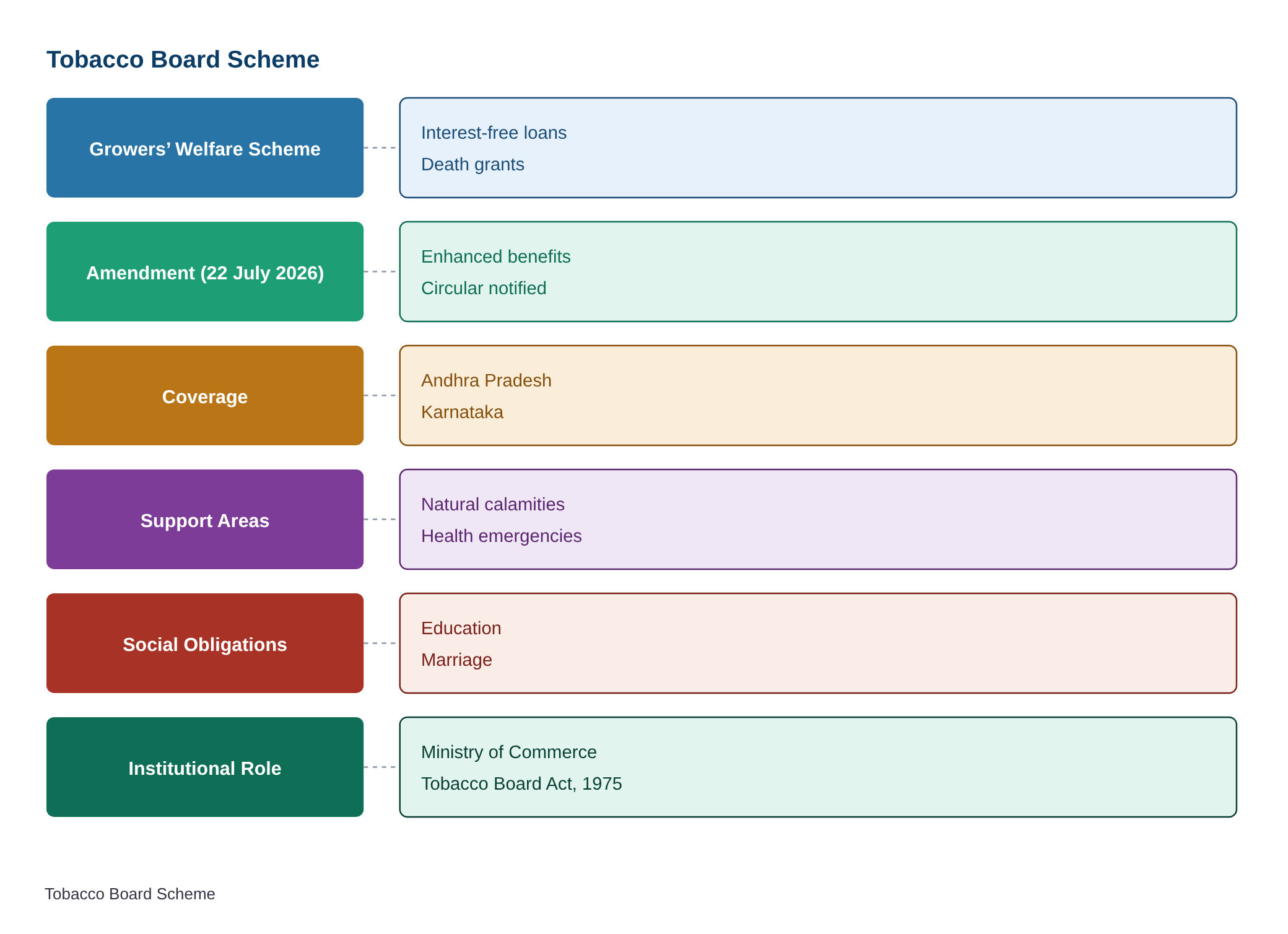
✎ The Tobacco Board’s Growers’ Welfare Scheme provides interest-free loans and death grants to registered tobacco growers, with recent enhancements in loan amounts and repayment schedules to address medical emergencies, education…
Subject Relevance — Where This Topic Fits
- GS Paper III — Agriculture | GS Paper III — Government Schemes for Development in various sectors
- Prelims: Tobacco Board, Growers’ Welfare Scheme, Interest-free loans, Agricultural credit, Social security schemes for farmers, National Agricultural Cooperative Marketing Federation of India (NAFED), Kisan Credit Card (KCC), Pradhan Mantri Fasal Bima Yojana (PMFBY)
- Essay: The role of institutional support in agricultural sustainability: A case study of tobacco growers in India, Balancing economic viability and social security in cash crop farming
Quick Revision: The Tobacco Board’s Growers’ Welfare Scheme provides interest-free loans and death grants to registered tobacco growers, with recent enhancements in loan amounts and repayment schedules to address medical emergencies, education, marriage, and infrastructure repair.
Why is this in the news?
The Tobacco Board has amended its Growers’ Welfare Scheme to enhance interest-free loans and death grants for registered tobacco growers in Andhra Pradesh and Karnataka. The amendments, notified via a circular dated 22 July 2026, reflect the Board’s proactive measures to address financial vulnerabilities among growers, particularly in the face of natural calamities, health emergencies, and social obligations such as education and marriage. This development is significant for UPSC aspirants as it intersects with broader themes of agricultural policy, social security, and institutional governance in India’s cash crop economy.
Background
- The Tobacco Board, established under the Tobacco Board Act, 1975, is a statutory body under the Ministry of Commerce and Industry, Government of India, tasked with the development of the tobacco industry and welfare of tobacco growers.
- Tobacco cultivation in India is predominantly concentrated in Andhra Pradesh and Karnataka, contributing significantly to the rural economy and employment in these states.
- Agricultural credit in India is provided through institutional mechanisms such as Kisan Credit Card (KCC) schemes, cooperative banks, and government-backed loan waivers, but sector-specific boards like the Tobacco Board play a pivotal role in addressing unique challenges faced by cash crop growers.
- The Growers’ Welfare Scheme is a social security initiative designed to mitigate financial distress among tobacco growers through interest-free loans and grants for medical emergencies, education, marriage, and infrastructure repair.
- Natural calamities such as cyclones, floods, and fires pose recurring threats to tobacco barns and crops, necessitating institutional support for recovery and resilience-building.
- The enhancement of benefits under the scheme aligns with the broader policy thrust of the Government of India to strengthen social security nets for farmers, as seen in schemes like PM-KISAN and PMFBY.
What is the Growers’ Welfare Scheme of the Tobacco Board?
- The Growers’ Welfare Scheme is a social security initiative implemented by the Tobacco Board to provide financial assistance to registered tobacco growers in the form of interest-free loans and grants.
- The scheme covers a range of contingencies, including medical treatment for major illnesses or accidents, marriage of daughters, education of dependent children, and repair of barns damaged by natural calamities or fire.
- Interest-free loans are provided without collateral, with repayment schedules structured to ease the financial burden on growers over a period of 3 to 5 years, depending on the purpose.
- Death grants are disbursed to the nominee of a registered grower in the event of natural or accidental death, providing immediate financial relief to the bereaved family.
- The Tobacco Board Act, 1975, empowers the Board to formulate and implement welfare schemes for tobacco growers, ensuring their socio-economic well-being and the sustainable growth of the tobacco industry.
- The scheme operates in coordination with regional managers and auction superintendents in tobacco-growing states, ensuring efficient disbursement and recovery of loans.
- The amendments to the scheme reflect a dynamic policy response to evolving challenges faced by tobacco growers, including climate-induced risks and socio-economic vulnerabilities.
Key Features
| Feature | Significance |
|---|---|
| Interest-free loans for medical treatment | Provides financial relief to tobacco growers facing high medical expenses, reducing out-of-pocket expenditure and preventing debt traps. |
| Enhanced marriage grant for daughters | Supports social security by easing financial burdens during traditional life-cycle events, promoting gender-sensitive welfare measures. |
| Education loan for dependent children | Encourages human capital formation by enabling growers’ families to invest in higher education, aligning with SDG 4 (Quality Education). |
| Barn repair assistance post-calamity | Mitigates economic losses from natural disasters, ensuring continuity of agricultural operations and livelihood protection. |
| Death grant enhancement | Strengthens social insurance by providing financial support to families in case of natural or accidental death, reducing vulnerability. |
Why it Matters
Economic
- Directly augments the income security of tobacco growers, a vulnerable segment of the agricultural workforce, by reducing liquidity constraints.
- Aligns with the objectives of the National Agricultural Policy to enhance farm income and resilience against shocks.
- Boosts rural demand by injecting liquidity into local economies, particularly in tobacco-growing districts of Andhra Pradesh and Karnataka.
Social
- Integrates gender-sensitive welfare measures through enhanced marriage grants for daughters, promoting financial inclusion of women in agricultural households.
- Expands access to healthcare and education, addressing intergenerational poverty and improving human development outcomes.
- Provides a safety net against unforeseen events (death, illness, disasters), reducing distress migration or asset liquidation.
Institutional
- Demonstrates the role of sector-specific statutory bodies (Tobacco Board) in implementing targeted welfare schemes for regulated agricultural commodities.
- Highlights the use of circulars and administrative notifications as tools for policy implementation and stakeholder communication.
- Showcases the integration of loan recovery schedules with income cycles, ensuring repayment feasibility without undue burden.
Policy Process
- Illustrates the amendment-driven evolution of welfare schemes, reflecting the dynamic nature of agricultural policy in response to ground realities.
- Emphasises the importance of periodic reviews and adjustments to welfare measures to maintain relevance and impact.
Challenges
1. Repayment Sustainability
- Risk of over-indebtedness if growers face repeated financial shocks despite enhanced loans, necessitating robust repayment monitoring.
- Recovery schedules assume stable income, which may not hold during crop failures or market price volatility.
UPSC Link: GS3: Agricultural Finance
2. Targeting and Leakage
- Ensuring that loans reach intended beneficiaries without diversion or misuse, particularly in regions with high informality.
- Verification of eligibility criteria (e.g., grower registration, income thresholds) requires efficient administrative infrastructure.
UPSC Link: GS2: Governance and Transparency
3. Climate Vulnerability
- Increased frequency of natural calamities (e.g., cyclones, droughts) may lead to repeated claims, straining the Board’s financial resources.
- Need for climate-resilient infrastructure (e.g., reinforced barns) alongside financial assistance to break the cycle of damage and repair.
UPSC Link: GS3: Disaster Management
4. Sectoral Sustainability
- Long-term viability of tobacco as a cash crop amid global health regulations and declining demand raises questions about the scheme’s scalability.
- Diversification incentives may need to be integrated to prevent over-reliance on a single commodity.
UPSC Link: GS3: Agricultural Diversification
5. Administrative Capacity
- Delays in disbursement or processing due to bureaucratic hurdles may erode the scheme’s effectiveness in times of urgent need.
- Training of field staff to handle claims, documentation, and recovery processes is critical for seamless implementation.
UPSC Link: GS2: Public Administration
Challenges — UPSC Perspective
| Issue | Concern |
|---|---|
| Repayment defaults | Potential strain on the Tobacco Board’s finances if growers face income shocks post-disbursement. |
| Eligibility verification | Risk of ineligible beneficiaries accessing loans due to weak monitoring mechanisms. |
| Climate-induced damage | Recurrent natural disasters may lead to unsustainable claims on the Board’s resources. |
| Sectoral decline | Long-term sustainability of tobacco farming may reduce the scheme’s relevance and coverage. |
| Administrative delays | Bureaucratic inefficiencies could delay loan disbursement during critical periods. |
Government Initiatives — Must-Memorise for Prelims
- Growers’ Welfare Scheme (Tobacco Board)
- National Agricultural Policy (supportive framework)
Way Forward
- Conduct periodic impact assessments of the enhanced loan scheme to evaluate its effectiveness in reducing distress and improving livelihoods.
- Strengthen climate-resilient infrastructure (e.g., cyclone-proof barns) alongside financial assistance to break the damage-repair cycle.
- Integrate financial literacy programs for growers to enhance repayment capacity and reduce default risks.
- Explore diversification incentives (e.g., alternative crops, allied activities) to reduce sectoral vulnerability.
- Enhance digitalisation of claim processing and disbursement to minimise delays and improve transparency.
- Collaborate with state agencies to streamline eligibility verification and reduce administrative bottlenecks.
- Align the scheme with broader agricultural insurance frameworks (e.g., PMFBY) to provide layered protection against risks.
- Monitor global tobacco market trends to assess the long-term viability of the scheme and adjust policies accordingly.
UPSC Value Addition
Keywords for Mains Answer-Writing
Tobacco Board · Growers’ Welfare Scheme · interest-free loans · agricultural credit · rural welfare schemes · agricultural cooperatives · farmers’ welfare · institutional credit · agricultural infrastructure · rural development · agricultural subsidies · crop insurance · agricultural extension services · regulatory bodies in agriculture · agricultural cooperatives in India
Concept Flow
Tobacco Board’s statutory mandate to regulate and promote the tobacco sector → Identification of welfare gaps for growers → Amendment of Growers’ Welfare Scheme → Enhancement of interest-free loans and grants → Disbursement to eligible growers → Repayment and recovery as per schedules → Reinvestment of recovered funds into scheme sustainability → Feedback loop for future amendments.
Prelims Practice Questions
Q1. Consider the following statements regarding the Tobacco Board of India:
1. It is a statutory body established under the Tobacco Board Act, 1975.
2. It functions under the administrative control of the Ministry of Agriculture and Farmers’ Welfare.
3. The Board provides financial assistance to tobacco growers through interest-free loans under the Growers’ Welfare Scheme.
How many of the above statements are correct?
- Only one
- Only two
- All
- None
Answer: All — Statement 1 is correct as the Tobacco Board is a statutory body under the Tobacco Board Act, 1975. Statement 2 is incorrect as the Board functions under the Ministry of Commerce and Industry, not the Ministry of Agriculture. Statement 3 is correct as the Board provides interest-free loans to tobacco growers under its welfare schemes.
Q2. Assertion (A): The Tobacco Board’s Growers’ Welfare Scheme includes provisions for interest-free loans to repair barns damaged by natural calamities.
Reason (R): The scheme aims to mitigate the financial burden on tobacco growers due to crop and infrastructure losses.
Options:
A. Both A and R are true, and R is the correct explanation of A.
B. Both A and R are true, but R is not the correct explanation of A.
C. A is true, but R is false.
D. A is false, but R is true.
Answer: ? — Assertion (A) is true as the scheme explicitly includes provisions for interest-free loans to repair barns damaged by natural calamities. Reason (R) is also true and correctly explains the assertion, as the scheme is designed to alleviate financial distress among growers due to such losses.
Q3. Match the following columns related to the Tobacco Board’s Growers’ Welfare Scheme:
Column I (Purpose of Loan)
1. Medical treatment for major illness
2. Marriage of daughters
3. Repair of barns (partial damage)
4. Education of dependent children
Column II (Loan Amount)
A. ₹40,000
B. ₹1,00,000
C. ₹50,000
D. ₹20,000
Options:
1. 1-B, 2-B, 3-A, 4-B
2. 1-A, 2-B, 3-D, 4-C
3. 1-C, 2-A, 3-D, 4-B
4. 1-B, 2-A, 3-C, 4-D
- 1
- 2
- 3
- 4
Answer: 1 — The correct match is: 1-B (Medical treatment for major illness: ₹1,00,000), 2-B (Marriage of daughters: ₹1,00,000), 3-A (Repair of barns partial damage: ₹40,000), 4-B (Education of dependent children: ₹1,00,000).
Mains Practice Question
✍ Critically analyse the role of statutory regulatory bodies in agriculture with reference to the Tobacco Board’s Growers’ Welfare Scheme. How does the enhancement of interest-free loans under the scheme address the socio-economic vulnerabilities of tobacco growers? (15 Marks)
Approach: MODEL-ANSWER SKELETON:
1. **Introduction (2 marks)**
– Define statutory regulatory bodies in agriculture (e.g., Tobacco Board, Coffee Board, Tea Board) as institutions established by Parliament to regulate, promote, and support specific agricultural commodities.
– Highlight their dual role: regulatory oversight and welfare provision to farmers.
2. **Tobacco Board: Structure and Mandate (3 marks)**
– Statutory basis: Tobacco Board Act, 1975; administrative control under Ministry of Commerce and Industry.
– Functions: Promotion of tobacco cultivation, quality control, export promotion, and welfare schemes for growers.
– Composition: Representation from growers, traders, and government.
3. **Growers’ Welfare Scheme: Key Features and Enhancements (4 marks)**
– Purpose: Mitigate financial distress among tobacco growers due to health emergencies, education costs, and infrastructure damage.
– Components of the scheme: Interest-free loans for medical treatment, marriage, education, and barn repairs; death grants.
– Recent enhancements (July 2026): Doubling of loan amounts (e.g., medical treatment from ₹50,000 to ₹1,00,000) and death grants (natural death from ₹50,000 to ₹1,00,000).
– Recovery mechanisms: Instalment schedules aligned with growers’ cash flows (e.g., 5-year recovery for education loans).
4. **Addressing Socio-Economic Vulnerabilities (3 marks)**
– **Healthcare**: High medical costs for major illnesses or accidents can push farmers into debt; interest-free loans reduce financial burden.
– **Education**: Rising costs of education for dependent children; loans enable access to quality education without liquidating assets.
– **Infrastructure**: Natural calamities (e.g., cyclones, fires) damage barns; loans for repairs ensure continuity of production.
– **Social Security**: Death grants provide financial support to families in case of untimely demise.
5. **Challenges and Limitations (2 marks)**
– **Eligibility and Coverage**: Scheme benefits are limited to registered tobacco growers; excludes landless labourers or marginal farmers in other crops.
– **Repayment Burden**: Despite interest-free loans, repayment schedules may strain growers with unstable incomes.
– **Sustainability**: Reliance on government funding; long-term viability depends on budgetary allocations.
6. **Conclusion (1 mark)**
– The Tobacco Board’s welfare scheme exemplifies how statutory bodies can integrate welfare measures with agricultural regulation.
– While the enhancements are a positive step, broader coverage and income stabilization measures (e.g., crop insurance) are needed to address systemic vulnerabilities.
Source: The Hindu
Generated by AanyaAi for educational purpose.

- मद्रास उच्च न्यायालय में ‘वेट्ट्री पयणम’ योजना को असंवैधानिक घोषित करने की मांग - October 4, 2026
- Gurugram’s groundwater extraction exceeds limit by 212%; HC seeks ban - October 4, 2026
- स्वतंत्रता सेनानी श्यामजी कृष्ण वर्मा की जन्म जयंती पर पीएम का श्रद्धांजलि - October 4, 2026

No Comments