


18 Aug Tobacco Board Boosts Interest-Free Loans Under Growers’ Welfare Scheme
✎ The Growers’ Welfare Scheme of the Tobacco Board provides interest-free loans and death grants to tobacco growers, with recent enhancements in loan amounts and repayment schedules to address agricultural and socio-economic risks.
Subject Relevance — Where This Topic Fits
- GS Paper III — Agriculture and Allied Activities | GS Paper III — Government Budgeting and Financial Inclusion | GS Paper III — Social Sector Initiatives and Welfare Schemes
- Prelims: Tobacco Board, Growers’ Welfare Scheme, interest-free loans, agricultural risk mitigation, financial inclusion in agriculture, crop insurance, agricultural cooperatives
- Essay: The role of institutional mechanisms in mitigating agricultural risks and ensuring farmer welfare, Balancing agricultural productivity with social security in cash crop economies
Quick Revision: The Growers’ Welfare Scheme of the Tobacco Board provides interest-free loans and death grants to tobacco growers, with recent enhancements in loan amounts and repayment schedules to address agricultural and socio-economic risks.
Why is this in the news?
The Tobacco Board’s decision to enhance interest-free loans and death grants under the Growers’ Welfare Scheme, as notified in a circular dated July 22, 2026, underscores the evolving governance framework for addressing the vulnerabilities of tobacco growers in India. This amendment reflects a targeted intervention in agricultural risk mitigation and social security, particularly in the context of climate-induced vulnerabilities and socio-economic challenges faced by small and marginal farmers in tobacco-growing regions such as Andhra Pradesh and Karnataka. The enhancements are significant for aspirants as they illustrate the operationalisation of welfare schemes through institutional mechanisms, with implications for financial inclusion, agricultural sustainability, and policy design.
Background
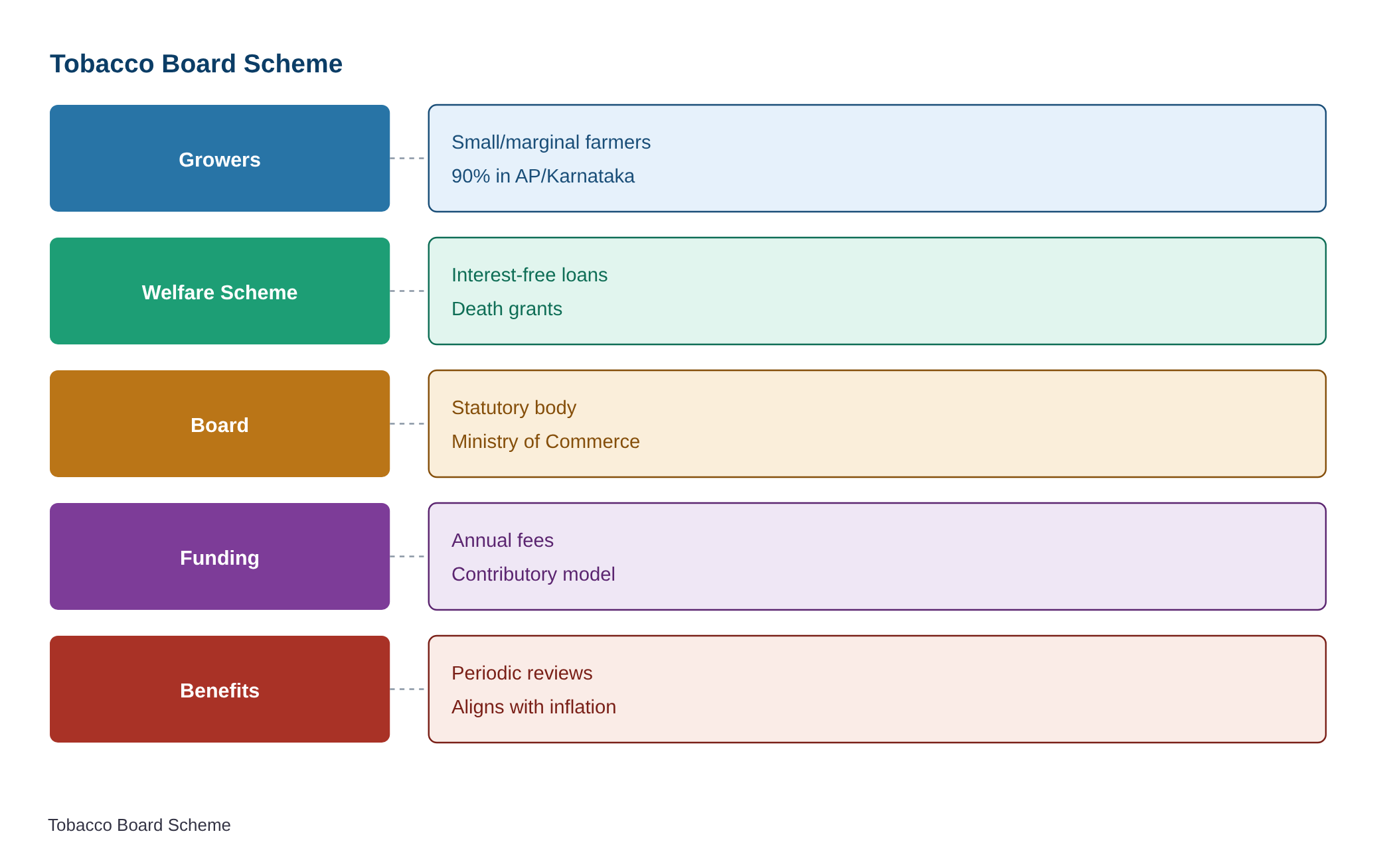
- The Tobacco Board, established under the Tobacco Board Act, 1975, is a statutory body under the Ministry of Commerce and Industry, Government of India, tasked with the development of the tobacco industry and the welfare of tobacco growers.
- Tobacco cultivation in India is predominantly undertaken by small and marginal farmers, with Andhra Pradesh and Karnataka accounting for over 90% of the country’s total production.
- The Growers’ Welfare Scheme is a flagship programme of the Tobacco Board, designed to provide financial and social security to tobacco growers through interest-free loans, grants, and insurance-like mechanisms.
- Agricultural risks in tobacco cultivation include natural calamities (e.g., cyclones, floods), fire hazards in curing barns, and socio-economic vulnerabilities such as medical emergencies and educational expenses.
- The scheme operates on a contributory model, where registered members pay an annual fee, and the Board disburses benefits based on predefined criteria and amendments.
- The enhancement of benefits follows a pattern of periodic reviews to align with inflation, changing socio-economic conditions, and the evolving risk profile of tobacco growers.
What is the Growers’ Welfare Scheme of the Tobacco Board?
- The Growers’ Welfare Scheme is a welfare-oriented financial assistance programme administered by the Tobacco Board to mitigate risks and provide social security to tobacco growers and their families.
- The scheme provides interest-free loans for specific purposes, including medical treatment, marriage of daughters, education of dependent children, and repair of damaged barns, thereby addressing both health and economic vulnerabilities.
- The scheme also includes a death grant, payable to the nominee of a registered grower in cases of natural or accidental death, functioning as a form of life insurance for the farming community.
- The loans are repaid in structured instalments over a fixed period, ensuring financial discipline while providing immediate liquidity to growers in need.
- The scheme operates on a contributory basis, with registered members paying an annual fee, which has recently been revised from ₹500 to ₹1,325 to sustain the enhanced benefits and administrative costs.
- The Tobacco Board Act, 1975, empowers the Board to formulate and implement such welfare schemes, subject to periodic amendments to reflect changing needs and economic realities.
- The scheme is implemented through a network of Regional Managers and Auction Superintendents, who oversee disbursement, recovery, and grievance redressal at the grassroots level.
- The recent amendments reflect a broader trend in agricultural governance, where statutory bodies are leveraging financial instruments to enhance resilience and social protection in cash crop economies.
Key Features
| Feature | Significance |
|---|---|
| Interest-free loans for medical treatment | Enhances financial accessibility for growers facing health emergencies, reducing out-of-pocket expenditure and improving welfare outcomes. |
| Interest-free loans for education and marriage | Supports socio-economic mobility by easing financial burdens on growers’ families for long-term human capital development. |
| Enhanced death grants (natural/accidental) | Provides financial security to families of deceased growers, mitigating economic vulnerability and ensuring dignity. |
| Increased loan amounts for barn repairs | Addresses infrastructure resilience against natural calamities, safeguarding livelihoods and productivity in tobacco cultivation. |
| Revised recovery schedules and instalments | Balances immediate relief with long-term repayment feasibility, ensuring sustainability of the welfare scheme. |
Why it Matters
Economic Significance
- Directly augments the income security of tobacco growers, a vulnerable agrarian community, by reducing financial stress in critical life events.
- Stimulates rural demand through increased liquidity, potentially boosting allied sectors such as healthcare, education, and construction.
- Enhances the viability of tobacco farming by mitigating risks from natural disasters and health emergencies, ensuring continuity of production.
Social Significance
- Promotes inclusive growth by addressing gender-specific needs (e.g., marriage of daughters) and intergenerational equity (education support).
- Reduces distress migration by providing financial safety nets, thereby preserving rural livelihoods and community structures.
- Strengthens social security nets for agrarian households, aligning with broader welfare objectives of the National Rural Livelihood Mission (NRLM).
Institutional Significance
- Demonstrates adaptive governance by the Tobacco Board through periodic reviews and amendments to welfare schemes, ensuring relevance and responsiveness.
- Highlights the role of statutory bodies in regulating and supporting primary producers, particularly in high-risk agricultural sectors.
- Sets a precedent for other commodity boards (e.g., Coffee Board, Tea Board) to emulate similar welfare interventions for growers.
Policy Relevance
- Aligns with the constitutional directive of Article 41 (Right to Public Assistance) by providing social security measures for economically weaker sections.
- Supports the objectives of the National Policy for Farmers (2007) by enhancing income security and reducing vulnerability in agriculture.
- Complements the Pradhan Mantri Fasal Bima Yojana (PMFBY) by addressing post-disaster financial needs beyond crop insurance coverage.
Challenges
1. Implementation Gaps
- Risk of exclusion errors due to stringent eligibility criteria or lack of awareness among marginalised growers, particularly in remote regions.
- Potential delays in disbursement of loans and grants, undermining the timeliness of financial relief during emergencies.
- Administrative burden on the Tobacco Board to verify claims and monitor repayments, especially with increased loan amounts and recovery schedules.
UPSC Link: GS-III: Public Distribution System
2. Sustainability Concerns
- Long-term financial viability of the scheme may be compromised if recovery rates are low or if the Tobacco Board faces funding constraints.
- Over-reliance on interest-free loans may discourage growers from exploring alternative livelihoods or diversifying crops, exacerbating monoculture risks.
- Environmental sustainability concerns arise if enhanced financial support inadvertently encourages unsustainable tobacco cultivation practices.
UPSC Link: GS-III: Agricultural Marketing
3. Equity and Accessibility
- Growers in less developed regions (e.g., tribal areas) may face barriers in accessing scheme benefits due to infrastructure deficits or bureaucratic hurdles.
- Gender disparities may persist if women growers or their families are less likely to utilise loans for education or healthcare due to socio-cultural norms.
- Digital divide could limit awareness dissemination, particularly for small and marginal growers who lack access to digital platforms.
UPSC Link: GS-II: Welfare Schemes for Vulnerable Sections
Challenges — UPSC Perspective
| Issue | Concern |
|---|---|
| Eligibility verification | Risk of incorrect exclusions or inclusions, leading to either leakage of benefits or denial of support to deserving growers. |
| Disbursement timelines | Delays in loan/grant distribution may render financial aid ineffective during urgent crises (e.g., medical emergencies). |
| Repayment compliance | Low recovery rates could strain the Tobacco Board’s financial resources, jeopardising future welfare initiatives. |
| Awareness and outreach | Inadequate dissemination of scheme details may result in low participation, particularly among small and marginal growers. |
| Environmental impact | Increased financial support for tobacco farming may inadvertently discourage diversification or adoption of sustainable practices. |
Government Initiatives — Must-Memorise for Prelims
- Growers’ Welfare Scheme (Tobacco Board)
Way Forward
- Conduct targeted awareness campaigns in regional languages to ensure all eligible growers are informed about the enhanced benefits and application processes.
- Streamline the verification and disbursement process by leveraging digital tools (e.g., Aadhaar-linked databases) to reduce delays and human errors.
- Introduce a grievance redressal mechanism with dedicated helplines or portals to address delays, rejections, or disputes in real time.
- Pilot a supplementary livelihood diversification programme to encourage growers to explore alternative crops or allied activities, reducing monoculture risks.
- Strengthen monitoring and evaluation by publishing annual reports on scheme performance, including recovery rates, beneficiary profiles, and impact assessments.
- Collaborate with local self-help groups (SHGs) and cooperatives to enhance grassroots outreach and ensure equitable access to benefits.
- Integrate environmental safeguards into the scheme, such as incentives for adopting sustainable farming practices or penalties for non-compliance with regulations.
UPSC Value Addition
Keywords for Mains Answer-Writing
Tobacco Board of India · Growers’ Welfare Scheme · Interest-free loans · Agricultural credit schemes · Farmers’ welfare · Natural calamity relief · Death grant under welfare schemes · Agricultural cooperatives · Agricultural marketing boards · Farmers’ distress mitigation
Constitutional & Policy Linkages
- Article 41 (Right to Public Assistance in Certain Cases) – Directive Principle of State Policy
Concept Flow
Tobacco cultivation faces economic vulnerabilities → Tobacco Board introduces Growers’ Welfare Scheme → Scheme provides interest-free loans and grants → Enhanced benefits announced (July 2026) → Increased loan amounts and death grants → Revised repayment schedules introduced → Potential challenges in implementation and sustainability → Way forward includes streamlining processes and promoting diversification.
Prelims Practice Questions
Q1. Consider the following statements regarding the Growers’ Welfare Scheme of the Tobacco Board:
1. The scheme provides interest-free loans for medical treatment, marriage of daughters, and education of dependent children.
2. The death grant for natural death has been enhanced from ₹50,000 to ₹1,00,000.
3. Loans for repair of barns damaged by natural calamity are repayable in a single instalment.
How many of the above statements are correct?
- Only one
- Only two
- All
- None
Answer: Only two — Statement 1 and 2 are correct as per the scheme details. Statement 3 is incorrect because loans for barn repairs are repayable in instalments (e.g., ₹10,000 each in the first and second years, and ₹20,000 in the third year for partial damage).
Q2. Assertion (A): The Tobacco Board’s Growers’ Welfare Scheme includes a death grant for growers.
Reason (R): The scheme aims to provide financial support to tobacco growers in case of death, including natural and accidental deaths.
Options:
A. Both A and R are true, and R is the correct explanation of A.
B. Both A and R are true, but R is not the correct explanation of A.
C. A is true, but R is false.
D. A is false, but R is true.
Answer: ? — Both A and R are true, and R correctly explains A as the death grant is explicitly mentioned as part of the scheme’s welfare measures for growers.
Q3. Match the following loan purposes under the Growers’ Welfare Scheme with their respective maximum loan amounts:
Column I (Purpose) | Column II (Maximum Loan Amount)
— | —
A. Medical treatment for major illness | 1. ₹1,00,000
B. Marriage of daughters | 2. ₹1,00,000
C. Partial damage to barns due to natural calamity | 3. ₹40,000
D. Full damage to barns due to fire | 4. ₹1,00,000
Options:
A. A-1, B-2, C-3, D-4
B. A-2, B-1, C-3, D-4
C. A-4, B-2, C-1, D-3
D. A-1, B-2, C-4, D-3
Answer: ? — The correct matching is: A-2 (₹1,00,000 for medical treatment), B-1 (₹1,00,000 for marriage of daughters), C-3 (₹40,000 for partial barn damage), and D-4 (₹1,00,000 for full barn damage).
Mains Practice Question
✍ The Tobacco Board of India has recently enhanced the financial support measures under its Growers’ Welfare Scheme, including interest-free loans and death grants. Critically examine the significance of such welfare schemes in mitigating farmers’ distress, particularly in the context of agricultural cooperatives and marketing boards. (15 Marks)
Approach: MODEL-ANSWER SKELETON:
1. **Introduction**: Define the Tobacco Board of India and its statutory role under the Tobacco Board Act, 1975. Briefly outline the Growers’ Welfare Scheme and the recent enhancements (interest-free loans, death grants, and instalment schedules).
2. **Role of Agricultural Cooperatives and Marketing Boards**:
– Explain the constitutional and legal framework supporting agricultural cooperatives (e.g., 97th Constitutional Amendment Act, 2011; Multi-State Cooperative Societies Act, 2002).
– Discuss the functions of marketing boards like the Tobacco Board in stabilising farmers’ income, ensuring fair prices, and providing credit support.
– Highlight the limitations of such boards in addressing structural issues like price volatility, climate vulnerability, and market access.
3. **Significance of Welfare Schemes in Mitigating Farmers’ Distress**:
– **Financial Inclusion**: Analyse how interest-free loans and grants reduce debt burdens and provide liquidity for emergencies (medical, education, marriage).
– **Risk Mitigation**: Examine the role of death grants in providing social security to farming families, particularly in cases of accidental or natural deaths.
– **Infrastructure Support**: Discuss the importance of loans for repairing barns damaged by natural calamities or fire in ensuring continuity of agricultural operations.
– **Comparative Advantage**: Contrast these measures with other government schemes (e.g., PM-KISAN, PMFBY) to highlight their targeted approach.
4. **Challenges and Limitations**:
– **Sustainability**: Evaluate the financial viability of such schemes, especially with the recent increase in annual membership fees from ₹500 to ₹1,325.
– **Reach and Inclusion**: Discuss potential gaps in coverage, such as exclusion of tenant farmers or smallholders, and the need for inclusive policies.
– **Market Dependence**: Critique the over-reliance on tobacco as a cash crop, which may not align with diversification goals for sustainable agriculture.
5. **Conclusion**: Summarise the importance of targeted welfare measures in agricultural cooperatives while advocating for a multi-pronged approach that includes market reforms, climate-resilient agriculture, and broader social security nets. Suggest measures to enhance the efficacy of such schemes, such as integrating them with existing PM-KISAN or PMFBY frameworks.
Source: The Hindu
Generated by AanyaAi for educational purpose.

- मद्रास उच्च न्यायालय में ‘वेट्ट्री पयणम’ योजना को असंवैधानिक घोषित करने की मांग - October 4, 2026
- Gurugram’s groundwater extraction exceeds limit by 212%; HC seeks ban - October 4, 2026
- स्वतंत्रता सेनानी श्यामजी कृष्ण वर्मा की जन्म जयंती पर पीएम का श्रद्धांजलि - October 4, 2026

No Comments