


10 Nov Transgender Persons Act: SC Plea on Gender Identity vs Sex
✎ The ongoing Supreme Court plea challenges provisions of the Transgender Persons Act, 2019, concerning gender identity recognition, potentially re-examining the distinction between biological sex and self-identified gender, a…
Subject Relevance — Where This Topic Fits
- GS Paper II — Governance, Constitution, Polity, Social Justice
- Prelims: Transgender Persons (Protection of Rights) Act, 2019, NALSA v. Union of India (2014), Gender identity, Biological sex, Articles 15, 16, 21 of the Constitution, Sex reassignment surgery (SRS)
- Essay: The evolving landscape of rights and identity in a modern democracy, Balancing individual autonomy with collective rights: A constitutional perspective
Quick Revision: The ongoing Supreme Court plea challenges provisions of the Transgender Persons Act, 2019, concerning gender identity recognition, potentially re-examining the distinction between biological sex and self-identified gender, a matter previously addressed in the NALSA judgment.
Why is this in the news?
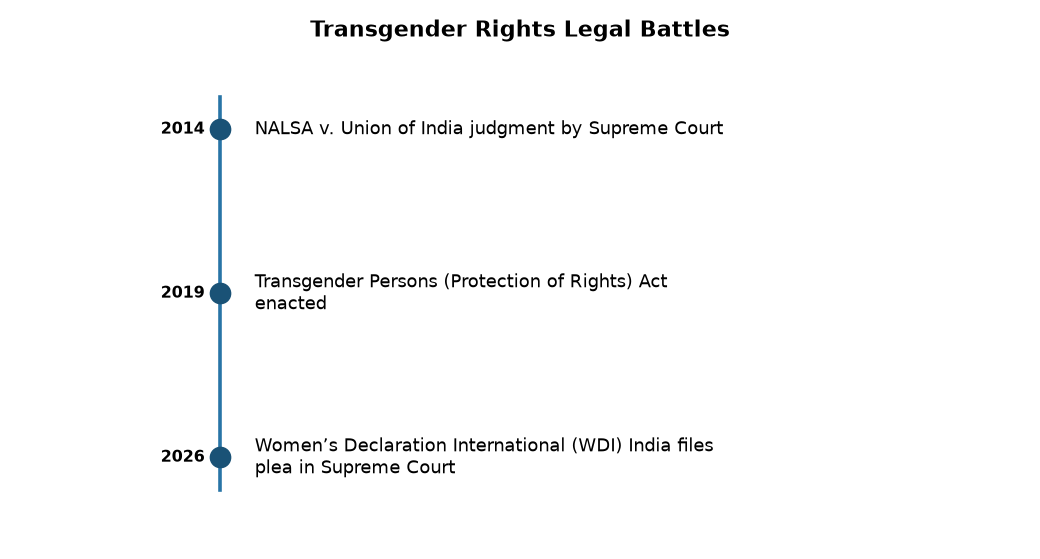
A recent plea filed in the Supreme Court of India by the India chapter of Women’s Declaration International (WDI) challenges specific provisions of the Transgender Persons (Protection of Rights) Act, 2019, and its associated rules. The petition argues that allowing individuals to obtain official documents recognising a gender different from their biological sex at birth could potentially impact protections and benefits specifically designated for women, thereby seeking a re-examination of the distinction between gender identity and biological sex, a matter previously addressed by the Supreme Court in the landmark NALSA judgment.
Background
- The Supreme Court of India delivered a pivotal judgment in NALSA v. Union of India in 2014, recognising the rights of transgender persons to self-identify their gender.
- This judgment affirmed that discrimination on the ground of ‘sex’ under Articles 15 and 16 of the Constitution includes discrimination based on gender identity.
- The NALSA judgment explicitly stated that an individual’s own understanding of their gender should be given primacy, and that no person should be compelled to undergo medical procedures like sex reassignment surgery (SRS), sterilisation, or hormonal therapy for legal recognition of their gender identity.
- Following the NALSA judgment, the Transgender Persons (Protection of Rights) Act, 2019, was enacted to provide for the protection of rights of transgender persons and their welfare.
- The Act includes provisions for obtaining a certificate of identity as a transgender person and allowing for a change in gender certificate.
- The current plea specifically challenges Section 7 of the Transgender Persons (Protection of Rights) Act, 2019, and Rule 7 of the Transgender Persons (Protection of Rights) Rules, which pertain to the process of obtaining and changing gender certificates.
- The petitioners contend that the provisions allowing for a change in gender certificate based on self-identification, without necessarily aligning with biological sex, could dilute the concept of ‘woman’ for legal and social protections.
The Transgender Persons (Protection of Rights) Act, 2019 and related legal concepts
- The Transgender Persons (Protection of Rights) Act, 2019, aims to prohibit discrimination against transgender persons in various spheres, including education, employment, healthcare, and access to public services.
- It defines a ‘transgender person’ as one whose gender does not match the gender assigned at birth, including trans-men and trans-women, persons with intersex variations, and gender-queer persons.
- The Act mandates the establishment of a National Council for Transgender Persons (NCTP) to advise the government on policies and programmes for transgender individuals.
- A key provision of the Act is the right to self-perceived gender identity, allowing individuals to obtain a certificate of identity as a transgender person from the District Magistrate.
- The Act also provides for the right to reside in one’s household and prohibits discrimination in employment, education, and healthcare.
- The NALSA v. Union of India (2014) judgment recognised gender identity as fundamental to dignity and self-determination, protected under Article 21 of the Constitution.
- The judgment distinguished between ‘biological sex’ (based on physical attributes like genitals, chromosomes) and ‘gender identity’ (an individual’s internal sense of being male, female, both, or neither).
- Articles 15 and 16 of the Constitution prohibit discrimination on grounds of religion, race, caste, sex, or place of birth, with the NALSA judgment expanding ‘sex’ to include gender identity.
Key Features
| Feature | Significance |
|---|---|
| Transgender Persons (Protection of Rights) Act, 2019 | Legislative framework for the protection of rights of transgender individuals, including legal recognition of gender identity. |
| Section 7 of the Transgender Persons Act | Allows a person to obtain official documents recognising a gender different from the one assigned at birth. |
| Rule 7 of the Transgender Rules | Governs the procedural aspects for obtaining a gender change certificate. |
| NALSA v. Union of India (2014) Judgment | Landmark Supreme Court ruling recognising gender identity as distinct from biological sex and affirming the right to self-determination of gender. |
| Distinction between Biological Sex and Gender Identity | Biological sex refers to physical characteristics, while gender identity is an individual’s internal sense of self, irrespective of biological attributes. |
Why it Matters
Social Justice and Inclusion
- The legal recognition of gender identity is crucial for the social inclusion and dignity of transgender persons, aligning with principles of equality and non-discrimination.
- It addresses historical marginalisation and discrimination faced by the transgender community, promoting their integration into mainstream society.
Legal and Constitutional Implications
- The ongoing legal challenge necessitates a re-examination of fundamental rights, particularly Article 14 (equality before law), Article 15 (prohibition of discrimination), Article 16 (equality of opportunity in public employment), and Article 21 (protection of life and personal liberty).
- It impacts the interpretation and application of existing laws and policies designed to protect specific gender categories, potentially leading to legal ambiguities or conflicts.
Human Rights Perspective
- The right to self-determination of gender identity is a recognised human right, essential for personal autonomy and dignity.
- The debate underscores the importance of aligning national legislation with international human rights standards concerning gender identity and expression.
Challenges
1. Balancing Rights and Protections
- The primary challenge involves reconciling the rights of transgender individuals to self-identify their gender with existing sex-based protections and benefits specifically designed for women.
- Ensuring that the expansion of gender identity rights does not inadvertently dilute or undermine the historical and structural protections afforded to biological women.
UPSC Link: Social Justice; Vulnerable Sections
2. Legal Interpretation and Clarity
- The Supreme Court’s NALSA judgment established a clear distinction between biological sex and gender identity, but subsequent legislative and judicial interpretations require consistent application.
- Achieving legal clarity on the definitions and implications of ‘sex’ and ‘gender’ in various legal contexts to prevent ambiguity and ensure uniform application of laws.
UPSC Link: Indian Constitution; Judiciary
3. Societal Acceptance and Awareness
- Overcoming societal prejudices and lack of understanding regarding gender identity and transgender rights remains a significant challenge.
- Promoting public awareness and education to foster a more inclusive and accepting environment for all gender identities.
UPSC Link: Social Issues; Human Values
4. Implementation of Legal Frameworks
- Effective implementation of the Transgender Persons (Protection of Rights) Act, 2019, and associated rules requires robust administrative mechanisms and sensitisation of authorities.
- Addressing practical difficulties in obtaining gender identity certificates and ensuring non-discriminatory access to public services and facilities.
UPSC Link: Governance; Policy Implementation
Challenges — UPSC Perspective
| Issue | Concern |
|---|---|
| Gender Identity vs. Biological Sex | The potential impact of self-identified gender on sex-based rights and protections traditionally reserved for biological women. |
| Interpretation of NALSA Judgment | Ensuring consistent application of the NALSA ruling that recognised gender identity as distinct from biological sex, without requiring medical procedures. |
| Legal Recognition Process | The procedural aspects of obtaining gender change certificates under the Transgender Persons Act and Rules, and their alignment with constitutional principles. |
| Protection of Women’s Rights | Concerns that allowing self-identification of gender could dilute or compromise safeguards and provisions specifically enacted for the benefit of women. |
Way Forward
- Promote comprehensive public education campaigns to enhance understanding of gender identity and foster social acceptance.
- Ensure robust implementation of the Transgender Persons (Protection of Rights) Act, 2019, with clear guidelines for authorities.
- Conduct thorough legal reviews to harmonise existing laws and policies concerning sex-based rights with the recognition of gender identity.
- Facilitate inclusive dialogues among all stakeholders, including women’s rights advocates and transgender community representatives, to address concerns collaboratively.
- Strengthen judicial mechanisms to provide clear interpretations and consistent application of constitutional principles regarding gender identity.
- Invest in research to better understand the socio-economic impacts of gender identity recognition on various segments of society.
UPSC Value Addition
Keywords for Mains Answer-Writing
Transgender Persons (Protection of Rights) Act 2019 · NALSA v. Union of India 2014 · Gender Identity · Biological Sex · Articles 15 and 16 · Article 21 · Sex-based rights · Self-determination of gender · Legal recognition of gender · Constitutional morality
Constitutional & Policy Linkages
- Article 14: Equality before law and equal protection of laws.
- Article 15: Prohibition of discrimination on grounds of sex, including gender identity.
- Article 16: Equality of opportunity in matters of public employment.
- Article 21: Protection of life and personal liberty, encompassing dignity and self-determination.
Concept Flow
NALSA judgment (2014) recognises gender identity as distinct from biological sex. → Transgender Persons (Protection of Rights) Act, 2019, legislates gender identity recognition. → New plea challenges provisions of the Act and Rules in Supreme Court. → Plea argues potential impact on sex-based rights for women. → Supreme Court to re-examine the balance between gender identity rights and existing protections.
Prelims Practice Questions
Q1. Consider the following statements regarding the NALSA v. Union of India (2014) judgment:
1. The Supreme Court recognised the right of transgender persons to determine their gender identity.
2. The judgment mandated Sex Reassignment Surgery (SRS) as a prerequisite for legal recognition of gender identity.
3. It held that discrimination on the ground of sex under Articles 15 and 16 includes discrimination based on gender identity.
How many of the above statements are correct?
- Only one
- Only two
- Only three
- None
Answer: Only two — Statement 1 is correct: The NALSA judgment explicitly recognised the right of transgender persons to self-determine their gender identity. Statement 2 is incorrect: The judgment explicitly stated that no one shall be forced to undergo medical procedures, including SRS, for legal recognition of their gender identity. Statement 3 is correct: The court clarified that ‘sex’ under Articles 15 and 16 encompasses both biological attributes and gender identity, thereby extending protection against discrimination based on gender identity.
Q2. Which of the following Articles of the Indian Constitution were invoked by the Supreme Court in the NALSA v. Union of India (2014) judgment to uphold the rights of transgender persons?
- Articles 14, 19, and 21
- Articles 15, 16, and 21
- Articles 17, 20, and 22
- Articles 25, 26, and 29
Answer: Articles 15, 16, and 21 — The NALSA judgment primarily relied on Articles 14 (equality before law), 15 (prohibition of discrimination on grounds of religion, race, caste, sex or place of birth), 16 (equality of opportunity in matters of public employment), and 21 (protection of life and personal liberty) to affirm the rights of transgender persons, specifically mentioning that discrimination on the ground of sex includes discrimination based on gender identity.
Mains Practice Question
✍ The Supreme Court’s NALSA judgment (2014) distinguished between biological sex and gender identity, affirming the right to self-determination of gender. Critically examine the implications of this distinction for existing sex-based rights and protections, particularly in the context of the Transgender Persons (Protection of Rights) Act, 2019. (15 Marks)
Approach: Introduction: Briefly introduce the NALSA v. Union of India (2014) judgment and its recognition of gender identity as distinct from biological sex, anchoring it in Articles 14, 15, 16, and 21.
Body Paragraph 1: Explain the core tenets of the NALSA judgment, including the right to self-determination of gender and the rejection of mandatory medical procedures for legal recognition.
Body Paragraph 2: Discuss the provisions of the Transgender Persons (Protection of Rights) Act, 2019, that allow for change in gender certificate and how they align with or diverge from the NALSA principles. Mention Section 7 and Rule 7.
Body Paragraph 3: Critically examine the implications of this distinction for ‘sex-based rights’ and protections, particularly those historically designed for women. Discuss arguments related to potential impacts on spaces, reservations, and benefits.
Body Paragraph 4: Present counter-arguments or a nuanced perspective, emphasising the constitutional imperative of non-discrimination and dignity for all individuals, as upheld in NALSA.
Conclusion: Offer a balanced conclusion on the ongoing legal and societal debate, highlighting the need for a framework that respects both gender identity and existing protections, potentially through further judicial interpretation or legislative refinement.
Source: The Indian Express
Generated by AanyaAi for educational purpose.
Related guides on our sites
- Best sociology optional coaching for upsc
- Which is best sociology optional coaching for upsc
- Best teacher of sociology optional for upsc
- How to prepare for GS paper 1 for UPSC CSE mains exam

- Transgender Persons Act: SC Plea on Gender Identity vs Sex - November 10, 2026
- नेपाल में बाढ़: प्रमुख कार्बन उत्सर्जकों पर मुकदमा चलाने की संभावना - November 10, 2026
- CWP Indian Regional Unit Meet in Bengaluru: Key Discussions - November 9, 2026

No Comments