


06 Aug Tribal Land Rights & Project Consent: Constitutional & Legal Provisions for UPSC
✎ Tribal land rights in developmental projects are safeguarded under the FRA (2006), PESA (1996), and the Forest (Conservation) Act (1980), with Gram Sabha consent and central government approvals acting as critical checks against…
Subject Relevance — Where This Topic Fits
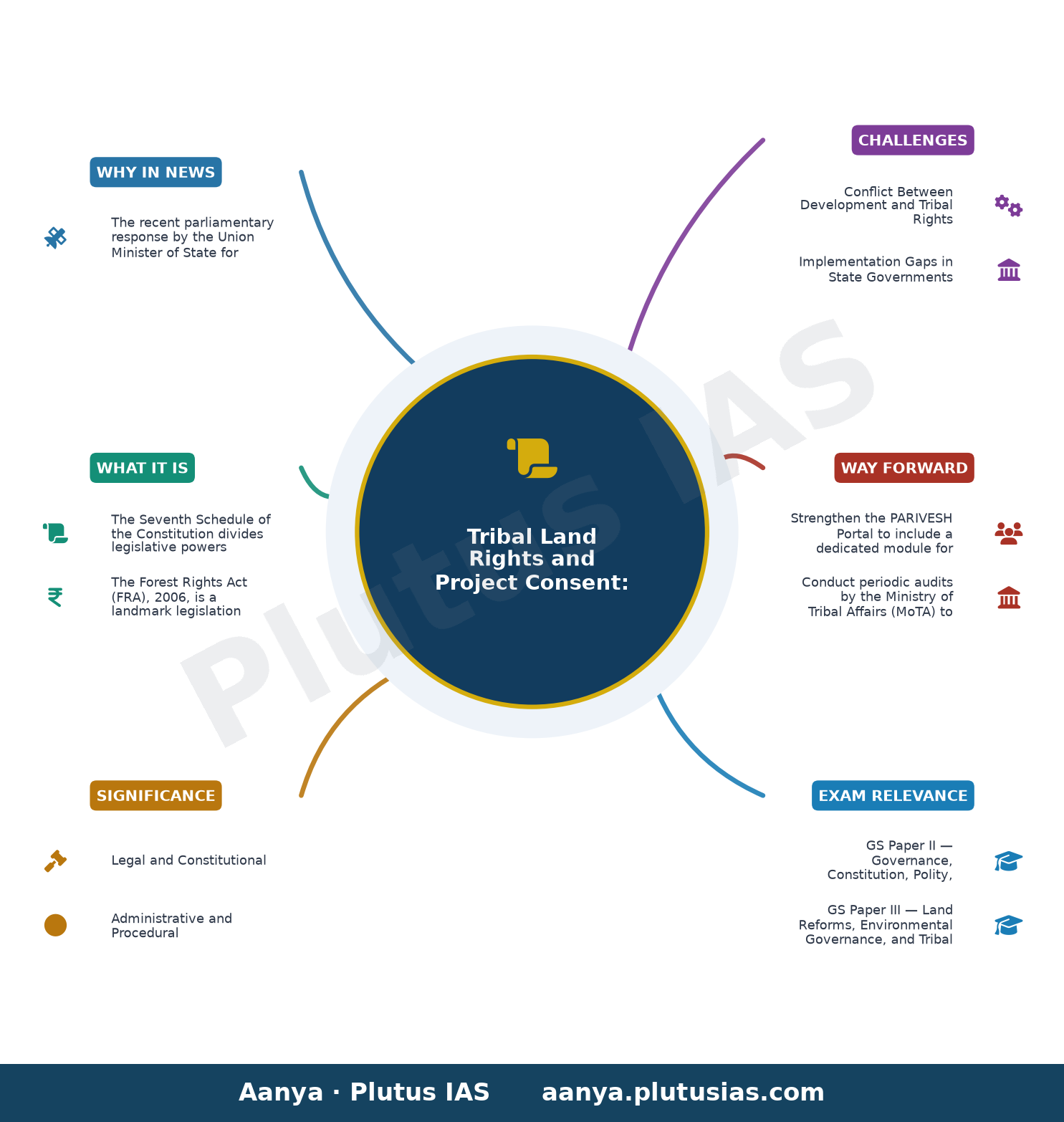
- GS Paper II — Governance, Constitution, Polity, Social Justice and International Relations | GS Paper III — Land Reforms, Environmental Governance, and Tribal Welfare
- Prelims: Forest Rights Act 2006, PESA 1996, Land Acquisition Act 2013, Scheduled Tribes and Other Traditional Forest Dwellers (Recognition of Forest Rights) Act, Forest Conservation Act 1980, PARIVESH Portal, Entry 18 of State List, Seventh Schedule, Vananchal, Gram Sabha, Rehabilitation and Resettlement, Compensatory Afforestation Fund Management and Planning Authority (CAMPA)
- Essay: Tribal rights and developmental aspirations: Balancing conservation with inclusive growth, Federalism in India: Distribution of powers over land and forest resources
Quick Revision: Tribal land rights in developmental projects are safeguarded under the FRA (2006), PESA (1996), and the Forest (Conservation) Act (1980), with Gram Sabha consent and central government approvals acting as critical checks against arbitrary land diversion.
Why is this in the news?
The recent parliamentary response by the Union Minister of State for Tribal Affairs highlights the constitutional and statutory safeguards governing tribal land rights in the context of developmental projects, particularly in forest areas. It underscores the procedural and administrative complexities in ensuring compliance with the Forest Rights Act (FRA), 2006, and the Panchayats (Extension to Scheduled Areas) Act (PESA), 1996, amid land diversion proposals for non-forestry uses.
Background
- The constitutional division of legislative and administrative powers over land and forests is vested in the State List (Seventh Schedule, Entry 18), making state governments the primary authorities for land management and acquisition.
- The Forest Rights Act (FRA), 2006, was enacted to recognize and vest forest rights and occupation in forest-dwelling Scheduled Tribes (STs) and other traditional forest dwellers, thereby addressing historical injustices.
- The Panchayats (Extension to Scheduled Areas) Act (PESA), 1996, extends the provisions of the Panchayati Raj system to Scheduled Areas, empowering Gram Sabhas to safeguard tribal interests in land and resource management.
- The Forest (Conservation) Act, 1980, regulates the diversion of forest land for non-forestry purposes, requiring prior approval from the central government.
- The PARIVESH portal, launched by the Ministry of Environment, Forest and Climate Change (MoEFCC), streamlines the process of forest land diversion proposals through an online system.
What are the constitutional and statutory safeguards for tribal land rights in developmental projects?
- The Seventh Schedule of the Constitution divides legislative powers between the Union and States. Land and its management fall under the State List (Entry 18), granting states exclusive authority over land-related matters, including acquisition and rehabilitation.
- The Forest Rights Act (FRA), 2006, is a landmark legislation that recognizes the forest rights of Scheduled Tribes and other traditional forest dwellers. It mandates that no tribal person can be evicted from forest land until their rights are verified and recognized under the Act (Section 4(5)).
- The Panchayats (Extension to Scheduled Areas) Act (PESA), 1996, empowers Gram Sabhas in Scheduled Areas to play a pivotal role in land and resource management, including consent for land use changes in tribal areas.
- The Forest (Conservation) Act, 1980, regulates the diversion of forest land for non-forestry purposes. Any such diversion requires prior approval from the central government under Section 2 of the Act, ensuring that forest conservation objectives are not compromised.
- The Forest (Conservation) Rules, 2023, further stipulate that state governments can only issue orders for diversion, lease, or dereservation of forest land after obtaining ‘final’ approval from the central government and ensuring compliance with all applicable laws, including the FRA.
- The PARIVESH portal, managed by MoEFCC, serves as a centralized platform for processing forest land diversion proposals. It provides transparency by disclosing project details, user agencies, and the status of proposals, including the impact on flora and fauna.
- For projects requiring land diversion in tribal areas, the FRA mandates that Gram Sabha consent is essential. Additionally, the diversion of forest land for specific developmental facilities is capped at one hectare per case under Section 3(2) of the FRA, subject to Gram Sabha recommendations.
- Disputes arising from land acquisition, rehabilitation, and resettlement in tribal areas are primarily addressed by state governments or project authorities, as the FRA and PESA place the onus of implementation on state administrations.
Key Features
| Feature | Significance |
|---|---|
| Constitutional Division of Powers (Seventh Schedule, State List Entry 18) | Land and its management fall under the exclusive legislative and administrative jurisdiction of State Governments, ensuring federalism and state autonomy in land-related matters. |
| Forest Rights Act (FRA), 2006, Section 3(2) | Permits diversion of forest land for specific development projects, subject to strict conditions: ≤1 hectare, Gram Sabha recommendation, and non-displacement of forest dwellers. |
| PARIVESH Portal (MoEFCC) | Centralized online platform for tracking forest land diversion proposals, ensuring transparency and compliance with environmental and forest conservation norms. |
| Forest (Conservation) Rules, 2023, Rule 11(7) | Mandates prior approval from the Central Government for forest land diversion, ensuring adherence to conservation and tribal rights frameworks. |
| Gram Sabha Consent (FRA, 2006) | Mandatory prior approval from the local tribal community for any land-related project affecting their rights, reinforcing participatory governance. |
| Land Acquisition and Rehabilitation & Resettlement (LARR) Act, 2013 | Regulates acquisition of land for public purposes, including tribal lands, with provisions for compensation, resettlement, and rehabilitation. |
Why it Matters
Legal and Constitutional
- Reinforces the federal structure of land governance, balancing central oversight with state autonomy under the Seventh Schedule.
- Ensures constitutional safeguards for Scheduled Tribes (STs) through FRA, 2006, protecting their land rights and preventing arbitrary displacement.
- Clarifies the hierarchy of laws governing land use, including forest conservation, tribal rights, and development projects.
Administrative and Procedural
- Introduces a multi-layered approval process for land diversion, involving Gram Sabha, State Governments, and Central Authorities, enhancing accountability.
- Centralizes tracking of forest land diversion proposals via PARIVESH, improving transparency and reducing procedural delays.
- Mandates prior consent of Gram Sabha for tribal land-related projects, ensuring community participation in decision-making.
Economic and Developmental
- Balances developmental imperatives with tribal rights, allowing limited forest land diversion for critical infrastructure while protecting tribal livelihoods.
- Provides a legal framework for land acquisition, compensation, and resettlement, reducing conflicts and ensuring fair treatment of affected communities.
- Supports sustainable land use planning by integrating environmental conservation with developmental needs.
Environmental
- Strengthens forest conservation through mandatory central approvals for forest land diversion, aligning with India’s climate and biodiversity commitments.
- Ensures compliance with environmental impact assessments and conservation norms before land use changes.
Challenges
1. Conflict Between Development and Tribal Rights
- Development projects often require forest land diversion, leading to potential violations of FRA, 2006, if Gram Sabha consent is not obtained or conditions are bypassed.
- Lack of centralized tracking of tribal land diversion cases makes it difficult to assess the scale of violations or enforce compliance.
UPSC Link: GS-II: Governance, Tribal Issues
2. Implementation Gaps in State Governments
- State Governments may delay or bypass FRA, 2006, provisions, particularly in cases of large-scale land acquisitions or infrastructure projects.
- Inadequate capacity of state agencies to process FRA claims or enforce Gram Sabha consent, leading to procedural lapses.
UPSC Link: GS-II: Governance, Federalism
3. Transparency and Accountability Deficits
- PARIVESH Portal, while centralized, may not capture all land diversion cases, especially those handled at the state level without central oversight.
- Lack of a unified database for tribal land rights and diversion cases hinders effective monitoring and redressal of grievances.
UPSC Link: GS-II: Governance, Transparency
4. Legal Ambiguities and Overlapping Jurisdictions
- Overlap between FRA, 2006, Forest (Conservation) Act, 1980, and Land Acquisition Laws creates confusion in project approvals and compliance.
- Unclear demarcation of responsibilities between central and state authorities in enforcing tribal land rights and forest conservation norms.
UPSC Link: GS-II: Governance, Legal Framework
5. Social and Political Resistance
- Tribal communities often resist land diversion projects, leading to protests, legal challenges, and delays in project execution.
- Political pressures may influence state governments to prioritize development over tribal rights, undermining FRA, 2006.
UPSC Link: GS-II: Governance, Social Issues
6. Environmental Degradation and Climate Impact
- Unregulated forest land diversion can lead to deforestation, loss of biodiversity, and increased carbon emissions, contradicting India’s climate goals.
- Failure to enforce environmental safeguards in land diversion projects exacerbates ecological degradation.
UPSC Link: GS-III: Environment, Climate Change
Challenges — UPSC Perspective
| Issue | Concern |
|---|---|
| Non-compliance with FRA, 2006 | Tribal land rights are violated due to lack of Gram Sabha consent or bypassing of FRA provisions in land diversion projects. |
| Centralized Monitoring Gaps | PARIVESH Portal does not track all tribal land diversion cases, leading to unaccounted violations and delays in redressal. |
| State-Level Implementation Deficiencies | State Governments may delay or ignore FRA, 2006, leading to procedural lapses and rights violations. |
| Overlapping Legal Frameworks | Conflicts between FRA, 2006, Forest (Conservation) Act, 1980, and Land Acquisition Laws create ambiguity in project approvals. |
| Tribal Community Resistance | Protests and legal challenges by tribal communities disrupt project execution and delay development initiatives. |
| Environmental Degradation Risks | Unregulated forest land diversion threatens biodiversity and climate goals, undermining sustainable development. |
Government Initiatives — Must-Memorise for Prelims
- Forest Rights Act (FRA), 2006
- Panchayats (Extension to Scheduled Areas) Act, 1996
Way Forward
- Strengthen the PARIVESH Portal to include a dedicated module for tracking tribal land diversion cases, ensuring real-time monitoring and transparency.
- Conduct periodic audits by the Ministry of Tribal Affairs (MoTA) to assess state-level compliance with FRA, 2006, and identify implementation gaps.
- Establish a grievance redressal mechanism at the central level to address violations of tribal land rights, with strict timelines for resolution.
- Enhance capacity-building programs for state officials and Gram Sabha members to improve understanding and enforcement of FRA, 2006.
- Promote inter-ministerial coordination (MoTA, MoEFCC, and State Governments) to streamline approval processes for land diversion projects while protecting tribal rights.
- Encourage the use of alternative land-use planning to minimize forest land diversion, prioritizing degraded or non-forest lands for development projects.
- Strengthen environmental impact assessments (EIAs) for land diversion projects, ensuring compliance with conservation norms and climate goals.
- Involve civil society organizations and tribal leaders in monitoring land diversion projects to enhance accountability and community participation.
UPSC Value Addition
Keywords for Mains Answer-Writing
Forest Rights Act 2006 · Scheduled Tribes and Other Traditional Forest Dwellers (Recognition of Forest Rights) Act · PESA Act 1996 · land diversion under Forest (Conservation) Act 1980 · gram sabha consent for tribal land use · Forest Conservation Rules 2023 · Forest Rights Act Section 4(5) · diversion of forest land for non-forestry purposes · tribal land rights and development projects · Forest Clearance process under PARIVESH portal · Forest (Conservation & Augmentation) Rules 2023 · tribal land alienation and rehabilitation · tribal land rights and constitutional provisions · forest land diversion and environmental governance · tribal land rights and judicial safeguards
Constitutional & Policy Linkages
- Seventh Schedule (State List, Entry 18) – Land and its management
- Fifth Schedule – Administration and control of Scheduled Areas and Scheduled Tribes
- Sixth Schedule – Autonomous District Councils in tribal areas
Concept Flow
Constitutional Division of Powers → State Governments regulate land and forest resources under Seventh Schedule, Entry 18 → Forest Conservation Act, 1980 → Mandates central approval for forest land diversion, ensuring environmental safeguards → Forest Rights Act, 2006 → Recognizes tribal rights, requires Gram Sabha consent for land diversion projects → Land Acquisition and Rehabilitation & Resettlement (LARR) Act, 2013 → Regulates compensation and resettlement for affected communities → PARIVESH Portal → Centralized tracking of forest land diversion proposals for transparency and compliance → Implementation Gaps → State-level delays or bypassing of FRA, 2006, leading to rights violations → Conflict Resolution → Grievance redressal mechanisms and audits to address violations and improve compliance
Prelims Practice Questions
Q1. Consider the following statements regarding the Scheduled Tribes and Other Traditional Forest Dwellers (Recognition of Forest Rights) Act, 2006 (FRA):
1. The Act mandates that no tribal person can be evicted from forest land until their rights are recognised and verified.
2. The Act allows for the diversion of forest land for non-forestry purposes up to one hectare without gram sabha consent.
3. The Act places the responsibility of implementing its provisions solely on the central government.
How many of the above statements are correct?
- Only one
- Only two
- All three
- None
Answer: Only two — Statement 1 is correct as per Section 4(5) of the FRA, which prohibits eviction until rights are recognised. Statement 2 is incorrect as diversion for non-forestry purposes requires gram sabha consent and is limited to one hectare only under specific conditions. Statement 3 is incorrect as the Act places implementation responsibility on state governments.
Q2. Assertion (A): The Forest (Conservation) Act, 1980, empowers the central government to regulate diversion of forest land for non-forestry purposes.
Reason (R): The Act mandates that any diversion of forest land must receive prior approval from the central government under Section 2 of the Act.
In the context of the above two statements, which of the following is correct?
- Both A and R are true, and R is the correct explanation of A.
- Both A and R are true, but R is not the correct explanation of A.
- A is true, but R is false.
- A is false, but R is true.
Answer: Both A and R are true, and R is the correct explanation of A. — The Forest (Conservation) Act, 1980, indeed empowers the central government to regulate diversion of forest land, and Section 2 requires prior approval for such diversion. Thus, both the assertion and reason are true, and the reason correctly explains the assertion.
Q3. Match the following pairs related to tribal land rights and forest governance in India:
Column I
A. Forest Rights Act, 2006
B. PESA Act, 1996
C. Forest (Conservation) Act, 1980
D. Forest Conservation Rules, 2023
Column II
1. Mandates gram sabha consent for land use changes in Scheduled Areas
2. Regulates diversion of forest land for non-forestry purposes
3. Recognises forest rights of Scheduled Tribes and Other Traditional Forest Dwellers
4. Provides for online clearance of forest land diversion proposals
- A-3, B-1, C-2, D-4; A-2, B-3, C-1, D-4; A-4, B-1, C-3, D-2; A-1, B-2, C-4, D-3
- answer_string_mapping_indexes_to_options_indexes_for_json_output_but_we_will_use_answer_array_with_correct_pairing
- answer_string_mapping_indexes_to_options_indexes_for_json_output_but_we_will_use_answer_array_with_correct_pairing
- answer_string_mapping_indexes_to_options_indexes_for_json_output_but_we_will_use_answer_array_with_correct_pairing
Answer: ? — A-3: The Forest Rights Act, 2006 recognises forest rights of Scheduled Tribes and Other Traditional Forest Dwellers. B-1: The PESA Act, 1996 mandates gram sabha consent for land use changes in Scheduled Areas. C-2: The Forest (Conservation) Act, 1980 regulates diversion of forest land for non-forestry purposes. D-4: The Forest Conservation Rules, 2023 provide for online clearance of forest land diversion proposals via the PARIVESH portal.
Mains Practice Question
✍ Critically examine the constitutional and statutory framework governing tribal land rights in the context of development projects involving forest land diversion. Also analyse the role of gram sabha consent and the safeguards provided under the Scheduled Tribes and Other Traditional Forest Dwellers (Recognition of Forest Rights) Act, 2006 and the Forest (Conservation) Act, 1980. (15 Marks)
Approach: MODEL-ANSWER SKELETON:
1. **Constitutional Framework**:
– Entry 18 of List II (State List) under the Seventh Schedule confers exclusive legislative and administrative jurisdiction on states over land and its management.
– Article 244 read with Fifth and Sixth Schedules provides for special provisions for Scheduled Areas, including tribal land rights.
– Directive Principles of State Policy (Articles 38, 39, 46) mandate protection of weaker sections, including Scheduled Tribes, from social injustice and exploitation.
2. **Statutory Framework**:
– **Forest Rights Act (FRA), 2006**:
– Sections 3 and 4 recognise individual and community forest rights of Scheduled Tribes and Other Traditional Forest Dwellers.
– Section 4(5) prohibits eviction of forest dwellers until their rights are recognised and verified.
– Section 5(2) empowers gram sabhas to protect and preserve community forest resources.
– **Forest (Conservation) Act, 1980**:
– Regulates diversion of forest land for non-forestry purposes.
– Section 2 requires prior approval of the central government for any diversion.
– Forest Conservation Rules, 2023 (Rule 11(7)) mandate compliance with FRA provisions before granting approval.
– **PESA Act, 1996**:
– Extends provisions of Panchayats to Scheduled Areas.
– Mandates gram sabha consent for land acquisition and land use changes in Scheduled Areas.
3. **Gram Sabha Consent and Safeguards**:
– FRA mandates gram sabha consent for diversion of forest land up to one hectare for specific development projects (Section 3(2)).
– PESA Act empowers gram sabhas to safeguard and preserve community resources, including land.
– The PARIVESH portal facilitates online scrutiny of forest land diversion proposals, ensuring transparency and compliance with statutory safeguards.
4. **Critical Analysis**:
– **Strengths**:
– FRA and PESA provide robust legal safeguards against arbitrary land alienation.
– Judicial interventions (e.g., Samata v. State of Andhra Pradesh, 1997) have reinforced tribal land rights.
– Online clearance mechanisms (PARIVESH portal) enhance transparency and accountability.
– **Challenges**:
– Implementation gaps: State governments often delay recognition of forest rights or bypass gram sabha consent.
– Ambiguity in defining ‘development projects’ under FRA Section 3(2) leads to misuse.
– Lack of centralised data on tribal land diversion disputes hampers effective monitoring.
– Conflicts between FRA and other laws (e.g., land acquisition laws) create legal ambiguities.
5. **Way Forward**:
– Strengthen institutional mechanisms for timely recognition of forest rights under FRA.
– Harmonise FRA with other land-related laws to avoid conflicts.
– Enhance capacity-building of gram sabhas for effective participation in decision-making.
– Promote alternative livelihoods to reduce pressure on forest lands.
Source: PIB (Press Information Bureau)
Generated by AanyaAi for educational purpose.

- संयुक्त राष्ट्र पैनल ने AI एजेंटों की बढ़ती शक्ति पर सुरक्षा बढ़ाने की चेतावनी दी - September 21, 2026
- UN Panel Warns: AI Agents May Outpace Human Control Safeguards - September 21, 2026
- तमिलनाडु में मुर्गे की लड़ाई पर पूर्ण प्रतिबंध नहीं: डीजीपी कार्यालय ने मद्रास उच्च न्यायालय को बताया - September 21, 2026

No Comments