


06 Aug Tribal Land Rights & Project Consent: Key Provisions for UPSC State PCS
✎ Tribal land rights in development projects are governed by a multi-layered legal framework, including the FRA (2006), Forest Conservation Rules (2023), and PESA (1996), with Gram Sabhas playing a pivotal role in consent and land…
Subject Relevance — Where This Topic Fits
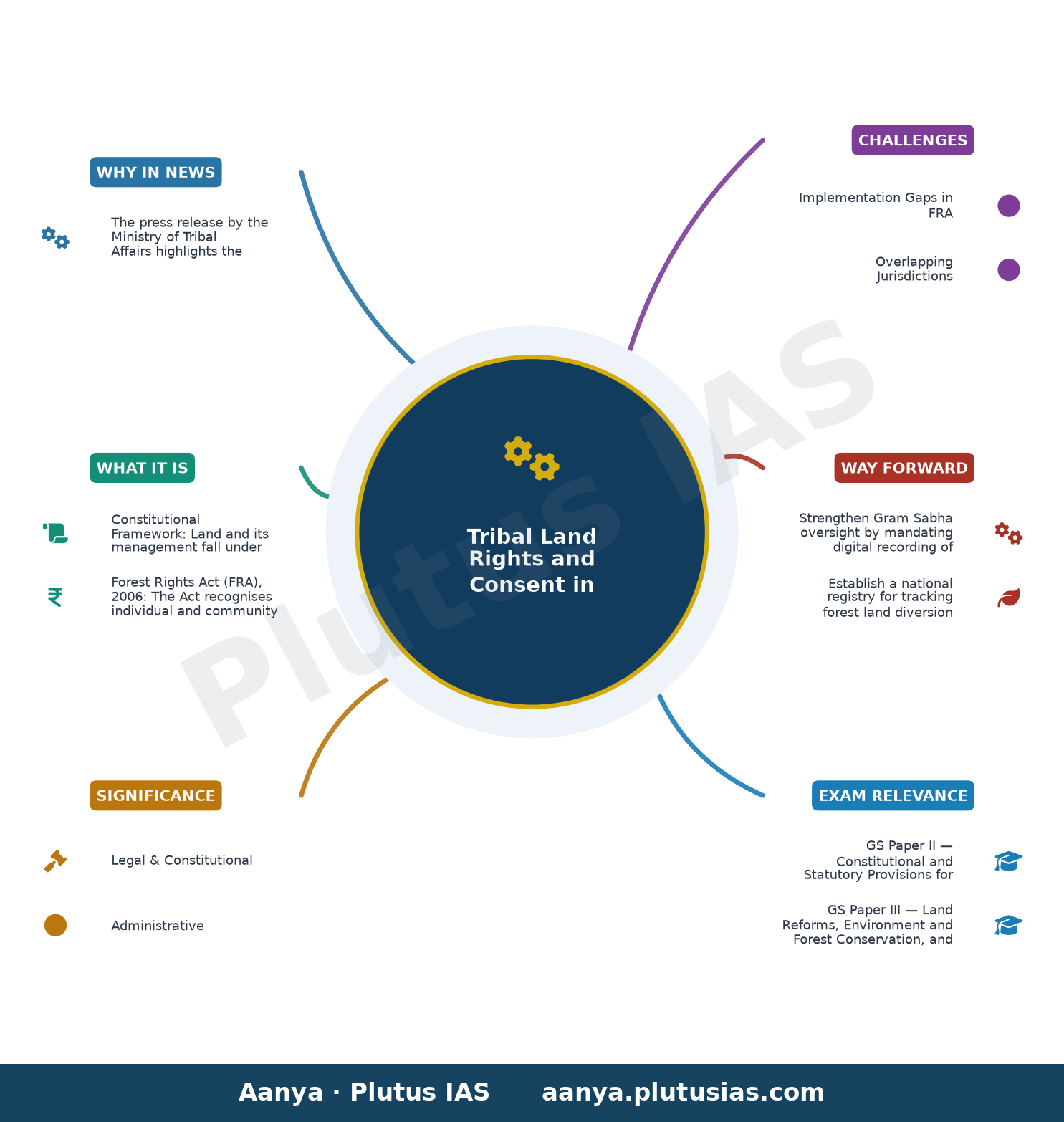
- GS Paper II — Constitutional and Statutory Provisions for Scheduled Tribes | GS Paper III — Land Reforms, Environment and Forest Conservation, and Disaster Management
- Prelims: Forest Rights Act 2006, PESA Act 1996, Land Acquisition Act 2013, Compensatory Afforestation Fund Management and Planning Authority (CAMPA), PARIVESH portal, Entry 18 in State List (Seventh Schedule), Scheduled Tribes and Other Traditional Forest Dwellers (Recognition of Forest Rights) Act, Forest Conservation Rules 2023
- Essay: Tribal rights and sustainable development: Balancing conservation with livelihood security, Federalism in India: Distribution of powers over land and forest resources
Quick Revision: Tribal land rights in development projects are governed by a multi-layered legal framework, including the FRA (2006), Forest Conservation Rules (2023), and PESA (1996), with Gram Sabhas playing a pivotal role in consent and land diversion, while state governments retain primary administrative authority.
Why is this in the news?
The press release by the Ministry of Tribal Affairs highlights the procedural and constitutional safeguards governing tribal land rights in the context of land diversion for development projects, particularly under the Forest Rights Act, 2006 (FRA), and the Forest Conservation Rules, 2023. It underscores the decentralised nature of land administration in India, the role of Gram Sabhas, and the absence of centralised monitoring of tribal land diversion cases, thereby raising questions about compliance and accountability in project implementation.
Background
- The Scheduled Tribes and Other Traditional Forest Dwellers (Recognition of Forest Rights) Act, 2006 (FRA), was enacted to recognise and vest forest rights in tribal and other forest-dwelling communities, including individual and community rights.
- The PARIVESH portal, developed by the Ministry of Environment, Forest and Climate Change (MoEFCC), facilitates online processing of proposals for diversion of forest land, ensuring transparency and compliance with statutory requirements.
What are the key legal and institutional mechanisms governing tribal land rights and consent in development projects?
- Constitutional Framework: Land and its management fall under the State List (Entry 18) of the Seventh Schedule, making state governments the primary authority for land-related matters, including tribal areas.
- Forest Rights Act (FRA), 2006: The Act recognises individual and community forest rights of Scheduled Tribes and other traditional forest dwellers. Section 4(5) of the FRA prohibits eviction of claimants until their rights are recognised and verified, ensuring tenure security for tribal communities.
- Forest Conservation Rules, 2023: These rules mandate that any diversion of forest land for non-forestry purposes requires prior approval from the central government under the Forest Conservation Act, 1980. The rules also require compliance with the FRA and other relevant laws to protect tribal rights.
- PARIVESH Portal: The MoEFCC’s PARIVESH portal provides a transparent platform for processing proposals for diversion of forest land, including details of user agencies, project categories, affected flora, and current status of proposals.
- Decentralised Governance: The absence of centralised monitoring of tribal land diversion cases underscores the federal structure of land administration in India, where state governments hold primary responsibility for implementation and compliance.
Key Features
| Feature | Significance |
|---|---|
| Forest Rights Act (FRA), 2006 (Section 3(2)) | Mandates minimal diversion of forest land (≤1 hectare) for government-managed development projects, subject to Gram Sabha recommendations, ensuring tribal rights are not arbitrarily extinguished. |
| PARIVESH Portal (MOEFCC) | Centralized online platform for tracking diversion proposals, enhancing transparency and accountability in forest land use decisions. |
| PESA Act, 1996 (MOPR) | Grants tribal self-governance in Scheduled Areas, including land management, but its implementation remains state-dependent, leading to variability in enforcement. |
| Forest (Conservation & Promotion) Rules, 2023 (Rule 11(7)) | Requires state/UT governments to obtain central approval for forest land diversion, ensuring compliance with FRA and other statutory safeguards. |
| Land Acquisition and Rehabilitation & Resettlement (LARR) Act, 2013 | Provides legal framework for compensation and rehabilitation of displaced tribal communities, though implementation gaps persist. |
Why it Matters
Legal & Constitutional
- FRA, 2006 reinforces constitutional provisions (Article 244, Fifth Schedule) to protect tribal rights over forest land, aligning with the directive principles of state policy (Article 48A).
- PESA Act operationalizes Articles 244(1) and 275(1) by devolving land management powers to tribal self-governance institutions.
Administrative
- Centralized monitoring via PARIVESH portal reduces discretionary forest land diversion, mitigating arbitrary state actions.
Environmental
- Strict scrutiny of forest land diversion under FRA and Forest Conservation Act ensures ecological balance, while balancing developmental needs.
Social Justice
- FRA’s Section 4(5) prevents eviction of tribal claimants until their rights are formally recognized, addressing historical injustices.
Challenges
1. Implementation Gaps in FRA
- State governments often bypass Gram Sabha consent, leading to procedural violations and tribal displacement without adequate compensation.
- Lack of centralized data on forest land diversion under FRA (Section 3(2)) hampers policy evaluation and corrective action.
UPSC Link: GS-II: Tribal Welfare
2. Overlapping Jurisdictions
- Concurrent role of state governments in land management (State List Entry 18, Seventh Schedule) and central approvals under Forest Conservation Act creates administrative friction.
3. Weak Enforcement of PESA
- PESA’s devolution of powers remains uneven across states, with tribal self-governance institutions lacking financial and administrative autonomy.
4. Delayed Compensation & Rehabilitation
- Under LARR Act, 2013, delayed or inadequate compensation for displaced tribal communities exacerbates socio-economic vulnerabilities.
5. Transparency Deficits in PARIVESH
- While PARIVESH tracks diversion proposals, public accessibility to detailed impact assessments remains limited, reducing stakeholder trust.
Challenges — UPSC Perspective
| Issue | Concern |
|---|---|
| Gram Sabha Consent Bypass | State authorities often prioritize developmental projects over tribal consent, violating FRA’s procedural safeguards. |
| Centralized vs. State Autonomy | Conflict between Forest Conservation Act’s central approvals and state-level land management powers leads to delays and policy ambiguity. |
| Data Asymmetry in FRA Compliance | Absence of centralized records on forest land diversion under FRA hinders accountability and policy formulation. |
| PESA Implementation Deficits | Inadequate devolution of powers to tribal institutions under PESA results in poor enforcement of land rights. |
| Compensation Delays | Protracted rehabilitation processes under LARR Act leave displaced tribal communities in precarious socio-economic conditions. |
Way Forward
- Strengthen Gram Sabha oversight by mandating digital recording of consent processes for forest land diversion under FRA.
- Establish a national registry for tracking forest land diversion cases under FRA (Section 3(2)) to ensure transparency and accountability.
- Amend PESA Act to include fiscal devolution mechanisms, ensuring tribal institutions have financial autonomy for land management.
- Accelerate compensation disbursement under LARR Act by setting strict timelines and third-party audits for state compliance.
- Enhance PARIVESH portal’s public interface to include real-time impact assessments and grievance redressal mechanisms for affected communities.
UPSC Value Addition
Keywords for Mains Answer-Writing
Forest Rights Act (FRA) 2006 · Scheduled Tribes and Other Traditional Forest Dwellers (Recognition of Forest Rights) Act · PESA Act 1996 · Land Acquisition and Rehabilitation Act 2013 · Forest Conservation Act 1980 · forest diversion · gram sabha consent · tribal land rights · Scheduled Areas and Tribal Sub-Plan · environmental governance · forest governance · tribal welfare and constitutional provisions · Article 244(1) · Ninth Schedule · tribal autonomy in land governance · forest land diversion mechanisms · tribal development and legal safeguards
Constitutional & Policy Linkages
- {‘State List Entry 18’: ‘Land and land revenue management’}
Concept Flow
Forest land diversion proposal → Centralized scrutiny via PARIVESH → State/UT approval under Forest Conservation Act → Gram Sabha consent under FRA → Compensation & rehabilitation under LARR Act → Tribal displacement or sustainable development outcome.
Prelims Practice Questions
Q1. Consider the following statements regarding the Scheduled Tribes and Other Traditional Forest Dwellers (Recognition of Forest Rights) Act, 2006 (FRA 2006):
1. Section 4(5) of FRA 2006 prohibits eviction of forest dwellers from their occupied forest land until their rights are recognised and verified.
2. Section 3(2) of FRA 2006 allows diversion of forest land for development projects without the consent of the gram sabha if the area is less than one hectare.
3. The Act empowers the gram sabha to initiate the process of determining the nature and extent of forest rights.
How many of the above statements are correct?
- Only one
- Only two
- All three
- None
Answer: All three — Statement 1 is correct: Section 4(5) of FRA 2006 explicitly prohibits eviction until rights are recognised and verified. Statement 2 is incorrect: Section 3(2) requires gram sabha consent for forest land diversion even for areas less than one hectare. Statement 3 is correct: The gram sabha plays a pivotal role in determining and verifying forest rights under FRA 2006.
Q2. Assertion (A): The Forest Conservation Act, 1980, empowers the central government to regulate the diversion of forest land for non-forestry purposes.
Reason (R): The Act mandates that any diversion of forest land for non-forestry purposes requires prior approval from the central government under Section 2 of the Act.
Examine the above assertion and reason in the context of forest governance in India.
- Both A and R are true, and R is the correct explanation of A
- Both A and R are true, but R is not the correct explanation of A
- A is true, but R is false
- A is false, but R is true
Answer: Both A and R are true, but R is not the correct explanation of A — Both the Assertion (A) and Reason (R) are true. The Forest Conservation Act, 1980, indeed empowers the central government to regulate forest land diversion through Section 2, which requires prior approval for any non-forestry use. The Reason (R) correctly explains the Assertion (A).
Q3. Match the following pairs related to tribal land rights and forest governance in India:
Column I (Legislative/Administrative Instrument)
A. PESA Act, 1996
B. FRA 2006
C. Forest Conservation Act, 1980
D. Land Acquisition and Rehabilitation Act, 2013
Column II (Key Provision)
1. Mandates consent of gram sabha for land acquisition in Scheduled Areas
2. Recognises forest rights of Scheduled Tribes and Other Traditional Forest Dwellers
3. Regulates diversion of forest land for non-forestry purposes
4. Provides for compensation and rehabilitation of land losers
Select the correct match:
- A-1, B-2, C-3, D-4
- A-2, B-1, C-4, D-3
- A-3, B-4, C-1, D-2
- A-4, B-3, C-2, D-1
Answer: A-1, B-2, C-3, D-4 — A-1 (PESA Act, 1996 mandates gram sabha consent for land-related matters in Scheduled Areas), B-2 (FRA 2006 recognises forest rights of Scheduled Tribes and Other Traditional Forest Dwellers), C-3 (Forest Conservation Act, 1980 regulates forest land diversion), D-4 (Land Acquisition and Rehabilitation Act, 2013 provides for compensation and rehabilitation).
Mains Practice Question
✍ Critically examine the constitutional and legal framework governing tribal land rights and forest land diversion in India. How does the interplay between the Forest Rights Act, 2006, the Panchayats (Extension to Scheduled Areas) Act, 1996, and the Forest Conservation Act, 1980 ensure or undermine tribal autonomy and welfare? (15 Marks)
Approach: MODEL-ANSWER SKELETON:
1. **Constitutional Foundations**:
– Article 244(1) read with the Fifth Schedule: Special provisions for Scheduled Areas and tribal autonomy.
– Article 243M(4)(b): Exempts Panchayats in Scheduled Areas from Part IX provisions, empowering gram sabhas.
– Ninth Schedule: Protects tribal land rights from judicial review (though recent judgments like IR Coelho v. State of Tamil Nadu have limited this).
2. **Forest Rights Act (FRA) 2006**:
– **Provisions**: Sections 3, 4, and 6: Recognition of forest rights, prohibition of eviction under Section 4(5), and role of gram sabhas in verification.
– **Strengths**: Empowers tribals, decentralises forest governance, and aligns with UN Declaration on Indigenous Rights.
– **Limitations**: Weak implementation due to lack of awareness, bureaucratic hurdles, and conflicts with forest departments.
– **Judicial Precedents**: Forest Rights Act, 2006 has been upheld by the Supreme Court in cases like *Orissa Mining Corporation v. Ministry of Environment and Forests* (2013), which emphasised gram sabha consent for forest land diversion.
3. **Panchayats (Extension to Scheduled Areas) Act, 1996 (PESA)**:
– **Provisions**: Sections 4(a), 4(d), and 5: Mandates gram sabha consent for land acquisition, mining leases, and other resource-related activities in Scheduled Areas.
– **Strengths**: Enhances tribal self-governance and checks arbitrary land acquisition.
– **Limitations**: Poor implementation due to resistance from state governments and vested interests; conflicts with central laws like the Mines and Minerals (Development and Regulation) Act, 1957.
4. **Forest Conservation Act, 1980**:
– **Provisions**: Section 2: Requires central government approval for forest land diversion.
– **Strengths**: Acts as a safeguard against indiscriminate forest land diversion.
– **Limitations**: Exemptions under Section 2(ii) for certain categories (e.g., linear projects) dilute its effectiveness; conflicts with FRA 2006, as seen in cases like *Samata v. State of Andhra Pradesh* (1997), where the Supreme Court upheld tribal rights over forest land.
5. **Interplay and Tensions**:
– **FRA vs. Forest Conservation Act**: FRA prioritises tribal rights, while the Forest Conservation Act prioritises environmental protection. The Supreme Court in *Wildlife First v. Ministry of Environment and Forests* (2014) held that FRA must be complied with before forest land diversion.
– **PESA vs. Central Laws**: PESA empowers gram sabhas, but central laws like the Land Acquisition Act, 2013, often override local consent mechanisms.
– **Implementation Gaps**: Lack of coordination between forest departments, tribal welfare departments, and gram sabhas; inadequate data on tribal land holdings.
6. **Way Forward**:
– Strengthen gram sabha institutions through capacity building and resource allocation.
– Harmonise FRA 2006, PESA, and Forest Conservation Act through clear guidelines and judicial interpretations.
– Ensure transparency in forest land diversion processes via digital platforms like PARIVESH.
– Promote participatory mapping and documentation of tribal lands to prevent encroachments and disputes.
**Balanced View**: While the legal framework provides robust protections for tribal land rights, implementation challenges and inter-institutional conflicts undermine its effectiveness. A rights-based approach, coupled with decentralised governance, is essential for ensuring tribal welfare.
Source: PIB (Press Information Bureau)
Generated by AanyaAi for educational purpose.

- पेरियार टाइगर रिजर्व में 6 नई प्रजातियाँ खोजी गईं, जानिए क्या हैं विशेषताएँ - September 22, 2026
- Six New Species Discovered in Periyar Tiger Reserve: UPSC & PCS Key Biodiversity Insights - September 22, 2026
- तमिलनाडु में बस किराए में संशोधन: सरकार को चार सप्ताह और समय मिला, उच्च न्यायालय का फैसला - September 22, 2026

No Comments