


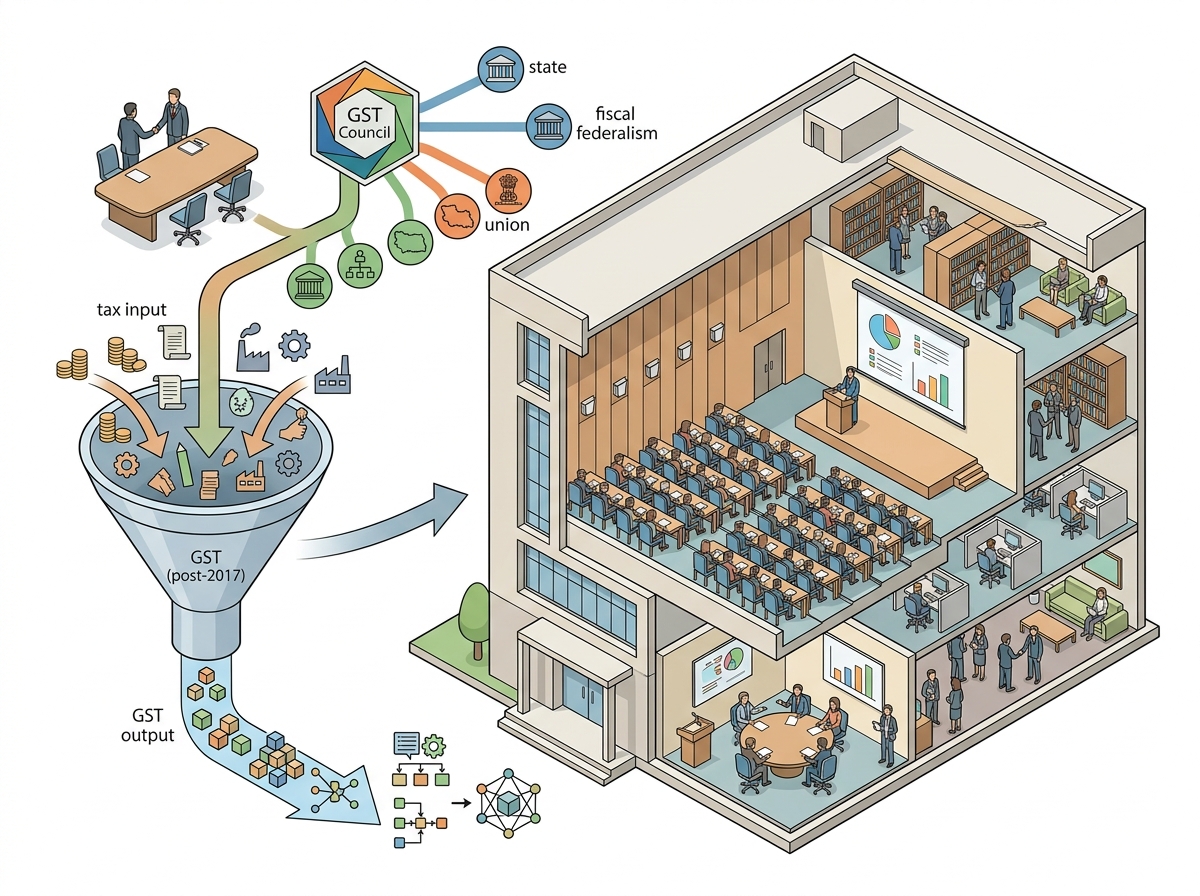
06 Sep Two-Day Seminar on GST Reforms: Key Insights for UPSC & State PCS Aspirants
✎ Second-generation GST reforms aim to recalibrate the GST architecture for enhanced revenue buoyancy, compliance, and fiscal federalism, addressing structural challenges in India’s indirect tax regime.
Subject Relevance — Where This Topic Fits
- GS Paper II — Functions and Responsibilities of the Union and the States | GS Paper III — Indian Economy and Issues Relating to Planning, Mobilisation of Resources, Growth, Development and Employment
- Prelims: GST Council, Goods and Services Tax (GST), Fiscal Federalism, Revenue Neutral Rate (RNR), Compensation Cess, Integrated GST (IGST), Gulati Institute of Finance and Taxation (GIFT), Indian Council of Social Science Research (ICSSR)
- Essay: Fiscal Federalism in India: Balancing Autonomy and Accountability, The Role of Cooperative Federalism in Economic Reforms
Quick Revision: Second-generation GST reforms aim to recalibrate the GST architecture for enhanced revenue buoyancy, compliance, and fiscal federalism, addressing structural challenges in India’s indirect tax regime.
Why is this in the news?
A two-day national seminar on second-generation GST reforms, organised by the Gulati Institute of Finance and Taxation (GIFT) in collaboration with the Indian Council of Social Science Research (ICSSR), has been convened to deliberate on the structural and operational challenges of the Goods and Services Tax (GST) regime. The seminar assumes significance in the context of evolving fiscal federalism and the persistent debates over GST’s revenue performance and administrative efficiency.
Background
- The Goods and Services Tax (GST) was introduced in India on 1 July 2017, subsuming multiple indirect taxes to create a unified indirect tax system across the country.
- The GST framework operates under the aegis of the GST Council, a constitutional body (Article 279A) comprising the Union Finance Minister and State Finance Ministers, which recommends tax rates, exemptions, and administrative procedures.
- The GST regime includes three components: Central GST (CGST), State GST (SGST), and Integrated GST (IGST) for inter-State transactions, with revenue sharing between the Centre and States as per agreed formulas.
- The GST compensation mechanism, which guaranteed States a 14% annual revenue growth for five years (2017-22), has been a subject of debate, with calls for its restructuring or extension due to fiscal pressures.
- Second-generation reforms refer to structural adjustments in the GST architecture to address revenue shortfalls, compliance challenges, and the need for greater fiscal autonomy for States.
- The Gulati Institute of Finance and Taxation (GIFT), an autonomous research institute under the Government of Kerala, specialises in fiscal policy analysis and tax reforms.
What are Second-Generation GST Reforms?
- Second-generation GST reforms entail a comprehensive review of the GST architecture to enhance its revenue productivity, administrative efficiency, and alignment with fiscal federalism principles.
- Key objectives include rationalising tax slabs, addressing revenue shortfalls, improving compliance through technology (e.g., GSTN), and ensuring equitable revenue distribution between the Centre and States.
- Reforms may involve recalibrating the Revenue Neutral Rate (RNR)—the rate at which GST revenue remains neutral to the pre-GST tax regime—to balance revenue sustainability and economic growth.
- The reforms aim to simplify the multi-tiered tax structure (currently 0%, 5%, 12%, 18%, and 28%) to reduce complexity and improve taxpayer compliance.
- Fiscal federalism considerations include ensuring States have adequate fiscal space to meet developmental needs while maintaining macroeconomic stability.
- The reforms may explore the integration of GST with other tax systems (e.g., Direct Taxes) to create a seamless tax ecosystem and reduce cascading effects.
- Administrative reforms focus on strengthening the GST Council’s decision-making process, enhancing data analytics for policy formulation, and addressing grievance redressal mechanisms.
- The seminar will also deliberate on the role of compensation cess, which was introduced to offset revenue losses during the transition phase and may require restructuring post-2022.
Key Features
| Feature | Significance |
|---|---|
| Second-generation GST reforms | Represents a structured policy evolution to address structural inefficiencies in the GST framework, including rate rationalisation, compliance simplification, and revenue stabilisation. |
| Fiscal federalism focus | Examines the balance between Centre-State revenue sharing, autonomy of sub-national fiscal policies, and the role of GST Council in cooperative federalism. |
| State finance impact assessment | Evaluates the distributional effects of GST on state revenues, particularly in revenue-deficit states and those with high reliance on indirect taxes. |
| Tax rate rationalisation | Discusses the need for harmonising multiple GST slabs to reduce complexity, enhance compliance, and minimise cascading effects. |
| Revenue performance analysis | Assesses the trajectory of GST collections post-implementation, identifying gaps between projected and actual revenues for policy recalibration. |
Why it Matters
Economic Governance
- The seminar underscores the iterative nature of tax policy reform in a federal structure, where Centre-State coordination remains pivotal for macroeconomic stability.
- Second-generation reforms aim to correct initial design flaws in GST, such as multiplicity of rates, classification disputes, and compliance burdens, to enhance ease of doing business.
- Fiscal federalism discussions are critical for ensuring that GST does not erode the fiscal space of states, particularly those with weaker revenue bases.
- The event highlights the role of independent research institutions (e.g., GIFT, ICSSR) in providing evidence-based inputs for policy formulation.
Policy Process & Institutions
- The GST Council, as a constitutional body under Article 279A, is the apex decision-making forum for tax rate adjustments and structural reforms.
- The seminar’s collaboration between GIFT and ICSSR exemplifies the integration of academic research with policy-making, fostering long-term fiscal governance.
- Publication of ‘Economy and Fiscal Watch’ (EFW) by GIFT signals an institutional effort to monitor fiscal trends and disseminate policy-relevant data.
- The participation of former finance ministers (e.g., T.M. Thomas Isaac, Haseeb Drabu) provides historical context and experiential insights into GST’s evolution.
Revenue Mobilisation & Compliance
- Analysis of GST revenue performance is essential to address the persistent gap between projected and actual collections, which affects Centre-State fiscal transfers.
- Rate rationalisation is a key reform area to reduce tax arbitrage, simplify compliance, and mitigate revenue leakages through exemptions and inverted duty structures.
- The seminar’s focus on compliance mechanisms (e.g., e-way bills, input tax credit) reflects ongoing efforts to curb tax evasion and improve transparency.
Challenges
1. Fiscal Asymmetry in GST Implementation
- States with higher dependence on indirect taxes (e.g., Kerala, Tamil Nadu) face revenue shortfalls post-GST due to loss of tax autonomy and delayed compensation.
- The transition from the GST compensation regime to a revenue-neutral framework poses challenges for states in budgetary planning.
- Disparities in GST collection efficiency across states necessitate targeted capacity-building and institutional support.
UPSC Link: GS-II: Cooperative Federalism
2. Multiplicity of GST Slabs
- The current four-tier GST structure (5%, 12%, 18%, 28%) complicates compliance, increases litigation, and distorts market efficiency.
- Rate rationalisation is politically sensitive due to competing sectoral interests (e.g., essentials vs. luxury goods).
- The absence of a single standard rate undermines the original goal of a unified market.
UPSC Link: GS-III: Taxation Reforms
3. Revenue Shortfalls and Compensation Mechanism
- The GST compensation cess, originally intended to bridge revenue gaps for five years, has created fiscal uncertainty post-2022.
- States are advocating for a permanent mechanism to address structural revenue deficits, while the Centre seeks fiscal consolidation.
- The seminar may explore alternative models, such as revenue-sharing formulas tied to economic growth.
UPSC Link: GS-II: Centre-State Financial Relations
4. Compliance and Tax Evasion
- Despite digitalisation, GST evasion persists through fake invoicing, under-reporting of sales, and misuse of input tax credit.
- The complexity of GST rules (e.g., place of supply, reverse charge mechanism) increases compliance costs for businesses.
- The seminar may discuss technological solutions (e.g., AI-driven audits, blockchain for transactions) to enhance enforcement.
UPSC Link: GS-III: Indirect Taxation
5. Fiscal Federalism and State Autonomy
- GST has reduced the fiscal autonomy of states by centralising tax administration, limiting their ability to tailor policies to local needs.
- States argue for greater flexibility in levying cesses or surcharges to address regional disparities.
- The seminar may examine the role of the GST Council in balancing uniformity with state-specific fiscal requirements.
UPSC Link: GS-II: Federalism
Challenges — UPSC Perspective
| Issue | Concern |
|---|---|
| Revenue Deficits in States | Loss of tax autonomy and delayed compensation post-GST transition period. |
| Multiplicity of GST Slabs | Increased compliance burden, litigation, and market distortions. |
| GST Compensation Cess Expiry | Fiscal uncertainty for states reliant on compensation for revenue shortfalls. |
| Tax Evasion Mechanisms | Persistent fake invoicing and under-reporting despite digital compliance tools. |
| Centre-State Fiscal Imbalance | Centralisation of tax administration vs. state demands for fiscal autonomy. |
Way Forward
- Constitute a high-powered committee under the GST Council to recommend a three-tier GST structure (0%, 12%, 18%) with a single standard rate for most goods.
- Develop a permanent fiscal stabilisation fund to address revenue shortfalls in states, funded through cess collections or budgetary allocations.
- Enhance the GST Network (GSTN) with AI-driven analytics to detect tax evasion and automate audits.
- Introduce a ‘one-nation-one-tax’ compliance portal integrating state and central tax systems to reduce duplication.
- Expand the scope of the GST Council to include state finance ministers in rate-setting decisions for essential goods.
- Pilot a ‘state-specific GST’ model in revenue-deficit states to allow limited surcharges for local priorities.
- Strengthen inter-state coordination through the Integrated GST (IGST) mechanism to curb cross-border tax evasion.
- Publish quarterly ‘GST Fiscal Reports’ by GIFT to track revenue trends, compliance gaps, and policy impacts.
UPSC Value Addition
Keywords for Mains Answer-Writing
Goods and Services Tax (GST) · Second-generation GST reforms · Gulati Institute of Finance and Taxation (GIFT) · fiscal federalism · GST revenue performance · Indian Council of Social Science Research (ICSSR) · GST Council · Goods and Services Tax (Compensation to States) Act, 2017 · fiscal policy · State finances · GST rate rationalisation · fiscal autonomy of States · GST compensation cess · Economy and Fiscal Watch (EFW) · Professor M.A. Oommen · T.M. Thomas Isaac · K.N. Balagopal · Haseeb A. Drabu · GST compliance · tax buoyancy · input tax credit (ITC) · GST Network (GSTN) · revenue-neutral rate (RNR) · tax administration · cooperative federalism · GST evasion · tax buoyancy · fiscal space for States · GST reforms agenda · GST compensation mechanism · tax administration reforms · GST dispute resolution · GST Council’s role · State GST (SGST) · Central GST (CGST) · Integrated GST (IGST) · Union and State tax jurisdictions · GST compliance rating · GST audit · GST anti-evasion measures · GST revenue forecasting · GST and inflation · GST and trade facilitation · GST and ease of doing business · GST and small and medium enterprises (SMEs) · GST and digital economy · GST and agriculture · GST and informal sector · GST and exports · GST and imports · GST and services sector · GST and manufacturing sector · GST and real estate sector · GST and petroleum products · GST and electricity · GST and alcohol · GST and tobacco · GST and healthcare · GST and education · GST and financial services · GST and insurance · GST and banking · GST and telecom · GST and transportation · GST and logistics · GST and e-commerce · GST and gig economy · GST and startups · GST and MSMEs · GST and cooperative societies · GST and trusts · GST and non-profit organisations · GST and government services · GST and public utilities · GST and environmental taxes · GST and carbon pricing · GST and digital taxes · GST and data localisation · GST and cross-border taxation · GST and transfer pricing · GST and customs duty · GST and excise duty · GST and service tax · GST and VAT · GST and sales tax · GST and octroi · GST and entry tax · GST and luxury tax · GST and entertainment tax · GST and betting and gambling tax · GST and amusement tax · GST and motor vehicle tax · GST and road tax · GST and registration fees · GST and stamp duty · GST and registration charges · GST and professional tax · GST and land revenue · GST and agricultural income tax · GST and land revenue cess
Constitutional & Policy Linkages
- Article 279A: GST Council – Constitutional framework for Centre-State tax coordination.
- Article 286: Restrictions on State taxation to prevent double taxation and inter-state trade barriers.
- Seventh Schedule: Union and State List – Division of taxing powers between Centre and States.
Concept Flow
GST implementation (2017) → Structural issues (multiplicity of rates, compliance gaps) → Revenue shortfalls in states → Demand for second-generation reforms → Seminar on fiscal federalism and rate rationalisation → Policy recommendations (e.g., GST Council reforms, stabilisation fund) → Implementation through constitutional bodies.
Prelims Practice Questions
Q1. Consider the following statements about the Goods and Services Tax (GST) in India:
1. GST is a destination-based tax levied on both goods and services.
2. The GST Council is chaired by the Union Finance Minister and includes representatives from all States and Union Territories.
3. The GST compensation cess was introduced under the Goods and Services Tax (Compensation to States) Act, 2017 to compensate States for revenue loss due to GST implementation.
4. The GST Network (GSTN) is a government-owned entity responsible for the IT backbone of GST.
How many of the above statements are correct?
- Only one
- Only two
- Only three
- All
Answer: All — Statements 1, 2, and 3 are correct. Statement 4 is incorrect as the GSTN is a private entity with government equity participation, not a government-owned entity.
Q2. Assertion (A): The GST compensation mechanism was introduced to ensure that States do not face revenue loss during the initial years of GST implementation.
Reason (R): The GST compensation cess is levied on certain luxury and sin goods to fund the compensation paid to States.
In the context of the above two statements, which of the following is correct?
- Both A and R are true, and R is the correct explanation of A
- Both A and R are true, but R is not the correct explanation of A
- A is true, but R is false
- A is false, but R is true
Answer: Both A and R are true, but R is not the correct explanation of A — Both A and R are true. The GST compensation mechanism was indeed introduced to protect States from revenue loss during the transition to GST, and the compensation cess is levied on specified goods to fund these payments.
Q3. Match the following GST-related terms with their correct descriptions:
Column I
A. Input Tax Credit (ITC)
B. Revenue Neutral Rate (RNR)
C. GST Council
D. GST Compensation Cess
Column II
1. A tax levied on certain luxury and sin goods to compensate States for revenue loss
2. The rate at which GST revenue remains unchanged for the Union and States combined
3. A mechanism to set off taxes paid on inputs against taxes payable on output
4. A constitutional body chaired by the Union Finance Minister to decide GST rates and related matters
Select the correct match:
- A-3, B-2, C-4, D-1
- A-1, B-2, C-3, D-4
- A-4, B-3, C-2, D-1
- A-2, B-1, C-4, D-3
Answer: A-3, B-2, C-4, D-1 — A-3: Input Tax Credit (ITC) allows businesses to set off taxes paid on inputs against taxes payable on output. B-2: Revenue Neutral Rate (RNR) is the rate at which GST revenue remains unchanged for the Union and States. C-4: The GST Council is a constitutional body chaired by the Union Finance Minister. D-1: GST Compensation Cess is levied on certain luxury and sin goods to fund compensation to States.
Mains Practice Question
✍ The Goods and Services Tax (GST) system in India, while transformative, continues to face structural and administrative challenges that necessitate second-generation reforms. Critically examine the key areas requiring reform, with particular reference to fiscal federalism, revenue buoyancy, and the GST Council’s role. Also, analyse how these reforms can enhance the fiscal autonomy of States while maintaining macroeconomic stability. (15 Marks)
Approach: MODEL-ANSWER SKELETON:
1. **Introduction (2 marks)**
– Brief background of GST: constitutional provisions (Articles 246A, 269A, 279A), GST Council, and the Goods and Services Tax (Compensation to States) Act, 2017.
– Define second-generation GST reforms: reforms beyond the initial implementation phase, focusing on structural, administrative, and compliance issues.
2. **Key Areas Requiring Reform (6 marks)**
– **Fiscal Federalism**:
– Examine the balance of power between the Union and States in GST administration (CGST, SGST, IGST).
– Discuss the need for greater fiscal autonomy for States in rate-setting and exemptions (e.g., States’ demand for inclusion of petroleum products under GST).
– Highlight the role of the GST Council in ensuring cooperative federalism (e.g., consensus-based decision-making, dispute resolution mechanisms).
– **Revenue Buoyancy**:
– Analyse GST revenue performance: trends in tax buoyancy, compliance rates, and the impact of rate rationalisation.
– Examine challenges such as GST evasion, fake invoicing, and the effectiveness of anti-evasion measures (e.g., e-way bills, GST audits).
– Discuss the role of the GST Network (GSTN) in improving compliance and data analytics.
– **GST Council’s Role**:
– Critically assess the functioning of the GST Council: decision-making processes, consensus requirements, and delays in rate revisions.
– Highlight the need for greater transparency and predictability in GST rate changes (e.g., frequent changes in GST rates for certain goods and services).
– Discuss the role of the Council in addressing sector-specific challenges (e.g., real estate, MSMEs, digital economy).
3. **Enhancing Fiscal Autonomy and Macroeconomic Stability (5 marks)**
– **Fiscal Autonomy for States**:
– Propose reforms to enhance State-level fiscal autonomy: flexibility in SGST rate-setting, inclusion of excluded items (e.g., petroleum, electricity) under GST, and greater devolution of tax powers.
– Discuss the potential risks of such reforms (e.g., tax competition between States, revenue leakage).
– **Macroeconomic Stability**:
– Examine the impact of GST reforms on inflation, trade facilitation, and ease of doing business.
– Discuss the need for a stable and predictable tax regime to encourage investment and economic growth.
– Highlight the role of the GST compensation mechanism in ensuring fiscal stability during the transition phase.
4. **Conclusion (2 marks)**
– Summarise the key reforms required for a robust GST system.
– Emphasise the need for a balanced approach that enhances fiscal federalism, improves revenue buoyancy, and strengthens the GST Council’s role, while ensuring macroeconomic stability.
Source: The Hindu
Generated by AanyaAi for educational purpose.
Related guides on our sites
- Current affairs for upsc 2026
- Best economics optional coaching for upsc
- Best economics optional teacher for upsc
- How to prepare for GS paper 1 for UPSC CSE mains exam

- आपातकाल में ‘गायब’ शाह आयोग रिपोर्ट का रहस्यमयी पुनर्प्राप्ति - September 23, 2026
- What happened to the Shah Commission report on Emergency? UPSC analysis - September 23, 2026
- तमिलनाडु के लिए क्या है ‘एल नीनो’ और उत्तर-पूर्वी मानसून का खतरा? - September 23, 2026

No Comments