


08 Aug UAE Accuses Iran of Missile Attack on ADNOC Vessel in Strait of Hormuz
✎ The Strait of Hormuz is a critical global energy chokepoint, and its disruption can trigger geopolitical tensions and economic volatility, necessitating robust diplomatic and security measures to ensure maritime stability.
Subject Relevance — Where This Topic Fits
- GS Paper II — International Relations — Bilateral, Regional and Global Groupings and Agreements involving India and/or affecting India’s interests | GS Paper II — International Relations — Effect of Policies and Politics of Developed and Developing Countries on India’s interests | GS Paper II — International Relations — India and its neighbourhood- relations | GS Paper III — Security — Challenges to internal security through external state and non-state actors | GS Paper III — Economy — Infrastructure: Energy, Ports, Roads, Airports, Railways etc.
- Prelims: Strait of Hormuz, ADNOC, UAE, Iran, Revolutionary Guards, Oman, US naval blockade, sanctions on Iran, maritime security, energy transit routes, Hormuz Peace Initiative
- Essay: Geopolitical flashpoints and the fragility of global energy security, Diplomacy in the shadow of war: Can regional conflicts be de-escalated through dialogue?
Quick Revision: The Strait of Hormuz is a critical global energy chokepoint, and its disruption can trigger geopolitical tensions and economic volatility, necessitating robust diplomatic and security measures to ensure maritime stability.
Why is this in the news?
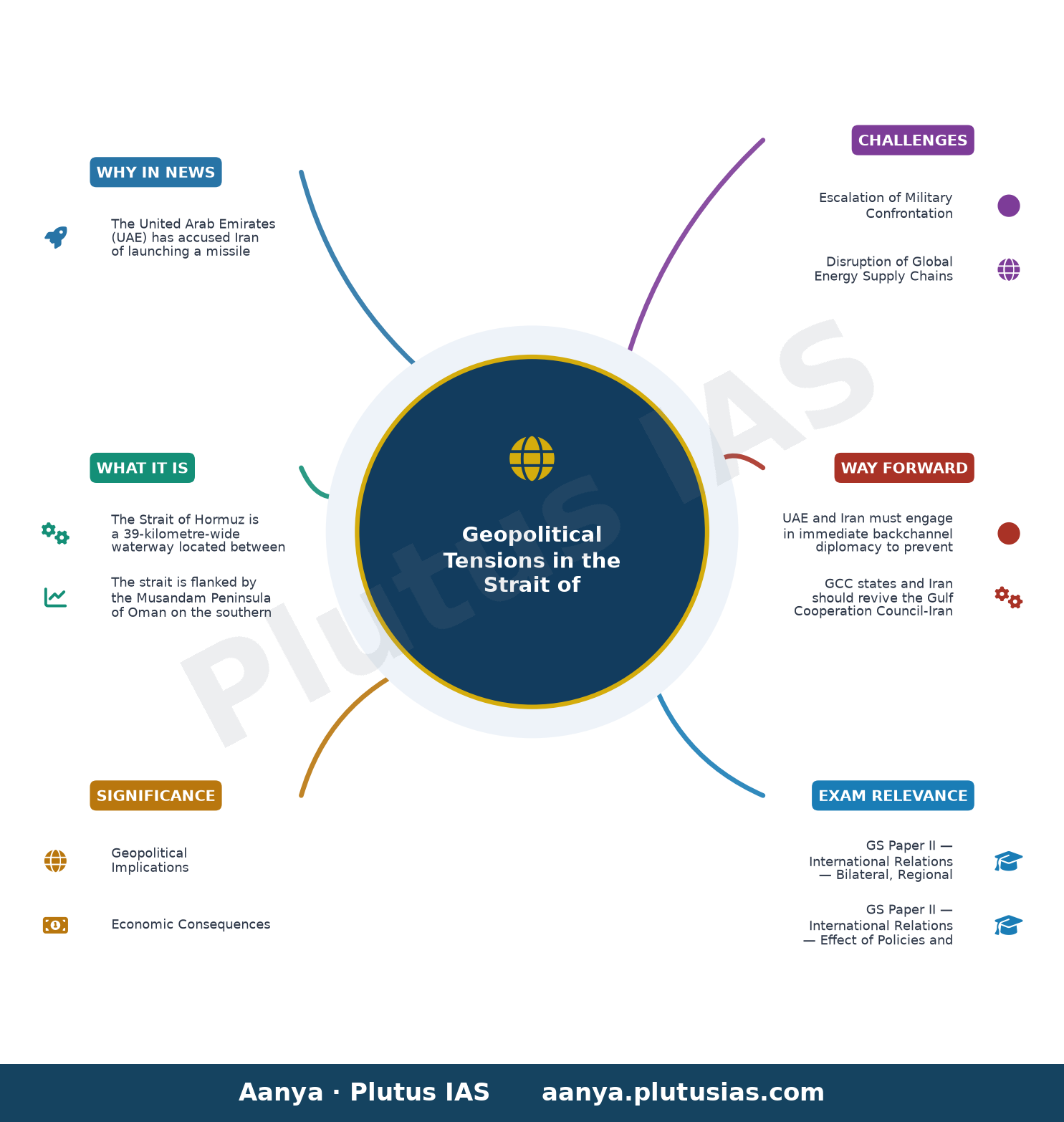
The United Arab Emirates (UAE) has accused Iran of launching a missile strike on a vessel affiliated with Abu Dhabi’s state-owned oil company, ADNOC, while transiting the strategically vital Strait of Hormuz. This incident occurs amid heightened regional tensions following the escalation of the US-Israel-Iran conflict in February 2026, and underscores the persistent vulnerability of global energy supply routes to geopolitical disruptions.
Background
- The Strait of Hormuz is a narrow waterway connecting the Persian Gulf to the Gulf of Oman and the Arabian Sea, through which approximately 20% of the world’s oil and gas shipments pass, making it a critical chokepoint for global energy security.
- Iran has historically leveraged its control over the Strait of Hormuz as a strategic leverage point, particularly during periods of heightened tensions with Western powers and Gulf states.
- Oman, acting as a neutral mediator in the region, has been engaged in negotiations with Iran to establish a temporary shipping route through the Strait of Hormuz, pending the resolution of technical and legal issues for a permanent arrangement.
- The UAE’s accusation against Iran follows a pattern of maritime security incidents in the region, which have prompted international condemnation and calls for de-escalation.
What is the Strait of Hormuz and why is it significant?
- The Strait of Hormuz is a 39-kilometre-wide waterway located between Oman and Iran, serving as the sole maritime exit point for oil exports from Gulf Cooperation Council (GCC) states, including Saudi Arabia, UAE, Kuwait, Qatar, Bahrain, and Iraq.
- The strait is flanked by the Musandam Peninsula of Oman on the southern side and the Hormuz Island of Iran on the northern side, making it a geostrategic chokepoint for global energy flows.
- Approximately 20-25% of the world’s oil supply and a significant portion of liquefied natural gas (LNG) transit through the Strait of Hormuz daily, rendering it indispensable to global energy markets.
- Historically, the strait has been a flashpoint during geopolitical crises, such as the Iran-Iraq War (1980–1988) and the US-led invasion of Iraq (2003), where Iran threatened to disrupt shipping in retaliation for perceived aggression.
- The strait’s significance extends beyond energy security; it is also a critical route for global trade, including container ships and bulk carriers, making it a vital artery for international commerce.
- Disruptions in the Strait of Hormuz can lead to significant spikes in global oil prices, as witnessed during past geopolitical crises, thereby impacting economies worldwide, including India, which imports a substantial portion of its oil from the Gulf region.
- The presence of the US Fifth Fleet in Bahrain and Iran’s Revolutionary Guards’ naval forces in the Persian Gulf further complicates the security dynamics of the strait, creating a potential for miscalculation and escalation.
Key Features
| Feature | Significance |
|---|---|
| Missile attack on ADNOC vessel | Demonstrates escalation in Strait of Hormuz tensions, directly impacting Gulf energy security and maritime trade |
| ADNOC’s vessel transiting Strait of Hormuz | Highlights vulnerability of critical energy supply routes to geopolitical conflict, affecting global oil markets |
| Iran-Oman negotiations on shipping route | Indicates regional diplomatic efforts to restore stability, though conditional on broader geopolitical concessions |
| US expectations of Iran-Oman agreement | Reflects US strategic interest in reopening Hormuz, contingent on Iran’s compliance with US demands |
| UK Maritime Trade Operations (UKMTO) alert | Signals international monitoring of maritime security risks in the region |
Why it Matters
Geopolitical Implications
- Escalation of proxy conflict dynamics in the Persian Gulf, with Iran and UAE/US-backed entities as primary antagonists
- Potential disruption to global oil supply chains, given the Strait of Hormuz’s role as a chokepoint for ~20% of global oil and gas shipments
- Risk of broader regional conflict spillover, particularly involving GCC states, Iran, and external powers like the US
- Undermining of diplomatic efforts to restore stability, as military actions and conditional negotiations create a feedback loop of mistrust
Economic Consequences
- Volatility in global oil prices due to perceived supply chain risks in the Strait of Hormuz
- Financial losses for energy companies (e.g., ADNOC) and insurers covering maritime transit in high-risk zones
- Potential long-term rerouting of trade routes, increasing costs and time for energy shipments
- Impact on Gulf Cooperation Council (GCC) economies reliant on hydrocarbon exports and maritime trade
Maritime Security Challenges
- Increased risk of asymmetric attacks (missiles, drones) on commercial vessels in contested waters
- Erosion of maritime governance frameworks, including traffic separation schemes and UNCLOS-based dispute resolution
- Heightened insurance premiums and operational costs for shipping companies transiting the Strait of Hormuz
- Potential for miscalculation or accidental escalation due to overlapping military presence and surveillance
Diplomatic and Legal Dimensions
- Failure of regional mediation efforts (e.g., Oman’s role) to de-escalate tensions without broader political concessions
- Conditionality of Iran’s demands (e.g., lifting sanctions, unfreezing assets) complicating negotiations
- Ambiguity in attribution of attacks, complicating accountability and response mechanisms
- Potential violation of international maritime law (e.g., UNCLOS) if attacks target civilian vessels
Challenges
1. Escalation of Military Confrontation
- Risk of direct military engagement between Iran and GCC states or their allies (e.g., US)
- Potential for retaliatory strikes or blockades, further disrupting global energy markets
- Challenge of de-escalation without face-saving concessions for all parties involved
UPSC Link: GS Paper 2: Bilateral Groupings
2. Disruption of Global Energy Supply Chains
- Increased oil price volatility, affecting inflation and economic stability in energy-importing nations
- Possible rationing or strategic stockpiling by major economies, distorting market dynamics
- Long-term shift in trade routes, increasing costs and reducing efficiency of global supply chains
UPSC Link: GS Paper 3: Infrastructure
3. Erosion of Maritime Governance and Rule of Law
- Undermining of UNCLOS-based frameworks for maritime security and dispute resolution
- Increased reliance on private security firms or state-backed escorts, raising operational costs
- Potential for piracy or non-state actor involvement in the power vacuum
UPSC Link: GS Paper 2: International Organisations
4. Humanitarian and Environmental Risks
- Risk of environmental disasters (e.g., oil spills) due to attacks on tankers or infrastructure
- Potential for civilian casualties or hostage situations in the event of escalation
- Displacement of maritime workers and disruption to global labor markets
UPSC Link: GS Paper 1: Social Issues
Challenges — UPSC Perspective
| Issue | Concern |
|---|---|
| Military escalation | Risk of direct conflict between Iran and GCC/US-backed forces |
| Energy supply disruption | Volatility in oil prices and potential shortages in global markets |
| Maritime insecurity | Increased attacks on civilian vessels and erosion of safe transit norms |
| Diplomatic deadlock | Conditionality of negotiations complicating de-escalation efforts |
| Humanitarian impact | Potential civilian casualties and environmental damage from attacks |
Way Forward
- UAE and Iran must engage in immediate backchannel diplomacy to prevent further escalation
- GCC states and Iran should revive the Gulf Cooperation Council-Iran dialogue mechanism
- International actors (e.g., UN, EU) should facilitate a multilateral framework to address maritime security
- Energy-importing nations should diversify supply sources and enhance strategic petroleum reserves
- Maritime insurance providers should reassess risk models and premiums for the Strait of Hormuz
- Regional states should strengthen maritime domain awareness through enhanced surveillance and intelligence-sharing
- Non-state actors (e.g., tanker operators) should adopt enhanced security protocols for high-risk transit zones
UPSC Value Addition
Keywords for Mains Answer-Writing
Strait of Hormuz · Geopolitical tensions in West Asia · Energy security and global oil supply · Iran-UAE relations · Maritime security and piracy · UNCLOS and freedom of navigation · Regional security architecture in West Asia · Oman’s mediation role in Iran-West relations · US-Iran conflict and its regional implications · ADNOC and energy infrastructure security · Missile and drone attacks on commercial vessels · International maritime law and maritime chokepoints · Supreme National Security Council of Iran · Revolutionary Guards and asymmetric warfare · Oil and gas supply chains and geopolitical risks
Constitutional & Policy Linkages
- [‘Article 51: Promotion of international peace and security’]
- [‘Article 253: Parliament’s power to legislate for implementing treaties’]
Concept Flow
Escalation of Iran-UAE tensions in Strait of Hormuz → Missile attack on ADNOC vessel → Regional military posturing → Disruption of global energy supply chains → Volatility in oil prices → Economic instability in energy-importing nations → Conditional negotiations between Iran and Oman → Failure to address core demands (e.g., sanctions) → Stalemate → International monitoring (e.g., UKMTO) → Heightened maritime security risks → Increased operational costs for shipping → Potential for retaliatory strikes or blockades → Further escalation → Broader regional conflict
Prelims Practice Questions
Q1. Consider the following statements regarding the Strait of Hormuz:
1. It connects the Persian Gulf to the Gulf of Oman and the Arabian Sea.
2. Approximately 20% of the world’s oil supply passes through it daily.
3. The Strait is governed by the provisions of the United Nations Convention on the Law of the Sea (UNCLOS) regarding transit passage.
4. Oman and Iran have historically shared sovereignty over the Strait under a bilateral treaty.
How many of the above statements are correct?
- Only one
- Only two
- Only three
- All four
Answer: Only three — Statements 1, 2, and 3 are correct. The Strait of Hormuz connects the Persian Gulf to the Gulf of Oman and the Arabian Sea; it carries about 20% of global oil shipments; and UNCLOS provides for transit passage rights. Statement 4 is incorrect as the Strait is not under joint sovereignty but is subject to the territorial sea and exclusive economic zone regimes of the littoral states under UNCLOS.
Q2. Assertion (A): The Revolutionary Guards of Iran have stated that the reopening of the Strait of Hormuz depends on Washington accepting Iran’s conditions.
Reason (R): Iran has consistently demanded the lifting of US sanctions and the removal of the naval blockade as prerequisites for restoring maritime security in the Strait.
In the context of the above two statements, which one of the following is correct?
- Both A and R are true, and R is the correct explanation of A.
- Both A and R are true, but R is NOT the correct explanation of A.
- A is true, but R is false.
- A is false, but R is true.
Answer: Both A and R are true, and R is the correct explanation of A. — Both the Assertion (A) and Reason (R) are true, and R correctly explains A. The Revolutionary Guards’ statement reflects Iran’s broader demand for sanctions relief and an end to the US naval blockade as conditions for reopening the Strait of Hormuz.
Q3. Match the following entities with their respective roles in the context of the Strait of Hormuz dispute:
Column I
A. ADNOC
B. Revolutionary Guards
C. Oman
D. Supreme National Security Council of Iran
Column II
1. State-owned oil company of Abu Dhabi, UAE
2. Iran’s paramilitary force responsible for asymmetric warfare
3. Mediator in Iran-West relations and facilitator of shipping arrangements
4. Iran’s top national security body setting reopening conditions
Select the correct match:
- A-1, B-2, C-3, D-4
- A-2, B-1, C-4, D-3
- A-3, B-4, C-1, D-2
- A-4, B-3, C-2, D-1
Answer: A-1, B-2, C-3, D-4 — The correct matches are: A (ADNOC) with 1 (State-owned oil company of Abu Dhabi, UAE), B (Revolutionary Guards) with 2 (Iran’s paramilitary force responsible for asymmetric warfare), C (Oman) with 3 (Mediator in Iran-West relations and facilitator of shipping arrangements), and D (Supreme National Security Council of Iran) with 4 (Iran’s top national security body setting reopening conditions).
Mains Practice Question
✍ The recent missile attack on a UAE-affiliated vessel in the Strait of Hormuz underscores the persistent geopolitical volatility in West Asia and its implications for global energy security. Critically examine the strategic significance of the Strait of Hormuz, the factors contributing to its instability, and the role of regional and international actors in maintaining maritime security. Also, assess the feasibility of Oman’s mediation efforts in resolving the current impasse. (15 Marks)
Approach: MODEL-ANSWER SKELETON:
1. **Strategic Significance of the Strait of Hormuz** (3 points, ~50 words)
– Chokepoint connecting the Persian Gulf to the Gulf of Oman and Arabian Sea; carries ~20% of global oil shipments and ~30% of LNG.
– Critical for energy security of major economies (US, EU, China, India).
– UNCLOS provisions on transit passage (Art. 37-44) and freedom of navigation (Art. 87) govern its legal regime.
2. **Factors Contributing to Instability** (4 points, ~70 words)
– **US-Iran conflict**: Since February 28, 2026, escalation has led to missile/drone attacks on commercial vessels (ADNOC reports 13+ attacks, 1 fatality, 20 injured).
– **Iran’s demands**: Lifting of US sanctions, removal of naval blockade, unfreezing of assets, compensation for war damage, and end to US military threats.
– **Asymmetric warfare**: Revolutionary Guards’ role in targeting commercial vessels as part of Iran’s deterrence strategy.
– **Regional rivalries**: Proxy conflicts involving Saudi Arabia, UAE, and Iran exacerbate tensions.
3. **Role of Regional and International Actors** (4 points, ~70 words)
– **Oman**: Mediator facilitating temporary shipping routes; condemned attacks without assigning blame; urged restraint to protect talks.
– **UAE**: ADNOC vessels targeted; diplomatic pressure on Iran; reliance on US for security guarantees.
– **US**: Supports Oman’s mediation; expects imminent Iran-Oman deal; may lift blockade contingent on Iran’s commitments.
– **UN and UNCLOS**: Legal framework for transit passage; calls for de-escalation and adherence to maritime law.
4. **Feasibility of Oman’s Mediation** (4 points, ~60 words)
– **Strengths**: Oman’s neutral stance; historical role in Iran-West diplomacy (e.g., 2015 nuclear deal talks).
– **Challenges**: Iran’s maximalist demands (e.g., sanctions relief, compensation); US reluctance to concede without verifiable Iranian compliance.
– **Limits**: Oman’s influence is constrained by broader geopolitical dynamics (US-Iran rivalry, regional proxy wars).
– **Outlook**: Success depends on Iran’s willingness to moderate demands and US’s flexibility in lifting sanctions incrementally.
Balance of views: Optimists highlight Oman’s track record; pessimists point to entrenched positions and lack of trust between parties.
Source: Mint
Generated by AanyaAi for educational purpose.

- उत्तराखंड में 54 धारा-नौलों का पारंपरिक विधि से पुनरुद्धार, सीमेंट का न्यूनतम प्रयोग - September 29, 2026
- Kerala doubles compensation for wildlife attacks, crop loss amid rising conflicts - September 29, 2026
- दिल्ली हाई कोर्ट ने रेड बुल के ‘एनर्जी ड्रिंक’ टैग पर FSSAI के आदेश को किया निरस्त - September 29, 2026

No Comments