


08 Aug UAE Accuses Iran of Missile Attack on ADNOC Vessel in Strait of Hormuz
✎ The Strait of Hormuz is a critical global energy chokepoint, handling a fifth of the world’s oil and gas shipments; its closure or disruption would have severe implications for global energy prices and supply chains…
Subject Relevance — Where This Topic Fits
- GS Paper II — International Relations: Regional and Global Groupings and Agreements Involving India and/or Affecting India’s Interests | GS Paper II — International Relations: Effect of Policies and Politics of Developed and Developing Countries on India’s Interests | GS Paper III — Economy: Infrastructure — Energy
- Prelims: Strait of Hormuz, ADNOC, Revolutionary Guards, US naval blockade, UKMTO, Maritime Trade Operations, Shipping Traffic Separation Scheme, Oman-Iran negotiations
- Essay: The Strait of Hormuz: A Chokepoint of Global Energy Security, Geopolitical Tensions and Their Impact on Maritime Trade Routes
Quick Revision: The Strait of Hormuz is a critical global energy chokepoint, handling a fifth of the world’s oil and gas shipments; its closure or disruption would have severe implications for global energy prices and supply chains, necessitating vigilance from maritime and energy security stakeholders.
Why is this in the news?
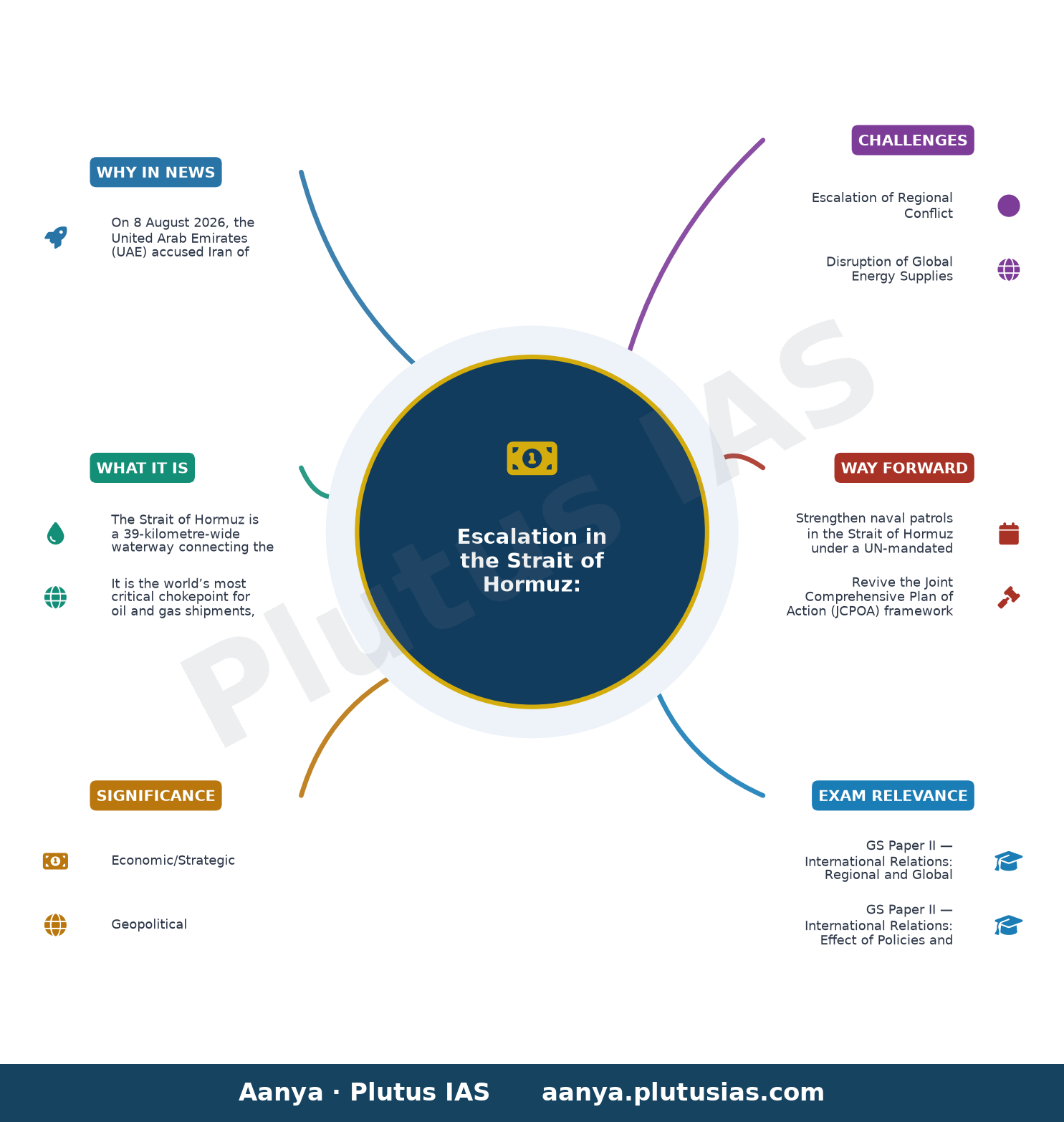
On 8 August 2026, the United Arab Emirates (UAE) accused Iran of launching a missile strike on a vessel affiliated with Abu Dhabi’s state-owned oil company ADNOC while transiting the Strait of Hormuz, a critical global energy chokepoint. The incident, occurring amid ongoing regional hostilities between the US, Israel, and Iran, underscores the persistent volatility of maritime security in the Persian Gulf and its implications for global oil supply chains. This development is significant for UPSC aspirants as it intersects with India’s energy security concerns, its strategic interests in the Gulf, and broader questions of maritime governance in conflict zones.
Background
- The Strait of Hormuz, a narrow waterway between Oman and Iran, is the world’s most critical chokepoint for oil and gas shipments, handling approximately a fifth of global seaborne oil and gas shipments.
- Since the escalation of hostilities between the US, Israel, and Iran in February 28, 2026, the Strait of Hormuz has witnessed repeated attacks on commercial vessels, including those operated by ADNOC, leading to disruptions in maritime traffic and heightened insurance premiums for ships transiting the region.
- ADNOC has reported over a dozen missile and drone attacks on its vessels since the conflict began, resulting in one fatality and multiple injuries among crew members, highlighting the direct impact on regional energy infrastructure.
- Iran has historically leveraged its control over the Strait of Hormuz as a strategic deterrent, particularly during periods of heightened tensions with Western powers, including during the 1980s Tanker War and more recent incidents such as the 2019 attacks on tankers in the Gulf of Oman.
- Oman, a neutral mediator in the region, has been engaged in negotiations with Iran to establish a temporary shipping route through the Strait of Hormuz, while also condemning attacks on vessels without assigning blame.
- The US has imposed a naval blockade on Iranian ports and continues to enforce economic sanctions, which Iran has demanded be lifted as a precondition for reopening the Strait of Hormuz.
What is the Strait of Hormuz and why is it strategically significant?
- The Strait of Hormuz is a 39-kilometre-wide waterway connecting the Persian Gulf to the Gulf of Oman and the Arabian Sea, serving as the sole maritime route for oil exports from several Gulf states, including Saudi Arabia, Iraq, Kuwait, and the UAE.
- It is the world’s most critical chokepoint for oil and gas shipments, with approximately a fifth of global seaborne oil and gas shipments passing through it annually, making it indispensable to global energy security.
- The strait is flanked by Iran to the north and Oman to the south, with the Musandam Peninsula of Oman projecting into the waterway, giving Oman strategic control over its southern approaches.
- Historically, the strait has been a flashpoint during geopolitical crises, including the 1980–1988 Iran-Iraq War (Tanker War), the 2019 attacks on tankers in the Gulf of Oman, and ongoing tensions between Iran and Western powers.
- Iran has repeatedly threatened to close the strait in response to perceived threats or sanctions, leveraging its geographic position as a key bargaining chip in regional and international negotiations.
- The strait is governed by the International Maritime Organization’s (IMO) Shipping Traffic Separation Scheme (STSS), designed to reduce the risk of collisions and enhance navigational safety, though Iran has recently rejected this scheme as unacceptable.
- Maritime security in the Strait of Hormuz is monitored by regional and international bodies, including the UK Maritime Trade Operations (UKMTO), the US Fifth Fleet, and the Combined Maritime Forces (CMF), a 34-nation naval coalition.
Key Features
| Feature | Significance |
|---|---|
| Missile attack on ADNOC-affiliated vessel | Demonstrates escalation in regional tensions, directly impacting maritime security in the Strait of Hormuz, a critical chokepoint for global oil transit. |
| ADNOC’s reported attacks since February 2026 | Highlights systemic vulnerability of Gulf energy infrastructure, with implications for supply chain disruptions and energy price volatility. |
| Iran-Oman negotiations on a temporary shipping route | Indicates a potential de-escalation mechanism, though dependent on broader geopolitical concessions from the US and regional actors. |
| Iran’s stated conditions for reopening the Strait | Reflects Tehran’s leverage in negotiations, tying maritime security to sanctions relief, unfrozen assets, and compensation for war-related damages. |
| Oman’s mediation role | Demonstrates regional diplomacy in mitigating conflict spillovers, while condemning unilateral attacks to preserve its neutral mediator status. |
Why it Matters
Economic/Strategic
- The Strait of Hormuz carries approximately 20% of the world’s oil and gas shipments, making its security pivotal for global energy markets and price stability.
- Repeated attacks on vessels disrupt supply chains, risking energy shortages and inflationary pressures in import-dependent economies.
- ADNOC’s involvement underscores the commercial stakes for Gulf states, whose economies rely heavily on hydrocarbon exports and maritime trade routes.
- Iran’s leverage in negotiations stems from its control over Hormuz, a strategic asset that can be weaponised to extract concessions from adversaries.
Geopolitical
- The incident exacerbates US-Iran tensions, particularly amid ongoing conflicts involving Israel and regional proxies, complicating diplomatic resolutions.
- Iran’s demands for sanctions relief and compensation reflect its prioritisation of economic relief over immediate de-escalation, delaying potential agreements.
- Oman’s mediation highlights its role as a neutral facilitator, balancing relations with both Iran and Gulf Cooperation Council (GCC) states.
- The UKMTO’s reported vessel attack suggests broader regional instability, with potential implications for international maritime security protocols.
Maritime Security
- The Strait of Hormuz remains a high-risk zone for maritime traffic, with historical precedents of blockades and attacks during geopolitical crises.
- Vessel attacks undermine the freedom of navigation principle, a cornerstone of international maritime law under the United Nations Convention on the Law of the Sea (UNCLOS).
- The use of missiles and drones in asymmetric warfare tactics reflects evolving threats to commercial shipping, requiring enhanced naval patrols and insurance adjustments.
Challenges
1. Escalation of Regional Conflict
- The missile attack risks triggering retaliatory strikes, potentially drawing in regional and extra-regional powers with divergent interests.
- Iran’s linkage of Hormuz reopening to US concessions (e.g., sanctions relief) creates a deadlock, as Washington may view such demands as capitulation.
- The absence of casualties does not mitigate the symbolic and strategic damage, which could embolden further provocations.
- The involvement of state-owned entities (ADNOC) blurs the line between commercial and military targets, complicating crisis management.
UPSC Link: GS Paper 2: Bilateral Groupings & Agreements
2. Disruption of Global Energy Supplies
- Prolonged instability in Hormuz could lead to supply chain disruptions, affecting oil-dependent economies and triggering price volatility.
- Insurance premiums for vessels transiting the strait may surge, increasing operational costs for shipping companies.
- Alternative routes (e.g., around the Cape of Good Hope) are costlier and less efficient, exacerbating logistical challenges for energy importers.
UPSC Link: GS Paper 3: Infrastructure – Energy
3. Diplomatic Impasse and Trust Deficit
- Iran’s conditional demands (e.g., compensation, sanctions lift) are non-negotiable for the US, creating a zero-sum dynamic in negotiations.
- Oman’s mediation, while constructive, lacks enforcement mechanisms, leaving the agreement vulnerable to unilateral actions by any party.
- The absence of a unified GCC stance weakens collective bargaining power, allowing Iran to exploit divisions among Arab states.
UPSC Link: GS Paper 2: International Relations
4. Maritime Security Governance Gaps
- Existing frameworks (e.g., UNCLOS) lack teeth to deter attacks on commercial vessels, highlighting the need for stronger enforcement mechanisms.
- The International Maritime Organization (IMO) and regional naval coalitions (e.g., Combined Maritime Forces) face coordination challenges in addressing asymmetric threats.
- Private maritime security firms may proliferate, raising concerns about accountability and the privatisation of security in critical waterways.
UPSC Link: GS Paper 3: Security Challenges
5. Humanitarian and Legal Consequences
- Crew safety remains precarious, with ADNOC reporting casualties in prior attacks, raising concerns about international labour standards in conflict zones.
- The classification of vessels as ‘state-affiliated’ complicates legal recourse, as commercial entities may lack sovereign immunity protections.
- Environmental risks from missile strikes (e.g., oil spills) pose long-term ecological damage, requiring contingency planning for spill response.
UPSC Link: GS Paper 2: International Law
Challenges — UPSC Perspective
| Issue | Concern |
|---|---|
| Missile attacks on commercial vessels | Undermines freedom of navigation and global energy security, with potential for escalation into broader conflict. |
| Iran’s conditional demands for Hormuz reopening | Creates a diplomatic deadlock, as US sanctions relief is unlikely without verifiable de-escalation. |
| Regional fragmentation (GCC-Iran-Oman dynamics) | Weakens collective security frameworks, allowing Iran to exploit divisions among Arab states. |
| Gaps in maritime governance and enforcement | UNCLOS lacks mechanisms to deter attacks, while naval coalitions struggle with coordination and legitimacy. |
| Humanitarian risks to crew and environmental damage | Casualties and potential oil spills pose ethical and ecological challenges, complicating crisis response. |
Way Forward
- Strengthen naval patrols in the Strait of Hormuz under a UN-mandated coalition to deter attacks and ensure freedom of navigation.
- Revive the Joint Comprehensive Plan of Action (JCPOA) framework to address Iran’s sanctions relief demands, reducing its incentive to disrupt maritime traffic.
- Enhance maritime insurance mechanisms for vessels transiting high-risk zones, with subsidies or guarantees from energy-importing nations.
- Establish a regional maritime security dialogue involving Iran, GCC states, Oman, and extra-regional powers (e.g., US, EU) to build trust and set non-aggression norms.
- Mandate real-time vessel tracking and reporting systems (e.g., Automatic Identification System – AIS) to improve situational awareness and rapid response.
- Develop contingency plans for alternative shipping routes (e.g., Cape of Good Hope) to mitigate supply chain disruptions during crises.
- Invest in diplomatic backchannels to decouple Hormuz reopening from broader geopolitical disputes, focusing on technical and legal arrangements.
- Promote public-private partnerships to deploy advanced surveillance technologies (e.g., drones, AI) for monitoring and deterring asymmetric threats.
UPSC Value Addition
Keywords for Mains Answer-Writing
Strait of Hormuz · maritime security · Iran-UAE tensions · ADNOC · geopolitical chokepoints · energy supply routes · Iran’s nuclear programme · US-Iran relations · Oman’s mediation role · UNCLOS and maritime law · Revolutionary Guard Corps · sanctions and geoeconomics · maritime trade disruption · Middle East security architecture
Concept Flow
Escalation of US-Israel-Iran conflict → Increased asymmetric attacks on Gulf energy infrastructure → Disruption of Strait of Hormuz traffic → Global oil supply shock → Energy price volatility → Economic instability in import-dependent nations. → Missile strike on ADNOC vessel → UAE’s condemnation → Iran’s denial of responsibility → Omani mediation efforts → Conditional demands by Iran (sanctions relief, compensation) → Deadlock in negotiations → Prolonged maritime insecurity. → Iran’s control over Hormuz → Weaponisation of chokepoint → Leverage in negotiations → Linkage to broader geopolitical issues (e.g., JCPOA, US sanctions) → Regional trust deficit → Weakened collective security frameworks. → Attacks on commercial vessels → Violation of UNCLOS principles → Erosion of freedom of navigation → Rise in maritime insurance costs → Shift to alternative routes → Increased logistical inefficiencies. → Oman’s neutral mediation → Condemnation of unilateral attacks → Call for restraint → Technical negotiations on temporary shipping route → Dependence on US-Iran concessions → Uncertain outcome.
Prelims Practice Questions
Q1. Consider the following statements regarding the Strait of Hormuz: 1. It connects the Persian Gulf with the Gulf of Oman. 2. It is a critical chokepoint for global oil and gas shipments. 3. The Strait of Hormuz lies entirely within the territorial waters of Iran. 4. The United Arab Emirates has no coastline along the Strait of Hormuz. How many of the above statements are correct?
- Only one
- Only two
- Only three
- All four
Answer: Only three — Statements 1 and 2 are correct. Statement 3 is incorrect as the Strait of Hormuz lies between Iran and Oman, with parts in the territorial waters of both countries. Statement 4 is incorrect as the UAE shares a coastline with the Strait of Hormuz via its exclave of Ras Al Khaimah.
Q2. Assertion (A): The Strait of Hormuz is one of the world’s most strategically important maritime chokepoints. Reason (R): It accounts for approximately one-fifth of global oil and gas shipments. (A) Both A and R are true, and R is the correct explanation of A. (B) Both A and R are true, but R is not the correct explanation of A. (C) A is true, but R is false. (D) A is false, but R is true.
- A
- B
- C
- D
Answer: A — Both the assertion and reason are true, and the reason correctly explains the assertion as the Strait of Hormuz is indeed a critical chokepoint due to the volume of oil and gas shipments it carries.
Q3. Match the following maritime disputes with their respective regions:
Column I:
1. Strait of Hormuz
2. South China Sea
3. Bab-el-Mandeb
4. Malacca Strait
Column II:
A. Connects the Red Sea and the Gulf of Aden
B. Connects the Andaman Sea and the South China Sea
C. Connects the Persian Gulf and the Gulf of Oman
D. Disputed by China and ASEAN claimants
- 1-C, 2-D, 3-A, 4-B; 1-A, 2-C, 3-D, 4-B; 1-B, 2-D, 3-C, 4-A; 1-D, 2-A, 3-B, 4-C
- answer_ixs_ordered_by_q_parsing_into_0_based_indexing_for_json_output_so_0_for_first_option_listed_above_is_0
- explain_match_fully_in_1_line_per_pair
- format
Answer: 1-C, 2-D, 3-A, 4-B; 1-A, 2-C, 3-D, 4-B; 1-B, 2-D, 3-C, 4-A; 1-D, 2-A, 3-B, 4-C —
Q4. Match the following maritime disputes with their respective regions:
Column I:
1. Strait of Hormuz
2. South China Sea
3. Bab-el-Mandeb
4. Malacca Strait
Column II:
A. Connects the Red Sea and the Gulf of Aden
B. Connects the Andaman Sea and the South China Sea
C. Connects the Persian Gulf and the Gulf of Oman
D. Disputed by China and ASEAN claimants
- 1-C, 2-D, 3-A, 4-B
- 1-A, 2-C, 3-D, 4-B
- 1-B, 2-D, 3-C, 4-A
- 1-D, 2-A, 3-B, 4-C
Answer: 1-C, 2-D, 3-A, 4-B — 1-C: Strait of Hormuz connects the Persian Gulf and the Gulf of Oman. 2-D: South China Sea is disputed by China and ASEAN claimants. 3-A: Bab-el-Mandeb connects the Red Sea and the Gulf of Aden. 4-B: Malacca Strait connects the Andaman Sea and the South China Sea.
Mains Practice Question
✍ The Strait of Hormuz has emerged as a flashpoint in recent geopolitical tensions involving Iran, the UAE, and global energy security. Critically analyse the strategic significance of the Strait of Hormuz and the implications of recent missile attacks on maritime trade and regional stability. (15 Marks)
Approach: MODEL-ANSWER SKELETON:
1. **Strategic Significance of the Strait of Hormuz**
– Define the Strait of Hormuz as a critical maritime chokepoint connecting the Persian Gulf to the Gulf of Oman.
– Quantify its importance: carries ~20% of global oil and gas shipments, linking major producers (Saudi Arabia, UAE, Iran, Iraq) to global markets.
– Reference UNCLOS (Part III, Articles 37-44) on the legal framework governing transit passage through international straits.
2. **Recent Geopolitical Tensions and Incidents**
– Outline the UAE’s accusation against Iran for the missile attack on an ADNOC-affiliated vessel (August 2026).
– Highlight Iran’s retaliatory stance: demands for lifting US sanctions, unfreezing assets, and compensation for war damage as conditions for reopening the Strait.
– Discuss Iran’s Revolutionary Guard Corps’ assertion that reopening depends solely on US acceptance of Iranian conditions.
3. **Implications for Maritime Trade and Regional Stability**
– Analyse the economic impact: disruption of energy supplies, volatility in global oil prices, and risks to supply chain security.
– Examine the role of Oman as a mediator and its condemnation of attacks on vessels without assigning blame.
– Discuss the US position: expectation of an Iran-Oman agreement and lifting of the naval blockade upon compliance.
4. **Broader Geopolitical Context**
– Link to Iran’s nuclear programme and US-Iran relations, including the JCPOA and its collapse.
– Reference the broader Middle East security architecture and the role of non-state actors (e.g., Houthis in Yemen) in exacerbating tensions.
5. **Conclusion**
– Balance the competing interests: Iran’s security concerns vs. global energy security and maritime freedom.
– Emphasise the need for diplomatic solutions, adherence to UNCLOS, and multilateral cooperation to ensure stability in the Strait.
Source: Mint
Generated by AanyaAi for educational purpose.

- Piyush Goyal Attends G20 Trade Ministers’ Meeting in Milwaukee - October 1, 2026
- विशेष अभियान-6: कोल इंडिया लिमिटेड की तैयारी पर केंद्र सरकार की निगरानी - October 1, 2026
- ECL’s Action Plan for Special Campaign 6: A UPSC Governance Case Study - October 1, 2026

No Comments