


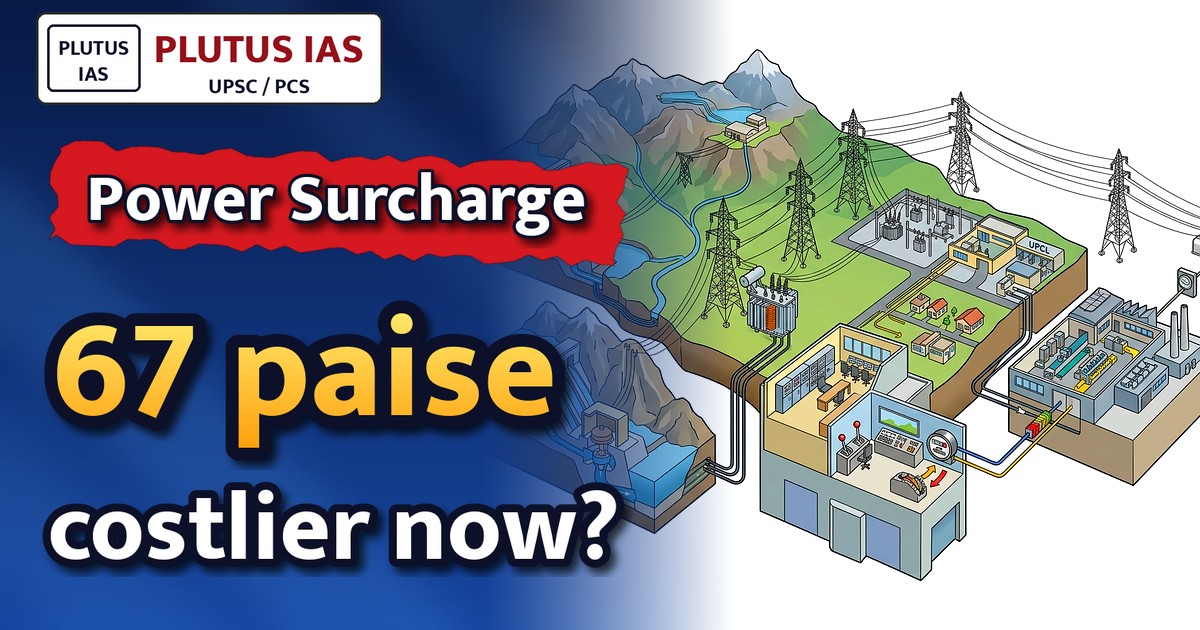
30 Sep UERC imposes 67 paise/unit surcharge on open access power in Uttarakhand
✎ Open access in electricity enables large consumers to buy power directly from generators, but utilities recover stranded capacity costs through regulated surcharges like the 67 paise per unit imposed by UERC in Uttarakhand.
Subject Relevance — Where This Topic Fits
- GS Paper III — Indian Economy: Energy Sector Reforms, Electricity (Rights of Consumers) Rules 2020, Open Access Regulations
- Prelims: Open Access in Electricity, Cross-Subsidy Surcharge, Fixed Cost Recovery, UERC, Uttarakhand Power Corporation Limited (UPCL), Electricity Act 2003, Electricity (Promoting Renewable Energy Through Green Energy Open Access) Rules 2022
- Essay: Energy Transition in India: Balancing Affordability and Sustainability
Quick Revision: Open access in electricity enables large consumers to buy power directly from generators, but utilities recover stranded capacity costs through regulated surcharges like the 67 paise per unit imposed by UERC in Uttarakhand.
Why is this in the news?
The Uttarakhand Electricity Regulatory Commission (UERC) has imposed a 67 paise per unit surcharge on open access consumers, effective from 1 October 2026, following a detailed review of unused contracted power and associated fixed costs. This decision addresses UPCL’s petition seeking compensation for stranded capacity costs due to industrial consumers opting for cheaper open market power, highlighting the regulatory challenges in balancing market efficiency with cost recovery in the electricity sector.
Background
- The Electricity Act, 2003, introduced open access provisions to enable large consumers to procure electricity directly from generators, bypassing distribution utilities, subject to regulatory approvals.
- UPCL, as the state’s distribution utility, is mandated to ensure uninterrupted power supply to all consumers, necessitating long-term power purchase agreements (PPAs) with fixed capacity charges.
- When large industrial consumers opt for open access, UPCL’s contracted power remains underutilised, leading to stranded capacity costs that must be recovered from remaining consumers to maintain financial viability.
- UERC’s decision follows a petition by UPCL seeking 88 paise per unit surcharge, which was reduced to 67 paise after accounting for technical losses and actual unused power (27.97 crore units) during October 2025–March 2026.
- Industrial associations, including the Kumaun-Garhwal Chamber of Commerce and Industry, opposed the surcharge, arguing it disproportionately burdens high-voltage consumers (132 kV and above) and undermines open access benefits.
What is Open Access in Electricity?
- Open access allows eligible consumers (typically those with a sanctioned load of 1 MW or more) to procure electricity directly from generators or power exchanges, bypassing the local distribution utility.
- Open access aims to enhance competition, reduce costs for large consumers, and facilitate renewable energy integration by enabling direct purchase of green power.
- Consumers must pay a cross-subsidy surcharge (CSS) to compensate for the loss of high-paying industrial consumers, ensuring the financial sustainability of distribution utilities.
- Technical and commercial losses in transmission and distribution are factored into tariff calculations, as seen in UERC’s adjustment of the surcharge from 88 paise to 67 paise per unit.
- Open access can be short-term (up to 1 year), medium-term (1–5 years), or long-term (>5 years), with varying regulatory requirements for each category.
- State utilities often face stranded capacity costs when large consumers leave the grid, necessitating regulatory mechanisms like CSS or surcharges to mitigate financial strain.
Key Features
| Feature | Significance |
|---|---|
| Open Access Power | Permits large consumers to purchase electricity directly from the market, bypassing the state utility, thereby enhancing competition and efficiency in the power sector. |
| Additional Surcharge (67 paise/unit) | Compensates the state utility (Uttarakhand Power Corporation Limited) for fixed costs incurred due to unutilised contracted power when consumers opt for Open Access, ensuring financial sustainability of the utility. |
| Regulatory Oversight by UERC | The Uttarakhand Electricity Regulatory Commission (UERC) determines the surcharge based on technical and financial assessments, ensuring transparency and adherence to the Electricity Act, 2003. |
| Fixed Cost Recovery | Addresses the financial burden on UPCIL when Open Access consumers reduce their reliance on contracted power, thereby maintaining the utility’s ability to meet demand from other consumers. |
| Six-Month Validity | The surcharge is imposed for a defined period (six months), allowing for periodic review and adjustment based on market conditions and consumer behaviour. |
Why it Matters
Economic
- Increases the cost of electricity for large industrial consumers opting for Open Access, potentially impacting their operational expenses and competitiveness.
- Ensures financial viability of the state utility (UPCIL) by recovering fixed costs, preventing cross-subsidisation from other consumer segments.
- Encourages balanced utilisation of contracted power and Open Access, promoting efficient resource allocation in the power sector.
Regulatory
- Demonstrates the role of state electricity regulatory commissions in balancing market dynamics with the financial health of utilities.
- Highlights the importance of data-driven decision-making in determining surcharges, as evidenced by UERC’s detailed technical review.
- Upholds the principles of the Electricity Act, 2003, by ensuring that Open Access consumers contribute to the fixed costs of the utility.
Sectoral
- Reflects the challenges in integrating Open Access with traditional utility-based power procurement models, particularly in hilly and geographically constrained states like Uttarakhand.
- Underscores the need for robust infrastructure to support Open Access, including transmission and distribution networks, to minimise technical losses.
Challenges
1. Financial Viability of State Utilities
- State utilities face revenue shortfalls when large consumers switch to Open Access, necessitating mechanisms like surcharges to recover fixed costs.
- The imposition of surcharges must balance the need for utility sustainability with the affordability of electricity for industrial consumers.
UPSC Link: GS-III: Infrastructure-Energy
2. Regulatory Arbitrage and Consumer Resistance
- Industrial consumers may resist surcharges, arguing that they disproportionately affect large users and undermine the benefits of Open Access.
- Regulatory bodies must ensure that surcharges are justified, transparent, and applied uniformly to avoid disputes.
UPSC Link: GS-II: Statutory/Regulatory Bodies
3. Technical Losses and Infrastructure Gaps
- High technical losses in transmission and distribution networks in hilly regions like Uttarakhand exacerbate financial challenges for utilities.
- Investments in grid strengthening and smart metering are essential to reduce losses and improve the efficiency of Open Access.
UPSC Link: GS-III: Infrastructure-Energy
4. Market Distortions and Competition
- The surcharge may distort market signals, discouraging Open Access and reducing competition in the power sector.
- A balanced approach is required to ensure that Open Access remains a viable option while protecting the financial health of utilities.
UPSC Link: GS-III: Infrastructure-Energy
Challenges — UPSC Perspective
| Issue | Concern |
|---|---|
| Revenue Shortfall for State Utilities | Fixed costs of contracted power remain unmet when consumers opt for Open Access, threatening the financial sustainability of utilities. |
| Consumer Affordability | Increased electricity costs for industrial consumers may reduce their competitiveness and operational efficiency. |
| Regulatory Consistency | Ensuring that surcharges are applied uniformly and justified to prevent disputes and legal challenges. |
| Infrastructure Limitations | High technical losses in transmission and distribution networks in hilly regions undermine the efficiency of Open Access. |
| Market Distortions | Surcharges may discourage Open Access, reducing competition and efficiency in the power sector. |
Way Forward
- Conduct a comprehensive review of Open Access policies to balance utility sustainability with consumer affordability.
- Invest in grid strengthening and smart metering in hilly regions to reduce technical losses and improve efficiency.
- Enhance transparency in the calculation of surcharges by publishing detailed technical and financial assessments.
- Engage with industrial consumers and stakeholders to address concerns and ensure equitable application of surcharges.
- Explore alternative mechanisms for cost recovery, such as dynamic pricing or incentives for utilities to reduce fixed costs.
- Strengthen the regulatory framework to ensure timely adjustments to surcharges based on market conditions.
- Promote energy efficiency and demand-side management to reduce the reliance on Open Access and mitigate revenue shortfalls.
- Collaborate with neighbouring states to develop regional power markets, enhancing competition and reducing costs.
UPSC Value Addition
Keywords for Mains Answer-Writing
Open Access in Electricity · Electricity Regulatory Commissions · Electricity Act 2003 · Fixed Cost Recovery in Power Sector · Open Access Consumers · Uttarakhand Electricity Regulatory Commission (UERC) · Uttarakhand Power Corporation Limited (UPCL) · Open Access Surcharge · Electricity Distribution Losses · Electricity Pricing Mechanism · Electricity Market Regulations · Regulatory Jurisdiction over Open Access · Electricity Act 2003 Section 42 · Electricity Act 2003 Section 62 · Electricity Act 2003 Section 63 · Power Sector Reforms · Electricity Tariff Determination · Electricity Regulatory Framework in India · Electricity Distribution Companies (DISCOMs) Obligations
Concept Flow
Large industrial consumers opt for Open Access to purchase electricity directly from the market. → State utility (UPCIL) incurs fixed costs for contracted power that remains unutilised due to Open Access. → UPCIL approaches the regulatory commission (UERC) for permission to impose a surcharge on Open Access consumers. → UERC conducts a technical and financial review to determine the surcharge, ensuring it is justified and transparent. → Surcharge is imposed on Open Access consumers to recover fixed costs, ensuring the financial viability of the utility. → Industrial consumers face higher electricity costs, potentially impacting their operational efficiency and competitiveness.
Prelims Practice Questions
Q1. Consider the following statements regarding Open Access in the electricity sector in India:
1. Open Access allows consumers to purchase electricity directly from the power market.
2. Open Access is regulated under Section 42 of the Electricity Act 2003.
3. Open Access consumers are exempt from paying any fixed charges to the distribution licensee.
4. The Electricity Regulatory Commission determines the surcharge for Open Access consumers.
How many of the above statements are correct?
- Only one
- Only two
- Only three
- All
Answer: Only three — Statements 1 and 2 are correct. Open Access permits direct procurement of electricity from the market. Section 42 of the Electricity Act 2003 governs Open Access. Statement 3 is incorrect as Open Access consumers are required to pay fixed charges to the distribution licensee to cover stranded costs. Statement 4 is correct as the regulatory commission determines the surcharge under Section 62 of the Act.
Q2. Assertion (A): The Electricity Act 2003 mandates that Open Access consumers must pay a surcharge to the distribution licensee to compensate for stranded capacity costs.
Reason (R): The surcharge is levied to ensure that the distribution licensee can recover fixed costs incurred for maintaining power purchase agreements even when Open Access consumers bypass the licensee’s supply.
In the context of the above two statements, which of the following is correct?
- Both A and R are true, and R is the correct explanation of A
- Both A and R are true, but R is not the correct explanation of A
- A is true, but R is false
- A is false, but R is true
Answer: Both A and R are true, and R is the correct explanation of A — Both the Assertion (A) and Reason (R) are true, and the Reason correctly explains the Assertion. The Electricity Act 2003, under Section 62, empowers the regulatory commission to impose a surcharge on Open Access consumers to compensate the distribution licensee for stranded fixed costs.
Q3. Match the following provisions of the Electricity Act 2003 with their respective functions:
Column I (Provision) | Column II (Function)
— | —
A. Section 42 | 1. Determination of tariffs by the Regulatory Commission
B. Section 61 | 2. Open Access to consumers
C. Section 62 | 3. Power to recover fixed costs from Open Access consumers
D. Section 63 | 4. Promotion of competition through multiple licenses
Select the correct match:
- A-2, B-4, C-3, D-1
- A-1, B-2, C-3, D-4
- A-3, B-1, C-2, D-4
- A-4, B-3, C-1, D-2
Answer: A-2, B-4, C-3, D-1 — The correct matches are: A-2 (Section 42 governs Open Access), B-4 (Section 61 promotes competition), C-3 (Section 62 empowers recovery of fixed costs from Open Access consumers), and D-1 (Section 63 empowers the Regulatory Commission to determine tariffs).
Mains Practice Question
✍ The imposition of an open access surcharge by the Uttarakhand Electricity Regulatory Commission (UERC) on consumers procuring electricity directly from the market raises critical questions about the balance between market efficiency and the financial sustainability of distribution utilities. Critically examine the rationale behind such surcharges, their legal basis under the Electricity Act 2003, and the potential implications for industrial consumers and the power sector ecosystem. Also, analyse the role of the regulatory commission in ensuring equitable tariff determination. (15 Marks)
Approach: MODEL-ANSWER SKELETON:
1. **Rationale for Open Access Surcharge**:
– Explain the concept of stranded fixed costs incurred by DISCOMs (UPCL) when large consumers opt for Open Access, leading to underutilisation of contracted capacity.
– Highlight the need to ensure financial viability of DISCOMs to maintain grid stability and universal service obligations.
– Reference the UERC’s calculation: 67 paise/unit surcharge based on stranded capacity of 27.97 crore units and fixed cost of ₹34.26 crore for the period October 2025–March 2026.
2. **Legal Basis under Electricity Act 2003**:
– **Section 42**: Governs Open Access, allowing consumers to procure electricity from any generator.
– **Section 62**: Empowers the State Electricity Regulatory Commission (SERC) to impose a surcharge on Open Access consumers to compensate DISCOMs for stranded fixed costs.
– **Section 61 & 63**: Promote competition and empower the SERC to determine tariffs, including surcharges, to ensure fair recovery of costs.
3. **Implications for Stakeholders**:
– **Industrial Consumers**: Higher tariffs may reduce competitiveness, particularly for energy-intensive industries. Discuss the trade-off between market freedom and cost efficiency.
– **DISCOMs**: Ensures revenue stability and ability to meet fixed obligations (e.g., PPAs, grid maintenance).
– **Power Sector Ecosystem**: Balances market-driven procurement with the need for cross-subsidisation and grid reliability.
4. **Role of the Regulatory Commission**:
– **Tariff Determination**: SERCs act as quasi-judicial bodies under Section 63, ensuring tariffs are fair, transparent, and based on cost-plus principles.
– **Consumer Protection**: Balances the interests of Open Access consumers with those of captive consumers and DISCOMs.
– **Data-Driven Decisions**: Reference the UERC’s methodology, including technical losses adjustment and slot-wise review, to ensure accuracy.
5. **Critical Perspective**:
– **Market Efficiency vs. Equity**: Discuss whether surcharges distort market signals and deter Open Access adoption.
– **Alternative Mechanisms**: Explore options like dynamic pricing, time-of-day tariffs, or capacity markets to align incentives.
– **Stakeholder Concerns**: Address objections from industrial associations (e.g., Kumaun-Garhwal Chamber of Commerce) regarding the fairness of surcharge imposition on high-voltage consumers.
6. **Conclusion**:
– Summarise the necessity of surcharges for DISCOM sustainability while acknowledging the need for reforms to minimise stranded costs (e.g., flexible PPAs, demand forecasting).
– Emphasise the SERC’s role in balancing efficiency, equity, and financial viability in tariff determination.
Source: amarujala.com
Uttarakhand PCS (UKPSC) — State PCS Practice
Prelims: As per the recent UKPSC directive, the electricity tariff in Uttarakhand will become expensive due to an additional surcharge imposed by the commission. What is the primary reason cited for this surcharge?
- A. Increased operational costs of state-run power plants
- B. High dependency on open market electricity purchases
- C. Decline in hydropower generation due to climate change
- D. Subsidies provided to rural consumers
Answer: B. High dependency on open market electricity purchases — The surcharge is imposed due to Uttarakhand’s high reliance on purchasing electricity from the open market at higher rates, increasing the overall cost burden.
Mains: Examine the implications of Uttarakhand’s growing dependence on open-market electricity purchases on the state’s power sector sustainability and consumer affordability. Suggest measures to mitigate the impact of fluctuating market rates on electricity tariffs in the state.
Generated by AanyaAi for educational purpose.
Related guides on our sites
- Current affairs for upsc 2026
- Anthropology VS PSIR
- Best PSIR optional coaching
- Best PSIR optional coaching online

- Cabinet Approves ₹13,000 Crore Green Energy Corridor Phase-III Scheme - September 30, 2026
- पेट्रोलियम (संशोधन) विधेयक 2026: हितधारकों से सुझाव आमंत्रित - September 30, 2026
- UERC imposes 67 paise/unit surcharge on open access power in Uttarakhand - September 30, 2026

No Comments