


18 Sep UN Accuses US of War Crimes in Iran: Key Facts for UPSC & State PCS
✎ War crimes are defined under international humanitarian law as grave breaches of the laws of war, including attacks on civilians, indiscriminate or disproportionate attacks, and failure to distinguish between combatants and…
Subject Relevance — Where This Topic Fits
- GS Paper II — International Relations: International Law and Human Rights | GS Paper II — International Relations: Role of UN and other International Institutions | GS Paper II — International Relations: Laws of Armed Conflict and Geneva Conventions | GS Paper III — Security Issues: Challenges to Internal Security and Role of Armed Forces
- Prelims: Geneva Conventions (1949), International Humanitarian Law (IHL), International Criminal Court (ICC), War Crimes, UN Human Rights Council, Independent Fact-Finding Missions, Principle of Distinction, Principle of Proportionality, Combatant and Civilian Immunity, Indiscriminate Attacks
- Essay: The moral and legal boundaries of warfare in the 21st century, The role of international institutions in upholding human rights during armed conflicts
Quick Revision: War crimes are defined under international humanitarian law as grave breaches of the laws of war, including attacks on civilians, indiscriminate or disproportionate attacks, and failure to distinguish between combatants and non-combatants, with accountability pursued through national and international judicial mechanisms.
Why is this in the news?
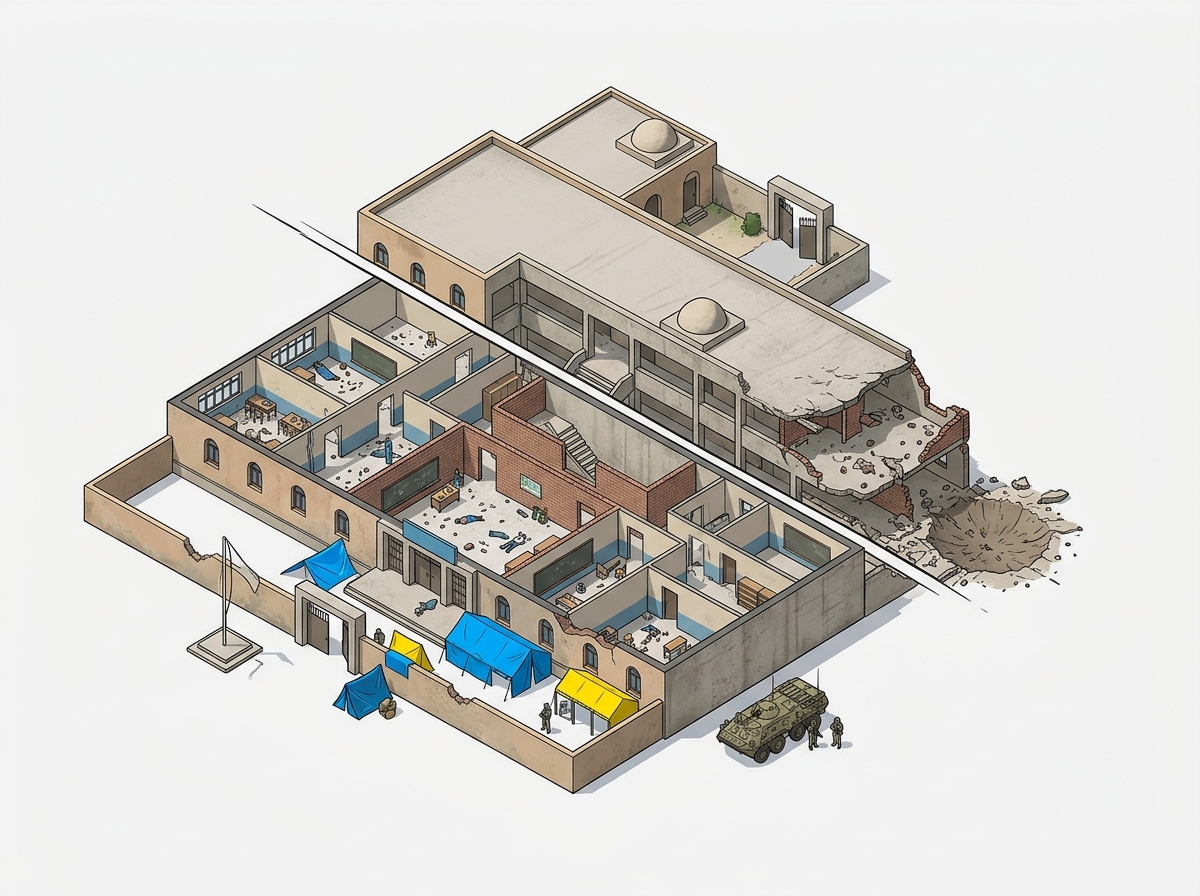
A United Nations (UN) fact-finding mission has reported reasonable grounds to believe that US forces committed war crimes during the Iran-US conflict in February 2026, following an attack on the Shajareh Tayyebeh Primary School in Minab, Iran, which resulted in the deaths of over 150 civilians, including approximately 120 schoolchildren. The mission’s findings, submitted to the UN Human Rights Council, highlight violations of international humanitarian law and underscore the legal accountability mechanisms available under international law, including potential referral to the International Criminal Court.
Background
- The UN Independent International Fact-Finding Mission on Iran was established to investigate alleged violations of international human rights law and international humanitarian law during the Iran-US conflict that began in February 2026 and the subsequent Iranian government crackdown on anti-government protests.
- The mission’s report, released on 17 September 2026, examines two specific incidents: the US military strike on the Shajareh Tayyebeh Primary School in Minab, Hormozgan province, and the Iranian government’s response to nationwide protests that began in late December 2025.
- The attack on the school occurred on 28 February 2026, during active hostilities between the US and Iran, and resulted in significant civilian casualties, raising questions about the adherence to the principles of distinction and proportionality under international humanitarian law.
- The Pentagon has stated that its investigation into the Minab school attack remains ongoing, while the White House has contested the mission’s findings, asserting that Iran alone has committed war crimes in the conflict.
- UN fact-finding missions are investigative bodies tasked with gathering evidence and establishing facts; they lack judicial authority but their findings can inform national or international prosecutions, including by the International Criminal Court (ICC).
- The principles of international humanitarian law, particularly those outlined in the Geneva Conventions (1949) and their Additional Protocols, govern the conduct of parties in armed conflicts and prohibit attacks on civilian objects and indiscriminate attacks.
What are War Crimes and How Are They Defined Under International Law?
- War crimes are serious violations of the laws and customs of war, including the Geneva Conventions and the Rome Statute of the International Criminal Court (ICC), that give rise to individual criminal responsibility under international law.
- The concept is rooted in the principle that even in war, certain acts are prohibited, such as targeting civilians, using prohibited weapons, or failing to distinguish between combatants and non-combatants.
- The Geneva Conventions (1949) and their Additional Protocols (1977) codify the obligations of parties to an armed conflict, including the protection of civilians, medical personnel, and civilian infrastructure, and the prohibition of indiscriminate or disproportionate attacks.
- The Rome Statute (1998), which established the ICC, defines war crimes in Article 8 and includes among them: intentional attacks on civilians or civilian objects, attacks that cause excessive incidental civilian harm, and attacks on protected sites such as schools or hospitals.
- The principle of distinction requires parties to an armed conflict to distinguish at all times between civilians and combatants and to direct attacks only against military objectives, while the principle of proportionality prohibits attacks that may be expected to cause incidental loss of civilian life or damage to civilian objects that would be excessive in relation to the concrete and direct military advantage anticipated.
- Indiscriminate attacks, which are not directed at a specific military objective or employ methods or means of combat that cannot be directed at a specific military objective, are prohibited under international humanitarian law.
- The International Committee of the Red Cross (ICRC) plays a key role in interpreting and promoting compliance with international humanitarian law, including through the development of customary international law.
- Accountability for war crimes can be pursued through national courts exercising universal jurisdiction, international tribunals such as the ICC, or hybrid courts, with the ICC having jurisdiction over crimes committed by nationals of States Parties or on the territory of States Parties.
Key Features
| Feature | Significance |
|---|---|
| UN Fact-Finding Mission on Iran | A quasi-judicial investigative body established to examine alleged violations of international humanitarian law and human rights during armed conflict, with findings admissible in subsequent legal proceedings. |
| Reasonable Grounds Standard | A lower evidentiary threshold than ‘beyond reasonable doubt,’ used by UN fact-finding missions to assess culpability in war crimes allegations. |
| Indiscriminate Attack | A military strike that fails to distinguish between combatants and civilians or civilian objects, violating the principle of distinction under international humanitarian law. |
| Reckless Conduct | Action taken with conscious disregard for the substantial risk of civilian harm, elevating negligence to a war crime under the Rome Statute. |
| Principle of Precaution | The obligation under international law to verify the nature of a target and take feasible precautions to avoid civilian casualties before launching an attack. |
Why it Matters
International Humanitarian Law (IHL)
- The UN report reinforces the binding nature of IHL, particularly the 1949 Geneva Conventions and Additional Protocol I, which prohibit indiscriminate attacks and require proportionality in military operations.
- The principle of distinction (Article 48, AP I) mandates that parties to a conflict must at all times distinguish between civilians and combatants, and between civilian objects and military objectives.
- The doctrine of ‘feasible precautions’ (Article 57, AP I) obliges attacking forces to take all reasonable steps to verify targets and minimize civilian harm, failing which strikes may constitute war crimes.
Accountability Mechanisms
- UN fact-finding missions serve as a critical accountability tool, providing impartial documentation of violations that can be used by national courts, the International Criminal Court (ICC), or other tribunals.
- The report’s findings may trigger universal jurisdiction claims, allowing third-party states to prosecute alleged war criminals under their domestic laws.
- The ICC’s jurisdiction over war crimes committed by nationals of State Parties or on the territory of State Parties could be engaged if the alleged perpetrators are nationals of such states.
Civilian Protection in Armed Conflict
- The attack on Shajareh Tayyebeh Primary School exemplifies the catastrophic consequences of failing to protect educational facilities, which are explicitly protected under IHL as civilian objects.
- The incident underscores the vulnerability of schools and other civilian infrastructure in urban warfare, necessitating enhanced protective measures under international law.
- The report highlights the ethical and legal imperative for states to adopt and enforce strict targeting protocols to prevent civilian casualties.
Geopolitical Implications
- The allegations against the US could strain diplomatic relations and influence international perceptions of its adherence to IHL, particularly in asymmetric conflicts.
- The report may embolden non-state actors and state adversaries to challenge the US’s military conduct in multilateral forums, including the UN Human Rights Council.
- The findings could impact future US military engagements by increasing scrutiny of targeting decisions and civilian harm assessments.
Challenges
1. Verification of Targeting Data
- The challenge of maintaining accurate and up-to-date targeting databases, particularly in dynamic conflict environments where civilian infrastructure may be misidentified as military objectives.
- The need for real-time intelligence sharing and cross-verification mechanisms to prevent errors in target identification.
UPSC Link: GS Paper 2: International Relations – Laws of War
2. Civilian Harm Mitigation
- The difficulty in balancing military necessity with the protection of civilians, especially in densely populated urban areas where military objectives are interspersed with civilian infrastructure.
- The requirement to adopt advanced technologies (e.g., precision-guided munitions, AI-assisted target recognition) to minimize collateral damage.
UPSC Link: GS Paper 3: Internal Security – Challenges in Counter-Terrorism
3. Legal Accountability in Transnational Conflicts
- The jurisdictional complexities in prosecuting war crimes committed by state actors in foreign territories, particularly when the alleged perpetrators are not nationals of State Parties to the ICC.
- The role of universal jurisdiction and the challenges in securing extradition or cooperation from non-cooperative states.
UPSC Link: GS Paper 2: International Relations – International Law
4. Ethical and Moral Dilemmas in Warfare
- The tension between achieving military objectives and adhering to ethical standards, particularly in conflicts involving non-state actors with ambiguous military-civilian distinctions.
- The need for robust ethical training and oversight mechanisms within military institutions to prevent violations of IHL.
UPSC Link: GS Paper 4: Ethics – Ethical Issues in Governance
5. Impact on Civilian Morale and Social Fabric
- The long-term psychological and social consequences of civilian casualties on affected communities, including trauma, displacement, and erosion of trust in state institutions.
- The risk of radicalization and recruitment by non-state actors in response to perceived injustices or indiscriminate violence.
UPSC Link: GS Paper 2: Governance – Role of Civil Society
Challenges — UPSC Perspective
| Issue | Concern |
|---|---|
| Target Misidentification | Risk of civilian infrastructure being erroneously classified as military objectives due to outdated or incomplete intelligence. |
| Collateral Damage | Inability to fully mitigate civilian harm despite precautions, leading to violations of the principle of proportionality. |
| Legal Immunity | Challenges in holding state actors accountable due to jurisdictional gaps and lack of cooperation from non-party states. |
| Ethical Erosion | Gradual normalization of violations of IHL in asymmetric warfare, undermining global humanitarian standards. |
| Humanitarian Access | Restrictions on aid delivery and protection of civilians in conflict zones due to security concerns or deliberate obstruction. |
| Post-Conflict Reconciliation | Difficulty in achieving transitional justice and reparations for civilian victims in the absence of formal accountability mechanisms. |
Way Forward
- Strengthen real-time intelligence sharing and verification mechanisms to reduce targeting errors in conflict zones.
- Enhance training for military personnel on IHL, particularly the principles of distinction, proportionality, and feasible precautions.
- Mandate independent post-strike assessments to evaluate civilian harm and adjust targeting protocols accordingly.
- Promote adherence to the Montreux Document and International Humanitarian Fact-Finding Commission to improve accountability in modern conflicts.
- Encourage states to ratify and implement the Arms Trade Treaty to regulate the transfer of conventional weapons and prevent their misuse in violations of IHL.
- Invest in civilian protection infrastructure, such as protected shelters and early warning systems, in conflict-prone regions.
- Foster international cooperation to establish a neutral, impartial mechanism for investigating war crimes allegations in non-party states.
- Integrate ethical oversight bodies within military institutions to monitor compliance with IHL and address violations proactively.
UPSC Value Addition
Keywords for Mains Answer-Writing
International Humanitarian Law · War Crimes · UN Fact-Finding Missions · Law of Armed Conflict · Indiscriminate Attacks · Civilian Protection · International Criminal Court · Geneva Conventions · Rules of Engagement · Proportionality Principle · Distinction Principle · Reckless Conduct in Warfare · Human Rights Council · Accountability in Armed Conflict · Protection of Schools during Armed Conflict · Rules of Targeting under IHL
Concept Flow
Armed conflict escalates between US and Iran (February 2026) → → UN Fact-Finding Mission on Iran established to investigate alleged violations → → Mission examines US strikes on Shajareh Tayyebeh Primary School and Iranian crackdown on protests → → Evidence suggests US forces responsible for indiscriminate attack on civilian school → → Attack violates principle of distinction and constitutes war crime under IHL → → Findings submitted to UN Human Rights Council for further action → → Potential legal and diplomatic consequences for US and Iran based on report’s recommendations.
Prelims Practice Questions
Q1. Consider the following statements regarding the principles of International Humanitarian Law (IHL):
1. The principle of distinction requires parties to an armed conflict to distinguish between combatants and civilians.
2. The principle of proportionality prohibits attacks that may cause incidental civilian harm excessive to the military advantage anticipated.
3. The principle of military necessity allows parties to target civilian objects if they serve a military purpose.
4. The principle of precaution in attack requires parties to take feasible precautions to verify that targets are military objectives.
How many of the above statements are correct?
- Only one
- Only two
- Only three
- All
Answer: All — Statements 1, 2, and 4 are correct under IHL. Statement 3 is incorrect because civilian objects may not be targeted even if they serve a military purpose; only military objectives may be targeted under the principle of distinction.
Q2. Assertion (A): A war crime is a serious violation of the laws and customs of war that gives rise to individual criminal responsibility.
Reason (R): The Rome Statute of the International Criminal Court (ICC) codifies war crimes and establishes the jurisdiction of the ICC over such crimes.
Options:
A. Both A and R are true, and R is the correct explanation of A.
B. Both A and R are true, but R is not the correct explanation of A.
C. A is true, but R is false.
D. A is false, but R is true.
Answer: ? — Both A and R are true. The Rome Statute (Art. 8) defines war crimes and establishes the ICC’s jurisdiction over them, making R the correct explanation of A.
Q3. Match the following principles of International Humanitarian Law (IHL) with their correct descriptions:
Column I (Principle) | Column II (Description)
1. Distinction | A. Parties must take feasible precautions to avoid or minimize civilian harm.
2. Proportionality | B. Attacks must not cause incidental civilian harm excessive to the military advantage anticipated.
3. Precaution in attack | C. Parties must distinguish between combatants and civilians, and between military objectives and civilian objects.
4. Military necessity | D. Attacks may only be directed against military objectives.
Options:
A. 1-C, 2-B, 3-A, 4-D
B. 1-D, 2-A, 3-B, 4-C
C. 1-B, 2-C, 3-D, 4-A
D. 1-A, 2-D, 3-C, 4-B
Answer: ? — The correct match is: 1-C (Distinction), 2-B (Proportionality), 3-A (Precaution in attack), 4-D (Military necessity).
Mains Practice Question
✍ The UN Fact-Finding Mission on Iran has concluded that there are reasonable grounds to believe that US forces committed war crimes during the recent conflict with Iran, including an attack on a primary school in Minab. In this context, critically examine the legal framework governing the protection of civilians in armed conflict, with particular reference to the principles of distinction, proportionality, and precaution in attack. Also, analyse the role of UN fact-finding missions in upholding international humanitarian law and the challenges they face in ensuring accountability. (15 Marks)
Approach: MODEL-ANSWER SKELETON:
1. **Introduction (2 marks)**
– Define International Humanitarian Law (IHL) and its primary instruments: Geneva Conventions (1949), Additional Protocols I & II (1977), and the Rome Statute (1998).
– State the objective of IHL: to protect civilians and combatants from unnecessary suffering during armed conflict.
2. **Principles Governing Civilian Protection (6 marks)**
– **Distinction Principle (Art. 48, AP I)**: Parties must distinguish between combatants and civilians, and between military objectives and civilian objects. Cite the Minab school attack as a potential violation.
– **Proportionality Principle (Art. 51(5)(b), AP I)**: Prohibits attacks causing incidental civilian harm excessive to the military advantage anticipated. Discuss the concept of ‘military advantage’ and ‘excessive harm’ with reference to the attack.
– **Precaution in Attack (Art. 57, AP I)**: Requires parties to take feasible precautions to verify targets, issue warnings, and choose methods minimizing civilian harm. Highlight the failure to update targeting databases and confirm the school’s status as a civilian object.
3. **Legal Framework for War Crimes (3 marks)**
– Define war crimes under Art. 8 of the Rome Statute: grave breaches of the Geneva Conventions or serious violations of the laws and customs of war.
– Cite the Minab school attack as a potential indiscriminate attack (Art. 8(2)(b)(i) or (ii)) and violation of the principle of distinction.
– Mention the principle of individual criminal responsibility (Art. 25, Rome Statute) and the role of the ICC or national courts in prosecuting such crimes.
4. **Role of UN Fact-Finding Missions (2 marks)**
– Explain the mandate of UN fact-finding missions: to investigate alleged violations of IHL and human rights, gather evidence, and report findings to the UN Human Rights Council.
– Discuss their limitations: lack of judicial authority, reliance on state cooperation, and challenges in securing evidence from conflict zones.
5. **Challenges in Ensuring Accountability (2 marks)**
– Highlight obstacles: political considerations, lack of universal ratification of the Rome Statute, and the principle of state sovereignty.
– Discuss alternative mechanisms: universal jurisdiction, hybrid tribunals, and the role of civil society in documenting violations.
6. **Conclusion (2 marks)**
– Emphasize the importance of upholding IHL to protect civilians in armed conflict.
– Stress the need for robust accountability mechanisms and international cooperation to address violations effectively.
Source: Mint
Generated by AanyaAi for educational purpose.
Related guides on our sites
- Current affairs for upsc 2026
- How to prepare for GS paper 1 for UPSC CSE mains exam
- Best PSIR optional coaching for upsc
- Best Law optional coaching for upsc

- UN Accuses US of War Crimes in Iran: Key Facts for UPSC & State PCS - September 18, 2026
- वित्त मंत्रालय का विशेष अभियान 6.0: स्वच्छता अभियान के लिए तैयारियाँ पूर्ण - September 18, 2026
- Expenditure Dept Launches Special Campaign 6.0 for Cleanliness & Efficiency - September 18, 2026

No Comments