


31 Aug UN CERD Report Flags India’s Discrimination Against Minorities & Dalits
✎ The International Convention on the Elimination of All Forms of Racial Discrimination (ICERD), 1968, obligates states to eliminate discrimination based on ‘race, colour, descent, or national or ethnic origin,’ including…
Subject Relevance — Where This Topic Fits
- GS Paper II — International Relations (Multilateral institutions, Human Rights) | GS Paper II — Polity and Governance (Constitutional provisions, Fundamental Rights) | GS Paper III — Social Justice (Caste-based discrimination, Affirmative Action, Civil Society) | GS Paper IV — Ethics (Human rights, Discrimination, Institutional Accountability)
- Prelims: CERD (Committee on the Elimination of Racial Discrimination), International Convention on the Elimination of All Forms of Racial Discrimination (ICERD), 1968, Article 1 of ICERD (definition of racial discrimination), National Register of Citizens (NRC), Forest (Conservation) Amendment Act, 2023, Foreign Contribution (Regulation) Act (FCRA), Unlawful Activities (Prevention) Act (UAPA), Armed Forces Special Powers Act (AFSPA), Prevention of Money Laundering Act (PMLA), Bharatiya Nyaya Sanhita (BNS), 2023, Special Intensive Revisions (SIR) of electoral rolls, National Human Rights Commission (NHRC), NCRB (National Crime Records Bureau), Manual Scavenging Act, 2013, Rohingya refugees, Scheduled Tribes and Other Traditional Forest Dwellers (Recognition of Forest Rights) Act, 2006
- Essay: The Role of Multilateral Institutions in Upholding Human Rights: A Case Study of CERD and India, Data, Governance, and the Challenge of Measuring Discrimination: Lessons from India’s CERD Review
Quick Revision: The International Convention on the Elimination of All Forms of Racial Discrimination (ICERD), 1968, obligates states to eliminate discrimination based on ‘race, colour, descent, or national or ethnic origin,’ including caste-based discrimination, and CERD’s 2026 review of India underscores the need for disaggregated data, legal reforms, and institutional independence to uphold these obligations.
Why is this in the news?
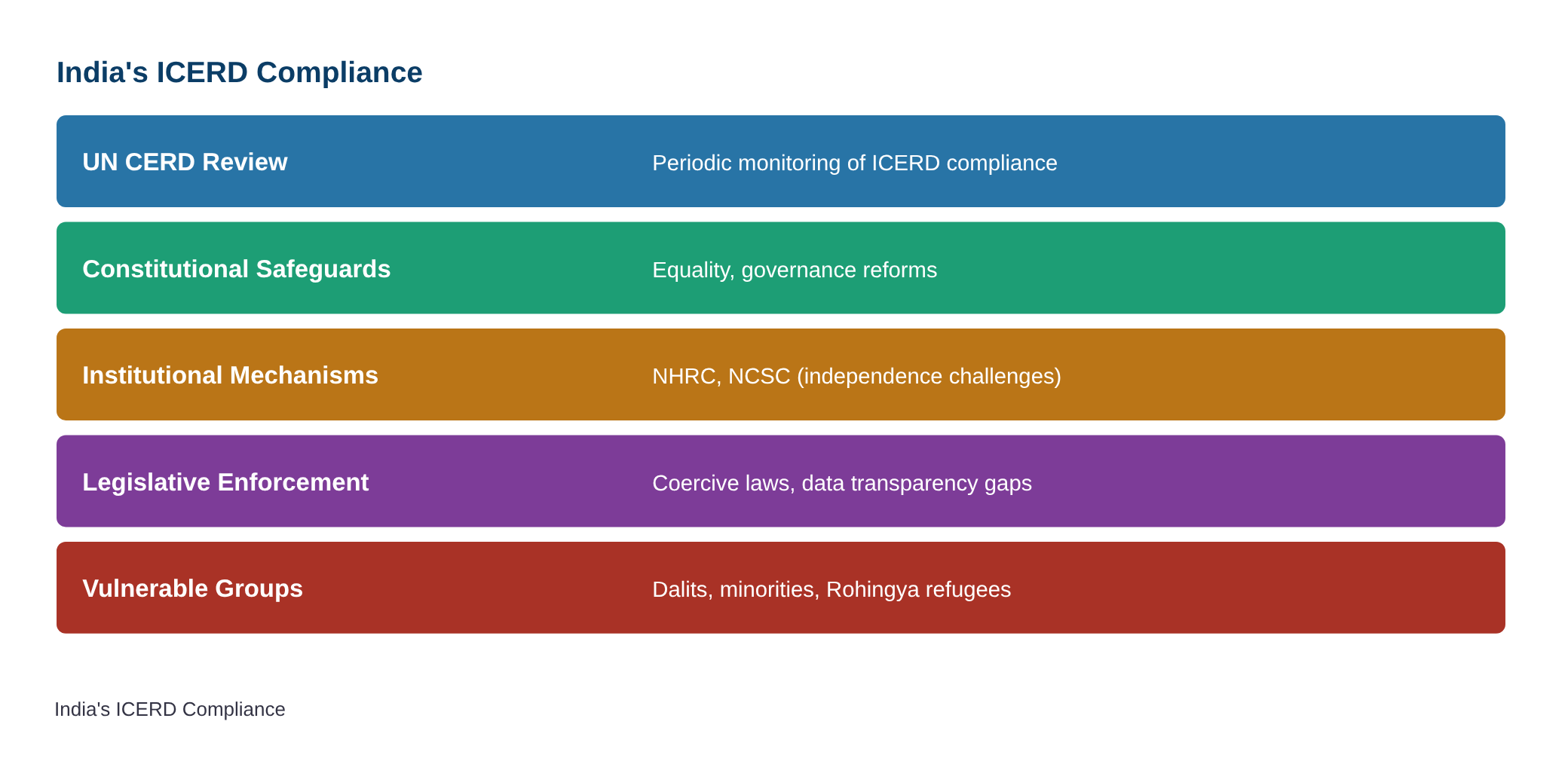
The United Nations Committee on the Elimination of Racial Discrimination (CERD) has, in its first review of India since 2007, expressed ‘grave concern’ over systemic discrimination, violence by law enforcement, and the erosion of institutional safeguards against caste- and faith-based bias. The report highlights gaps in data transparency, legal enforcement, and the use of coercive legislation that undermine India’s obligations under the International Convention on the Elimination of All Forms of Racial Discrimination (ICERD), 1968. These concerns intersect with constitutional principles of equality, governance reforms, and the protection of vulnerable groups, making the CERD’s observations a critical reference point for India’s human rights discourse.
Background
- India ratified the International Convention on the Elimination of All Forms of Racial Discrimination (ICERD) in 1968, committing to eliminate racial and ethnic discrimination through legislative, administrative, and judicial measures.
- The CERD is a treaty body under the UN Office of the High Commissioner for Human Rights (OHCHR), tasked with monitoring state compliance with ICERD through periodic reviews.
- The last CERD review of India occurred in 2007; the 2026 review reflects evolving domestic and international scrutiny of discrimination, particularly against minorities, Dalits, and marginalised communities.
- India’s obligations under ICERD extend beyond ‘race’ to include discrimination based on ‘inherited status’ (e.g., caste), as affirmed by CERD’s General Recommendation No. 29 (2002).
- Institutional mechanisms such as the National Human Rights Commission (NHRC) and National Commission for Scheduled Castes (NCSC) are mandated to address discrimination but face challenges in independence and effectiveness.
- The 2026 review coincides with debates on citizenship determination (NRC), electoral roll revisions, and environmental governance (Forest Conservation Amendment Act), all of which intersect with discrimination concerns.
What is the Committee on the Elimination of Racial Discrimination (CERD)?
- CERD is a UN treaty body established under Article 8 of ICERD to monitor state compliance with the convention’s provisions.
- It comprises 18 independent experts elected by state parties, who review periodic reports submitted by member states and issue concluding observations.
- CERD’s mandate includes investigating individual complaints under the Optional Protocol to ICERD (not ratified by India) and conducting country-specific reviews.
- The committee’s interpretations of ICERD, such as General Recommendation No. 29 (2002), clarify that discrimination based on caste, descent, or inherited status falls within the convention’s scope.
- CERD’s reviews assess legal frameworks, policy implementation, and data transparency, with a focus on systemic discrimination and structural inequalities.
- Concluding observations by CERD are non-binding but carry significant moral and diplomatic weight, influencing international perceptions and domestic advocacy.
- CERD’s 2026 review of India is the first since 2007, reflecting heightened global scrutiny of discrimination, governance, and human rights compliance.
- The committee’s concerns often align with other UN mechanisms, such as the Universal Periodic Review (UPR) and Special Rapporteurs on minority rights or contemporary forms of racism.
Key Features
| Feature | Significance |
|---|---|
| UN CERD review (first since 2007) | Highlights systemic gaps in India’s compliance with the International Convention on the Elimination of All Forms of Racial Discrimination (ICERD), 1968. |
| Caste discrimination under ICERD | CERD rejects India’s claim that caste bias falls outside Article 1, affirming that inherited status discrimination is prohibited under the convention. |
| Manual scavenging despite legal ban | Persistent violation of constitutional and statutory obligations under Article 21 and the Prohibition of Employment as Manual Scavengers and their Rehabilitation Act, 2013. |
| Mass refoulement of Rohingya Muslims | Raises issues of non-refoulement obligations under international law and India’s obligations under ICERD to protect ethnic and religious minorities. |
| FCRA, UAPA, AFSPA, PMLA usage | Examines how these laws may disproportionately restrict civil society’s ability to monitor and report on discrimination, affecting transparency and accountability. |
Why it Matters
Legal and Institutional
- Reinforces the global scrutiny of India’s compliance with ICERD, a binding international treaty ratified in 1968.
- Underscores the role of UN treaty bodies in monitoring state compliance with human rights obligations.
- Highlights the erosion of institutional independence, particularly in bodies like the NHRC, due to structural and procedural deficiencies.
Human Rights and Social Justice
- Exposes systemic discrimination against Scheduled Castes, Scheduled Tribes, religious minorities, and non-citizens, including Rohingya refugees.
- Raises concerns about the normalization of caste- and faith-based discrimination in law enforcement and civic life.
- Emphasizes the intersectionality of discrimination, linking caste, ethnicity, religion, and citizenship status.
Administrative and Governance
- Reveals administrative lethargy in data collection, particularly the delayed Census and NCRB reporting, which obstructs evidence-based policy and oversight.
- Highlights gaps in disaggregated data on marginalized communities, impeding targeted affirmative action and monitoring.
- Examines the use of legal instruments (FCRA, UAPA, AFSPA, PMLA) that may disproportionately impact civil society’s ability to challenge discrimination.
Constitutional and Democratic
- Questions the alignment of India’s domestic laws and policies with constitutional guarantees under Articles 14, 15, 16, 21, and 29.
- Examines the impact of electoral roll revisions and mass deletions on the democratic rights of marginalized communities.
- Assesses the role of the Forest (Conservation) Amendment Act, 2023, in diluting participatory decision-making for tribal and forest-dwelling communities.
Challenges
1. Institutional Independence of Human Rights Bodies
- NHRC’s downgrade recommendation by GANHRI in 2025 due to lack of pluralism and police officers in investigative roles.
- Erosion of credibility in domestic human rights institutions, reducing their effectiveness in addressing discrimination.
UPSC Link: GS Paper 2: Statutory, Regulatory and various Quasi-judicial Bodies
2. Data Disaggregation and Transparency Deficits
- Delayed Census (last conducted in 2011) and slow release of NCRB data hinder evidence-based policymaking and monitoring.
- Lack of disaggregated data on Scheduled Tribes, Adivasis, and religious minorities obscures regressive trends in socioeconomic status.
UPSC Link: GS Paper 2: Government Policies and Interventions for Development
3. Legal and Policy Gaps in Combating Discrimination
- Absence of explicit criminalisation of racist hate speech in the Bharatiya Nyaya Sanhita, 2023.
- Use of FCRA, UAPA, AFSPA, and PMLA to restrict civil society’s role in monitoring and reporting discrimination.
- Forest (Conservation) Amendment Act, 2023, exempting ‘national security’ projects from consultative decision-making, marginalizing tribal communities.
UPSC Link: GS Paper 2: Fundamental Rights
4. Enforcement of Anti-Discrimination Laws
- Persistent manual scavenging despite the Prohibition of Employment as Manual Scavengers and their Rehabilitation Act, 2013.
- Mass refoulement of Rohingya Muslims violates the principle of non-refoulement under international law.
- Electoral roll revisions and deletions disproportionately affecting marginalized communities, raising concerns about democratic inclusivity.
UPSC Link: GS Paper 2: Issues Relating to Development and Management of Social Sector/Services
5. Affirmative Action and Special Measures
- Reliance on outdated 2011 Census data for ‘special measures’ may mask regression in socioeconomic indicators for Scheduled Tribes and Adivasis.
- Need for updated, disaggregated data to design effective affirmative action policies for marginalized groups.
UPSC Link: GS Paper 1: Social Empowerment
6. International Human Rights Obligations
- India’s obligations under ICERD to eliminate racial discrimination, including caste-based discrimination, remain inadequately addressed.
- Global scrutiny by UN treaty bodies highlights gaps between India’s domestic policies and international commitments.
UPSC Link: GS Paper 2: Important International Institutions
Challenges — UPSC Perspective
| Issue | Concern |
|---|---|
| Caste discrimination under ICERD | India’s claim that caste bias falls outside Article 1 of ICERD is rejected; inherited status discrimination is prohibited. |
| Manual scavenging | Persistent violation of constitutional and statutory obligations despite legal bans. |
| Mass refoulement of Rohingya Muslims | Violation of non-refoulement principle and ICERD obligations to protect ethnic and religious minorities. |
| Electoral roll revisions | Mass deletions disproportionately affecting marginalized communities, undermining democratic inclusivity. |
| FCRA, UAPA, AFSPA, PMLA usage | Restrictions on civil society’s ability to monitor and report discrimination, affecting transparency and accountability. |
| Forest (Conservation) Amendment Act, 2023 | Exemption of ‘national security’ projects from consultative decision-making marginalizes tribal communities. |
Way Forward
- Restore independence and pluralism of the National Human Rights Commission (NHRC) by amending its composition and appointment process.
- Criminalise racist hate speech explicitly in the Bharatiya Nyaya Sanhita, 2023, to align with ICERD obligations.
- Conduct the decennial Census at the earliest and release disaggregated data on Scheduled Castes, Scheduled Tribes, and religious minorities to inform policy.
- Strengthen enforcement of the Prohibition of Employment as Manual Scavengers and their Rehabilitation Act, 2013, with strict penalties and rehabilitation measures.
- Reform electoral roll revision processes to ensure transparency, inclusivity, and protection against mass deletions of marginalized voters.
- Enhance transparency in the use of FCRA, UAPA, AFSPA, and PMLA to prevent their misuse in suppressing civil society’s role in monitoring discrimination.
- Align the Forest (Conservation) Amendment Act, 2023, with the Forest Rights Act, 2006, to ensure participatory decision-making for tribal communities.
- Establish an independent mechanism to monitor and report on compliance with ICERD, with periodic reviews and public disclosures.
UPSC Value Addition
Keywords for Mains Answer-Writing
United Nations Committee on the Elimination of Racial Discrimination (CERD) · International Convention on the Elimination of All Forms of Racial Discrimination (ICERD) · caste-based discrimination and untouchability · National Register of Citizens (NRC) · Forest (Conservation) Amendment Act, 2023 · Foreign Contribution (Regulation) Act (FCRA) · Unlawful Activities (Prevention) Act (UAPA) · Armed Forces (Special Powers) Act (AFSPA) · Prevention of Money Laundering Act (PMLA) · National Human Rights Commission (NHRC) independence · disaggregated data on marginalised communities · electoral roll revisions and mass deletions · manual scavenging and sewer deaths · Rohingya refugee crisis and refoulement · hate speech and criminalisation under Bharatiya Nyaya Sanhita
Constitutional & Policy Linkages
- {‘Article 14’: ‘Right to Equality’}
- {‘Article 15’: ‘Prohibition of Discrimination’}
- {‘Article 16’: ‘Equality of Opportunity’}
- {‘Article 21’: ‘Right to Life and Personal Liberty’}
- {‘Article 29’: ‘Protection of Interests of Minorities’}
Concept Flow
State’s ratification of ICERD (1968) → Obligation to eliminate racial discrimination → UN CERD review (first since 2007) → Concerns raised on caste discrimination, manual scavenging, Rohingya refoulement, and electoral roll deletions → Gaps in data disaggregation and institutional independence → Erosion of NHRC credibility → Need for legal reforms, data transparency, and enforcement → Alignment with constitutional guarantees (Articles 14, 15, 16, 21, 29) → Strengthening of domestic and international accountability mechanisms
Prelims Practice Questions
Q1. Consider the following statements regarding the United Nations Committee on the Elimination of Racial Discrimination (CERD):
1. CERD is a body established under the International Convention on the Elimination of All Forms of Racial Discrimination (ICERD).
2. India ratified ICERD in 1968.
3. CERD has the mandate to investigate individual complaints of racial discrimination.
4. India’s caste-based discrimination falls outside the purview of CERD as per the government’s submission.
How many of the above statements are correct?
- Only one
- Only two
- Only three
- All
Answer: Only three — Statements 1 and 2 are correct. Statement 3 is incorrect as CERD does not have a mandate to investigate individual complaints; it reviews state reports and issues general recommendations. Statement 4 is incorrect as CERD has clarified that caste-based discrimination falls within its ambit.
Q2. Assertion (A): The Forest (Conservation) Amendment Act, 2023 exempts certain projects from the requirement of prior approval under the Forest Conservation Act, 1980.
Reason (R): The amendment aims to balance environmental conservation with national security and development imperatives.
Options:
A. Both A and R are true, and R is the correct explanation of A.
B. Both A and R are true, but R is not the correct explanation of A.
C. A is true, but R is false.
D. A is false, but R is true.
Answer: ? — Assertion (A) is true as the Forest (Conservation) Amendment Act, 2023 does exempt ‘national security’ projects from prior approval requirements. Reason (R) is also true and correctly explains the rationale behind the exemption.
Q3. Which of the following legal instruments has been criticised by the UN Committee on the Elimination of Racial Discrimination (CERD) for its potential to hamper the work of civil society organisations in India?
A. The Right to Information Act, 2005
B. The Foreign Contribution (Regulation) Act, 2010
C. The Right to Education Act, 2009
D. The National Food Security Act, 2013
- A
- B
- C
- D
Answer: B — The Foreign Contribution (Regulation) Act (FCRA), 2010 has been criticised by CERD for its restrictive provisions that can impede the functioning of civil society organisations.
Mains Practice Question
✍ The UN Committee on the Elimination of Racial Discrimination (CERD) has expressed ‘grave concern’ over the persistence of systemic discrimination in India, citing legal instruments, institutional practices, and data gaps. Critically examine the constitutional and statutory framework governing the prohibition of discrimination in India, and assess the adequacy of these measures in addressing contemporary challenges such as caste-based discrimination, mass deprivation of citizenship, and restrictions on civil society. (15 Marks)
Approach: MODEL-ANSWER SKELETON:
1. **Constitutional Framework**:
– Article 15(1) and 15(2) – Prohibition of discrimination on grounds of religion, race, caste, sex, or place of birth.
– Article 17 – Abolition of untouchability and its enforcement via the Protection of Civil Rights Act, 1955.
– Article 25(2)(b) – State’s power to regulate religious practices to eliminate social disabilities.
– Article 46 – Directive Principle of State Policy to promote educational and economic interests of Scheduled Castes, Scheduled Tribes, and other weaker sections.
2. **Statutory and Policy Measures**:
– Scheduled Castes and Scheduled Tribes (Prevention of Atrocities) Act, 1989 and its amendments.
– The Prohibition of Employment as Manual Scavengers and their Rehabilitation Act, 2013.
– Forest Rights Act, 2006 – Recognition of forest rights of Scheduled Tribes and other traditional forest dwellers.
– Right to Education Act, 2009 – Prohibition of discrimination in educational institutions.
– Representation of the People Act, 1951 – Provisions for electoral roll revisions and safeguards against mass deletions.
3. **Contemporary Challenges and Gaps**:
– **Caste-based discrimination**: Persistence of social exclusion, atrocities, and lack of disaggregated data post-2011 Census delays.
– **Mass deprivation of citizenship**: National Register of Citizens (NRC) and its implications for marginalised communities.
– **Restrictions on civil society**: Use of FCRA, UAPA, PMLA, and AFSPA to curb dissent and civil society activities.
– **Hate speech**: Bharatiya Nyaya Sanhita’s silence on criminalising racist hate speech despite ICERD obligations.
– **Institutional independence**: Concerns over NHRC’s independence due to lack of pluralism and police officers in investigative roles.
4. **Judicial and Multilateral Oversight**:
– Landmark judgments: Indra Sawhney v. Union of India (1992) on reservation; Safai Karamchari Andolan v. Union of India (2014) on manual scavenging.
– Role of CERD and other UN mechanisms in monitoring compliance with ICERD.
– Recommendations for strengthening enforcement, data collection, and affirmative action.
5. **Way Forward**:
– Criminalisation of hate speech under Bharatiya Nyaya Sanhita to align with ICERD.
– Transparent and inclusive electoral roll revisions with safeguards against mass deletions.
– Strengthening NHRC’s independence and pluralism.
– Enforcing the Forest Rights Act and ensuring community participation in forest conservation decisions.
– Publishing disaggregated data on marginalised communities to enable evidence-based policy.
Source: The Hindu
Generated by AanyaAi for educational purpose.
Related guides on our sites
- Best economics services coaching
- Anthropology VS PSIR
- Best PSIR optional coaching
- Best PSIR optional coaching online

- कस्तूरीरंगन रिपोर्ट लागू करने की मांग: पश्चिमी घाट संरक्षण पर सरकार से अपील - September 20, 2026
- Foundation urges Kasturirangan report implementation for Western Ghats protection - September 20, 2026
- कैट की जम्मू बेंच: सेवा मामलों के निपटारे में देश में सर्वोच्च, जानें पूरा विवरण - September 20, 2026

No Comments