


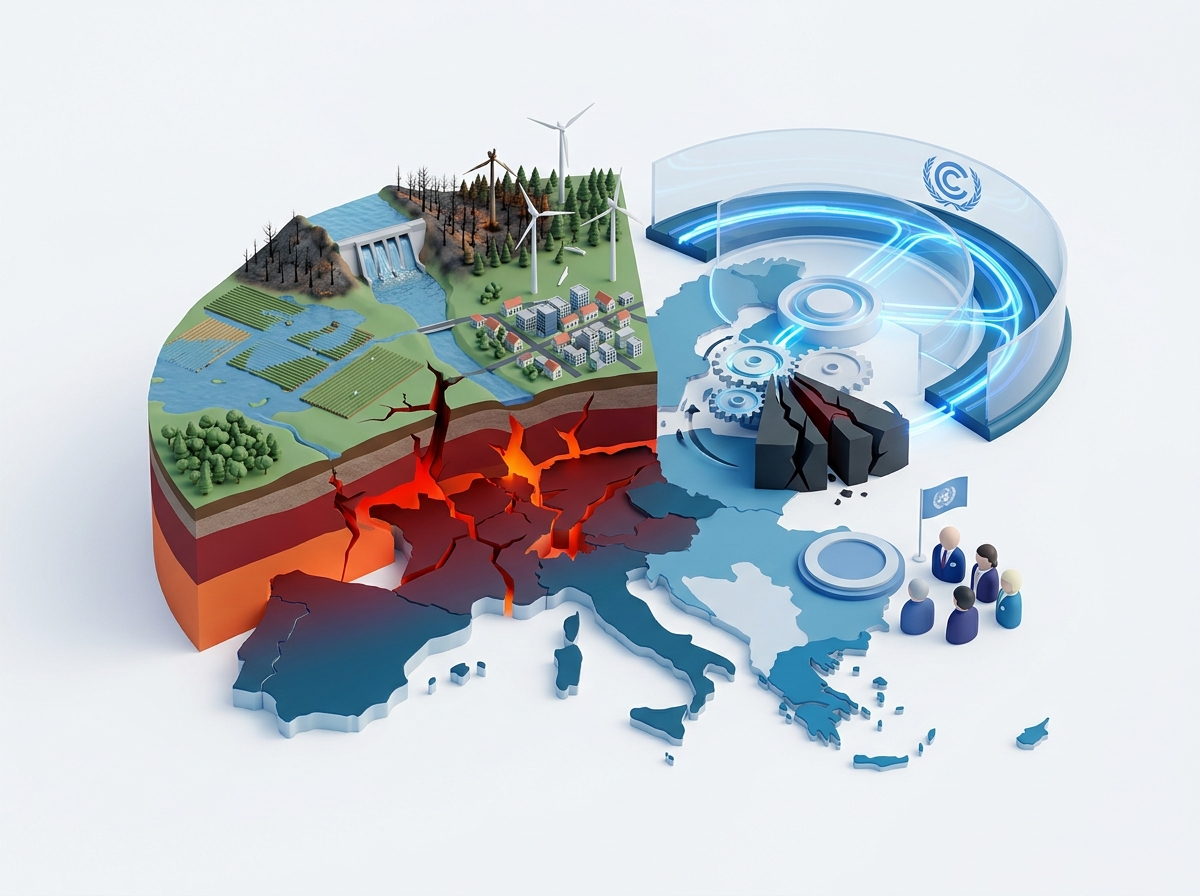
11 Sep UN Chief Warns Political Divisions Undermining Global Climate Action Urgently
✎ Climate action is not a partisan issue but an economic security imperative; the UNFCCC’s role is to enable multilateral cooperation to limit warming to 1.5°C, address loss and damage, and mobilise finance for adaptation and…
Subject Relevance — Where This Topic Fits
- GS Paper II — International Organisations and Agreements | GS Paper III — Environment, Climate Change and Disaster Management | GS Paper III — Economic Development and Inclusive Growth
- Prelims: UNFCCC, COP31, methane reduction, climate-induced migration, clean energy transition, UNEP Emissions Gap Report, Paris Agreement 1.5°C target, fossil fuel dependency, energy security
- Essay: Climate change as a multiplier of global economic and security risks, The paradox of polarisation in addressing existential threats
Quick Revision: Climate action is not a partisan issue but an economic security imperative; the UNFCCC’s role is to enable multilateral cooperation to limit warming to 1.5°C, address loss and damage, and mobilise finance for adaptation and mitigation.
Why is this in the news?
The Executive Secretary of the UN Framework Convention on Climate Change (UNFCCC) has warned that political polarisation is obstructing effective climate action, framing climate change as a ‘continent-wide economic security emergency’ in Europe. This statement, delivered to the European Parliament’s environment committee, highlights the escalating economic costs of extreme weather events, the inadequacy of current mitigation efforts, and the urgent need for accelerated global cooperation ahead of COP31 in Türkiye.
Background
- The UNFCCC, established in 1992, is the foundational treaty for international climate governance, with 198 Parties committed to stabilising greenhouse gas concentrations to prevent dangerous anthropogenic interference with the climate system.
- The Paris Agreement (2015) under the UNFCCC sets a long-term temperature goal to limit global warming to well below 2°C, preferably to 1.5°C, compared to pre-industrial levels.
- The UNEP Emissions Gap Report annually assesses the gap between projected emissions under current policies and the levels required to meet the Paris Agreement goals, consistently indicating insufficient progress.
- Extreme weather events linked to climate change—such as the 2026 European heatwaves, Himalayan floods, and North African heat-driven power outages—are increasingly recognised as drivers of economic disruption, forced migration, and food insecurity.
- The global clean energy investment surpassed USD 2 trillion in 2025, yet global emissions continue to rise, necessitating deeper systemic transitions.
- COP31, scheduled for 2026 in Türkiye, is positioned as a critical juncture for revisiting implementation mechanisms, particularly in methane reduction, food systems, and urban resilience.
What is the UNFCCC and its role in climate governance?
- The UN Framework Convention on Climate Change (UNFCCC) is an international treaty adopted in 1992 to address climate change through multilateral cooperation, with its secretariat based in Bonn, Germany.
- Its supreme decision-making body, the Conference of the Parties (COP), meets annually to review progress, negotiate new commitments, and adopt legal instruments such as the Kyoto Protocol (1997) and the Paris Agreement (2015).
- The UNFCCC operates on principles of equity, common but differentiated responsibilities, and respective capabilities, recognising historical and current emissions disparities among nations.
- The Paris Agreement’s Nationally Determined Contributions (NDCs) are voluntary pledges by Parties to reduce emissions, with a global stocktake every five years to assess collective progress.
- The UNFCCC also facilitates technology transfer, capacity-building, and financial mechanisms, including the Green Climate Fund, to support developing countries in climate adaptation and mitigation.
- The UNFCCC’s work extends beyond mitigation to include adaptation, loss and damage, and resilience-building, particularly in vulnerable regions such as Small Island Developing States (SIDS) and Least Developed Countries (LDCs).
- The UNFCCC Secretariat coordinates scientific assessments through the Intergovernmental Panel on Climate Change (IPCC), providing policymakers with evidence-based insights on climate risks and solutions.
- Despite its mandate, the UNFCCC faces challenges in ensuring compliance, mobilising adequate finance, and reconciling divergent national priorities amid geopolitical tensions.
Key Features
| Feature | Significance |
|---|---|
| UNFCCC Executive Secretary’s Warning | Highlights the economic security emergency posed by climate change, framing it as a non-partisan issue requiring urgent collective action. |
| Economic Toll of Climate Change in Europe | Quantifies the 180 billion euros loss in productivity and disruption to food, energy, and transport systems due to extreme weather events. |
| Fossil Fuel Dependency and Energy Crises | Links Europe’s vulnerability to energy shortages and inflation to its reliance on fossil fuels, particularly during geopolitical conflicts. |
| Clean Energy Transition Progress | Notes that renewables supply ~50% of Europe’s power and solar energy alone saved 30 billion euros in avoided gas imports during the Middle East conflict. |
| Global Clean Energy Investment | Reports a two-trillion-dollar investment in clean energy globally in 2025, doubling fossil fuel investments and accelerating decarbonisation. |
| Temperature Projections and 1.5°C Limit | Warns that without cooperation, global warming could exceed 4°C, while current policies project a 2.6°C rise, still above the 2015 Paris Agreement target. |
Why it Matters
Economic Security
- Climate-induced extreme weather events (heatwaves, floods, droughts) disrupt supply chains, reduce agricultural productivity, and increase operational costs for businesses, directly impacting GDP growth.
- Energy price volatility, driven by fossil fuel dependency, exacerbates inflation and undermines economic stability, particularly in import-dependent regions like Europe.
- Forced migration and displacement due to climate disasters strain public resources, social cohesion, and regional security frameworks.
- The clean energy transition offers a dual benefit: mitigating climate risks while creating jobs, reducing energy import bills, and fostering technological innovation.
Strategic and Geopolitical
- Climate change acts as a threat multiplier, intensifying existing geopolitical tensions over resources (water, arable land) and exacerbating conflicts in vulnerable regions (e.g., North Africa, South Asia).
- Europe’s strategic autonomy in energy is compromised by reliance on fossil fuel imports, making it vulnerable to supply disruptions and price shocks during global crises.
- International cooperation is critical to align climate action with economic resilience, as unilateral measures risk carbon leakage and competitive disadvantages.
- COP31 (hosted by Türkiye) presents an opportunity to shift from policy pledges to implementation, focusing on methane reduction, food security, and urban resilience.
Environmental and Social
- Extreme weather events (e.g., Himalayan floods, European heatwaves) disproportionately affect marginalised communities, exacerbating inequalities in access to resources and livelihoods.
- The 1.5°C threshold, though temporarily breached under current policies, remains a critical benchmark for avoiding catastrophic climate impacts, including ecosystem collapse and biodiversity loss.
- Urban resilience and adaptation measures (e.g., heat-resistant infrastructure, flood management) are essential to protect vulnerable populations in rapidly urbanising regions.
Institutional and Governance
- The UNFCCC plays a pivotal role in coordinating global climate action, but its effectiveness depends on political will and the alignment of national policies with international commitments.
- The European Parliament’s recognition of climate change as an ‘economic security emergency’ underscores the need for integrated governance frameworks that link climate policy with economic and security strategies.
- Methane reduction and food security initiatives require cross-sectoral collaboration, involving agriculture, energy, and trade ministries to address systemic vulnerabilities.
Challenges
1. Political Polarisation on Climate Action
- Climate change is increasingly framed as a partisan issue, delaying policy consensus and undermining long-term investment in mitigation and adaptation measures.
- Short-term electoral cycles often prioritise immediate economic concerns over long-term climate resilience, leading to inconsistent policy implementation.
- Populist rhetoric and misinformation campaigns distort public perception, creating resistance to evidence-based climate policies.
UPSC Link: GS3: Environmental Governance
2. Economic Dependence on Fossil Fuels
- High fossil fuel dependency increases vulnerability to geopolitical shocks, supply chain disruptions, and price volatility, undermining economic stability.
- Transitioning to clean energy requires substantial upfront investments, technological upgrades, and workforce reskilling, posing fiscal and logistical challenges.
- Industries reliant on fossil fuels (e.g., steel, cement, aviation) face structural barriers to decarbonisation, necessitating targeted policy incentives and innovation.
UPSC Link: GS3: Energy Security
3. Implementation Gap in Climate Commitments
- Despite global pledges under the Paris Agreement, current policies project a 2.6°C temperature rise, indicating a significant implementation deficit.
- National climate action plans (NDCs) often lack binding enforcement mechanisms, leading to non-compliance and delayed progress.
- Monitoring and verification systems for climate finance and emissions reductions remain underdeveloped, hindering accountability and transparency.
UPSC Link: GS3: Climate Change – International Agreements
4. Disproportionate Impact on Vulnerable Populations
- Marginalised communities, including indigenous groups, low-income households, and smallholder farmers, bear the brunt of climate-induced disasters due to limited adaptive capacity.
- Forced migration and displacement exacerbate social tensions, straining public services and increasing the risk of conflict in host communities.
- Gender disparities in climate impacts are pronounced, as women and girls face heightened risks in disasters and limited access to resources for adaptation.
UPSC Link: GS2: Vulnerable Sections
5. Technological and Infrastructure Constraints
- Limited access to advanced clean energy technologies (e.g., carbon capture, green hydrogen) in developing nations hinders their ability to transition away from fossil fuels.
- Urban infrastructure in many cities is ill-equipped to handle extreme weather events, requiring retrofitting and investment in resilient systems.
- Grid stability and energy storage solutions remain critical challenges for integrating high shares of renewable energy into national power systems.
UPSC Link: GS3: Science & Technology
Challenges — UPSC Perspective
| Issue | Concern |
|---|---|
| Fossil Fuel Dependency | Increases economic vulnerability to geopolitical shocks and price volatility, undermining energy security. |
| Policy Inconsistency | Short-term political cycles and partisan divides delay long-term climate action and investment. |
| Implementation Deficit | Current policies project a 2.6°C temperature rise, indicating a gap between commitments and actions. |
| Disproportionate Impacts | Marginalised communities face heightened risks, exacerbating social inequalities and conflicts. |
| Technological Lag | Limited access to clean energy technologies and infrastructure constraints hinder decarbonisation efforts. |
| Global Coordination Gaps | Fragmented international responses risk carbon leakage and undermine collective climate goals. |
Way Forward
- Strengthen international climate cooperation under frameworks like the UNFCCC, focusing on implementation of COP31 outcomes and alignment of NDCs with 1.5°C pathways.
- Accelerate the clean energy transition by scaling up investments in renewables, grid modernisation, and energy storage, while phasing out fossil fuel subsidies.
- Enhance urban resilience through integrated planning, retrofitting critical infrastructure, and developing early warning systems for extreme weather events.
- Implement targeted adaptation measures for vulnerable populations, including social protection schemes, livelihood diversification, and gender-responsive climate policies.
- Promote methane reduction initiatives in agriculture and energy sectors, leveraging technological innovations and international partnerships to cut emissions rapidly.
- Align climate policies with economic strategies by integrating climate risk assessments into macroeconomic planning and fiscal policies.
- Invest in research and development for breakthrough technologies (e.g., green hydrogen, carbon capture) to overcome current technological constraints.
- Enhance transparency and accountability in climate finance by strengthening monitoring mechanisms and ensuring equitable distribution of resources.
UPSC Value Addition
Keywords for Mains Answer-Writing
climate change and economic security · UNFCCC and COP processes · global warming and 1.5°C target · climate-induced economic losses · clean energy transition · climate finance and investment · methane reduction and food security · climate migration and forced displacement · fossil fuel dependency and energy crises · international climate cooperation · urban resilience and adaptation · climate policy and inflation · sustainable development and sovereignty · Paris Agreement and implementation gaps
Concept Flow
Climate change-induced extreme weather events → Economic disruptions (supply chains, agriculture, energy) → Inflation and GDP loss → Increased political polarisation and policy inertia → Fossil fuel dependency → Geopolitical vulnerabilities (energy price shocks, supply disruptions) → Erosion of economic sovereignty → Delayed climate action → Paris Agreement (2015) → Nationally Determined Contributions (NDCs) → Implementation gap → Projected 2.6°C temperature rise → Risk of breaching 1.5°C threshold → Clean energy transition → Renewable energy deployment → Reduced fossil fuel imports → Lower energy costs and inflation → Enhanced economic resilience → Forced migration and displacement → Strain on public resources → Social tensions and conflicts → Undermined regional stability → UNFCCC coordination → COP processes → Methane reduction and urban resilience initiatives → Collective climate action → Mitigation of economic security risks
Prelims Practice Questions
Q1. Consider the following statements regarding the UN Framework Convention on Climate Change (UNFCCC):
1. The UNFCCC was adopted at the Earth Summit in Rio de Janeiro in 1992.
2. The UNFCCC sets legally binding targets for greenhouse gas emissions for all member states.
3. The Conference of Parties (COP) is the supreme decision-making body of the UNFCCC.
4. The Kyoto Protocol, adopted in 1997, is a protocol to the UNFCCC.
How many of the above statements are correct?
- Only one
- Only two
- Only three
- All
Answer: All — Statements 1, 3, and 4 are correct. Statement 2 is incorrect because the UNFCCC sets non-binding targets, while legally binding targets were introduced under the Kyoto Protocol and subsequently under the Paris Agreement.
Q2. Assertion (A): The Paris Agreement aims to limit global temperature rise to well below 2°C above pre-industrial levels, with efforts to limit the increase to 1.5°C.
Reason (R): The 1.5°C target is a legally binding obligation under the Paris Agreement for all signatory nations.
Options:
A. Both A and R are true, and R is the correct explanation of A.
B. Both A and R are true, but R is NOT the correct explanation of A.
C. A is true, but R is false.
D. A is false, but R is true.
Answer: ? — Assertion (A) is true as the Paris Agreement sets the 1.5°C target. Reason (R) is false because the 1.5°C target is aspirational and not a legally binding obligation; the Agreement relies on nationally determined contributions (NDCs) for implementation.
Q3. Match the following climate agreements with their respective years of adoption:
Column I (Agreement) | Column II (Year of Adoption)
———————|————————–
A. Kyoto Protocol | 1. 1992
B. Paris Agreement | 2. 1997
C. UNFCCC | 3. 2015
D. Montreal Protocol | 4. 1987
- A-2, B-3, C-1, D-4
- A-1, B-2, C-3, D-4
- A-3, B-2, C-1, D-4
- A-4, B-3, C-2, D-1
Answer: A-2, B-3, C-1, D-4 — The correct match is: Kyoto Protocol (1997), Paris Agreement (2015), UNFCCC (1992), and Montreal Protocol (1987).
Mains Practice Question
✍ ‘Climate change is not merely an environmental issue but a multidimensional economic security emergency.’ Critically examine this assertion in the context of recent global developments. (15 Marks)
Approach: MODEL-ANSWER SKELETON:
1. **Introduction (2 marks)**: Define climate change as an economic security emergency, citing recent UNFCCC warnings (e.g., Simon Stiell’s remarks) and the economic toll of extreme weather events in Europe (€180 billion loss in productivity).
2. **Economic Dimensions (4 marks)**:
– **Inflation and Cost of Living**: Link fossil fuel dependency to energy crises (e.g., Europe’s winter fuel crisis) and inflation.
– **Sovereignty and Security**: Discuss climate-induced forced migration (e.g., Himalayan floods, North African water shortages) and its impact on national security.
– **Growth and Jobs**: Highlight the clean energy transition as a driver of economic growth (e.g., renewables supplying 50% of Europe’s power, solar savings of €30 billion in gas imports).
3. **Policy and Institutional Responses (5 marks)**:
– **Paris Agreement and COP Processes**: Explain the 1.5°C target, nationally determined contributions (NDCs), and the implementation gap (current policies point to 2.6°C warming).
– **Methane Reduction and Food Security**: Discuss the urgency of methane mitigation (e.g., livestock emissions) and its link to food security.
– **Urban Resilience**: Highlight the need for climate adaptation in urban areas (e.g., heat-resistant infrastructure, flood management).
4. **Challenges and Critiques (3 marks)**:
– **Political Polarization**: Address the framing of climate change as a partisan issue and the risks of delayed action.
– **Financing Gaps**: Mention the disparity between clean energy investment (€2 trillion) and fossil fuel investment, and the need for climate finance (e.g., Green Climate Fund).
5. **Conclusion (1 mark)**: Reiterate the multidimensional nature of climate change as an economic security emergency and the necessity of international cooperation (e.g., COP31 in Türkiye) for sustainable solutions.
Source: news.un.org
Generated by AanyaAi for educational purpose.
Related guides on our sites
- Best PSIR optional coaching for upsc
- Best economics optional coaching for upsc
- Best PSIR optional teacher for upsc
- Best teacher of PSIR optional for upsc

- महाराष्ट्र में त्योहार जुलूसों पर बॉम्बे हाईकोर्ट का बड़ा फैसला: पटाखे, लेजर और संगीत पर रोक - September 24, 2026
- Bombay HC Bans Firecrackers, Music in Maharashtra Processions: Key UPSC Analysis - September 24, 2026
- तमिलनाडु में महिला कर्मचारियों के लिए सवैतनिक माहवारी अवकाश नीति पर HC का आदेश - September 24, 2026

No Comments