


24 Sep UN Declaration on Sea Level Rise: UPSC Current Affairs for 2026
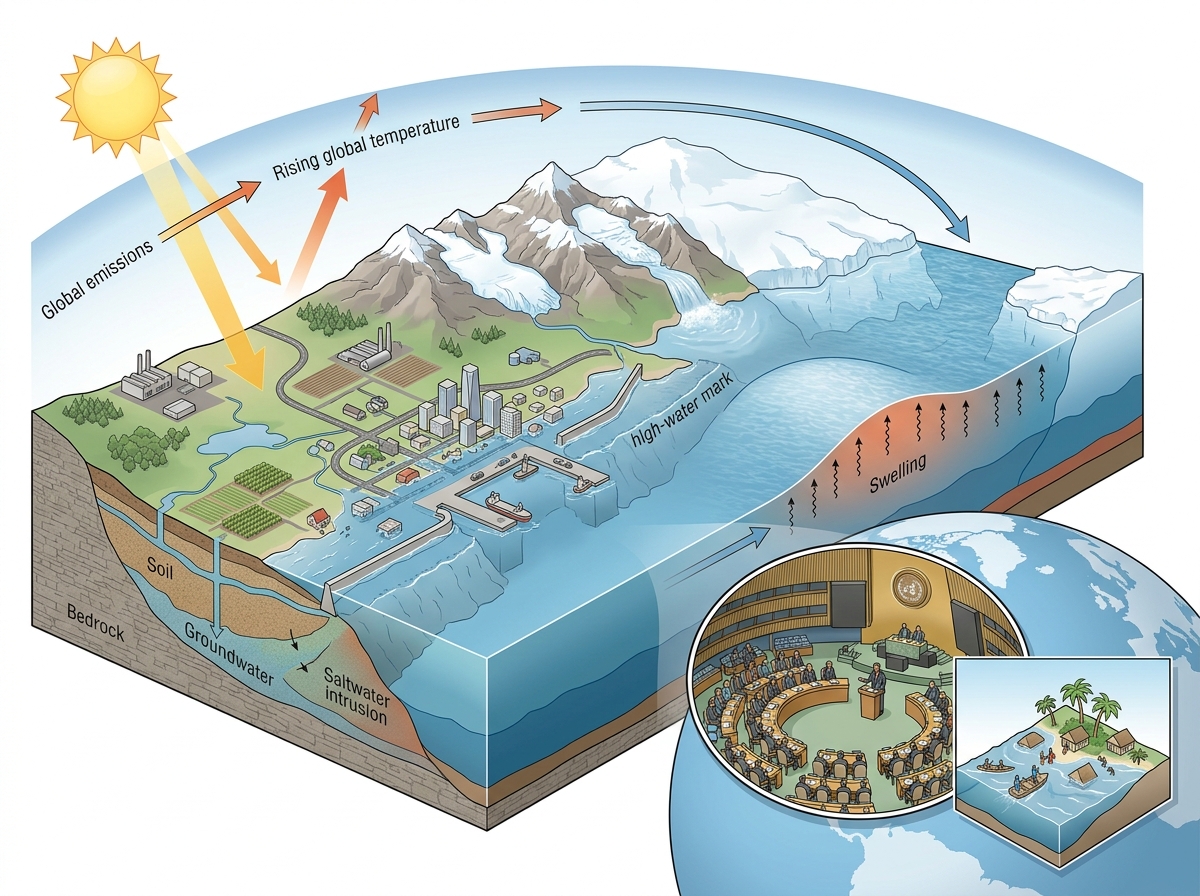
✎ The UN Declaration on Sea Level Rise is a political commitment to address the existential threat of rising sea levels, emphasising mitigation, adaptation, and international cooperation for vulnerable coastal and island nations.
Subject Relevance — Where This Topic Fits
- GS Paper II — International Relations | GS Paper III — Environment, Ecology, Biodiversity and Climate Change
- Prelims: Sea level rise, Coastal vulnerability, UN Declaration on Sea Level Rise, IPCC projections, Small Island Developing States (SIDS), Climate-induced displacement, Digital nation concept, UNFCCC, Paris Agreement, Loss and Damage Fund
- Essay: Climate change as a multiplier of global inequalities: The disproportionate burden on vulnerable nations, The role of international cooperation in addressing existential threats to small island states
Quick Revision: The UN Declaration on Sea Level Rise is a political commitment to address the existential threat of rising sea levels, emphasising mitigation, adaptation, and international cooperation for vulnerable coastal and island nations.
Why is this in the news?
The United Nations is convening a high-level meeting to adopt the UN Declaration on Sea Level Rise, marking a critical juncture in global climate governance. This initiative underscores the accelerating threat posed by rising sea levels to coastal and low-lying nations, particularly Small Island Developing States (SIDS), which face existential risks despite contributing minimally to global emissions. The declaration seeks to strengthen international cooperation, mobilise resources, and address the humanitarian and geopolitical consequences of climate-induced displacement.
Background
- Sea level rise is a direct consequence of global warming, driven primarily by thermal expansion of ocean water and the melting of glaciers and polar ice sheets.
- Coastal zones, home to approximately 770 million people globally, are particularly vulnerable to flooding, saltwater intrusion, and loss of habitable land.
- Small Island Developing States (SIDS) such as Tuvalu, Maldives, and Kiribati face disproportionate risks due to their low elevation, limited land area, and high population density.
- The concept of ‘climate-induced displacement’ has gained prominence, with projections indicating that a 0.5-metre rise could displace 150-300 million people by the end of the century.
- The Paris Agreement (2015) under the UNFCCC framework aims to limit global temperature rise to well below 2°C, with efforts to cap it at 1.5°C, though current commitments fall short of this target.
What is the UN Declaration on Sea Level Rise?
- The UN Declaration on Sea Level Rise is a non-binding political commitment adopted by Member States to acknowledge the existential threat posed by rising sea levels and to strengthen international cooperation in addressing it.
- The declaration emphasises the need for urgent action to mitigate greenhouse gas emissions, enhance coastal resilience, and support vulnerable nations through adaptation and relocation strategies.
- It calls for the mobilisation of financial resources, technology transfer, and capacity-building support for SIDS and other low-lying countries.
- The declaration also highlights the importance of integrating sea level rise considerations into national climate action plans and disaster risk reduction strategies.
- It underscores the principle of ‘common but differentiated responsibilities’ under the UNFCCC, recognising the historical responsibility of developed nations in contributing to climate change.
- The declaration is expected to complement existing frameworks such as the Sendai Framework for Disaster Risk Reduction and the Sustainable Development Goals (SDGs), particularly SDG 13 (Climate Action) and SDG 14 (Life Below Water).
- It may also pave the way for future legally binding agreements or protocols addressing climate-induced displacement and the protection of stateless populations.
- The declaration aligns with the broader goal of achieving net-zero emissions by mid-century to limit long-term sea level rise and its associated risks.
Key Features
| Feature | Significance |
|---|---|
| UN Declaration on Sea Level Rise | A legally non-binding but politically significant international instrument to formalise commitments and mobilise resources for vulnerable coastal and island nations facing existential threats from rising sea levels. |
| Global Mean Sea Level Rise | Accelerating due to thermal expansion of oceans and melting of glaciers and ice sheets, with a projected increase of 0.3–1.0 metre by 2100, directly impacting coastal ecosystems and human settlements. |
| Vulnerability of Small Island Developing States (SIDS) | Low-lying nations such as Tuvalu, Maldives, and Kiribati face disproportionate risks, including territorial loss, forced displacement, and economic destabilisation, despite contributing minimally to global emissions. |
| Digital Nation Transition (e.g., Tuvalu) | A strategic adaptation measure where nations preserve sovereignty, culture, and governance by digitising national records, assets, and identity systems to mitigate physical territorial loss. |
| Coastal Population Exposure | Approximately 770 million people in low-elevation coastal zones are at risk, with projections indicating that a 0.5-metre rise could displace 150–300 million individuals by the end of the century. |
UPSC Value Addition
Keywords for Mains Answer-Writing
Sea level rise · Climate change vulnerability · Small Island Developing States (SIDS) · UN Declaration on Sea Level Rise · Coastal displacement · UNFCCC · Paris Agreement · Climate justice · Adaptation mechanisms · Disaster risk reduction · Global mean sea level · Tuvalu digital nation · UN Intergovernmental Panel on Climate Change (IPCC) · Climate-induced migration · International cooperation on climate action
Prelims Practice Questions
Q1. Consider the following statements about sea level rise and its impacts:
1. The global mean sea level is rising at an accelerating rate due to global warming.
2. A half-metre rise in sea levels by the end of the century could force between 150 million and 300 million people from their homes.
3. Small Island Developing States (SIDS) contribute the most to global greenhouse gas emissions but are the most vulnerable to sea level rise.
How many of the above statements are correct?
- Only one
- Only two
- All three
- None
Answer: All three — Statements 1 and 2 are correct as per the IPCC and UN reports cited in the article. Statement 3 is incorrect because SIDS contribute the least to global greenhouse gas emissions but face the most severe impacts of climate change, including sea level rise.
Q2. Assertion (A): The UN Declaration on Sea Level Rise aims to strengthen international cooperation to support vulnerable low-lying nations.
Reason (R): The declaration was finalised by Member States last month and is expected to be approved by world leaders during a high-level meeting.
Options:
A. Both A and R are true, and R is the correct explanation of A.
B. Both A and R are true, but R is NOT the correct explanation of A.
C. A is true, but R is false.
D. A is false, but R is true.
- A
- B
- C
- D
Answer: A — Both the Assertion (A) and Reason (R) are true. The declaration indeed aims to strengthen international cooperation, and the reason correctly explains the assertion as it highlights the process of finalisation and approval by Member States.
Q3. Match the following pairs related to climate change and sea level rise:
Column I (Concept/Term) Column II (Description/Definition)
1. UN Declaration on Sea Level Rise A. A framework adopted in 2015 to limit global warming to well below 2°C above pre-industrial levels.
2. Climate-induced migration B. The process of people being forced to leave their homes due to environmental changes, including rising sea levels.
3. Paris Agreement C. A legally non-binding international agreement adopted to address the challenges posed by sea level rise and support vulnerable nations.
4. IPCC D. An intergovernmental body of the UN dedicated to providing scientific assessments on climate change.
Options:
1. 1-A, 2-B, 3-C, 4-D
2. 1-C, 2-B, 3-A, 4-D
3. 1-B, 2-A, 3-D, 4-C
4. 1-D, 2-C, 3-B, 4-A
- 1
- 2
- 3
- 4
Answer: 2 — The correct matches are: 1-C (UN Declaration on Sea Level Rise is a non-binding agreement), 2-B (Climate-induced migration refers to displacement due to environmental changes), 3-A (Paris Agreement aims to limit global warming), and 4-D (IPCC is the intergovernmental body for climate change assessments).
Mains Practice Question
✍ The UN Declaration on Sea Level Rise, adopted in 2026, underscores the existential threat posed by rising sea levels to Small Island Developing States (SIDS) and coastal communities. In this context, critically examine the efficacy of existing international legal and policy frameworks, including the UNFCCC and the Paris Agreement, in addressing climate-induced displacement and adaptation. (15 Marks)
Approach: MODEL-ANSWER SKELETON:
1. **Introduction (2 marks)**: Define sea level rise as a consequence of global warming and highlight its disproportionate impact on SIDS and coastal communities, citing IPCC projections (e.g., potential displacement of 150–300 million people with a 0.5-metre rise).
2. **International Legal Frameworks (4 marks)**:
– **UNFCCC (1992)**: Outline its objective (stabilisation of greenhouse gas concentrations) and principles (common but differentiated responsibilities).
– **Paris Agreement (2015)**: Explain its temperature goals (well below 2°C, preferably 1.5°C) and Nationally Determined Contributions (NDCs).
– **UN Declaration on Sea Level Rise (2026)**: Highlight its non-binding nature, focus on international cooperation, and support for vulnerable nations.
3. **Gaps and Challenges (5 marks)**:
– **Legal Gaps**: Lack of a binding instrument for climate-induced displacement (e.g., no specific treaty under the UNFCCC or UNHCR for ‘climate refugees’).
– **Implementation Deficits**: Weak enforcement of NDCs, inadequate financial commitments (e.g., failure to meet $100 billion annual climate finance target), and absence of a dedicated global adaptation fund.
– **Institutional Constraints**: Fragmented governance (UNFCCC, UNHCR, IOM) and limited capacity of SIDS to implement adaptation measures.
– **Example**: Cite Tuvalu’s transition to a ‘digital nation’ as a coping mechanism due to limited land availability.
4. **Way Forward (4 marks)**:
– **Strengthening Frameworks**: Propose a binding treaty for climate-induced displacement (e.g., modelled on the 1951 Refugee Convention) or an expanded mandate for UNHCR.
– **Enhanced Cooperation**: Call for a dedicated global adaptation fund with predictable financing (e.g., through the Green Climate Fund).
– **Technological and Institutional Support**: Highlight the need for technology transfer, capacity-building, and early warning systems for SIDS.
– **Balance of Views**: Acknowledge debates on sovereignty (e.g., whether SIDS can retain statehood if submerged) and the role of international law in protecting displaced populations.
Source: news.un.org
Generated by AanyaAi for educational purpose.
Related guides on our sites
- Current affairs for upsc 2026
- How to prepare for GS paper 1 for UPSC CSE mains exam
- Best UPSC coaching for IFOS exam
- Best geography optional coaching

- UN Declaration on Sea Level Rise: UPSC Current Affairs for 2026 - September 24, 2026
- हिमाचल हाईकोर्ट का बड़ा फैसला: तृतीय श्रेणी कर्मचारियों को मिलेगी पेंशन, राज्य सरकार की अपील खारिज - September 24, 2026
- Himachal HC: Class III Employees Entitled to Pension, State Govt Appeal Rejected - September 24, 2026

No Comments