


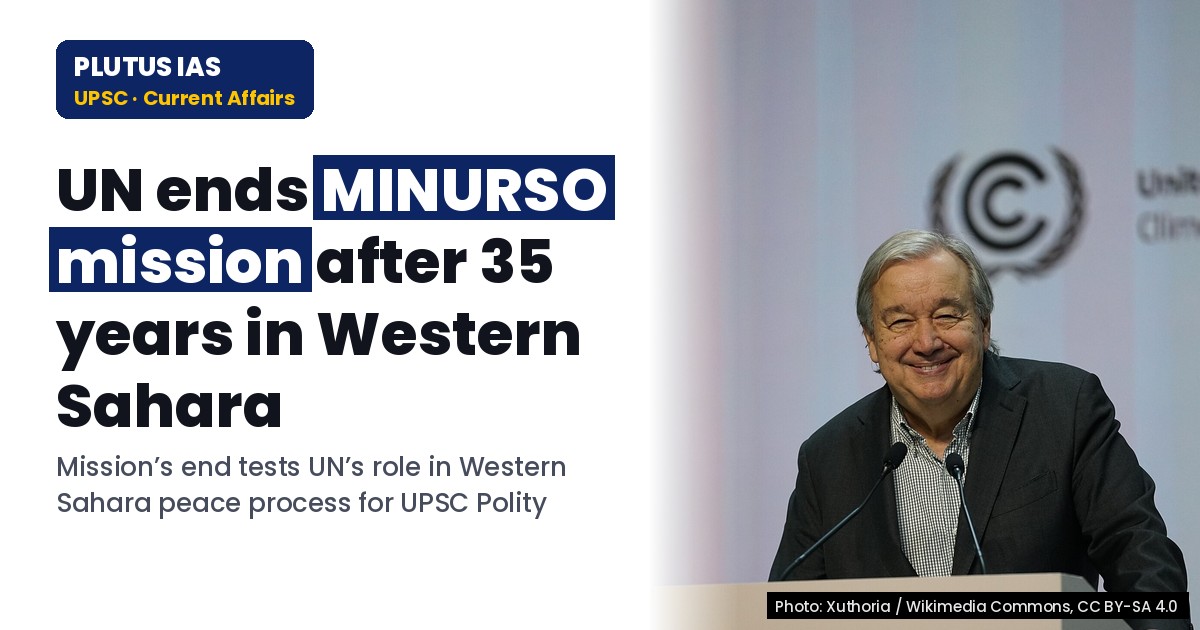
01 Nov UN ends MINURSO mission in Western Sahara: Key implications for UPSC
✎ MINURSO (established 1991) was the UN’s peacekeeping mission in Western Sahara tasked with organising a self-determination referendum, but its mandate expired on 31 October 2026 without renewal, leaving the conflict unresolved…
Subject Relevance — Where This Topic Fits
- GS Paper II — International Relations — International Organisations (UN), Regional Organisations (AU), Peacekeeping Operations, Conflict Resolution | GS Paper II — International Relations — India’s Role in UN Peacekeeping Missions
- Prelims: MINURSO, Western Sahara, Frente POLISARIO, Morocco, self-determination, UN peacekeeping, Security Council veto, ceasefire monitoring, demining operations, UN Personal Envoy, Polisario Front, Sahrawi Arab Democratic Republic (SADR), UN-Organization of African Unity (OAU) settlement proposals, 1988 peace plan, 1991 UNSC Resolution 690
- Essay: Ethics of self-determination in contested territories: Lessons from Western Sahara, The role of international organisations in conflict resolution: A case study of UN peacekeeping
Quick Revision: MINURSO (established 1991) was the UN’s peacekeeping mission in Western Sahara tasked with organising a self-determination referendum, but its mandate expired on 31 October 2026 without renewal, leaving the conflict unresolved and the UN committed to alternative diplomatic avenues.
Why is this in the news?
The termination of the United Nations Mission for the Referendum in Western Sahara (MINURSO) on 31 October 2026 marks a pivotal moment in the decades-long Western Sahara conflict. The failure of the UN Security Council to renew MINURSO’s mandate underscores the persistent divisions among permanent members regarding the path to a political solution, while the UN reaffirms its commitment to facilitating self-determination for the Sahrawi people through alternative diplomatic channels.
Background
- The Western Sahara conflict traces its origins to the decolonisation of Spanish Sahara in 1975, when Morocco and Mauritania laid claim to the territory, prompting the Frente POLISARIO to declare independence as the Sahrawi Arab Democratic Republic (SADR).
- The conflict escalated into armed hostilities between Morocco and POLISARIO, leading to Mauritania’s withdrawal in 1979 and Morocco’s subsequent control of most of the territory, including the economically significant phosphate-rich areas.
- A ceasefire was brokered in 1991 under UN auspices, with the UN Mission for the Referendum in Western Sahara (MINURSO) established to organise a referendum on self-determination, as envisaged in the 1988 UN-OAU settlement proposals accepted by both Morocco and POLISARIO.
- MINURSO’s mandate has been repeatedly extended, but the referendum envisaged in 1991 has never materialised due to disagreements over voter eligibility and the status of the territory.
- Hostilities resumed in 2020 following the breakdown of negotiations and Morocco’s resumption of military operations in the buffer zone, prompting MINURSO to adapt its monitoring role amid heightened tensions.
- The African Union (AU) has consistently supported the POLISARIO’s position on self-determination, while Morocco’s proposal of autonomy under Moroccan sovereignty has gained international traction, including recognition by the United States in 2020.
What is the Western Sahara conflict and MINURSO?
- Western Sahara is a disputed territory in North Africa, formerly a Spanish colony, whose sovereignty remains contested between Morocco and the Frente POLISARIO, which represents the Sahrawi people.
- The Frente POLISARIO, founded in 1973, advocates for the independence of Western Sahara and declared the Sahrawi Arab Democratic Republic (SADR) in 1976, recognised by several African states and the AU.
- Morocco claims Western Sahara as an integral part of its territory, citing historical ties and the 1975 Madrid Accords, and administers much of the territory while maintaining a military presence along the berm (a defensive sand wall).
- The United Nations Mission for the Referendum in Western Sahara (MINURSO) was established by UN Security Council Resolution 690 (1991) to monitor the ceasefire, organise a referendum on self-determination, and facilitate a political solution.
- MINURSO’s core functions included ceasefire monitoring, mine action, and confidence-building measures, with a mandate that has been renewed periodically despite the failure to hold the envisaged referendum.
- The mission’s headquarters were located in Laayoune, with team sites spanning both sides of the berm, and a liaison office in Tindouf, Algeria, where POLISARIO maintains its administrative centre.
- MINURSO operated with personnel from over 35 countries, including military observers, civilian staff, and demining experts, reflecting its multinational character and technical support functions.
- The termination of MINURSO’s mandate does not extinguish the Sahrawi people’s right to self-determination, as affirmed by the UN Secretary-General, and the UN will continue diplomatic efforts through its Personal Envoy for Western Sahara.
Key Features
| Feature | Significance |
|---|---|
| Mandate of MINURSO | Established in 1991 under UNSC Resolution 690 to monitor the ceasefire between Morocco and the Frente POLISARIO and facilitate a referendum on self-determination. |
| Geographical Scope | Operated across the territory of Western Sahara, including the berm (a defensive sand wall) dividing the region, with headquarters in Laayoune and a liaison office in Tindouf. |
| Personnel Composition | Comprised approximately 200 civilian staff, military observers, and staff officers from over 35 countries, with a dedicated mine action capability. |
| Liquidation Process | Post-mandate, a smaller UN team will oversee the orderly withdrawal of assets, repatriation of personnel, and disposal of equipment. |
| UN Personal Envoy | Staffan de Mistura will continue diplomatic efforts to achieve a political solution, maintaining UN engagement despite the mission’s closure. |
Why it Matters
International Peacekeeping
- MINURSO’s 35-year tenure underscores the challenges of long-term peacekeeping in unresolved territorial disputes, particularly where ceasefire monitoring and referendum facilitation remain unfulfilled.
- The mission’s closure highlights the limitations of UN peacekeeping in the absence of political consensus among key stakeholders, including permanent members of the Security Council.
- The failure to renew MINURSO’s mandate reflects broader geopolitical divisions, particularly between the United States and Russia, which impeded collective action on Western Sahara.
Regional Stability
- Western Sahara remains a flashpoint in North Africa, with potential implications for regional security, including the risk of renewed hostilities and the destabilising impact on neighbouring states like Algeria and Mauritania.
- The unresolved status of Western Sahara continues to strain Morocco-Algeria relations, affecting broader Maghreb integration and cooperation.
- The UN’s continued engagement through the Personal Envoy framework signals sustained international interest in preventing escalation and fostering dialogue.
Humanitarian and Security Concerns
- The territory faces persistent humanitarian challenges, including the protracted displacement of Sahrawi refugees in camps near Tindouf, Algeria, with limited access to durable solutions.
- The presence of landmines and unexploded ordnance, addressed by MINURSO’s mine action unit, poses ongoing risks to civilian populations and hinders development.
- The security vacuum following MINURSO’s withdrawal raises concerns about potential violations of the ceasefire and increased militarisation.
Challenges
1. Political Stalemate and Veto Dynamics
- The Security Council’s inability to agree on MINURSO’s mandate renewal reflects entrenched divisions among permanent members, particularly the United States and Russia, complicating multilateral conflict resolution.
- Draft resolutions proposing self-determination frameworks were vetoed or rejected, indicating irreconcilable positions between Morocco (backed by the US draft) and the Frente POLISARIO (aligned with Russia’s proposal).
- The absence of consensus undermines the UN’s ability to enforce or facilitate a binding political solution, leaving the status quo unresolved.
UPSC Link: UNSC Veto Power (Chapter V, Article 27 of UN Charter)
2. Self-Determination vs. Territorial Integrity
- The core dispute centres on the right to self-determination for the Sahrawi people, as envisaged in the 1988 UN-OAU settlement proposals, versus Morocco’s claim of sovereignty over Western Sahara.
- The referendum envisaged in 1991 has never materialised, with both parties interpreting the process differently—Morocco advocating for autonomy under its sovereignty, while the Frente POLISARIO insists on a vote on independence.
- The failure to reconcile these positions perpetuates the conflict, with neither side willing to compromise on fundamental principles.
UPSC Link: Right to Self-Determination (UNGA Resolution 1514, 1960)
3. Humanitarian Crisis and Refugee Camps
- The Sahrawi refugee population in Tindouf, Algeria, has endured decades of displacement, with limited access to basic services, education, and economic opportunities.
- International aid to the camps is often constrained by political sensitivities, as donor support may be perceived as legitimising either Morocco’s or the Frente POLISARIO’s position.
- The protracted nature of the crisis exacerbates socio-economic vulnerabilities, including food insecurity and limited livelihood opportunities.
UPSC Link: UNHCR Mandate and Refugee Protection (1951 Refugee Convention)
4. Security Vacuum and Ceasefire Risks
- MINURSO’s withdrawal leaves a security void, increasing the risk of ceasefire violations, particularly in the buffer zones and along the berm.
- The resumption of hostilities in 2020, despite the 1991 ceasefire, demonstrates the fragility of the status quo and the potential for renewed violence.
- The presence of armed groups and militarised factions on both sides heightens the risk of escalation, particularly in the absence of a neutral monitoring mechanism.
UPSC Link: Peacekeeping Principles (UN Peacekeeping Operations Principles)
5. Geopolitical Rivalries and External Influences
- The involvement of external actors, such as the United States and Russia, reflects broader geopolitical competition in North Africa, complicating conflict resolution efforts.
- Morocco’s strategic alliances, including with the United States (e.g., recognition of Moroccan sovereignty over Western Sahara in 2020), and Algeria’s support for the Frente POLISARIO, further entrench positions.
- The lack of a unified international approach weakens the UN’s ability to mediate and enforce a sustainable solution.
UPSC Link: Great Power Politics and UNSC Dynamics
Challenges — UPSC Perspective
| Issue | Concern |
|---|---|
| Renewal of MINURSO Mandate | Failure of the Security Council to agree on a renewal reflects deep divisions among permanent members, hindering collective action. |
| Right to Self-Determination | The Sahrawi people’s inalienable right remains unfulfilled due to unresolved political differences between Morocco and the Frente POLISARIO. |
| Humanitarian Conditions in Tindouf | Prolonged displacement of Sahrawi refugees in Algeria’s Tindouf camps, with limited access to durable solutions and basic services. |
| Security and Ceasefire Risks | Withdrawal of MINURSO increases the risk of ceasefire violations and renewed hostilities in the absence of a monitoring mechanism. |
| Geopolitical Rivalries | External influences, including US and Russian involvement, complicate conflict resolution and perpetuate the stalemate. |
Way Forward
- The UN must intensify diplomatic efforts through the Personal Envoy to revive negotiations between Morocco and the Frente POLISARIO, focusing on confidence-building measures.
- The Security Council should explore alternative frameworks for conflict resolution, such as a phased autonomy plan or a revised referendum process, to break the current deadlock.
- International actors, including the African Union and regional organisations, should facilitate dialogue to reduce geopolitical polarisation and foster a unified approach.
- Humanitarian agencies must prioritise support for Sahrawi refugees, including education, healthcare, and livelihood programmes, to address immediate needs and long-term resilience.
- A new UN-mandated monitoring mechanism, even if non-peacekeeping, should be considered to maintain a neutral presence and prevent escalation in the territory.
- Parties to the conflict should recommit to the ceasefire and refrain from actions that could undermine regional stability, including military mobilisation or provocative rhetoric.
- The UN should advocate for the demining of Western Sahara to mitigate risks to civilians and enable safe access to land and resources.
- Regional stakeholders should explore economic cooperation initiatives to reduce tensions, such as joint infrastructure projects or trade agreements that benefit all parties.
UPSC Value Addition
Keywords for Mains Answer-Writing
Western Sahara conflict · MINURSO mandate · United Nations peacekeeping · right to self-determination · UN Security Council veto · decolonisation · territorial integrity vs self-determination · ceasefire monitoring · UN Personal Envoy for Western Sahara · international conflict resolution · post-colonial territorial disputes · UN peacekeeping withdrawal · international law and territorial sovereignty · UN Charter Chapter VI · UN peacekeeping operations history
Constitutional & Policy Linkages
- UN Charter, Chapter VI (Pacific Settlement of Disputes) – Framework for UN mediation in territorial disputes.
- UN Charter, Article 2(7) – Principle of non-interference in domestic affairs, relevant to the self-determination debate.
Concept Flow
Ceasefire Agreement (1991) → Establishment of MINURSO → Failure to implement referendum → Resumption of hostilities (2020) → Security Council deadlock on mandate renewal → Withdrawal of MINURSO → Risk of escalation → UN Personal Envoy’s renewed mediation efforts → Potential for dialogue revival or further stagnation.
Prelims Practice Questions
Q1. Consider the following statements regarding the United Nations Mission for the Referendum in Western Sahara (MINURSO):
1. MINURSO was established under UN Security Council Resolution 690 (1991).
2. Its mandate included organising a referendum for self-determination of the people of Western Sahara.
3. The mission’s mandate expired on 31 October 2026 after the Security Council failed to agree on its extension.
4. MINURSO was headquartered in Algiers.
How many of the above statements are correct?
- Only one
- Only two
- Only three
- All four
Answer: Only three — Statements 1, 2, and 3 are correct. MINURSO was established under Resolution 690 (1991) to organise a referendum for self-determination, and its mandate expired on 31 October 2026. Statement 4 is incorrect as MINURSO was headquartered in Laayoune, not Algiers.
Q2. Assertion (A): The United Nations Mission for the Referendum in Western Sahara (MINURSO) was primarily tasked with monitoring a ceasefire between Morocco and the Frente POLISARIO.
Reason (R): MINURSO’s mandate did not include organising a referendum for self-determination as originally envisaged due to political disagreements.
In the context of the above two statements, which of the following is correct?
- Both A and R are true, and R is the correct explanation of A
- Both A and R are true, but R is NOT the correct explanation of A
- A is true, but R is false
- A is false, but R is true
Answer: A is true, but R is false — Assertion (A) is true: MINURSO monitored the ceasefire. Reason (R) is also true: the referendum mandate could not be implemented due to political disagreements, but R does not explain A, as monitoring the ceasefire was a separate function.
Q3. Match the following columns related to the Western Sahara conflict:
Column I
A. MINURSO
B. Frente POLISARIO
C. UN Personal Envoy for Western Sahara
D. 1988 Settlement Proposals
Column II
1. Political wing representing the Sahrawi Arab Democratic Republic
2. UN peacekeeping mission established in 1991
3. Framework for a political solution accepted by Morocco and Frente POLISARIO
4. Role currently held by Staffan de Mistura
Select the correct match:
- A-2, B-1, C-4, D-3
- A-1, B-2, C-3, D-4
- A-3, B-4, C-1, D-2
- A-4, B-3, C-2, D-1
Answer: A-2, B-1, C-4, D-3 — A matches with 2 (MINURSO is the UN peacekeeping mission established in 1991). B matches with 1 (Frente POLISARIO is the political wing representing the Sahrawi Arab Democratic Republic). C matches with 4 (Staffan de Mistura is the current UN Personal Envoy for Western Sahara). D matches with 3 (the 1988 Settlement Proposals provided a framework for a political solution).
Mains Practice Question
✍ The termination of the United Nations Mission for the Referendum in Western Sahara (MINURSO) marks the end of a decades-long peacekeeping effort in a territory embroiled in a protracted territorial dispute. Critically examine the implications of MINURSO’s withdrawal for the right to self-determination of the people of Western Sahara and the broader principles of international peacekeeping. (15 Marks)
Approach: MODEL-ANSWER SKELETON:
1. **Context and Mandate of MINURSO**:
– Establishment under UNSC Resolution 690 (1991) to monitor ceasefire and organise a referendum for self-determination.
– Failure to implement the referendum due to political disagreements between Morocco and Frente POLISARIO.
– Role in maintaining ceasefire and humanitarian access over 35 years.
2. **Right to Self-Determination**:
– Definition under international law: UN Charter (Article 1(2)), ICCPR (Article 1), and ICESCR (Article 1).
– Application to Western Sahara: UN-Organization of African Unity Settlement Proposals (1988) accepted by both parties.
– Implications of MINURSO’s withdrawal: Does it abrogate the right to self-determination? (Refer to UN Secretary-General’s statement: ‘does not abrogate the inalienable right’).
– Legal and moral obligations of the international community to uphold self-determination.
3. **Broader Principles of International Peacekeeping**:
– MINURSO as a Chapter VI peacekeeping mission under the UN Charter: principles of consent, impartiality, and non-use of force except in self-defence.
– Challenges faced: political deadlock, lack of consensus in the UN Security Council, and veto politics (US draft vetoed by Russia).
– Lessons for future peacekeeping missions: need for consensus, flexibility in mandates, and adherence to international law.
4. **Alternative Pathways for Resolution**:
– Role of the UN Personal Envoy (Staffan de Mistura) in facilitating dialogue.
– Importance of regional cooperation (e.g., African Union’s role in conflict resolution).
– Potential for bilateral or multilateral negotiations outside the UN framework.
5. **Critical Analysis**:
– Has the withdrawal weakened the international commitment to self-determination?
– Does the termination of MINURSO signal a shift towards realpolitik over normative principles?
– Evaluate the effectiveness of peacekeeping missions in protracted conflicts where political solutions remain elusive.
6. **Conclusion**:
– Summarise the implications for Western Sahara and the principles of international peacekeeping.
– Emphasise the need for renewed diplomatic efforts to uphold the right to self-determination while respecting territorial integrity.
Source: news.un.org
Generated by AanyaAi for educational purpose.
Related guides on our sites
- Best PSIR optional coaching for upsc
- Best PSIR optional teacher for upsc
- Best teacher of PSIR optional for upsc
- Best PSIR optional coaching in delhi for UPSC

- UN ends MINURSO mission in Western Sahara: Key implications for UPSC - November 1, 2026
- अमित शाह ने चंडीगढ़ में 258 करोड़ रुपये की परियोजनाओं का किया लोकार्पण एवं शिलान्यास - November 1, 2026
- CJI Urges Strengthening Public Trust in High Courts for Timely Justice - November 1, 2026

No Comments