


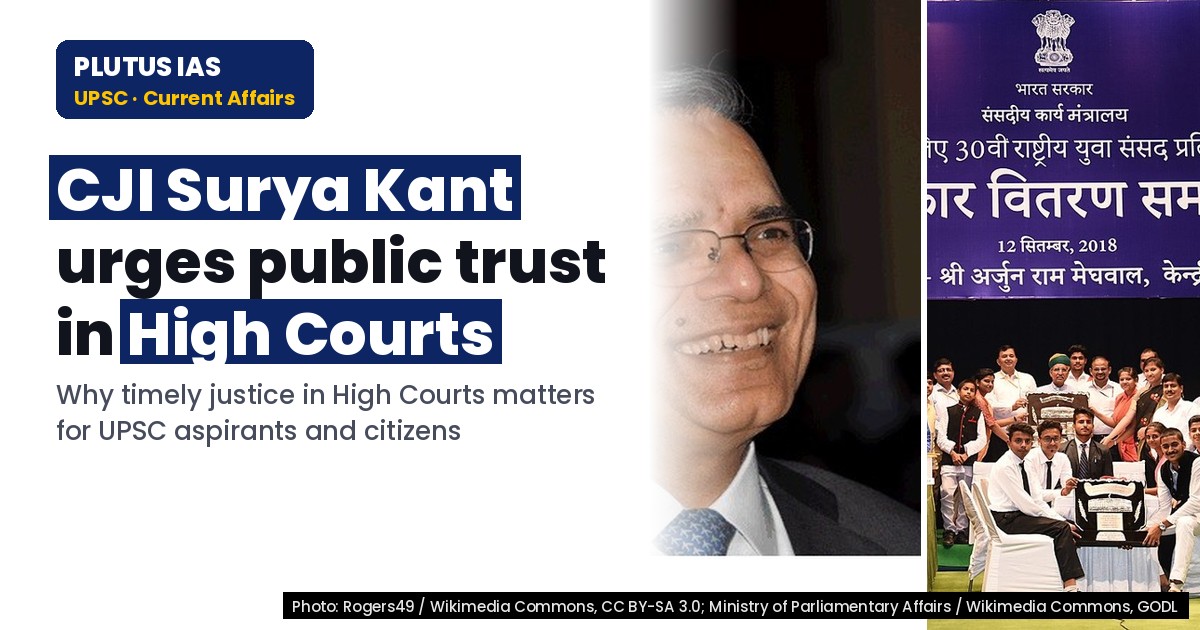
01 Nov CJI Urges Strengthening Public Trust in High Courts for Timely Justice
✎ High Courts in India are constitutional courts with original, appellate, and writ jurisdictions, serving as the primary forums for constitutional remedies and ensuring judicial review of executive and legislative actions to…
Subject Relevance — Where This Topic Fits
- GS Paper II — Polity and Governance: Judiciary and Constitutional Framework | GS Paper IV — Ethics, Integrity and Aptitude: Public Service Values and Accountability
- Prelims: Judicial Review, Constitutional Remedies, High Court Jurisdiction, Access to Justice, Judicial Transparency, Constitutional Morality, Judicial Activism, Public Trust in Institutions
- Essay: Access to Justice as a Fundamental Right: Balancing Efficiency and Equity in the Judiciary, Institutional Integrity and Public Confidence: The Role of the Judiciary in Democratic Governance
Quick Revision: High Courts in India are constitutional courts with original, appellate, and writ jurisdictions, serving as the primary forums for constitutional remedies and ensuring judicial review of executive and legislative actions to uphold constitutional values and public trust.
Why is this in the news?
The Chief Justice of India (CJI) Surya Kant, while inaugurating the platinum jubilee celebrations of the Kerala High Court on November 1, 2026, emphasised the need to strengthen public confidence in High Courts as the primary forums for constitutional remedies. He underscored the importance of accessibility, transparency in listing procedures, technological integration for case prioritisation, and the High Courts’ role in addressing human suffering and constitutional values. This address highlights critical governance challenges and opportunities in India’s judicial system, particularly concerning institutional responsiveness and public trust.
Background
- The High Courts in India, established under Articles 214 to 231 of the Constitution, serve as the highest judicial authorities in their respective states and union territories, with appellate, original, and writ jurisdictions.
- High Courts play a pivotal role in upholding constitutional values, ensuring judicial review of executive and legislative actions, and providing remedies for violations of fundamental rights under Articles 32 and 226.
- Public confidence in the judiciary is a cornerstone of democratic governance, as articulated in the Preamble of the Constitution, which seeks to secure justice, liberty, and equality for all citizens.
- The judiciary’s accessibility to vulnerable sections—such as farmers, workers, and marginalised communities—is essential for realising the constitutional promise of justice for all, irrespective of socio-economic status.
- Technological advancements, such as e-courts and case management systems, have been introduced to enhance efficiency, but challenges remain in ensuring equitable access and transparency.
- The CJI’s remarks align with broader judicial reforms aimed at reducing pendency, improving case listing mechanisms, and enhancing the judiciary’s responsiveness to societal needs.
What are High Courts and their Constitutional Role?
- Constitutional Status: High Courts are constitutional courts established under Part VI, Chapter V of the Constitution (Articles 214–231), with jurisdiction over their respective states or union territories.
- Jurisdictional Powers: They exercise original jurisdiction in matters such as writ petitions (under Article 226), civil and criminal appeals from subordinate courts, and constitutional interpretations.
- Writ Jurisdiction: High Courts can issue writs—such as habeas corpus, mandamus, prohibition, certiorari, and quo warranto—to enforce fundamental rights and check administrative excesses.
- Appellate Role: They hear appeals from lower courts (District Courts, Sessions Courts) and tribunals, ensuring legal consistency and adherence to constitutional principles.
- Judicial Review: High Courts possess the power to review executive actions, subordinate legislation, and even state laws for constitutional validity, acting as guardians of the Constitution.
- Accessibility and Local Context: High Courts are institutionally closer to the people, enabling them to address local grievances, regional disparities, and socio-economic realities more effectively than the Supreme Court.
- Role in Governance: By adjudicating disputes involving public interest, environmental concerns, and socio-economic rights, High Courts contribute to governance accountability and policy implementation.
- Judicial Independence: High Courts operate under the principle of judicial independence, as enshrined in Articles 50 and 233–235, ensuring impartiality and protection from executive interference.
Key Features
| Feature | Significance |
|---|---|
| Accessibility to vulnerable sections | Ensures that marginalised groups, including fishermen, farmers, and workers, can seek justice without systemic barriers, aligning with constitutional guarantees of equality and non-discrimination under Articles 14 and 15. |
| Transparency in case listing | Reduces arbitrariness in judicial processes, fosters public trust, and mitigates perceptions of bias by making judicial proceedings predictable and accountable. |
| Technological assistance for prioritisation | Leverages digital tools to expedite urgent cases (e.g., habeas corpus, eviction disputes), ensuring timely justice while maintaining procedural fairness. |
| Regional contextualisation | High Courts, being closer to local realities, can better interpret constitutional principles in the context of regional socio-economic conditions, enhancing the relevance of judicial decisions. |
| Human-centric judicial approach | Prioritises the urgency of human suffering over procedural formalities, reinforcing the judiciary’s role as a protector of fundamental rights under Part III of the Constitution. |
Why it Matters
Judicial Governance
- High Courts serve as the primary constitutional forums for remedial justice, acting as the first line of defence against executive or legislative overreach.
- Strengthening public confidence in High Courts is essential for maintaining the separation of powers and upholding the rule of law in a federal structure.
- The judiciary’s legitimacy depends on its perceived impartiality, accessibility, and responsiveness to societal needs, particularly in a diverse democracy like India.
Constitutional Framework
- The independence of the judiciary, as enshrined in Articles 50 and 124(2), is critical to its ability to function as a counter-majoritarian institution.
- The doctrine of judicial review (implicit in Part V and Part VI) empowers High Courts to strike down unconstitutional laws or executive actions, necessitating public trust in their decisions.
- The principle of natural justice (Article 21) and the right to a speedy trial (Article 21) are directly implicated in the CJI’s call for urgent case resolution.
Federalism and Local Governance
- High Courts, as state-level constitutional authorities, bridge the gap between centralised governance and localised justice, ensuring that regional grievances are addressed within the constitutional framework.
- Their proximity to local issues enables them to interpret constitutional provisions in a manner that is contextually relevant to the socio-economic fabric of the region.
Challenges
1. Case Pendency and Delay
- Prolonged litigation erodes public confidence, particularly in cases involving human rights, livelihoods, or urgent relief.
- The backlog of cases in High Courts (over 50 lakh pending as of 2023) necessitates systemic reforms in listing procedures and judicial capacity.
- Delays disproportionately affect marginalised communities, who lack the resources to navigate prolonged legal battles.
UPSC Link: Judicial Pendency and Access to Justice
2. Accessibility Barriers
- Geographical and economic constraints limit litigants’ ability to approach High Courts, especially in remote or underdeveloped regions.
- The requirement for physical presence in High Court registries or benches acts as a deterrent for vulnerable groups, including daily-wage workers and rural populations.
- Lack of awareness about legal rights and procedures further exacerbates exclusion from the justice system.
UPSC Link: Judicial Accessibility and Legal Aid
3. Transparency and Predictability
- Opaque listing mechanisms and arbitrary adjournments contribute to perceptions of judicial bias or inefficiency.
- The absence of standardised criteria for case prioritisation can lead to inequities in justice delivery, particularly in matters of life and liberty.
- Public scrutiny of judicial processes is essential to maintain accountability and legitimacy.
UPSC Link: Judicial Transparency and Accountability
4. Technological Integration
- While digital tools can expedite case management, their implementation requires robust infrastructure and training for judicial officers and staff.
- Over-reliance on technology without safeguards may exclude litigants unfamiliar with digital platforms, particularly the elderly or illiterate.
- Data privacy and cybersecurity concerns must be addressed to protect sensitive case information.
UPSC Link: E-Courts and Digital Judiciary
5.
- Inadequate judge-to-population ratios in High Courts (e.g., 1 judge per 10 lakh people in some states) strain judicial resources.
- Insufficient court infrastructure, including physical spaces and digital tools, hampers efficient case disposal.
- The need for specialised benches (e.g., for environmental or commercial disputes) requires targeted capacity-building.
UPSC Link: Judicial Infrastructure and Manpower
Challenges — UPSC Perspective
| Issue | Concern |
|---|---|
| Case backlog | Delays in justice delivery undermine constitutional guarantees of speedy trial and access to justice. |
| Geographical barriers | Remote litigants face difficulties in accessing High Courts, exacerbating inequalities in justice. |
| Opaque listing procedures | Lack of transparency in case allocation fuels perceptions of judicial bias or inefficiency. |
| Digital divide | Technological solutions may exclude litigants without access to digital tools or literacy. |
| Inadequate infrastructure | Poor court facilities and judge shortages impede efficient judicial functioning. |
| Regional disparities | Variations in High Court performance across states affect uniform justice delivery. |
Way Forward
- Implement standardised, transparent criteria for case prioritisation in High Courts, with a focus on urgent matters (e.g., habeas corpus, eviction disputes).
- Expand digital infrastructure for e-filing, virtual hearings, and AI-assisted case management to reduce pendency and improve accessibility.
- Strengthen legal aid mechanisms (e.g., through the National Legal Services Authority) to ensure marginalised groups can navigate judicial processes.
- Establish specialised benches in High Courts for socio-economic disputes (e.g., labour, environmental, or land rights) to enhance contextual adjudication.
- Conduct periodic audits of High Court performance, including case disposal rates, pendency, and litigant feedback, to identify systemic gaps.
- Promote regional language proficiency among judicial officers to improve communication with local communities and reduce barriers to justice.
- Enhance inter-state judicial cooperation to address cases with multi-jurisdictional implications (e.g., inter-state river disputes).
- Invest in capacity-building for judicial officers on emerging legal technologies and ethical considerations in digital adjudication.
UPSC Value Addition
Keywords for Mains Answer-Writing
Judicial hierarchy in India · High Courts under the Constitution · Access to justice · Judicial transparency · Constitutional remedies · Judicial accountability · Technology in judicial processes · Human-centric adjudication · Judicial accessibility · Constitutional values in adjudication
Constitutional & Policy Linkages
- Article 14: Equality before law and equal protection of laws
- Article 15: Prohibition of discrimination
- Article 21: Protection of life and personal liberty (right to speedy trial)
- Article 50: Separation of judiciary from executive
- Article 124(2): Independence of Supreme Court judges
- Article 227: Power of superintendence over subordinate courts
Concept Flow
Public perception of judicial inefficiency → Erosion of trust in High Courts → Reduced faith in constitutional remedies → Weakening of rule of law → High pendency and delays → Prolonged litigation → Disproportionate impact on marginalised groups → Violation of Article 21 (speedy trial) → Opaque case listing → Perceived arbitrariness → Undermining judicial legitimacy → Erosion of separation of powers (Article 50) → Geographical and economic barriers → Limited access to justice → Exclusion of vulnerable sections → Contradiction with Articles 14 and 15 → Lack of technological integration → Inefficient case management → Delayed justice → Public dissatisfaction with judiciary → Regional disparities in judicial performance → Unequal justice delivery → Federalism challenges → Need for standardised reforms → CJI’s call for reform → Focus on accessibility, transparency, and technology → Strengthening of constitutional governance → Reinforcement of judicial independence
Prelims Practice Questions
Q1. Consider the following statements regarding the High Courts in India:
1. High Courts are constitutional courts established under Article 214 of the Constitution.
2. The High Courts possess original jurisdiction over disputes relating to the enforcement of Fundamental Rights.
3. The High Courts can issue writs for the enforcement of Fundamental Rights under Article 226.
4. The High Courts are subordinate to the Supreme Court but superior to the District Courts in the judicial hierarchy.
How many of the above statements are correct?
- Only one
- Only two
- Only three
- All four
Answer: All four — Statements 1, 2, and 3 are correct. Statement 4 is incorrect because the High Courts are not subordinate to the Supreme Court; they are part of the same judicial hierarchy but operate independently within their jurisdictions.
Q2. Assertion (A): The High Courts in India are empowered to issue writs under Article 226 for the enforcement of Fundamental Rights.
Reason (R): Article 32 of the Constitution confers the Supreme Court with the exclusive power to issue writs for the enforcement of Fundamental Rights.
- Both A and R are true, and R is the correct explanation of A.
- Both A and R are true, but R is not the correct explanation of A.
- A is true, but R is false.
- A is false, but R is true.
Answer: A is true, but R is false. — Assertion (A) is true as High Courts can issue writs under Article 226. Reason (R) is true but does not correctly explain the assertion, as Article 32 pertains to the Supreme Court’s writ jurisdiction, while Article 226 pertains to High Courts.
Q3. Match the following constitutional provisions with their correct descriptions:
Column I (Provision) Column II (Description)
A. Article 214 1. Empowers High Courts to issue writs for enforcement of Fundamental Rights
B. Article 226 2. Establishes the High Courts in the States
C. Article 217 3. Deals with the appointment and conditions of High Court judges
D. Article 227 4. Provides for the superintendence of all courts by the High Court
Select the correct match:
- A-2, B-1, C-3, D-4
- A-1, B-2, C-3, D-4
- A-4, B-3, C-2, D-1
- A-3, B-4, C-1, D-2
Answer: A-2, B-1, C-3, D-4 — The correct matches are: A-2 (Article 214 establishes High Courts), B-1 (Article 226 empowers High Courts to issue writs), C-3 (Article 217 deals with High Court judges), and D-4 (Article 227 provides for superintendence of courts by High Courts).
Mains Practice Question
✍ The High Courts in India, as the first forum for constitutional remedies, must balance accessibility, efficiency, and constitutional fidelity to sustain public confidence. Critically examine this proposition with reference to the recent observations of the Chief Justice of India on strengthening public confidence in High Courts. (15 Marks)
Approach: MODEL-ANSWER SKELETON:
1. **Introduction**: Define the constitutional role of High Courts (Art. 214, 226, 227) and their significance as the first forum for constitutional remedies.
2. **Accessibility and Vulnerability**: Discuss the CJI’s emphasis on accessibility to vulnerable sections (e.g., fishermen, farmers, workers) and the need for localised adjudication to address regional grievances.
3. **Efficiency and Transparency**: Examine the CJI’s call for transparent and predictable listing procedures, technological assistance in case prioritisation, and timely justice without dependence on proximity to the Supreme Court.
4. **Constitutional Fidelity**: Highlight the CJI’s assertion that High Courts must remain unwavering in their commitment to constitutional values, including human-centric adjudication and urgency in matters of suffering.
5. **Challenges**: Identify systemic issues such as case backlog, lack of regional representation in judicial appointments, and the need for judicial reforms to address these concerns.
6. **Conclusion**: Synthesise the arguments to underscore the importance of High Courts in maintaining public confidence through a balance of accessibility, efficiency, and constitutional adherence. Provide a balanced view with no partisan slant.
Source: The Hindu
Generated by AanyaAi for educational purpose.
Related guides on our sites
- Anthropology VS PSIR
- Best PSIR optional coaching
- Best PSIR optional coaching online
- Best PSIR optional teacher

- CJI Urges Strengthening Public Trust in High Courts for Timely Justice - November 1, 2026
- हरियाणा हीरक जयंती: राष्ट्रपति मुर्मु ने राज्य के 60 साल के योगदान को किया नमन - November 1, 2026
- UPSC Alert: Coal Ministry’s Star Rating Awards for Mining Excellence - November 1, 2026

No Comments