


06 Aug UN Reports July 2026 as Deadliest Month for Ukrainian Civilians Since 2022
✎ The principle of distinction in International Humanitarian Law mandates that parties to a conflict must at all times distinguish between civilians and combatants, and between civilian objects and military objectives, ensuring…
Subject Relevance — Where This Topic Fits
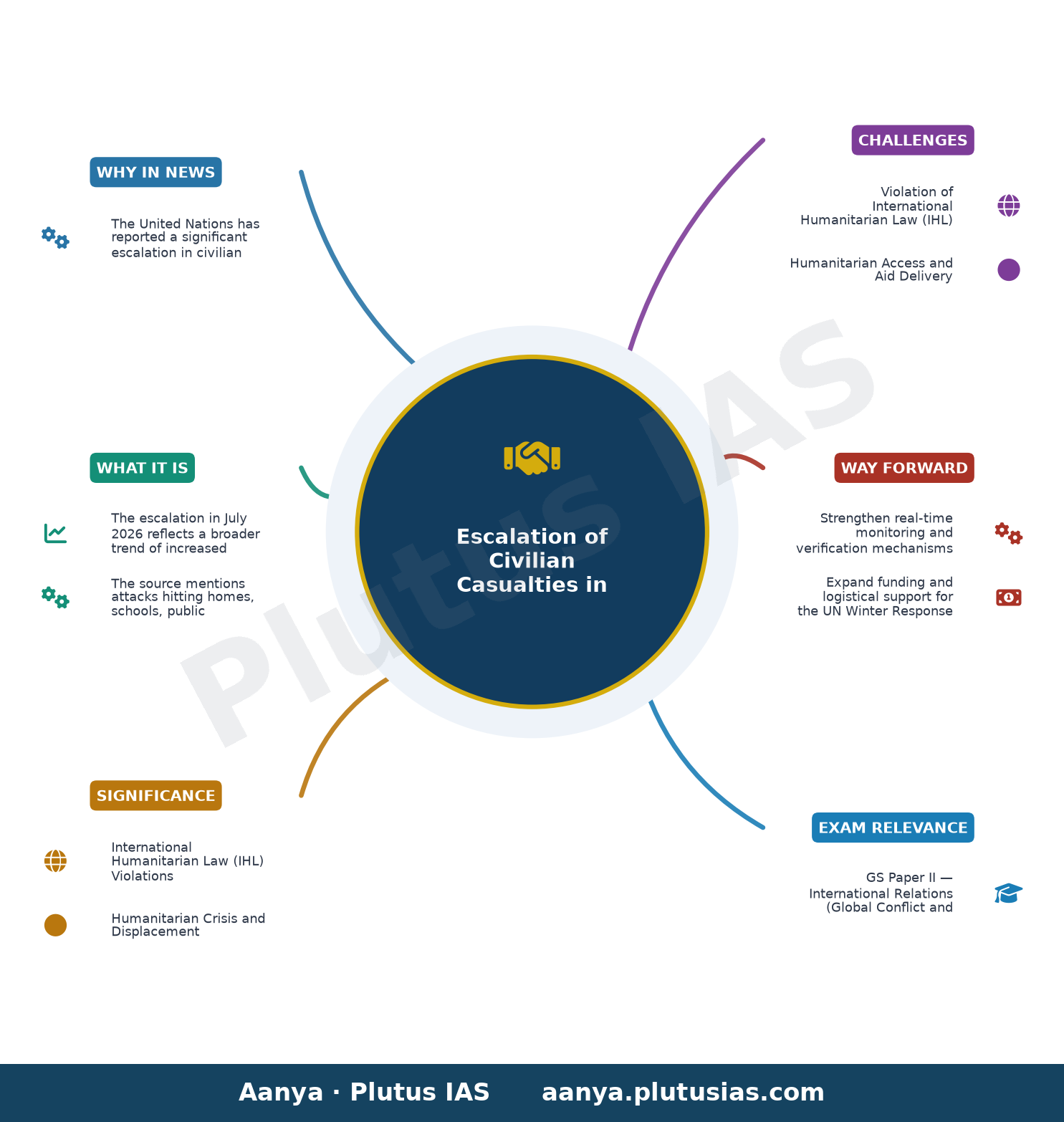
- GS Paper II — International Relations (Global Conflict and Peacekeeping)
- Prelims: Geneva Conventions, International Humanitarian Law (IHL), UN Office for the Coordination of Humanitarian Affairs (OCHA), UN High Commissioner for Human Rights (OHCHR), UNICEF, Internally Displaced Persons (IDPs), Refugee crisis, Ballistic missiles, Long-range drones, Protection of civilians in armed conflict
- Essay: The moral and legal dimensions of modern warfare: Balancing sovereignty and humanitarian imperatives, Human security in the 21st century: The erosion of civilian protection in prolonged conflicts
Quick Revision: The principle of distinction in International Humanitarian Law mandates that parties to a conflict must at all times distinguish between civilians and combatants, and between civilian objects and military objectives, ensuring that attacks are directed solely at military targets.
Why is this in the news?
The United Nations has reported a significant escalation in civilian casualties in Ukraine during July 2026, marking the deadliest month for civilians since April 2022. The attacks have targeted critical civilian infrastructure, including homes, schools, and water systems, exacerbating a humanitarian crisis that already displaces millions. The UN’s humanitarian coordinator has underscored the violation of international humanitarian law, while Ukrainian counter-strikes have also caused civilian casualties in Russia, highlighting the indiscriminate nature of modern warfare.
Background
- The Russo-Ukrainian War, which began in 2014 with Russia’s annexation of Crimea, escalated into a full-scale invasion in February 2022, triggering a global geopolitical and humanitarian crisis.
- The conflict has been characterized by periodic ceasefires, failed peace talks, and a steady increase in the use of long-range precision weapons, including ballistic missiles and drones, by both sides.
- The UN has consistently documented violations of international humanitarian law (IHL), including attacks on civilian infrastructure and the displacement of over 12.7 million Ukrainians, with 3.7 million internally displaced and 5.9 million as refugees.
- The war has strained global food and energy supplies, with Ukraine being a major exporter of grain and Russia a key supplier of oil and gas, leading to economic repercussions worldwide.
- The International Criminal Court (ICC) has issued arrest warrants for Russian officials, including President Vladimir Putin, for alleged war crimes, including the unlawful deportation of Ukrainian children.
- The conflict has also become a proxy battleground for broader geopolitical tensions, with Western nations providing military and humanitarian aid to Ukraine while Russia seeks support from allies like China, Iran, and North Korea.
What constitutes the escalation in civilian casualties in the Russo-Ukrainian War?
- The escalation in July 2026 reflects a broader trend of increased long-range strikes by Russia, utilizing ballistic missiles and drones to target urban centers and critical infrastructure beyond the frontline, violating the principle of distinction under IHL.
- The source mentions attacks hitting homes, schools, public transportation infrastructure, water systems, and humanitarian warehouses in Kramatorsk, Kherson, and Zaporizhzhia, and multiple people killed near Kyiv.
- The UN’s OCHA and OHCHR have documented a sharp increase in civilian casualties in the first half of 2026 compared to the same period in 2024 and 2025, indicating a deliberate or indiscriminate pattern of violence.
- The use of long-range weapons in populated areas contravenes the Geneva Conventions, which mandate that parties to a conflict must take all feasible precautions to avoid harm to civilians and civilian objects.
- The humanitarian crisis is compounded by the destruction of energy infrastructure, leaving millions without heating during winter, as seen in previous years when Russia targeted power grids to disrupt civilian life.
- The source material states that Ukrainian long-range drone strikes killed at least 12 people – including children – across multiple cities in Russia, according to local authorities.
- The UN’s Winter Response Plan aims to provide heating assistance, shelter repairs, and essential services, but its effectiveness is undermined by the ongoing intensity of attacks and limited access to conflict zones.
- The international community’s response has been fragmented, with humanitarian aid often delayed by geopolitical divisions, while calls for a ceasefire and negotiations remain unheeded.
Key Features
| Feature | Significance |
|---|---|
| Escalation of Russian long-range strikes | Violates international humanitarian law by targeting civilian infrastructure, leading to mass casualties and displacement. |
| July 2026 as deadliest month for civilians since April 2022 | Indicates systematic intensification of hostilities, with 1,396 civilian deaths and 7,978 injuries in the first half of 2026. |
| Destruction of critical civilian infrastructure (homes, schools, water systems) | Disrupts essential services, exacerbates humanitarian crisis, and violates Article 54 of Additional Protocol I to the Geneva Conventions. |
| Internal displacement of 3.7 million Ukrainians and 5.9 million refugees globally | Strains regional stability, humanitarian aid systems, and underscores protracted conflict dynamics. |
| UN Winter Response Plan 2026-27 | Aims to mitigate winter-related risks through heating assistance, shelter repairs, and healthcare delivery amid energy infrastructure attacks. |
Why it Matters
International Humanitarian Law (IHL) Violations
- Deliberate or indiscriminate attacks on civilians violate Geneva Conventions (1949) and Additional Protocols (1977), particularly Articles 48, 51, and 57.
- Use of ballistic missiles and long-range drones in populated areas contravenes the principle of distinction (civilians vs. military objectives).
- Destruction of water and energy infrastructure violates Article 54 of Additional Protocol I, which prohibits attacks on objects indispensable to civilian survival.
Humanitarian Crisis and Displacement
- Escalating civilian casualties (1,396 deaths in H1 2026) reflect a deteriorating security environment with long-term socio-economic repercussions.
- 3.7 million internally displaced persons (IDPs) and 5.9 million refugees strain host countries’ resources, particularly in Eastern Europe and beyond.
- Winter exacerbates vulnerabilities, with 12.7 million requiring humanitarian assistance, necessitating coordinated UN-led interventions.
Regional and Global Geopolitical Implications
- Prolonged conflict risks destabilizing Eastern Europe, with potential spillover effects on energy security, migration flows, and NATO-Russia dynamics.
- International responses (sanctions, aid, diplomatic pressure) highlight the UN’s role in conflict resolution and humanitarian coordination.
Protection of Children and Vulnerable Groups
- UNICEF reports child casualties in both Ukraine and Russia, violating Articles 38 and 77 of the UN Convention on the Rights of the Child.
- Psychosocial trauma, disrupted education, and loss of caregivers compound long-term humanitarian needs.
Energy and Infrastructure Warfare
- Systematic targeting of energy grids (as in previous winters) reflects a strategy of attrition, with severe humanitarian consequences.
- Violates the principle of proportionality under IHL, as collateral damage to civilians outweighs military gains.
Challenges
1. Violation of International Humanitarian Law (IHL)
- Indiscriminate attacks on civilians and civilian infrastructure contravene Geneva Conventions and Additional Protocols.
- Lack of accountability for war crimes complicates post-conflict justice and reconciliation.
- Challenges in enforcing IHL due to geopolitical divisions in the UN Security Council.
UPSC Link: GS2: International Law
2. Humanitarian Access and Aid Delivery
- Destruction of roads, railways, and warehouses disrupts supply chains for food, medicine, and shelter materials.
- Security risks for humanitarian workers in conflict zones hinder aid distribution.
- Winter conditions exacerbate logistical challenges, requiring preemptive planning.
UPSC Link: GS2: Humanitarian Issues
3. Protection of Civilians in Asymmetric Warfare
- Use of drones and ballistic missiles in urban areas blurs the line between military and civilian targets.
- Civilian casualties are often underreported due to access restrictions and propaganda narratives from belligerents.
- Need for real-time monitoring and verification mechanisms to document violations.
UPSC Link: GS2: Conflict Resolution
4. Winter-Induced Humanitarian Crisis
- Energy infrastructure attacks (e.g., heating systems) risk mass civilian displacement and mortality.
- Limited resources for winterization efforts (e.g., insulation, fuel subsidies) in war-torn regions.
- Cross-border coordination required for refugee reception and IDP resettlement.
UPSC Link: GS2: Disaster Management
5. Psychosocial and Long-Term Recovery
- Trauma among children and displaced populations requires sustained mental health support and education continuity.
- Reconstruction of homes, schools, and hospitals demands international funding and technical expertise.
- Economic stagnation in conflict zones delays recovery and exacerbates poverty.
UPSC Link: GS2: Social Justice
6. Geopolitical Polarization and Diplomatic Paralysis
- Veto powers in the UN Security Council hinder unified responses to ceasefire resolutions or sanctions.
- Proxy involvement (e.g., arms supply, mercenaries) prolongs the conflict, complicating peace negotiations.
- Rise of disinformation and propaganda complicates humanitarian advocacy and conflict resolution.
UPSC Link: GS2: International Relations
Challenges — UPSC Perspective
| Issue | Concern |
|---|---|
| Indiscriminate attacks on civilians | Violation of IHL, mass casualties, and displacement. |
| Destruction of critical infrastructure | Disruption of essential services (water, energy, healthcare) and humanitarian access. |
| Winter-induced vulnerabilities | Exacerbation of humanitarian crisis due to energy infrastructure attacks and sub-zero temperatures. |
| Child casualties and trauma | Violation of CRC, long-term psychosocial impact, and disruption of education. |
| Humanitarian access constraints | Security risks for aid workers, supply chain disruptions, and underreporting of violations. |
| Geopolitical polarization | Veto powers in UNSC, proxy involvement, and stalled peace negotiations. |
Way Forward
- Strengthen real-time monitoring and verification mechanisms (e.g., UN OCHA, UNHCR) to document IHL violations and civilian casualties.
- Expand funding and logistical support for the UN Winter Response Plan, prioritizing heating assistance and shelter repairs.
- Enhance coordination between UN agencies (UNICEF, IOM, UNHCR) to address psychosocial trauma, education continuity, and livelihood restoration.
- Advocate for the establishment of an international tribunal or hybrid court to investigate war crimes and ensure accountability.
- Promote diplomatic efforts through neutral platforms (e.g., OSCE, Geneva Conventions) to de-escalate hostilities and facilitate ceasefire negotiations.
- Invest in resilient infrastructure (e.g., micro-grids, water treatment plants) to mitigate future attacks on critical services.
- Support cross-border initiatives for refugee reception and IDP resettlement, including cash assistance and housing rehabilitation.
- Encourage states to ratify and enforce Additional Protocols to the Geneva Conventions, particularly Articles 51 and 54.
UPSC Value Addition
Keywords for Mains Answer-Writing
International Humanitarian Law · Protection of Civilians in Armed Conflict · Geneva Conventions · Principles of Distinction and Proportionality · Civilian Infrastructure in War · UN Human Rights Monitoring in Ukraine · Humanitarian Crisis in War Zones · Winter Response Plan for Ukraine · Children in Armed Conflict · Displacement and Refugee Crisis · Ballistic Missiles and Long-Range Strikes · International Law Obligations of States · UN Charter and Use of Force · Humanitarian Access in Conflict Zones · UNICEF and Protection of Children in War
Concept Flow
Russian military escalation → Intensified long-range strikes on civilian infrastructure → Mass civilian casualties and displacement → Violation of IHL (Geneva Conventions, Additional Protocols) → Humanitarian crisis (12.7 million requiring aid) → UN-led winter response planning → Geopolitical polarization (veto powers, proxy involvement) → Protracted conflict with regional instability → Long-term recovery challenges (psychosocial trauma, infrastructure reconstruction)
Prelims Practice Questions
Q1. Consider the following statements regarding the principles of International Humanitarian Law (IHL) in armed conflicts:
1. The principle of distinction requires parties to a conflict to distinguish between civilians and combatants.
2. The principle of proportionality prohibits attacks that may cause incidental civilian harm which is excessive in relation to the concrete and direct military advantage anticipated.
3. The principle of precaution requires parties to take all feasible precautions to verify that targets are military objectives and to minimize civilian harm.
How many of the above statements are correct?
- Only one
- Only two
- All
- None
Answer: All — Statements 1, 2, and 3 are all correct principles of IHL under the Geneva Conventions and Additional Protocols. Statement 1 is derived from Article 48 of Additional Protocol I; Statement 2 from Article 51(5)(b); and Statement 3 from Article 57. Hence, all three statements are correct.
Q2. Assertion (A): The United Nations Security Council has the primary responsibility for the maintenance of international peace and security under the UN Charter.
Reason (R): The UN Charter, in Article 24, explicitly vests the Security Council with the authority to act on behalf of member states in this regard.
Options:
A. Both A and R are true, and R is the correct explanation of A.
B. Both A and R are true, but R is not the correct explanation of A.
C. A is true, but R is false.
D. A is false, but R is true.
Answer: ? — Assertion (A) is true as per Article 24 of the UN Charter. Reason (R) is also true and correctly explains (A), as Article 24(1) states that the Security Council acts on behalf of member states in discharging its duties.
Q3. Match the following legal instruments with their primary focus:
Column I (Instrument) Column II (Focus)
1. Geneva Conventions (1949) A. Protection of civilians and combatants in international armed conflicts
2. Additional Protocol I (1977) B. Protection of victims of non-international armed conflicts
3. Additional Protocol II (1977) C. Enhancement of protections for victims of international armed conflicts
4. Convention on Cluster Munitions (2008) D. Prohibition of certain conventional weapons causing indiscriminate harm
Options:
A. 1-A, 2-C, 3-B, 4-D
B. 1-B, 2-A, 3-C, 4-D
C. 1-C, 2-B, 3-A, 4-D
D. 1-A, 2-D, 3-C, 4-B
Answer: ? — 1-A: Geneva Conventions (1949) primarily protect civilians and combatants in international armed conflicts. 2-C: Additional Protocol I (1977) enhances protections for victims of international armed conflicts. 3-B: Additional Protocol II (1977) focuses on non-international armed conflicts. 4-D: Convention on Cluster Munitions (2008) prohibits cluster munitions due to their indiscriminate harm.
Mains Practice Question
✍ The increasing use of ballistic missiles and long-range drones in populated areas during the ongoing conflict in Ukraine has led to a sharp rise in civilian casualties and destruction of civilian infrastructure. Critically examine the obligations of parties to the conflict under International Humanitarian Law (IHL) with reference to the principles of distinction, proportionality, and precaution. Also, discuss the role of the United Nations in monitoring and addressing violations of IHL in such contexts. (15 Marks)
Approach: MODEL-ANSWER SKELETON:
1. **Introduction (2 marks)**
– Brief context of the conflict in Ukraine and the reported escalation in civilian casualties due to ballistic missiles and long-range drones.
– Define International Humanitarian Law (IHL) and its relevance in armed conflicts.
2. **Obligations under IHL (6 marks)**
– **Principle of Distinction (Art. 48, Additional Protocol I)**: Parties must distinguish between civilians and combatants; attacks must be directed only at military objectives.
– **Principle of Proportionality (Art. 51(5)(b))**: Attacks causing incidental civilian harm must not be excessive compared to the military advantage gained.
– **Principle of Precaution (Art. 57)**: Parties must take all feasible precautions to verify targets, minimize civilian harm, and issue warnings where possible.
– **Protection of Civilian Infrastructure (Art. 52)**: Civilian objects (homes, schools, hospitals) must not be targeted unless they become military objectives.
– **Special Protection for Children (Art. 77, Additional Protocol I)**: Parties must take special care to avoid harm to children and provide for their needs.
3. **Role of the United Nations (5 marks)**
– **Monitoring and Reporting**: UN human rights offices (e.g., OHCHR in Ukraine) document violations, including those by UNICEF and OCHA.
– **Humanitarian Access**: UN agencies (UNHCR, IOM, UNICEF) provide aid and advocate for safe access to conflict zones.
– **Winter Response Plan**: UN’s coordinated efforts to provide heating, shelter, and healthcare to mitigate civilian suffering.
– **Accountability Mechanisms**: UN reports to the Human Rights Council and General Assembly; potential referral to the International Criminal Court (ICC) for war crimes.
4. **Challenges and Critique (2 marks)**
– **Enforcement Gaps**: Lack of immediate enforcement mechanisms despite clear violations.
– **Political Constraints**: Veto powers in the UN Security Council may impede decisive action.
– **Asymmetry in Compliance**: Parties may selectively adhere to IHL based on strategic interests.
5. **Conclusion (2 marks)**
– Reiterate the importance of upholding IHL to protect civilians.
– Emphasize the need for international cooperation, accountability, and adherence to legal frameworks to mitigate humanitarian crises.
Source: news.un.org
Generated by AanyaAi for educational purpose.

- तमिलनाडु के लिए क्या है ‘एल नीनो’ और उत्तर-पूर्वी मानसून का खतरा? - September 23, 2026
- El Nino & Northeast Monsoon: Impact on Tamil Nadu for UPSC 2026 - September 23, 2026
- हिमाचल में डिजिटल भुगतान क्रांति: बिलासपुर अव्वल, महिलाओं की भागीदारी 93% तक पहुंची - September 23, 2026

No Comments