


04 Aug UN Warns: Global Breastfeeding Support Still Inadequate for Mothers
✎ Breastfeeding is a cost-effective, life-saving public health intervention that reduces child and maternal mortality, enhances cognitive development, and mitigates noncommunicable diseases, yet its full potential remains…
Subject Relevance — Where This Topic Fits
- GS Paper II — Social Justice and Health | GS Paper IV — Ethics and Governance in Health Systems
- Prelims: Infant and Young Child Feeding (IYCF), UNICEF, WHO, World Breastfeeding Week, Exclusive Breastfeeding, Maternity Protection Policies, Breastmilk Substitutes Marketing, Noncommunicable Diseases (NCDs), Cognitive Development, Primary Healthcare (PHC), Humanitarian Settings
- Essay: The Role of Public Health Systems in Ensuring Equitable Access to Maternal Care, Ethical Dimensions of State Intervention in Family Nutrition Choices
Quick Revision: Breastfeeding is a cost-effective, life-saving public health intervention that reduces child and maternal mortality, enhances cognitive development, and mitigates noncommunicable diseases, yet its full potential remains unrealised due to systemic gaps in support, policy enforcement, and regulatory safeguards.
Why is this in the news?
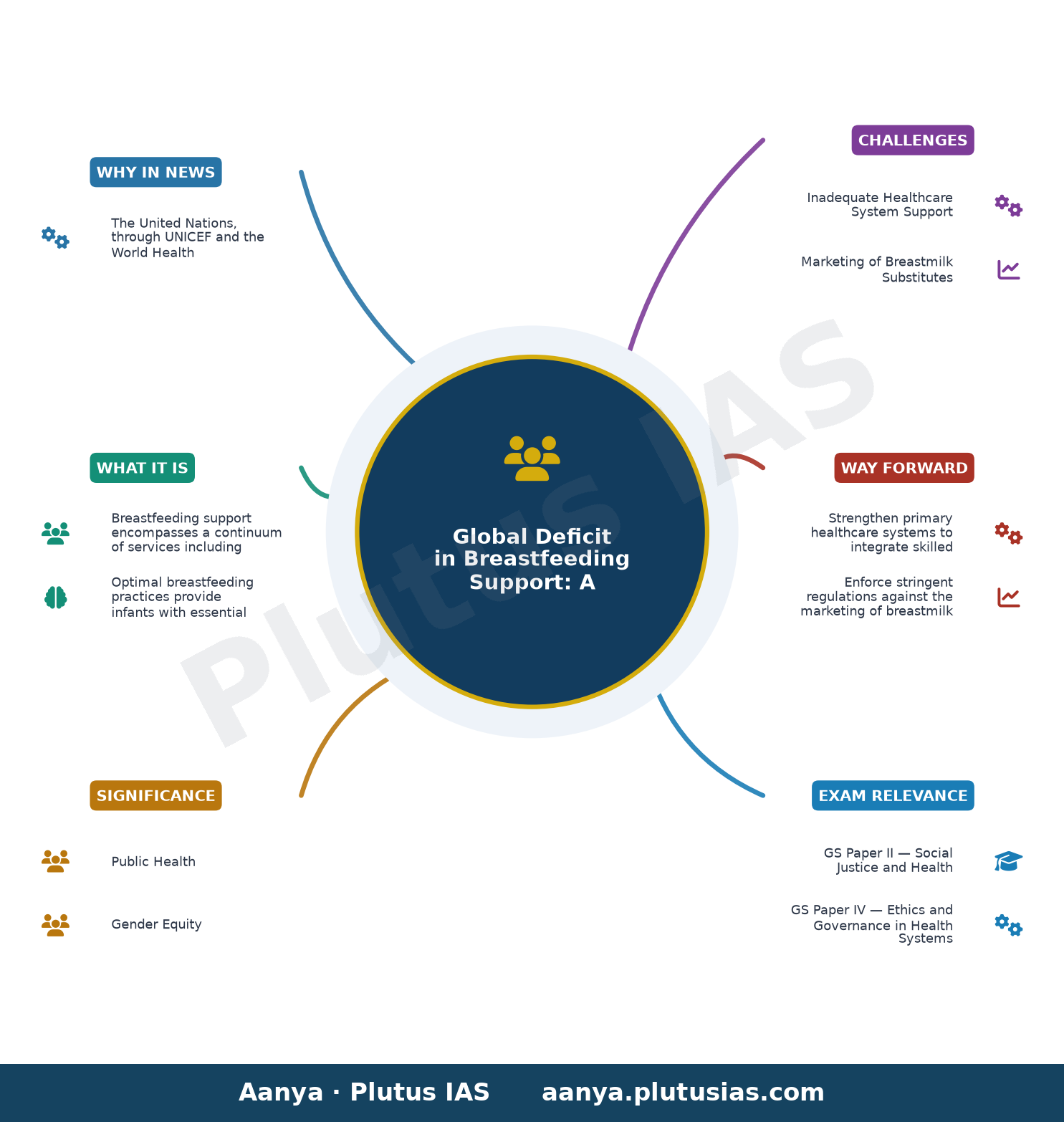
The United Nations, through UNICEF and the World Health Organization, has issued a joint warning highlighting the persistent global shortfall in support systems for breastfeeding mothers, despite measurable progress in exclusive breastfeeding rates. The appeal coincides with World Breastfeeding Week (1–7 August 2026), underscoring the need for strengthened health systems, workplace protections, and regulatory safeguards against the marketing of breastmilk substitutes to achieve sustainable maternal and child health outcomes.
Background
- Breastfeeding is a critical determinant of child survival, with evidence indicating that optimal breastfeeding practices could avert nearly 400,000 child deaths and 140,000 maternal deaths annually.
- The World Health Organization (WHO) and UNICEF recommend initiating breastfeeding within the first hour of birth, exclusive breastfeeding for the first six months, and continued breastfeeding up to two years or beyond, alongside appropriate complementary feeding from six months.
- Global exclusive breastfeeding rates in the first six months have risen from 37% in 2012 to over 47% today, while breastfeeding up to two years has increased from 38% to 50%, yet progress remains uneven across regions.
- Low-income, fragile, and humanitarian settings face disproportionate challenges due to inadequate health system coverage, inconsistent policy enforcement, and poor service quality for breastfeeding support.
- The marketing of breastmilk substitutes, particularly in low-resource contexts, undermines breastfeeding practices and exacerbates health inequities, necessitating stricter regulatory frameworks.
What is Breastfeeding Support and Why is it Critical?
- Breastfeeding support encompasses a continuum of services including skilled counselling, maternity protection policies, workplace accommodations, and community-based education to enable mothers to initiate and sustain breastfeeding.
- Optimal breastfeeding practices provide infants with essential nutrients, antibodies, and bioactive compounds that enhance immunity, cognitive development, and long-term health, reducing risks of infections, diarrhoea, and respiratory illnesses.
- Maternal benefits of breastfeeding include reduced risks of breast and ovarian cancers, type 2 diabetes, and postpartum haemorrhage, alongside psychological and economic advantages such as bonding and cost savings on formula.
- The WHO and UNICEF classify breastfeeding as a ‘readily available, clean, and safe’ source of nutrition, particularly vital in humanitarian crises where food insecurity and contaminated water supplies pose severe risks to infant health.
- Maternity protection policies, such as paid maternity leave, breastfeeding breaks, and workplace crèches, are essential to enable mothers to breastfeed without compromising economic stability or workplace participation.
- Community-based interventions, including peer support groups and home visits by health workers, have demonstrated efficacy in increasing breastfeeding initiation and duration, particularly in low-resource settings.
- Protection from the exploitative marketing of breastmilk substitutes is mandated under the International Code of Marketing of Breast-milk Substitutes (1981) and subsequent World Health Assembly resolutions, yet enforcement remains weak in many countries.
- Breastfeeding is a low-cost, high-impact intervention aligned with Sustainable Development Goals (SDG 2, 3, and 5), contributing to zero hunger, good health and well-being, and gender equality.
Key Features
| Feature | Significance |
|---|---|
| Exclusive breastfeeding for first six months | Ensures optimal nutrition, immunity, and cognitive development in infants, reducing child mortality and long-term health risks. |
| Breastfeeding up to two years or beyond | Provides sustained nutritional and immunological benefits, while supporting maternal health through reduced risks of cancers and diabetes. |
| Skilled breastfeeding support in health systems | Enhances maternal confidence, corrects latch issues, and addresses complications, improving breastfeeding success rates. |
| Community-based counselling | Extends support beyond healthcare facilities, reaching mothers in homes and community settings, especially in resource-limited environments. |
| Maternity protection policies | Guarantees workplace rights, paid leave, and breastfeeding breaks, enabling mothers to continue breastfeeding post-return to work. |
Why it Matters
Public Health
- Breastfeeding is a cost-effective intervention that reduces infant and under-five mortality by preventing infections and malnutrition-related diseases.
- Linked to long-term health benefits for both mother and child, including lower risks of non-communicable diseases (NCDs) such as breast cancer, ovarian cancer, and type 2 diabetes.
- Supports cognitive development in early childhood, contributing to improved educational outcomes and economic productivity in later life.
Gender Equity
- Strengthens maternal autonomy by enabling women to fulfill their caregiving roles without compromising economic participation, particularly through maternity protection policies.
- Reduces gender disparities in unpaid care work by institutionalising breastfeeding support in workplaces and communities.
Socio-Economic Development
- Lowers healthcare costs by preventing diet-related diseases in infancy and childhood, reducing the burden on public health systems.
- Enhances workforce participation and productivity by supporting working mothers to balance professional and caregiving responsibilities.
Humanitarian and Crisis Contexts
- Provides a clean, safe, and readily available food source for infants in emergencies, such as conflict zones or displacement camps, where food insecurity is prevalent.
- Reduces reliance on imported breastmilk substitutes, which may be unaffordable or culturally inappropriate in humanitarian settings.
Challenges
1. Inadequate Healthcare System Support
- Low coverage of skilled breastfeeding counselling in primary healthcare systems, particularly in low-income and fragile states.
- Inconsistent enforcement of maternity protection policies, leading to workplace discrimination and lack of support for breastfeeding mothers.
UPSC Link: GS-II: Health Infrastructure
2. Marketing of Breastmilk Substitutes
- Aggressive promotion of commercial milk formulas undermines breastfeeding practices, particularly in urban and middle-income settings.
- Lack of regulatory enforcement against misleading marketing claims, leading to misinformation among mothers and families.
UPSC Link: GS-II: Health Services
3. Cultural and Social Norms
- Prevailing myths and misconceptions about breastfeeding, such as perceived insufficient milk supply or cultural taboos, discourage initiation and continuation.
- Limited community awareness and peer support networks, especially in rural and marginalised communities.
UPSC Link: GS-I: Social Empowerment
4. Workplace Barriers
- Insufficient maternity leave policies and lack of breastfeeding-friendly workplaces, such as lactation rooms and flexible schedules.
- Informal sector employment, where legal protections are often absent, exacerbates challenges for working mothers.
UPSC Link: GS-II: Labour Reforms
5. Humanitarian Crises and Displacement
- Displacement camps and conflict zones often lack access to skilled lactation support and clean water, increasing risks of unsafe feeding practices.
- Overcrowding and resource constraints in emergency settings limit the availability of breastfeeding-friendly spaces.
UPSC Link: GS-II: International Organisations
Challenges — UPSC Perspective
| Issue | Concern |
|---|---|
| Regulatory gaps in marketing of breastmilk substitutes | Exploitative advertising misleads mothers and undermines breastfeeding norms. |
| Inconsistent maternity protection policies | Lack of enforcement leads to workplace discrimination and early cessation of breastfeeding. |
| Limited access to skilled lactation support | Health systems fail to provide adequate counselling, particularly in rural and humanitarian settings. |
| Cultural misconceptions about breastfeeding | Myths and taboos reduce initiation rates and duration of exclusive breastfeeding. |
| Insufficient workplace infrastructure | Absence of lactation rooms and flexible policies hinders breastfeeding continuation post-maternity leave. |
Way Forward
- Strengthen primary healthcare systems to integrate skilled breastfeeding counselling and support services.
- Enforce stringent regulations against the marketing of breastmilk substitutes, aligned with the International Code of Marketing of Breast-milk Substitutes.
- Expand maternity protection policies to include paid leave, breastfeeding breaks, and workplace lactation facilities.
- Promote community-based peer support networks to address cultural barriers and misconceptions.
- Invest in public awareness campaigns to educate families and communities on the benefits of breastfeeding.
- Prioritise breastfeeding support in humanitarian and crisis settings, including displacement camps and conflict zones.
- Encourage intersectoral collaboration between health, labour, and education ministries to create enabling environments.
- Monitor and evaluate progress through national surveys and data systems to track breastfeeding rates and policy implementation.
UPSC Value Addition
Keywords for Mains Answer-Writing
Maternal and Child Health · Sustainable Development Goals (SDGs) · UNICEF and WHO Global Breastfeeding Targets · Exclusive Breastfeeding · Maternity Protection Policies · Breastmilk Substitute Marketing Regulation · Primary Healthcare in Humanitarian Settings · Nutrition Security for Infants · Immunisation through Breastfeeding · Non-Communicable Diseases (NCDs) Prevention · Primary Health Care Approach · Right to Health under SDG 3
Concept Flow
Global recognition of breastfeeding as a public health priority → Inadequate systemic support → Low exclusive breastfeeding rates → Increased child and maternal mortality → Long-term health and economic costs → Urgent policy and systemic reforms.
Prelims Practice Questions
Q1. Consider the following statements regarding breastfeeding and its benefits:
1. Breastfeeding reduces the risk of type 2 diabetes in mothers.
2. Exclusive breastfeeding for the first six months is recommended by WHO and UNICEF.
3. Breastfeeding provides passive immunity to infants through antibodies.
4. Breastfeeding is contraindicated in cases of maternal HIV infection.
How many of the above statements are correct?
- Only one
- Only two
- Only three
- All four
Answer: Only three — Statements 1, 2, and 3 are correct. Statement 4 is incorrect as WHO recommends breastfeeding with antiretroviral therapy in HIV-infected mothers under specific conditions.
Q2. Assertion (A): The World Health Organization recommends initiating breastfeeding within the first hour of birth.
Reason (R): Early initiation of breastfeeding enhances the newborn’s immunity and reduces neonatal mortality.
Options:
A. Both A and R are true, and R is the correct explanation of A.
B. Both A and R are true, but R is not the correct explanation of A.
C. A is true, but R is false.
D. A is false, but R is true.
- A
- B
- C
- D
Answer: A — Both A and R are true, and R correctly explains A as early breastfeeding is linked to reduced neonatal mortality and improved immunity.
Q3. Match the following initiatives with their respective objectives:
Column I (Initiative) | Column II (Objective)
1. Global Strategy for Infant and Young Child Feeding | A. Promotes exclusive breastfeeding and complementary feeding practices
2. Maternity Protection Convention, 2000 (ILO Convention No. 183) | B. Ensures paid maternity leave and workplace protections for breastfeeding mothers
3. International Code of Marketing of Breast-milk Substitutes | C. Regulates the marketing of breastmilk substitutes to protect breastfeeding
4. Every Newborn Action Plan | D. Aims to end preventable newborn deaths and stillbirths
Options:
A. 1-A, 2-B, 3-C, 4-D
B. 1-B, 2-A, 3-D, 4-C
C. 1-C, 2-D, 3-A, 4-B
D. 1-D, 2-C, 3-B, 4-A
- A
- B
- C
- D
Answer: A — 1 matches A (Global Strategy for Infant and Young Child Feeding aims to promote breastfeeding). 2 matches B (ILO Convention No. 183 ensures maternity protection). 3 matches C (International Code regulates marketing of substitutes). 4 matches D (Every Newborn Action Plan aims to reduce newborn deaths).
Mains Practice Question
✍ The World Health Organization and UNICEF have highlighted that despite measurable progress, global breastfeeding rates remain suboptimal due to systemic gaps in health systems, workplace policies, and community support. Critically examine the challenges in achieving universal breastfeeding, with reference to India’s policy framework and on-ground implementation. Also, discuss the health and economic consequences of inadequate breastfeeding for infants and mothers. (15 Marks)
Approach: MODEL-ANSWER SKELETON:
1. **Introduction (2 marks)**: Define breastfeeding as a public health imperative under SDG 3 (Good Health and Well-being) and its dual benefits for infants (nutrition, immunity, cognitive development) and mothers (reduced NCD risks). Cite WHO-UNICEF Global Breastfeeding Targets (e.g., 70% exclusive breastfeeding by 2030).
2. **Challenges in Achieving Universal Breastfeeding (5 marks)**:
– **Health System Gaps**: Inadequate skilled breastfeeding counselling (e.g., lack of lactation consultants in public health centres), inconsistent enforcement of the *Infant Milk Substitutes, Feeding Bottles and Infant Foods (Regulation of Production, Supply and Distribution) Act, 1992* (amended 2022).
– **Workplace Barriers**: Limited maternity leave (12 weeks under the Maternity Benefit (Amendment) Act, 2017, vs. ILO Convention No. 183’s 18 weeks) and lack of lactation rooms in formal/informal sectors.
– **Cultural and Socioeconomic Factors**: Myths (e.g., colostrum is harmful), early introduction of formula feeds in urban middle-class households, and lack of community support networks.
– **Humanitarian Settings**: Displacement camps (e.g., Sudan case study) lack primary healthcare infrastructure for breastfeeding support.
3. **India’s Policy Framework (4 marks)**:
– **Legal Provisions**: *Infant Milk Substitutes Act, 1992* (prohibits promotion of formula), *Maternity Benefit Act, 2017* (12 weeks leave), *National Health Policy 2017* (promotes breastfeeding), and *Poshan Abhiyaan* (nutrition security).
– **Institutional Mechanisms**: *National Guidelines on Infant and Young Child Feeding (IYCF)* (2020), *Maa Bharati Yojana* (Madhya Pradesh), and *Saksham Anganwadi and Poshan 2.0* (integrated nutrition programmes).
– **Gaps**: Poor inter-ministerial coordination (e.g., Ministry of Women and Child Development vs. Ministry of Health and Family Welfare), weak monitoring of *Infant Milk Substitutes Act*, and inadequate funding for lactation support programmes.
4. **Health and Economic Consequences (4 marks)**:
– **Infant Health**: Increased risk of diarrhoea, pneumonia, and stunting (linked to 14% of child deaths under 5, per *Lancet* 2023). Long-term cognitive deficits (e.g., reduced IQ by 3-4 points per *BMJ* 2021 study).
– **Maternal Health**: Higher lifetime risks of breast/ovarian cancers and type 2 diabetes (400,000 maternal deaths prevented annually if breastfeeding rates improve, per WHO).
– **Economic Costs**: India loses ~$14 billion annually due to suboptimal breastfeeding (UNICEF 2022), including healthcare costs and reduced productivity.
5. **Conclusion (2 marks)**: Emphasise the need for a multi-sectoral approach—strengthening *Ayushman Bharat* (primary healthcare), enforcing *Infant Milk Substitutes Act*, and leveraging *Poshan Tracker* for real-time monitoring. Highlight India’s potential to achieve SDG 3.2 (ending preventable child deaths) through targeted breastfeeding interventions.
Source: news.un.org
Generated by AanyaAi for educational purpose.

- राजस्थान पंचायत चुनाव 2026: सरपंच-वार्ड पदों की आरक्षण लॉटरी आज, जानिए आरक्षण तय करने की प्रक्रिया - September 24, 2026
- Rajasthan Panchayat Polls 2026: Reservation Lottery for Sarpanch & Ward Panch Seats Today - September 24, 2026
- यूपी में पहली बार तेंदुओं का बधियाकरण: मानव-वन्यजीव संघर्ष रोकेगा अभियान - September 24, 2026

No Comments