


06 Aug UN warns of escalating civilian casualties in Ukraine war: July 2026 deadliest month since 2022
✎ The escalation in the Ukraine conflict in 2026 underscores the critical need for adherence to international humanitarian law, particularly the protection of civilians and civilian infrastructure, as indiscriminate attacks violate…
Subject Relevance — Where This Topic Fits
- GS Paper II — International Relations: Role of UN and International Humanitarian Law | GS Paper II — International Relations: Regional Security Dynamics in Europe | GS Paper III — Internal Security: Impact of Asymmetric Warfare and Long-Range Strikes
- Prelims: Geneva Conventions, 1949, UN Office for the Coordination of Humanitarian Affairs (OCHA), International Committee of the Red Cross (ICRC), Internally Displaced Persons (IDPs), Protection of Civilians in Armed Conflict (PoC), Ballistic Missiles, Long-Range Drone Strikes, UNHCR, UNICEF, IOM
- Essay: The Moral and Legal Imperatives of Protecting Civilians in Modern Warfare, Humanitarian Crises and the Role of International Institutions in Conflict Resolution
Quick Revision: The escalation in the Ukraine conflict in 2026 underscores the critical need for adherence to international humanitarian law, particularly the protection of civilians and civilian infrastructure, as indiscriminate attacks violate the principles of distinction, proportionality, and precaution.
Why is this in the news?
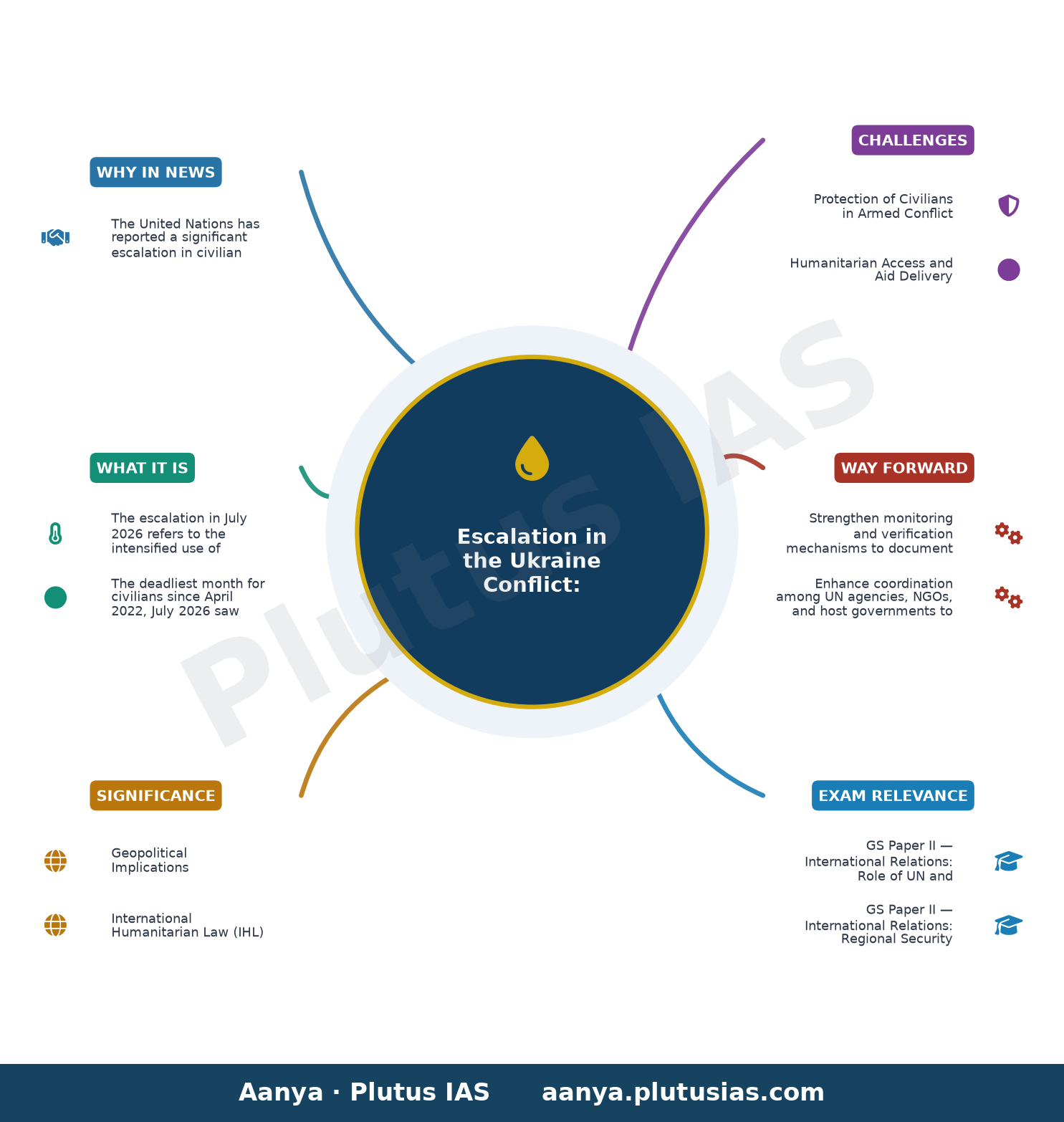
The United Nations has reported a significant escalation in civilian casualties in Ukraine during July 2026, marking the deadliest month for civilians since April 2022. The intensification of Russian attacks, including ballistic missiles and long-range drones, has resulted in widespread destruction of civilian infrastructure, displacement, and a deepening humanitarian crisis, necessitating urgent international attention and adherence to international humanitarian law.
Background
- The Russia-Ukraine conflict, which began in February 2022, has entered its fifth year with no sign of de-escalation, despite multiple ceasefire attempts and international mediation efforts.
- The conflict has witnessed a shift from frontline battles to long-range strikes, with both sides increasingly targeting civilian infrastructure, including energy grids, transportation networks, and residential areas.
- The UN has documented a sharp rise in civilian casualties in the first half of 2026 compared to previous years, reflecting the intensification of hostilities and the use of indiscriminate weapons.
- The humanitarian situation remains dire, with 12.7 million Ukrainians requiring assistance, 3.7 million internally displaced, and 5.9 million refugees globally as of August 2026.
- The winter of 2025-26 saw severe attacks on Ukraine’s energy infrastructure, exacerbating the humanitarian crisis and underscoring the vulnerability of civilian populations to strategic warfare.
- International humanitarian law, including the Geneva Conventions and Additional Protocols, mandates the protection of civilians and civilian infrastructure, which has been repeatedly violated in the conflict.
What is the Current Escalation in the Ukraine Conflict and Its Humanitarian Impact?
- The escalation in July 2026 refers to the intensified use of ballistic missiles and long-range drones by Russian forces, resulting in at least 17 civilian deaths and 44 injuries in a single overnight attack, primarily around Kyiv.
- The deadliest month for civilians since April 2022, July 2026 saw 1,396 civilians killed and 7,978 injured in the first six months of 2026.
- Attacks have extended beyond frontline areas to major cities such as Kramatorsk, Kherson, and Zaporizhzhia, destroying homes, schools, water systems, and humanitarian warehouses, violating the principle of distinction under international humanitarian law.
- The humanitarian crisis is exacerbated by the destruction of critical infrastructure, including energy grids and transportation networks, leading to widespread power outages, disrupted supply chains, and increased displacement.
- The UN’s Winter Response Plan for 2026-27 aims to provide heating assistance, shelter repairs, healthcare, food, and cash support to mitigate the impact of winter on vulnerable populations, particularly children and the elderly.
- The conflict has also seen reciprocal civilian casualties in Russia, with Ukrainian long-range drone strikes targeting cities and causing fatalities, further complicating the humanitarian landscape.
- International humanitarian agencies, including UNHCR, UNICEF, and IOM, are actively engaged in providing emergency shelters, cash assistance, education, and psychosocial support to mitigate the crisis.
Key Features
| Feature | Significance |
|---|---|
| Escalation in civilian casualties | July 2026 marked the deadliest month for Ukrainian civilians since April 2022, with 1,396 deaths and 7,978 injuries in the first six months of 2026, indicating a severe deterioration in the humanitarian crisis. |
| Long-range strikes on civilian infrastructure | Russian attacks utilising ballistic missiles and drones targeted residential areas, schools, water systems, and humanitarian warehouses, violating international humanitarian law (IHL) and exacerbating civilian suffering. |
| Humanitarian crisis and displacement | 3.7 million Ukrainians remain internally displaced, while 5.9 million are refugees globally, creating a protracted displacement crisis requiring sustained international assistance. |
| Winter Response Plan 2026 | Launched by UN humanitarian partners to address heating, shelter repairs, healthcare, and food security for 12.7 million Ukrainians in need of assistance during the upcoming winter. |
| Protection of children | UNICEF reports multiple child casualties in both Russia and Ukraine, highlighting systemic failures in protecting minors amid ongoing conflict, in contravention of the UN Convention on the Rights of the Child. |
Why it Matters
Geopolitical Implications
- The intensification of Russian strikes beyond the frontline suggests a strategic shift toward attrition warfare, aiming to degrade Ukrainian civilian morale and infrastructure resilience.
- Escalating civilian casualties risk eroding international support for Ukraine, potentially influencing diplomatic negotiations or aid commitments.
- The conflict’s prolongation threatens regional stability, particularly in Eastern Europe, with potential spillover effects on NATO member states and energy security.
International Humanitarian Law (IHL)
- Deliberate or indiscriminate attacks on civilian infrastructure contravene the principles of distinction, proportionality, and precaution under IHL, as codified in the Geneva Conventions and Additional Protocol I.
- The use of ballistic missiles and drones in populated areas constitutes a grave violation of IHL, warranting accountability under international mechanisms such as the International Criminal Court (ICC).
- Humanitarian agencies’ access to affected populations is increasingly constrained, exacerbating violations of the right to humanitarian assistance under IHL.
Global Refugee and Displacement Crisis
- The war in Ukraine remains one of the largest displacement crises since World War II, with significant implications for host countries’ social and economic systems.
- The protracted nature of displacement strains global humanitarian resources, necessitating coordinated international responses under frameworks like the Global Compact on Refugees.
- Internal displacement within Ukraine exacerbates regional inequalities, particularly in areas with limited infrastructure and services.
Energy and Infrastructure Warfare
- Attacks on energy infrastructure, such as those in the 2022-2023 winter, demonstrate a pattern of weaponising critical civilian systems to inflict suffering and coerce compliance.
- The destruction of water and heating systems during winter months violates the right to essential services, as outlined in the International Covenant on Economic, Social and Cultural Rights (ICESCR).
- Rebuilding civilian infrastructure post-conflict will require substantial international investment, with long-term economic consequences for Ukraine’s reconstruction and recovery.
Challenges
1. Protection of Civilians in Armed Conflict
- Ensuring compliance with IHL by all parties to the conflict, particularly in the use of long-range weapons in populated areas.
- Addressing the systemic failure to protect civilians, including children, from indiscriminate attacks and collateral damage.
- Strengthening early warning systems and evacuation protocols to mitigate civilian casualties during air raids.
UPSC Link: GS II: International Relations – Humanitarian Law
2. Humanitarian Access and Aid Delivery
- Overcoming bureaucratic and logistical barriers to deliver aid to conflict-affected regions, particularly in areas under siege or heavy bombardment.
- Protecting humanitarian workers and infrastructure from attacks, as mandated by the UN Security Council Resolution 2175 (2014).
- Ensuring the neutrality and impartiality of humanitarian aid to avoid politicisation or diversion by conflict parties.
UPSC Link: GS II: International Relations – Humanitarian Assistance
3. Winter Preparedness and Resilience
- Mitigating the impact of attacks on energy and heating infrastructure to prevent civilian suffering during harsh winters.
- Ensuring the availability of emergency shelters, medical supplies, and food assistance for vulnerable populations.
- Coordinating international support for Ukraine’s Winter Response Plan to avoid duplication or gaps in aid delivery.
UPSC Link: GS II: International Relations – Disaster Management
4. Accountability and Justice for War Crimes
- Documenting and preserving evidence of war crimes, including attacks on civilians and civilian infrastructure, for potential prosecution under international law.
- Ensuring cooperation with international judicial mechanisms, such as the ICC, to hold perpetrators accountable.
- Addressing impunity for violations of IHL, particularly in cases involving state actors and their proxies.
UPSC Link: GS II: International Relations – International Criminal Law
5. Refugee and Displacement Management
- Balancing the needs of internally displaced persons (IDPs) with those of refugees in host countries to prevent overburdening of local systems.
- Ensuring the rights of refugees and IDPs, including access to education, healthcare, and livelihood opportunities, under international refugee law.
- Facilitating safe and dignified voluntary repatriation for displaced populations once conditions permit.
UPSC Link: GS II: International Relations – Refugee Law
6. Energy Security and Reconstruction
- Rebuilding and securing critical civilian infrastructure, such as energy grids and water systems, to restore essential services and economic activity.
- Addressing the long-term economic impact of infrastructure destruction on Ukraine’s recovery and reconstruction efforts.
- Ensuring energy security for civilians while transitioning to sustainable and resilient energy systems post-conflict.
UPSC Link: GS III: Economic Development – Infrastructure
Challenges — UPSC Perspective
| Issue | Concern |
|---|---|
| Indiscriminate attacks on civilians | Violation of IHL principles of distinction and proportionality, leading to high civilian casualties and displacement. |
| Restricted humanitarian access | Bureaucratic, logistical, and security barriers impede aid delivery to conflict-affected populations. |
| Winter infrastructure vulnerability | Attacks on heating and energy systems exacerbate civilian suffering during extreme cold, straining humanitarian resources. |
| Accountability gaps | Lack of effective mechanisms to investigate and prosecute war crimes, perpetuating impunity. |
| Refugee burden on host countries | Prolonged displacement strains social services, housing, and economic systems in neighbouring and distant host nations. |
| Post-conflict reconstruction | Destruction of civilian infrastructure necessitates substantial investment and coordination for sustainable recovery. |
Way Forward
- Strengthen monitoring and verification mechanisms to document violations of IHL, including attacks on civilians and civilian infrastructure, for accountability purposes.
- Enhance coordination among UN agencies, NGOs, and host governments to ensure efficient and equitable distribution of humanitarian aid.
- Invest in early warning systems and public awareness campaigns to improve civilian preparedness and reduce casualties during air raids.
- Prioritise the protection of children and vulnerable groups, including the elderly and disabled, in humanitarian response plans and infrastructure repairs.
- Advocate for the ratification and implementation of international conventions, such as the Arms Trade Treaty, to regulate the transfer of weapons used in civilian harm.
- Support Ukraine’s Winter Response Plan through sustained funding and technical assistance to mitigate the impact of infrastructure attacks.
- Promote diplomatic efforts to de-escalate the conflict, including confidence-building measures and ceasefire negotiations under international auspices.
- Facilitate safe and voluntary repatriation of displaced persons by addressing security concerns and restoring essential services in conflict-affected areas.
UPSC Value Addition
Keywords for Mains Answer-Writing
International Humanitarian Law · Protection of Civilians in Armed Conflict · Geneva Conventions · UN Human Rights Office · Long-range missile strikes · Civilian infrastructure · Internally Displaced Persons (IDPs) · Winter Response Plan · Protection of Children in War · International Humanitarian Law obligations · UNICEF mandate · OCHA humanitarian coordination · Civilians as protected persons under IHL · Ballistic missile attacks · Humanitarian access in conflict zones
Concept Flow
Russian military strategy shifts to long-range strikes on civilian infrastructure → Escalation in civilian casualties and displacement → Violation of IHL principles (distinction, proportionality, precaution) → Humanitarian crisis deepens with restricted aid access → International law mechanisms (ICC, UNSC) face challenges in accountability → Protracted displacement strains regional stability → Winter exacerbates civilian suffering due to energy infrastructure attacks → Reconstruction and recovery require long-term international support → Geopolitical implications influence global humanitarian and diplomatic responses
Prelims Practice Questions
Q1. Consider the following statements regarding the protection of civilians in armed conflict under International Humanitarian Law (IHL):
1. Civilian objects such as schools and hospitals are protected from attack unless they are used for military purposes.
2. Parties to a conflict must take all feasible precautions to verify that targets are military objectives before launching an attack.
3. The use of ballistic missiles in populated areas is prohibited under all circumstances, irrespective of military necessity.
4. Humanitarian organisations are obligated to provide medical care to wounded combatants as a matter of IHL.
How many of the above statements are correct?
- Only one
- Only two
- Only three
- All
Answer: Only three — Statements 1 and 2 are correct as per Articles 48, 51(2), and 57(2)(a) of Additional Protocol I to the Geneva Conventions. Statement 3 is incorrect because the use of ballistic missiles is not prohibited per se, but their use in populated areas must comply with the principles of distinction, proportionality, and precautions in attack. Statement 4 is incorrect because IHL requires medical care for wounded and sick combatants only when they fall into the hands of the enemy, not as a general obligation.
Q2. Assertion (A): The UN Human Rights Office in Ukraine has reported July 2026 as the deadliest month for Ukrainian civilians since April 2022.
Reason (R): The escalation in Russian attacks has included the use of long-range ballistic missiles and drones, resulting in increased civilian casualties and damage to civilian infrastructure.
Options:
A) Both A and R are true, and R is the correct explanation of A.
B) Both A and R are true, but R is NOT the correct explanation of A.
C) A is true, but R is false.
D) A is false, but R is true.
Answer: ? — Both Assertion (A) and Reason (R) are factually accurate. The UN Human Rights Office in Ukraine reported July 2026 as the deadliest month for civilians since April 2022 due to intensified Russian attacks using long-range ballistic missiles and drones, which directly caused increased civilian casualties and infrastructure damage. Therefore, R correctly explains A.
Q3. Match the following UN agencies with their primary humanitarian functions in Ukraine as reported in the context of the ongoing conflict:
Column I (UN Agency) | Column II (Primary Function)
1. UNHCR | A. Provision of safe water, education, and psychosocial support for children
2. OCHA | B. Coordination of humanitarian response and access to lifesaving services
3. UNICEF | C. Emergency shelters, cash assistance, and housing repairs for internally displaced persons
4. IOM | D. Humanitarian logistics and cash assistance for displaced populations
Options:
A) 1-C, 2-B, 3-A, 4-D
B) 1-A, 2-C, 3-B, 4-D
C) 1-D, 2-A, 3-C, 4-B
D) 1-B, 2-D, 3-A, 4-C
Answer: ? — The correct matches are: 1. UNHCR (C) provides emergency shelters, cash assistance, and housing repairs for internally displaced persons. 2. OCHA (B) coordinates humanitarian response and ensures access to lifesaving services. 3. UNICEF (A) provides safe water, education, and psychosocial support for children. 4. IOM (D) provides humanitarian logistics and cash assistance for displaced populations.
Mains Practice Question
✍ The intensification of long-range missile and drone strikes by Russia in Ukraine has led to a sharp rise in civilian casualties and destruction of civilian infrastructure, including homes, schools, and water systems. Critically examine the obligations of parties to the conflict under International Humanitarian Law (IHL) to protect civilians, with particular reference to the principles of distinction, proportionality, and precautions in attack. Also, assess the adequacy of the international community’s response in addressing the humanitarian crisis. (15 Marks)
Approach: MODEL-ANSWER SKELETON:
1. **Introduction (2 marks)**
– Briefly define International Humanitarian Law (IHL) and its applicability in the context of the Ukraine conflict.
– State the core obligation to protect civilians under IHL, anchored in the Geneva Conventions (1949) and Additional Protocol I (1977).
2. **Obligations under IHL (6 marks)**
– **Principle of Distinction (Art. 48, AP I)**: Parties must distinguish between civilians/civilian objects and military objectives. Cite the prohibition on indiscriminate attacks (Art. 51(4), AP I) and the definition of military objectives (Art. 52(2), AP I).
– **Principle of Proportionality (Art. 51(5)(b), AP I)**: Attacks causing excessive civilian harm relative to the military advantage gained are prohibited. Discuss the threshold for proportionality with reference to the ICJ’s *Nuclear Weapons Advisory Opinion* (1996).
– **Precautions in Attack (Art. 57, AP I)**: Parties must verify targets, give effective warnings, and choose methods/means of warfare to minimise civilian harm. Highlight the obligation to avoid attacks on densely populated areas unless military necessity dictates otherwise.
– **Protection of Civilian Objects (Art. 52(1), AP I)**: Schools, hospitals, and water systems are protected unless used for military purposes. Cite the UN’s reports on damage to such infrastructure in Ukraine.
3. **Challenges in Implementation (4 marks)**
– **Use of Long-Range Weapons**: Discuss how ballistic missiles and drones complicate adherence to IHL due to their indiscriminate nature and difficulty in targeting with precision.
– **Urban Warfare**: Explain the challenges of conducting hostilities in populated areas, referencing the UN’s observations on the destruction of civilian infrastructure.
– **Accountability Gaps**: Highlight the difficulties in attributing violations to specific parties and the role of the International Criminal Court (ICC) in investigating war crimes.
4. **International Community’s Response (3 marks)**
– **Humanitarian Aid**: Outline the roles of UN agencies (UNHCR, UNICEF, IOM, OCHA) in providing shelter, healthcare, and psychosocial support, as reported in the context.
– **Winter Response Plan**: Discuss the UN’s initiative to provide heating assistance and shelter repairs, linking it to the recurring issue of energy infrastructure attacks.
– **Limitations**: Critique the adequacy of the response, including funding gaps, access constraints, and the failure to secure a cessation of hostilities.
5. **Conclusion (2 marks)**
– Summarise the critical gaps between IHL obligations and ground realities.
– Emphasise the need for political solutions, stronger enforcement mechanisms, and sustained humanitarian funding to mitigate civilian suffering.
Source: news.un.org
Generated by AanyaAi for educational purpose.

- मद्रास उच्च न्यायालय ने एआईएडीएमके के व्हिप के मामले को खारिज किया, मेकेदातू संशोधन पर तमिलनाडु विधानसभा का फैसला बरकरार - September 23, 2026
- Madras HC Rejects AIADMK Plea Against Mekedatu Resolution Amendment - September 23, 2026
- कर्नाटक में उद्योग-आधारित पाठ्यक्रम तैयार करेगा विशेष समिति: मुख्यमंत्री - September 23, 2026

No Comments