


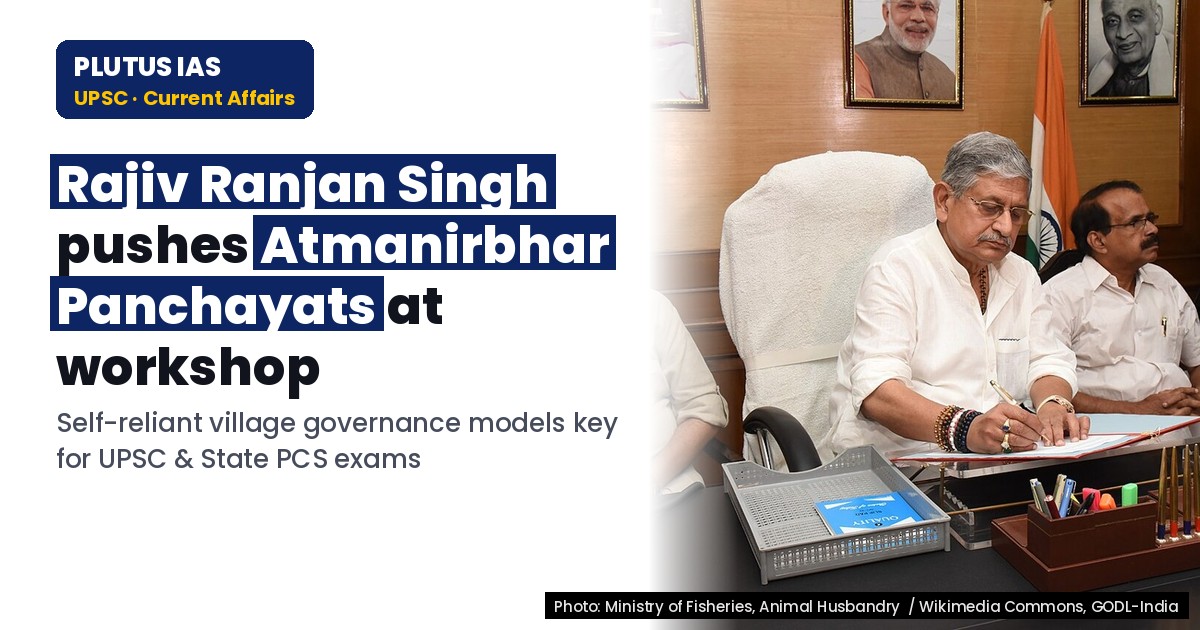
31 Oct Union Minister Calls for Self-Reliant Panchayats at National Workshop
✎ Atmanirbhar Panchayats leverage constitutional provisions (73rd CAA) and fiscal devolution (15th Finance Commission) to enhance rural self-reliance through participatory planning, local resource mobilisation, and integration with…
Subject Relevance — Where This Topic Fits
- GS Paper II — Governance, Constitution, Polity, Social Justice and International Relations (Decentralisation and Local Governance) | GS Paper III — Economy (Rural Economy, Decentralised Planning, Infrastructure Development)
- Prelims: 73rd Constitutional Amendment Act, 1992, People’s Plan Campaign (PPC), Localisation of Sustainable Development Goals (LSDGs), Gram Panchayat Development Plans (GPDPs), Panchayati Raj Institutions (PRIs), Rural Infrastructure Development Fund (RIDF), Deendayal Antyodaya Yojana – National Rural Livelihoods Mission (DAY-NRLM), Aspirational Districts Programme
- Essay: Decentralisation as a cornerstone of participatory democracy: Challenges and opportunities in India, From Panchayati Raj to Atmanirbhar Bharat: The role of grassroots governance in national development
Quick Revision: Atmanirbhar Panchayats leverage constitutional provisions (73rd CAA) and fiscal devolution (15th Finance Commission) to enhance rural self-reliance through participatory planning, local resource mobilisation, and integration with national development frameworks.
Why is this in the news?
The Union Minister for Panchayati Raj, Shri Rajiv Ranjan Singh, has urged a national-level workshop on the People’s Plan Campaign (PPC) to accelerate the creation of ‘Atmanirbhar Panchayats’—self-reliant rural local bodies capable of designing, financing, and implementing locally tailored development plans. This initiative aligns with the broader Atmanirbhar Bharat mission by leveraging constitutional provisions for decentralised governance to enhance rural resilience, productivity, and service delivery through participatory planning and resource mobilisation.
Background
- The 73rd Constitutional Amendment Act (CAA), 1992, established a three-tier Panchayati Raj system to promote democratic decentralisation in rural India, vesting PRIs with constitutional status and functional responsibilities.
- The People’s Plan Campaign (PPC), launched in 2018, is a Ministry of Panchayati Raj initiative to prepare Gram Panchayat Development Plans (GPDPs) through participatory processes, integrating local priorities with national development frameworks such as the Sustainable Development Goals (SDGs).
- The Atmanirbhar Bharat initiative, announced in 2020, aims to reduce dependency on imports while enhancing domestic production, innovation, and self-sufficiency across sectors, including rural and agricultural economies.
- Rural local bodies face persistent challenges in financial autonomy, technical capacity, and resource mobilisation, which constrain their ability to execute development projects independently.
- The Fifteenth Finance Commission (2021–2026) recommended enhanced fiscal devolution to PRIs, including untied funds, to strengthen grassroots governance and service delivery.
- The Union Budget 2023–24 emphasised the need for localisation of SDGs at the panchayat level to ensure inclusive and sustainable rural development.
What are Atmanirbhar Panchayats?
- Constitutional framework: Atmanirbhar Panchayats are rooted in the 73rd CAA, which mandates PRIs to prepare and implement GPDPs through participatory planning, ensuring local ownership of development priorities.
- Self-reliance through localisation: The concept emphasises reducing dependency on external funding by enhancing local resource mobilisation, including own revenue generation, community contributions, and utilisation of untied funds provided by higher tiers of government.
- Participatory governance: Atmanirbhar Panchayats prioritise inclusive decision-making, involving women, marginalised groups (SC/ST/OBC), and youth in planning, monitoring, and evaluation processes to ensure equitable outcomes.
- Integration with national missions: The initiative aligns with programmes such as the Aspirational Districts Programme, DAY-NRLM, and PM-KISAN, ensuring that panchayat-level plans are synchronised with broader national development goals.
- Fiscal decentralisation: Enhanced devolution of funds, as recommended by the Fifteenth Finance Commission, empowers PRIs to design, finance, and execute projects aligned with local needs, such as rural infrastructure, water supply, sanitation, and digital connectivity.
- Capacity building: Technical and administrative capacity-building for elected representatives and officials is critical to enable PRIs to undertake complex planning, financial management, and project implementation.
- Monitoring and accountability: Robust grievance redressal mechanisms, social audits, and real-time monitoring through digital platforms (e.g., e-Gram Swaraj) ensure transparency and accountability in the utilisation of funds and execution of plans.
- Sustainable development linkages: Atmanirbhar Panchayats contribute to the localisation of SDGs by addressing local priorities such as climate resilience, renewable energy adoption, and sustainable agriculture, thereby advancing India’s commitment to the 2030 Agenda.
Key Features
| Feature | Significance |
|---|---|
| National Workshop on People’s Plan Campaign | A platform for multi-stakeholder deliberation on decentralised planning, aligning local priorities with national development goals under the People’s Plan Campaign-2024. |
| Atmanirbhar Panchayats Initiative | Emphasises self-reliance at the grassroots level by leveraging local resources, skills, and governance mechanisms to address rural development challenges. |
| Concerted Efforts by Union Minister | Highlights the central government’s commitment to fostering participatory governance and capacity-building in rural local bodies for sustainable development. |
| Focus on Decentralised Planning | Reinforces the constitutional mandate of Panchayati Raj Institutions (PRIs) under the 73rd Constitutional Amendment Act, 1992, to ensure bottom-up planning. |
Why it Matters
Governance and Institutional Strengthening
- Strengthens the institutional framework of Panchayati Raj Institutions (PRIs) by promoting participatory planning and localised decision-making.
- Enhances the capacity of PRIs to design and implement development projects aligned with the needs of rural communities.
- Fosters a culture of accountability and transparency in rural governance through structured deliberations and stakeholder engagement.
Economic Development and Self-Reliance
- Encourages the utilisation of local resources, skills, and traditional knowledge for economic growth, reducing dependency on external inputs.
- Promotes the creation of rural enterprises and skill development initiatives to generate employment and livelihood opportunities.
- Aligns with the broader objective of achieving inclusive and sustainable economic development at the grassroots level.
Social Equity and Inclusive Growth
- Ensures that marginalised and vulnerable sections of rural society are actively involved in planning and implementation processes.
- Facilitates the convergence of various central and state-sponsored schemes to address multi-dimensional rural challenges.
- Promotes gender-sensitive and socially inclusive development by integrating the perspectives of women, SCs, STs, and other disadvantaged groups.
Policy and Programme Synergy
- Bridges the gap between national policies and local implementation by ensuring that grassroots priorities are reflected in higher-level planning.
- Facilitates the integration of innovative practices and best-case examples from different regions to enhance rural development outcomes.
- Provides a feedback mechanism for central ministries to assess the effectiveness of rural development schemes and make data-driven adjustments.
Challenges
1. Limited Financial and Administrative Autonomy of PRIs
- PRIs often lack adequate financial resources and decision-making authority to implement ambitious development plans.
- Dependence on state or central funds for critical projects can lead to delays and misalignment with local priorities.
- Need for greater devolution of funds, functions, and functionaries to PRIs as envisaged under the 73rd Constitutional Amendment Act.
UPSC Link: 73rd CAA, 1992
2. Capacity Gaps in Local Governance
- Many elected representatives and officials in PRIs lack the technical and managerial skills required for effective planning and implementation.
- Inadequate training and mentorship programmes to equip PRIs with modern governance tools and techniques.
- Requirement for continuous capacity-building initiatives to enhance the functional efficiency of PRIs.
UPSC Link: Panchayati Raj Institutions
3. Data Deficiency and Planning Gaps
- Insufficient granular data at the village level to inform evidence-based planning and resource allocation.
- Lack of standardised frameworks for data collection, analysis, and utilisation in rural development projects.
- Need for robust data systems and digital tools to support decentralised planning and monitoring.
UPSC Link: Decentralised Planning
4. Coordination Challenges Among Stakeholders
- Fragmented governance structures and overlapping jurisdictions between PRIs, state agencies, and central ministries.
- Inadequate mechanisms for inter-departmental coordination to ensure convergence of schemes and resources.
- Requirement for institutionalised platforms to facilitate seamless collaboration among all stakeholders.
UPSC Link: Convergence of Schemes
5. Sustainability of Local Initiatives
- Many rural development projects suffer from short-term funding cycles, leading to unsustainable outcomes.
- Lack of long-term financing mechanisms to support community-led initiatives beyond election cycles.
- Need for innovative financing models, such as public-private partnerships and social impact bonds, to ensure continuity.
UPSC Link: Local Self-Governance
Challenges — UPSC Perspective
| Issue | Concern |
|---|---|
| Financial Constraints | Inadequate devolution of funds and functions to PRIs limits their ability to plan and execute projects. |
| Skill Deficits | Lack of trained personnel in PRIs hampers effective implementation of development schemes. |
| Data Gaps | Absence of reliable village-level data impedes evidence-based planning and monitoring. |
| Coordination Failures | Poor inter-departmental and inter-agency coordination leads to duplication and inefficiencies. |
| Sustainability Risks | Short-term funding cycles undermine the long-term viability of rural development initiatives. |
Government Initiatives — Must-Memorise for Prelims
- People’s Plan Campaign-2024
- Atmanirbhar Panchayats Initiative
Way Forward
- Strengthen the financial and administrative autonomy of PRIs through greater devolution of funds, functions, and functionaries under the 73rd Constitutional Amendment Act.
- Establish a national-level capacity-building programme for elected representatives and officials of PRIs to enhance their governance and technical skills.
- Develop a standardised framework for village-level data collection, analysis, and utilisation to support evidence-based planning.
- Create institutionalised platforms for inter-departmental and inter-agency coordination to ensure convergence of rural development schemes.
- Promote innovative financing models, such as public-private partnerships and social impact bonds, to ensure the sustainability of local initiatives.
- Encourage the adoption of digital tools and platforms to streamline planning, monitoring, and grievance redressal in rural governance.
- Facilitate the integration of traditional knowledge and local innovations into rural development projects to enhance their relevance and effectiveness.
UPSC Value Addition
Keywords for Mains Answer-Writing
Atmanirbhar Panchayats · People’s Plan Campaign · Local Governance · Grassroots Development · Decentralised Planning · Panchayati Raj Institutions (PRIs) · Convergence of Schemes · Capacity Building in Panchayats · Local Economic Development · Inclusive Growth · Sustainable Development Goals (SDGs) · Community Participation in Governance
Constitutional & Policy Linkages
- Article 243G: Powers, authority, and responsibilities of Panchayats
- Article 243W: Powers, authority, and responsibilities of Municipalities
- 73rd Constitutional Amendment Act, 1992: Framework for Panchayati Raj Institutions
Concept Flow
Decentralised Planning under 73rd CAA → Empowerment of PRIs → Capacity-building and resource devolution → People’s Plan Campaign-2024 → Atmanirbhar Panchayats Initiative → Localised self-reliance and sustainable development → National Workshop on People’s Plan Campaign → Multi-stakeholder deliberation → Identification of local priorities → Integration with national development goals → Implementation through PRIs → Monitoring and feedback loop → Financial and administrative devolution to PRIs → Enhanced autonomy → Improved planning and implementation → Convergence of schemes → Inclusive and equitable rural development → Capacity gaps in PRIs → Need for training and mentorship → Skill development initiatives → Effective governance → Sustainable local initiatives → Data deficiency at village level → Requirement for robust data systems → Evidence-based planning → Targeted resource allocation → Improved development outcomes → Coordination challenges among stakeholders → Institutionalised platforms for collaboration → Convergence of schemes → Reduced duplication and inefficiencies → Enhanced project outcomes
Prelims Practice Questions
Q1. Consider the following statements regarding the People’s Plan Campaign (PPC) in India:
1. The PPC is a centrally sponsored scheme aimed at strengthening decentralised planning in rural areas.
2. It mandates the preparation of Gram Panchayat Development Plans (GPDPs) with convergence of existing schemes.
3. The campaign is implemented exclusively by the Ministry of Rural Development.
4. It seeks to achieve the Sustainable Development Goals (SDGs) at the grassroots level.
How many of the above statements are correct?
- Only one
- Only two
- Only three
- All four
Answer: All four — Statements 1, 2, and 4 are correct. Statement 3 is incorrect as the PPC involves multiple ministries and departments for convergence of schemes.
Q2. Assertion (A): The concept of ‘Atmanirbhar Panchayats’ emphasises self-reliance at the local governance level.
Reason (R): It aims to reduce dependence on centralised funding by promoting local resource mobilisation and economic activities.
In the context of the above two statements, which one of the following is correct?
- Both A and R are true, and R is the correct explanation of A.
- Both A and R are true, but R is not the correct explanation of A.
- A is true, but R is false.
- A is false, but R is true.
Answer: Both A and R are true, but R is not the correct explanation of A. — Both the assertion and reason are correct, and the reason accurately explains the assertion.
Q3. Match the following initiatives with their respective ministries/departments:
Initiative:
1. People’s Plan Campaign
2. Gram Panchayat Development Plans (GPDPs)
3. Atmanirbhar Bharat Abhiyan
4. Mission Antyodaya
Ministry/Department:
A. Ministry of Panchayati Raj
B. Ministry of Rural Development
C. NITI Aayog
D. Ministry of Finance
Choose the correct match:
- 1-A, 2-B, 3-D, 4-C; 1-B, 2-A, 3-D, 4-C; 1-A, 2-B, 3-C, 4-D; 1-C, 2-A, 3-D, 4-B
- answer_list_indexes_to_options_indexes_mapping_is_not_used_here_but_see_below
- answer_list_indexes_to_options_indexes_mapping_is_not_used_here_but_see_below
Answer: ? — 1-A (People’s Plan Campaign is implemented by the Ministry of Panchayati Raj), 2-B (GPDPs are prepared under the Ministry of Rural Development), 3-D (Atmanirbhar Bharat Abhiyan is under the Ministry of Finance), 4-C (Mission Antyodaya is implemented by NITI Aayog).
Mains Practice Question
✍ The Union Government has recently emphasised the need to build ‘Atmanirbhar Panchayats’ through the People’s Plan Campaign. In this context, critically examine the role of Panchayati Raj Institutions (PRIs) in achieving grassroots-level self-reliance and inclusive development. Also, assess the challenges in translating this vision into reality at the local governance level. (15 Marks)
Approach: 1. **Definition and Constitutional Framework**: Define PRIs and their constitutional mandate under Part IX of the Constitution (73rd Amendment Act, 1992). Highlight the three-tier system (Gram Panchayat, Panchayat Samiti, Zila Parishad) and the functions devolved to them (Article 243G).
2. **Role in Self-Reliance and Inclusive Development**:
– **Local Resource Mobilisation**: Discuss how PRIs can leverage local resources (land, water, labour) for economic activities (e.g., MGNREGA, PM-KISAN, and convergence with other schemes like PMGSY, Mission Antyodaya).
– **Decentralised Planning**: Explain the significance of Gram Panchayat Development Plans (GPDPs) under the People’s Plan Campaign and their alignment with SDGs.
– **Community Participation**: Highlight the role of SHGs, VOs, and Gram Sabhas in ensuring inclusive growth and bottom-up planning.
– **Skill Development and Entrepreneurship**: Cite examples of PRIs promoting local enterprises (e.g., FPOs, agro-based industries) under schemes like DAY-NRLM.
3. **Challenges in Implementation**:
– **Capacity Constraints**: Lack of technical and administrative capacity in PRIs (e.g., untrained staff, poor record-keeping).
– **Financial Dependence**: Over-reliance on centralised funding (e.g., Finance Commission grants, centrally sponsored schemes) and limited own revenue generation.
– **Political Interference**: Issues of elite capture, gender bias in decision-making, and lack of autonomy in planning.
– **Data and Monitoring Gaps**: Poor data systems for tracking progress (e.g., delayed audits, lack of real-time monitoring).
– **Legal and Bureaucratic Hurdles**: Delays in fund disbursement, complex approval processes, and lack of convergence among departments.
4. **Way Forward**:
– **Capacity Building**: Strengthen PRI training programs (e.g., through the National Institute of Rural Development and Panchayati Raj).
– **Financial Empowerment**: Promote local revenue generation (e.g., property tax reforms, user charges for services).
– **Institutional Reforms**: Empower Gram Sabhas and SHGs in decision-making; enforce mandatory social audits (e.g., MGNREGA).
– **Technology Adoption**: Use of GIS, mobile apps, and e-governance platforms for transparent planning and monitoring.
– **Convergence of Schemes**: Ensure seamless integration of central and state schemes at the PRI level (e.g., convergence of PMGSY, PM-KISAN, and Swachh Bharat Mission).
5. **Conclusion**: Summarise that while PRIs hold immense potential for grassroots self-reliance, structural and institutional challenges must be addressed through concerted reforms and capacity-building measures.
Source: PIB (Press Information Bureau)
Generated by AanyaAi for educational purpose.
Related guides on our sites
- Anthropology VS PSIR
- Best PSIR optional coaching
- Best PSIR optional coaching online
- Best PSIR optional teacher

- Union Minister Calls for Self-Reliant Panchayats at National Workshop - October 31, 2026
- जीएसएलवी-एफ18 के सफल प्रक्षेपण पर पीएम ने इसरो की सराहना की, जानिए NVS-03 मिशन की खासियत - October 31, 2026
- PMGSY-IV: 45 New Roads in Mizoram to Boost Rural Connectivity - October 31, 2026

No Comments